Amel 50 Review, Price and Used Buying Guide
Amel dropped the mizzen, added twin rudders and wrapped the helm in glass, and the result sailed better than its own loyalists expected.
- Length
- 54.1 ft16.5 m
- Beam
- 15.7 ft4.79 m
- Draft
- 7.1 ft2.15 m
- Cabins
- 3
- Used price
- $850K to $1.35M
On this page
- Overview
- Why the Amel 50 dropped the mizzen
- Berret-Racoupeau's hull, built the Amel way
- Steering from an armchair inside the doghouse
- What the Amel 50 does under sail
- Owner's suite aft, two guest cabins forward
- Engine room, 24 volts and the standard equipment list
- Amel 50 or the new Amel 50.2
- Specifications
- Price and value
- Strengths and weaknesses
- Used buyer checklist
- Rivals
- Our verdict
- FAQ
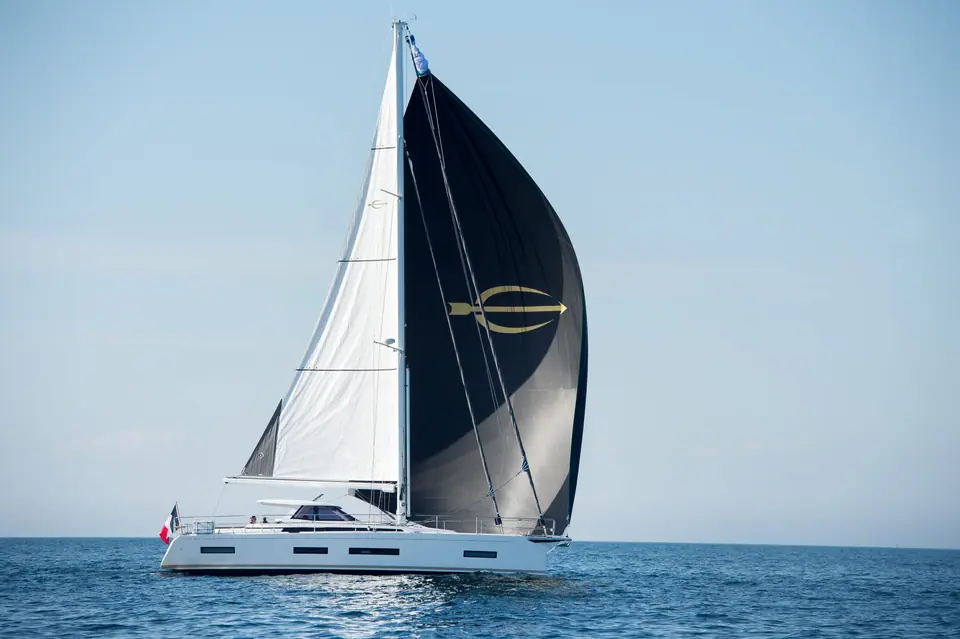
The Amel 50 is a Berret-Racoupeau designed 54-foot sloop built in La Rochelle from 2017 to 2026, about 140 hulls. Amel's first sloop in two decades, it has now been succeeded by the Amel 50.2.
- Couples crossing oceans
- Cold and hot climate cruising
- Owners upgrading from a Super Maramu or 54
- Buyers who want a turnkey boat
Amel 50 by the numbers
- Sail area to displacement
- 18.1Balanced power for coastal and offshore cruising.
- Displacement to length
- 171Light displacement for its length, quick but sensitive to added cruising weight.
- Theoretical hull speed
- 9.2 knThe practical top speed of a displacement monohull under normal sailing, based on waterline length.
- Ballast ratio
- 29%Relatively low ballast, form stability does more of the work.
- Capsize screening
- 1.82Below 2.0, the traditional threshold for offshore suitability.
- Motion comfort ratio
- 32.9Moderate motion comfort, typical of modern cruisers.
- Length to beam ratio
- 3.44 : 1Moderate proportions.
Why the Amel 50 dropped the mizzen
For a generation, an Amel meant a ketch. The Maramu, the Super Maramu, the 54 and the 55 all carried a mizzen, and Amel owners defended it as the key to balanced, easily reefed sailing. So when the yard unveiled the Amel 50 in 2017, the headline was what was missing. This was Amel's first sloop since 1997, its first boat drawn by the outside studio Berret-Racoupeau, its first with twin rudders and its first built by resin infusion.
Losing the mizzen freed the stern for a longer, fully covered center cockpit and a big aft owner's cabin, and the new hull carried 47 ft 7 in of waterline within its 54 ft 2 in overall length. The traditional Amel values stayed: watertight bulkheads, a single sea chest, 24 volt systems, a glass doghouse and a long standard equipment list. Roughly 140 boats later, the Amel 50 is being replaced by the Amel 50.2, shown for the first time at Cannes in September 2026. That makes now an interesting moment to shop for an Amel 50 for sale on the brokerage market.
Berret-Racoupeau's hull, built the Amel way
The infused hull is solid laminate below the waterline and foam-cored above, which saves weight where it matters while keeping the bottom robust. Displacement is 18,750 kg (41,337 lbs) light, rising to about 22,200 kg fully loaded, with 5,360 kg of iron ballast in a bulb keel drawing 7 ft 1 in. The ballast ratio is a modest 29 percent and the iron choice drew comment from Cruising World's judges, who wondered whether it costs some righting moment upwind.
Inside the structure, Cruising World counted four watertight bulkheads tabbed to hull and deck, including a forward crash bulkhead, plus watertight bow and lazarette compartments. Raw water for engine, generator, watermaker and air conditioning comes from a single sea chest with one through-hull. Handrails are solid stainless tube rather than wire, and a retractable bow thruster is standard. It is a hull designed by a modern studio but specified by a yard that still thinks like a cruiser.
Steering from an armchair inside the doghouse
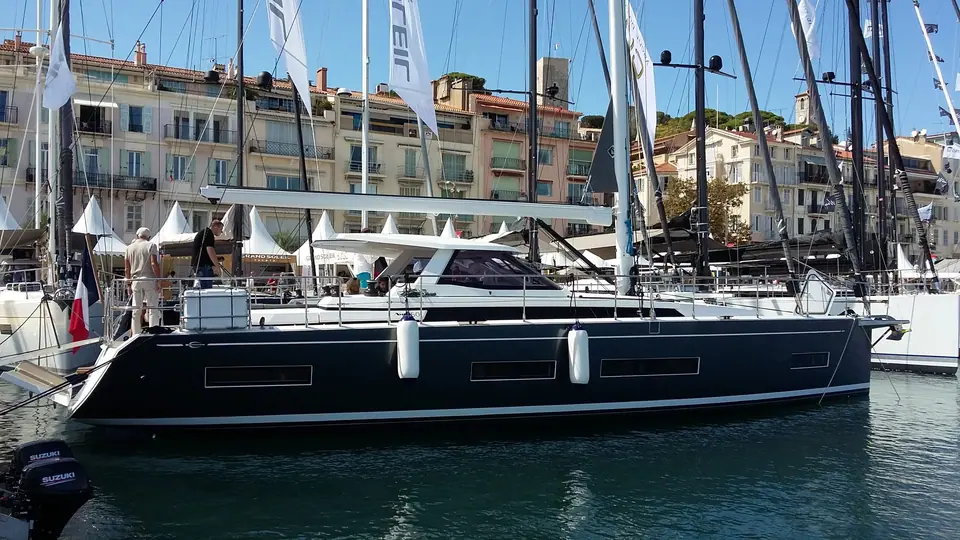
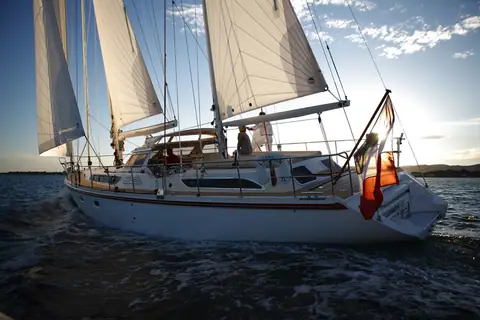
The defining feature on deck is the doghouse. The helm sits at the front of the center cockpit, offset to port, with a helmsman's chair behind it, under a hard top with a pillarless panoramic windscreen and the furling and winch controls within reach. In cold or wet weather you can stand a watch in a sweater. In the tropics the side panels open and the whole cockpit becomes a shaded outdoor room.
Not everyone loves it. A Cruising World judge felt the enclosure isolated the helmsman from the weather, Yachting World found the push-pull cable steering sensitive but lacking feel, and noted that when seated at the helm a shorter sailor's arms are at full stretch. Close-quarters handling is the other caveat: windage from the high topsides and little prop wash over the twin rudders make tight turns very hard without the bow thruster. Yachting Monthly still reversed into a finger berth easily using the joystick thruster control. Fender steps or a boarding ladder are almost essential given the freeboard.
What the Amel 50 does under sail
The performance surprised testers. Yachting World recorded 8.1 knots at 50 degrees true wind angle in 18 knots, gaining another 0.3 knots with the optional staysail, 9 knots reaching under a furling gennaker in 20 knots and close to 9 knots dead downwind in 22 knots. Yachting Monthly saw 8.4 knots close-hauled in 20 knots true and 9.2 knots downwind with extra sail. In 5 knots of breeze both magazines found the boat moving at about 4.4 to 4.5 knots, respectable for a cruiser of this weight.
Amel says the rig handles a wind window from 5 to 45 knots without a mizzen. The furling main is 62 m2, the genoa 64 m2, and the optional cutter rig adds a 24 m2 staysail on its own furler, which is our pick for ocean passages because it gives a proper heavy weather headsail. With white sails alone the boat is underpowered in very light air, so a code zero or furling gennaker is close to mandatory.
Owner's suite aft, two guest cabins forward
The interior follows a familiar center cockpit plan. The owner's cabin is aft with an island double, a desk, a sofa and an en suite head with shower. Forward, a double guest cabin shares a head and shower with a third cabin of bunks, which Yachting World called disproportionately small next to the rest of the boat. In between, a large saloon with a folding table sits under big windows, the chart table is aft to port and a corridor galley runs along the starboard side.
Stowage is excellent, with six lockers under the floorboards and a dedicated sail locker forward. A washer-dryer, watermaker and drop-down bathing platform were part of the standard list, and the passerelle stows in the lazarette. Early boats had too few handholds along the forward passage through the saloon at sea, a point worth checking and easy to remedy.
Engine room, 24 volts and the standard equipment list
Power is a five cylinder 110 hp Volvo Penta with a conventional shaft and a three blade Varifold folding propeller, a departure from the C-drive of the Super Maramu. A German test recorded a cruising speed of 8.1 knots under engine. The engine room, reached by a ladder under the cockpit sole, also houses the generator, watermaker, air conditioning plant and two inverters, all fed from the single sea chest.
The ship's system is 24 volts DC, with shore power capable of 50 or 60 hertz at 120 or 230 volts, so the boat plugs in from Martinique to Maine. That global electrical setup, together with Amel's standard inventory of spares, sails and even provisions at handover, is part of why owners can head offshore within weeks of delivery. One early test boat had an engine noise issue in the aft cabin that Amel later addressed, so ask about sound insulation updates on early hulls.
Amel 50 or the new Amel 50.2
The Amel 50.2 is an evolution rather than a new concept. Amel lists 16.70 m overall, 14.90 m on the waterline, 4.99 m of beam, a 150 hp engine, larger solar capacity and an inverted bow, with a reworked center cockpit and doghouse pillars moved aft for better visibility. If you want the latest boat, the 50.2 is the obvious choice, but it will cost substantially more than a late Amel 50.
For most buyers, a 2019 to 2023 Amel 50 with documented service from Amel's network is the smarter purchase. Budget $55,000 to $105,000 a year to run one in the US, covering insurance, a 55 ft slip, haul-outs, generator, watermaker and air conditioning service, electronics and a reserve for sails and rigging.
Amel 50 specifications
| Length overall | 54.1 ft16.5 m |
|---|---|
| Waterline length | 47.6 ft14.5 m |
| Beam | 15.7 ft4.79 m |
| Draft | 7.1 ft2.15 m |
| Air draft | 73.8 ft22.49 m |
| Displacement | 41,337 lbs18,75 kg |
| Ballast | 11,817 lbs5,36 kg |
| Sail area | 1,356 sq ft126 m² |
| Fuel capacity | 172 gal65 L |
| Fresh water | 159 gal6 L |
| Cabins | 3 |
| Berths | 6 |
| Heads | 2 |
| Standard engines | Volvo Penta 110 hp diesel, shaft drive |
| Maximum power | 110 hp |
| Cruise speed | 8.1 knots |
| Hull type | Moderate displacement monohull with twin rudders |
| Keel | Fin keel with bulb, iron ballast, 7 ft 1 in draft |
| Rig | Sloop with electric in-mast furling main and furling genoa; optional cutter staysail of 24 m2 on a second furler |
| Hull construction | Vacuum-infused fiberglass, solid below the waterline and foam-cored above |
| CE design category | A |
| Builder | Amel, France |
| Naval architect | Berret-Racoupeau Yacht Design |
| Other design credits | Amel in-house engineering team |
| Production | 2017 to 2026 |
| Status | Discontinued |
Figures come from builder documentation and independent tests where available. Displacement is usually quoted light, so a loaded cruising boat will weigh more. Compare these specs with another model.
How much does a Amel 50 cost?
At launch the Amel 50 started at 790,000 euros ex VAT, about $1.1 million in the US, and Yachting World's test boat came to 940,000 euros ex VAT. Because Amel fits so much as standard, and because prices climbed steadily through the production run (a later German test quoted a base of about 1.25 million euros ex yard), the spread on the used market follows build year more than options. Early hulls trade in the high six figures, while 2022 and later boats approach the cost of a new 50.2.
Estimate your yearly cost
A planning estimate using common rules of thumb: insurance near 1.5 percent of value, maintenance near 3 percent, haul out and bottom paint by length. Your marina, region and use will move these numbers. Open the full cost calculator.
Versions and options
- Amel 50 sloop
- Standard rig with furling main and genoa, 126 m2 of working sail.
- Amel 50 cutter option
- Adds a 24 m2 staysail on a second furler, the better offshore configuration.
- Amel 50.2 (from 2026)
- Successor with a slightly larger hull, inverted bow, 150 hp engine and redesigned cockpit.
Amel 50 timeline
- 1997Amel's last sloop before the 50 is built; the range becomes ketch only for two decades
- 2017Amel 50 unveiled as the yard's first sloop since 1997; YACHT magazine tests hull one
- 2018Named European Yacht of the Year 2018
- 2019Cruising World reviews the boat at a US base price of about $1.1 million
- 2026Amel 50.2 makes its world premiere at Cannes as the successor
Strengths and weaknesses
What owners like
- Quick for a heavy cruiser, 8 knots upwind in a breeze
- Enclosed doghouse helm for all climates
- Watertight bulkheads and a single sea chest
- Long standard equipment list
- Global shore power and 24 volt systems
- Strong Amel resale and owner network
What to weigh up
- Little steering feedback through cables
- Hard to maneuver in tight marinas without the thruster
- Third cabin is cramped
- Iron ballast and modest ballast ratio
- High freeboard makes boarding awkward
Used Amel 50 buyer checklist
Take this list to a viewing. Your ticks are saved in this browser so you can come back to it.
Always commission an independent marine survey and an engine survey before you buy. How a marine survey works.
Rivals to consider
Oyster 495
More luxurious and hydraulic-heavy, with an open center cockpit and a much higher price.
Compare side by sideHallberg-Rassy 44
Smaller, with a fixed windscreen rather than a full doghouse, and a more traditional Swedish interior.
Compare side by sideAmel Super Maramu
The classic Amel ketch at a fraction of the price, slower but proven around the world.
Compare side by sideOutremer 51
The performance catamaran alternative for couples, far faster on a reach but without the monohull's motion.
Compare side by sideOur verdict on the Amel 50
The Amel 50 proved that Amel could modernize without abandoning what made its boats special. It sails faster than any previous Amel, protects its crew better than almost any rival and still arrives fully equipped. The trade-offs are a remote helm feel, awkward close-quarters handling and a small third cabin. For a couple who will spend most of their time on passage or at anchor, a well-kept Amel 50 is one of the most complete and liveable 50-footers built, and the arrival of the 50.2 makes good used examples easier to negotiate.
Amel 50 questions answered
How much does an Amel 50 cost?
At launch the base price was 790,000 euros ex VAT, about $1.1 million in the US, and later boats rose toward 1.25 million euros. Used Amel 50s generally range from about $850,000 to $1.35 million.
Is the Amel 50 still in production?
No. The Amel 50.2 replaced it in 2026, with a world premiere at the Cannes Yachting Festival.
How many Amel 50s were built?
About 140 were built between 2017 and 2026.
Is the Amel 50 a ketch?
No. It is a sloop with an optional cutter staysail, Amel's first sloop since 1997.
How fast is the Amel 50?
Tests recorded about 8.1 to 8.4 knots upwind in 18 to 20 knots of wind and around 9 knots downwind, with 8.1 knots cruising under engine.
Where can I find an Amel 50 for sale?
Amel's own brokerage and the major portals list most boats, many in France and the Caribbean. Expect few on the US market and budget for a delivery.
Amel 50 photos
More bluewater sailboats to explore
Oyster 495
Bluewater Sailboats, 53 ft
Used $1.5M to $2.25M

Shannon 47/52
Bluewater Sailboats, 53 ft
Used $325K to $650K
Amel Super Maramu
Bluewater Sailboats, 52 ft
Used $150K to $320K
Amel 54
Bluewater Sailboats, 56 ft
Used $425K to $700K