Kraken Yachts Bluewater Sailboats
Kraken 50 Review, the Bolt-Free Bluewater Cruiser From Kraken Yachts
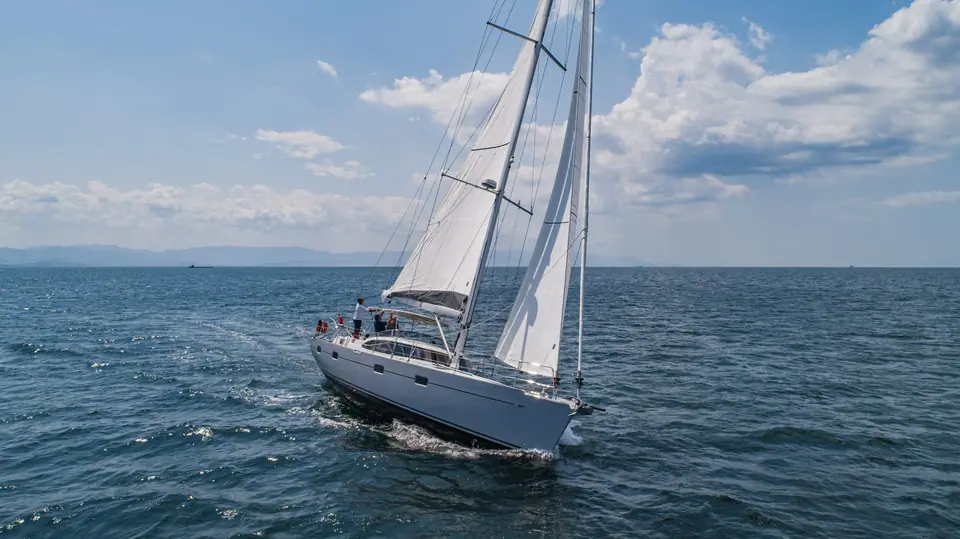
A 50-foot Kevin Dibley center-cockpit ocean cruiser with an integral lead-bulb keel, full-length skeg and Solent rig, built for places with no travel lift.
- Length
- 50 ft15.24 m
- Beam
- 14.8 ft4.5 m
- Draft
- 7.5 ft2.3 m
- Cabins
- 2 or 3 depending on layout (4, 5 and 6 berth versions offered)
- Used price
- $700K to $1.05M
On this page
- Overview
- Kraken yachts and the sailor they are built for
- No keel bolts, and a rudder that hides behind a skeg
- How a 19-tonne Solent sloop actually sails
- A deep center cockpit, high bulwarks and a tall boom
- Layouts, the walk-in engine room and three fuel tanks
- Why the Kraken equipment list changes the price math
- Owning one far from home
- Finding a Kraken 50 for sale in the US
- Where the 50 sits against Hallberg-Rassy, Amel and Oyster
- Specifications
- Price and value
- Strengths and weaknesses
- Used buyer checklist
- Rivals
- Our verdict
- FAQ
The Kraken 50 is a Kevin Dibley designed center-cockpit bluewater sailboat launched in 2019, with a bolt-free integral keel, skeg-hung rudder, Solent rig, 80 hp Yanmar and a long standard equipment list.
- Couples planning circumnavigations
- Remote and high-latitude cruising
- Sailors who distrust bolted keels
- Long passages with a small crew
Kraken yachts and the sailor they are built for
Kraken Yachts builds one kind of boat. Its own literature says that if the purpose is to cruise around the world, you are in the right place, because the company builds nothing else. The Kraken 50 put that philosophy into series production. Cruising World showcased it in 2017, SAIL introduced it to American readers that autumn as a center-cockpit cruiser aimed at Hallberg-Rassy territory, and Yachting Monthly sailed hull number one off Hong Kong in 2019, weeks after it left the yard in China.
Founder and chairman Dick Beaumont had sailed more than 200,000 miles by then, the last 27,000 aboard his own Kraken 66, White Dragon, which became the test bed for ideas now used across the 44, 50 and 58. Design work on the 50 went to New Zealander Kevin Dibley. It is a semi-custom ocean cruiser for crews who expect to be far from a travel lift when something goes wrong.
Kraken 50 by the numbers
- Sail area to displacement
- 19.2Balanced power for coastal and offshore cruising.
- Displacement to length
- 207Moderate displacement, a classic cruising balance between load carrying and speed.
- Theoretical hull speed
- 9.0 knThe practical top speed of a displacement monohull under normal sailing, based on waterline length.
- Ballast ratio
- 34%A typical ballast ratio for a cruising monohull.
- Capsize screening
- 1.70Below 2.0, the traditional threshold for offshore suitability.
- Motion comfort ratio
- 38.7A slow, easy motion in a seaway, kind to crews on long passages.
- Length to beam ratio
- 3.39 : 1Moderate proportions.
No keel bolts, and a rudder that hides behind a skeg
The defining feature of the Kraken 50 is what the builder calls the Zero Keel. Instead of a cast fin bolted to a stub, the keel is molded as part of the hull, with a 6.5 tonne (14,330 pound) lead bulb encapsulated at its base so the ballast sits low, unlike the internal ballast of traditional long keels. The ballast ratio works out to roughly 34 to 36 percent depending on which displacement figure you use.
The raked leading edge carries Kevlar reinforcement, and the long chord spreads grounding loads. Below the waterline the laminate is solid, with no core, from about 8 inches above the waterline to the bottom of the keel. Kraken quotes 17 to 22 layers of engineered fabrics, rising to at least 20 layers including aramids in the collision zones.
Aft, the Alpha Rudder hangs on a full-length reinforced skeg with three independent bearings, one serviceable afloat. Beaumont's reasoning is personal: sailing White Dragon from Cape Town to St Helena at 9 knots, he hit what he believes was a whale. It slid down the keel into the skeg, distorting the heel casting, but the rudder survived. He is convinced a spade rudder would have been lost.
Up front there is a foam-filled, two-stage crash box and two collision bulkheads around the bow locker. Frames and stringers are bonded in by hand rather than using a separately molded grid.
How a 19-tonne Solent sloop actually sails
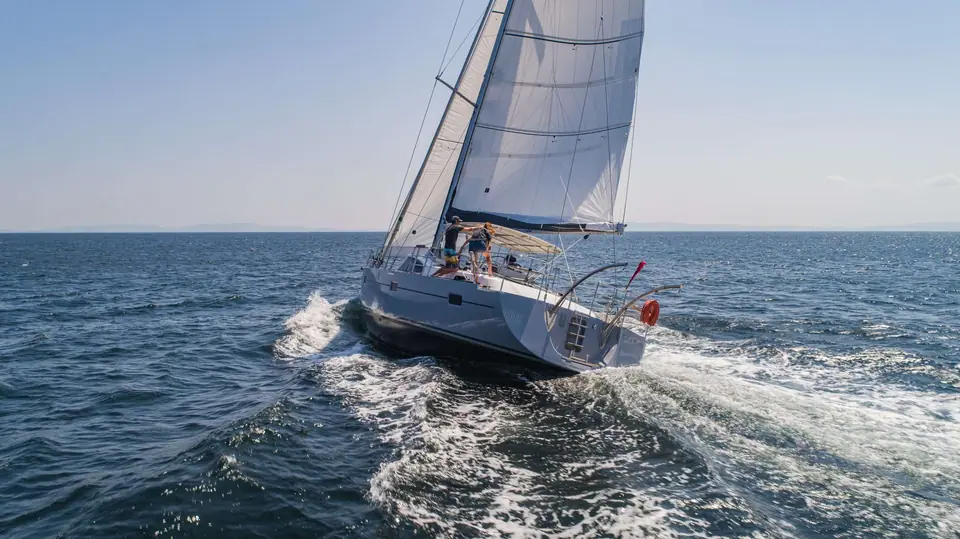
The keel-stepped, high-fractional mast stands on three sets of swept spreaders with two forestays and a split backstay. The inner stay carries a working jib for windward work; the outer carries a big genoa for reaching, which must be furled before tacking. There is no upwind genoa at all.
Kraken quotes 1,444.5 square feet of sail and a sail area to displacement ratio of 19.2. In Yachting Monthly's test the boat made 6.5 knots under main and genoa in just 12 knots of apparent wind forward of the beam, about 5 knots upwind on the jib alone, and 7 knots on the wind in 20 to 22 knots true. Heading home on a broad reach under a cruising chute she held 8 to 9 knots.
The tester described a comfortable, slam-free motion, a dry ride and impressive stiffness, with excellent directional stability and little loss of maneuverability. The compromise is that a large rudder behind a full skeg is unbalanced, so you feel more load through the wheel, partly offset by low steering gearing. Kraken said future boats would get rod rather than cable steering and a lighter rudder stock.
A deep center cockpit, high bulwarks and a tall boom
Beaumont favors a center cockpit because it reduces pitching and the consequences of being pooped. The Kraken 50's cockpit is deep, protected by high coamings and a fixed windscreen, and sized for four crew moving around. A large fixed table gives secure bracing but makes crossing from side to side a squeeze.
On deck, a molded concave bulwark gives a solid foothold, stanchions stand 80 cm (about 31.5 inches) tall with triple lifelines, and cleats are rated for 12 tonnes. The penalty of the center cockpit is boom height: the gooseneck is about 6 feet above the deck and the stowed main nearly 10 feet up, so many owners choose in-mast furling.
All six Harken cockpit winches are two-speed electric on the current standard list, because the boat is designed to be handled by a couple. A raised inside navigation station duplicates the autopilot, plotter and VHF so a watchkeeper can stay dry below and still see out.
Layouts, the walk-in engine room and three fuel tanks
Kraken offers four layouts with four, five or six berths around a fixed galley and engine room. The tested layout had an owner's aft cabin with an island double and lee cloths, a forward double offset to starboard, two heads with separate showers and a U-shaped dinette. Joinery comes in cherry, teak or light oak, and bulkheads can shift a few inches to suit an owner.
The galley is laid out for offshore use, with front-opening fridge and freezer, deep twin sinks and a gimbaled GN Espace induction hob and oven on current boats. The saloon sole is raised to hide three separate fuel tanks, and a tank-to-tank polishing system cleans fuel for the engine and generator.
The walk-in engine room holds the 80 hp shaft-drive Yanmar, watermaker and Kohler generator, and the tester found the boat notably quiet below. The current spec sheet lists 290 US gallons of diesel and 171 of water; the 2019 test quoted 850 and 670 liters, so confirm tankage on any specific hull.
Why the Kraken equipment list changes the price math
Kraken markets its standard spec as "their extra, our standard," and the list matters when comparing a Kraken 50 price with a Hallberg-Rassy or Oyster quote. Standard on the current boat, according to the builder:
- Kohler generator with sound shield, Hydromaster watermaker and Veco Frigomar tropical air conditioning
- Webasto diesel heating in all cabins
- Dual-station Garmin electronics with two autopilots, two plotters and two VHF radios
- EmpirBus digital switching and monitoring
- Side-Power 24V bow thruster and an extra 5,000 liter per hour emergency bilge pump
Owning one far from home
Budget roughly $40,000 to $80,000 a year for offshore insurance, a slip or mooring, haul-outs, generator, watermaker and air conditioning service, rigging checks and sail care. The single Yanmar is frugal at displacement speed, but Kraken publishes no fuel curve, so treat range estimates with caution.
The design does remove some long-term risks: no keel bolts to corrode, no core to saturate, and a skeg that protects the rudder in groundings. The Solent rig with two forestays and three spreader sets will cost more to re-rig than a simple masthead sloop.
Kraken sells direct and has no American dealer network, so most US owners rely on independent yards for routine work and on the factory for parts and warranty support.
Finding a Kraken 50 for sale in the US
Kraken 50s rarely come up for sale, and when they do they are often lying in the Mediterranean, the Caribbean or Southeast Asia. Yachting Monthly reported that boats for Australasia, Asia and the US West Coast would still be built in China while European production moved to Turkey, so ask which yard built the hull and review its build documentation.
Because these are semi-custom boats with big options lists, two used Kraken 50s can differ by six figures in real value. A boat that has completed an ocean crossing and been sorted by an experienced owner is often the better buy, provided the survey confirms the skeg, rudder bearings and keel area are clean.
Where the 50 sits against Hallberg-Rassy, Amel and Oyster
The Kraken 50 competes with the Hallberg-Rassy 44 and 50, the Amel 50 and the Oyster 495. It is more conservative under water than all of them, none of which has an integral keel. In return it gives up some light-air pace, interior volume aft and the swim platform culture of newer European designs.
Yachting Monthly called her very competitively priced, and that holds once the standard equipment is counted. The Kraken suits a couple heading for coral atolls and high latitudes; for marina hopping, a lighter fin keel boat will be cheaper, quicker in light air and easier at the dock.
Kraken 50 specifications
| Length overall | 50 ft15.24 m |
|---|---|
| Waterline length | 44.9 ft13.68 m |
| Beam | 14.8 ft4.5 m |
| Draft | 7.5 ft2.3 m |
| Air draft | 81.4 ft24.8 m |
| Displacement | 41,888 lbs19, kg |
| Ballast | 14,33 lbs6,5 kg |
| Sail area | 1,445 sq ft134.2 m² |
| Fuel capacity | 29 gal1,1 L |
| Fresh water | 171 gal65 L |
| Cabins | 2 or 3 depending on layout (4, 5 and 6 berth versions offered) |
| Berths | 4 to 6 |
| Heads | 2 in the layout tested by Yachting Monthly, each with a separate shower |
| Standard engines | Yanmar 80 hp diesel with shaft drive |
| Maximum power | 80 hp |
| Hull type | Moderate to heavy displacement monohull with raked stem and V-shaped forefoot |
| Keel | Zero Keel, an integral keel molded with the hull and a 6.5 tonne lead bulb encapsulated inside, no keel bolts; single rudder on a full-length skeg |
| Rig | High-fractional keel-stepped Solent rig with two forestays, three sets of swept spreaders and a split backstay |
| Hull construction | Solid hand-laid composite below the waterline with aramid (Kevlar) reinforcement in the bow and keel leading edge |
| CE design category | A (Ocean) |
| Builder | Kraken Yachts (first hulls built in China, production moving to Turkey from 2019), United Kingdom |
| Naval architect | Kevin Dibley (Dibley Marine, New Zealand) |
| Other design credits | Concept and specification by Kraken founder Dick Beaumont |
| Production | 2019 to present |
| Status | In production |
Figures come from builder documentation and independent tests where available. Displacement is usually quoted light, so a loaded cruising boat will weigh more. Compare these specs with another model.
Performance data
| Point of sail | Apparent wind angle | Apparent wind (kn) | Boat speed (kn) |
|---|---|---|---|
| Close hauled | 37 deg | 15 to 17 | 5.2 to 5.6 |
| Fetch | 60 deg | 11 to 13 | 6.2 to 6.8 |
| Beam reach | 90 deg | 16 to 18 | 7.1 to 7.4 |
| Broad reach | 120 deg | 12 to 16 | 7.6 to 7.9 |
| Run | 180 deg | 9 to 11 | 4.8 to 6.2 |
Yachting Monthly test of hull number one off Hong Kong, 2019, sailed by David Harding. Speeds under sail; Kraken does not publish a motoring fuel curve.
How much does a Kraken 50 cost?
Yachting Monthly quoted a starting price of 704,440 GBP including VAT in 2019 and tested hull number one at 800,500 GBP with about 100,000 GBP of extras. Kraken's standard list already includes a generator, watermaker, air conditioning, diesel heating, a bow thruster, electric winches and a tender with davits, so the gap between base and sail-away is smaller than on most production cruisers. Fewer than a few dozen 50s exist, so used asking prices swing on equipment, ocean miles and whether the boat is lying in Europe, Asia or North America.
Estimate your yearly cost
A planning estimate using common rules of thumb: insurance near 1.5 percent of value, maintenance near 3 percent, haul out and bottom paint by length. Your marina, region and use will move these numbers. Open the full cost calculator.
Versions and options
- Layouts A to D
- Four interior layouts with four, five or six berths, all sharing the fixed galley and walk-in engine room positions.
- Interior joinery
- Cherry, teak or light oak joinery; semi-custom build lets owners adjust details and move bulkheads a few inches.
Kraken 50 timeline
- 2017Kraken 50 introduced in Cruising World's New Boat Showcase and SAIL's new boats column
- 2019Hull number one launched at the yard in China and tested by Yachting Monthly in Hong Kong
- 2019Kraken announces European production moving to a yard in Turkey
- 2026The 50 remains in the range alongside the Kraken 44 and Kraken 58
Strengths and weaknesses
What owners like
- Bolt-free integral keel with a low lead bulb
- Skeg-hung rudder with a bearing serviceable afloat
- Solid, heavily reinforced hull below the waterline
- Very long standard equipment list
- Comfortable, dry motion and good speed for her weight
- Walk-in engine room and triple fuel polishing
What to weigh up
- High boom makes mainsail handling a stretch
- Cockpit table makes side-to-side movement tight
- No dinghy garage or large swim platform
- Heavier helm than spade-rudder designs
- No US dealer network and few used boats
Used Kraken 50 buyer checklist
Take this list to a viewing. Your ticks are saved in this browser so you can come back to it.
Always commission an independent marine survey and an engine survey before you buy. How a marine survey works.
Rivals to consider
Hallberg-Rassy 44
Smaller and lighter Swedish center cockpit with a bolted fin and twin rudders, stronger dealer support and resale.
Compare side by sideAmel 50
French bluewater center cockpit with a more modern underbody, bigger interior and a strong owner community.
Compare side by sideOyster 495
Luxurious British deck-saloon cruiser with a higher price and more refined finish, but a conventional keel.
Compare side by sideShannon 47/52
American-built offshore cruiser for buyers who want proven heavy construction on the used market.
Compare side by sideOur verdict on the Kraken 50
The Kraken 50 is the most uncompromising production bluewater sailboat of its size, which is both its strength and its limit. The bolt-free keel, skeg-hung rudder and solid bottom answer the questions that keep ocean sailors awake, and she sails far better than her 19 tonnes suggest. For crossing oceans and anchoring off reefs, few boats offer this much protection and standard equipment for the money. Coastal sailors who live in marinas will pay in boom height, helm weight and interior space for capability they may never use.
Kraken 50 questions answered
Who builds Kraken yachts?
Kraken Yachts, founded by ocean sailor Dick Beaumont, builds the 44, 50 and 58. The 50 is designed by New Zealander Kevin Dibley; early hulls were built in China and European production moved to Turkey.
What is the Zero Keel on the Kraken 50?
It is an integral keel molded as part of the hull with a 6.5 tonne lead bulb encapsulated at the bottom, so there are no keel bolts that can fail.
How much does a Kraken 50 cost?
Yachting Monthly quoted a base of 704,440 GBP including VAT in 2019. A new, well-equipped Kraken 50 delivered to the US is likely to cost roughly $950,000 to $1.3 million in 2026.
How fast is the Kraken 50 under sail?
In Yachting Monthly's test she sailed at 6.5 knots in 12 knots of apparent wind, reached 7.6 to 7.9 knots on a broad reach and ran at 8 to 9 knots under a cruising chute.
What engine does the Kraken 50 have?
An 80 hp Yanmar diesel with shaft drive, installed in a walk-in engine room with the generator and watermaker.