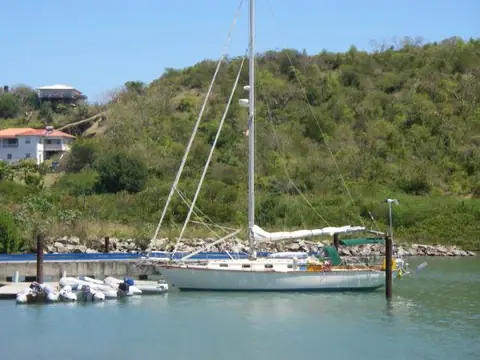
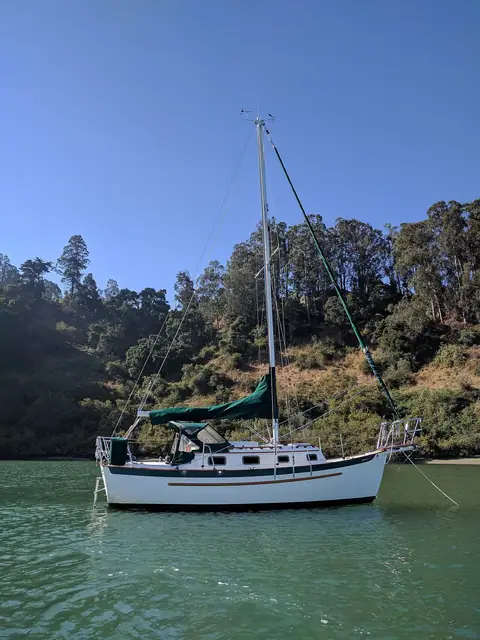
Sam L. Morse Co. (Bristol Channel Cutter) Bluewater Sailboats
Bristol Channel Cutter for Sale, a Buyer's Guide to the BCC 28
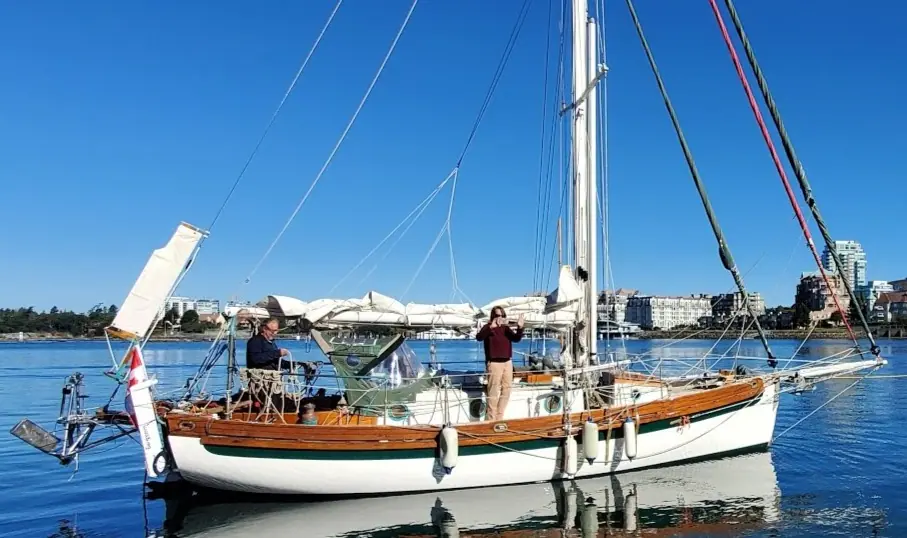
Lyle Hess's 28 foot gaff-era spirit in hand-laid fiberglass, built one at a time in Costa Mesa and owned for decades by the people who buy them.
- Length
- 28.1 ft8.56 m
- Beam
- 10.1 ft3.07 m
- Draft
- 4.8 ft1.47 m
- Cabins
- 1 (open plan)
- Used price
- $60K to $175K
On this page
- Overview
- Bristol Channel Cutter for sale, and why so few come up
- Lyle Hess, the Renegade and the Pardey connection
- The Costa Mesa build standard
- Fourteen thousand pounds on a 28 foot deck
- A big rig on a small boat, and what it costs at the dock
- Reaching machine, tiller workout
- A yacht-finished cabin for two
- Pixie and the case for a small, simple ocean boat
- Specifications
- Price and value
- Strengths and weaknesses
- Used buyer checklist
- Rivals
- Our verdict
- FAQ
A 28-foot on deck, 14,000 pound full-keel cutter designed by Lyle Hess and built by the Sam L. Morse Co. from 1976 to 2007. Only 128 US-built hulls exist, so good boats are scarce and hold their value.
- Couples planning long-term ocean cruising on a small boat
- Traditional sailors who value craftsmanship
- Singlehanders using a wind vane
Bristol Channel Cutter 28 by the numbers
- Sail area to displacement
- 18.5Balanced power for coastal and offshore cruising.
- Displacement to length
- 346Heavy displacement. Slow to accelerate but steady and sea kindly with a full load.
- Theoretical hull speed
- 6.9 knThe practical top speed of a displacement monohull under normal sailing, based on waterline length.
- Ballast ratio
- 33%A typical ballast ratio for a cruising monohull.
- Capsize screening
- 1.67Below 2.0, the traditional threshold for offshore suitability.
- Motion comfort ratio
- 37.2A slow, easy motion in a seaway, kind to crews on long passages.
- Length to beam ratio
- 2.79 : 1A beamy hull with lots of volume for its length.
Bristol Channel Cutter for sale, and why so few come up
If you are hunting for a Bristol Channel Cutter for sale, start with the math. The Sam L. Morse Co. built only 128 BCCs in California between 1976 and 2007, and roughly 30 to 45 more were completed in Vancouver by Steveston Fiberglass and G and B Woodworks. Many owners keep them for 20 or 30 years, so in a typical year only a handful of US-built boats reach the brokerage market.
That scarcity changes how you shop. Set up saved searches on every listing site under Bristol Channel Cutter, BCC 28 and Sam L. Morse, tell brokers who specialize in traditional boats what you want, and be ready to travel. A good BCC often sells to someone who was already waiting. If one is listed for months, there is usually a reason, and the survey will tell you what it is.
Expect three broad price tiers. Early California boats needing rig, deck or engine work ask around $60,000 to $90,000. Sound mid-production boats with a healthy Yanmar and newer sails sit around $90,000 to $130,000. Late hulls with fresh refits can reach $150,000 to $175,000. Canadian-built boats from Vancouver usually trade below comparable Morse boats, so confirm the builder from the hull identification number and documentation before you compare prices.
Lyle Hess, the Renegade and the Pardey connection
Lyle Hess drew the BCC from his earlier Renegade design, the same family of hulls that gave cruising legends Lin and Larry Pardey their small wooden cutters and inspired a generation to go voyaging in modest boats. The fiberglass BCC took that philosophy, heavy displacement, a long keel and a big, simple cutter rig, and turned it into a production boat built to yacht standards.
Cruising World summed up the type as a cruising philosophy in which solid construction, first-class workmanship and enough displacement to carry gear and stand up to a gale at sea reign supreme. That remains the right lens for judging the boat.
The Costa Mesa build standard
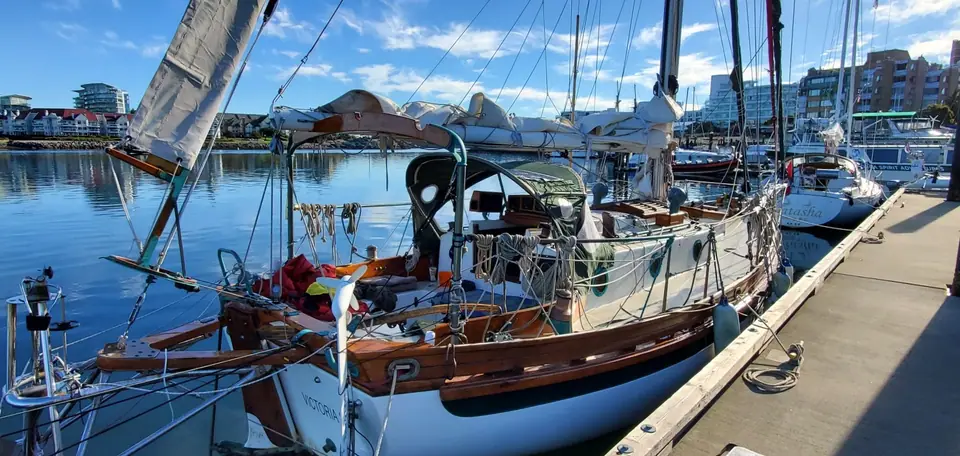
The hull is laid up by hand in up to 10 layers of mat, roving and cloth, from about 3/8 inch at the sheer to between 1 and 1.5 inches at the bottom, with three coats of epoxy barrier below the waterline against blisters. The pre-cast lead ballast is set in the keel, bedded in epoxy and completely encapsulated with roving, so there are no keel bolts. Bulkheads are glassed to the hull with five layers of mat along their full length.
The hull-to-deck joint is an inward-turned flange bedded in 3M 5200 and through-bolted on 5 inch centers, then covered by a teak plank and a teak rubrail. The deck is plywood-cored, which is the one structural element that ages badly if fittings are not kept bedded. Interiors were finished to a very high standard, and original Morse joinery is part of what buyers pay for.
- Hull up to 1.5 inches thick below the waterline
- Lead ballast fully encapsulated, no keel bolts
- Three epoxy barrier coats from the factory
- Hull-to-deck bolts on 5 inch centers
Fourteen thousand pounds on a 28 foot deck
The BCC measures 28 feet 1 inch on deck, but the waterline is 26 feet 3 inches because the stem is nearly plumb and the transom carries an outboard rudder. With 10 feet 1 inch of beam and 14,000 pounds of displacement, it carries more volume than most 32 footers. The displacement to length ratio is about 345 and the ballast ratio 0.33. Hull speed is about 6.9 knots.
Those numbers explain the boat's character: lots of load-carrying ability, a motion that stays gentle in a sea, and a boat that can carry a cruising couple's gear without sinking to its boot top. They also explain why it is not a light-air performer.
A big rig on a small boat, and what it costs at the dock
Total sail area is about 673 square feet, or 556 square feet with a 100 percent foretriangle, carried on a long bowsprit and a boomkin that stretch the overall sparred length to 37 feet 9 inches. The cutter rig gives a wide choice of sail combinations, from a big genoa or yankee in light air to staysail and reefed main in a gale.
The practical consequence is marina billing. Many US marinas charge on overall length, so a BCC can cost as much to berth as a 38 foot boat. Ask about end ties, mooring fields or marinas that charge on length on deck before you buy. A removable or reefing bowsprit arrangement helps in tight slips.
Reaching machine, tiller workout
Reaching is the BCC's forte. Practical Sailor found the boat surging along at 4 to 5 knots to windward in 7 to 10 knots of breeze, which is better than its reputation suggests. Off the wind in a breeze it settles in near hull speed and stays there for days.
The trade-offs are real. The rudder is unbalanced and the tiller can be heavy, sweeping much of the cockpit. Most owners let a wind vane or autopilot steer and trim the sails for balance. Light-air performance is slow, and maneuvering in reverse with a full keel takes planning. Under power, Practical Sailor saw a comfortable 5.5 knots at 2,500 rpm on a boat repowered with a Beta 25.
For a couple, the most valuable upgrades are a servo-pendulum wind vane, a roller-furling yankee and a staysail that can be handled from the cockpit. With those, the boat is far easier to sail than its traditional rig suggests.
A yacht-finished cabin for two
The interior is built for a couple, with four berths: two settees in the saloon, a pilot berth and a quarter berth. Headroom in the main cabin is generous for a 28 footer, quoted at 6 feet 1 inch to 6 feet 3 inches, with 6 feet 6 inches offered as an option, though you will stoop to reach the forward cabin, which is essentially the head and stowage.
Tankage is about 30 gallons of fuel, 64 to 70 gallons of water in the keel depending on the source, and a 15 gallon holding tank. Cruising World noted three basic layouts and plenty of semi-custom variation, since the interior is built by hand without liners. Engine access, especially to the transmission and stuffing box at the rear, is tight and demands some flexibility.
Bristol Channel Cutter 28 specifications
| Length overall | 28.1 ft8.56 m |
|---|---|
| Waterline length | 26.3 ft8 m |
| Beam | 10.1 ft3.07 m |
| Draft | 4.8 ft1.47 m |
| Displacement | 14, lbs6,35 kg |
| Ballast | 4,6 lbs2,087 kg |
| Sail area | 673 sq ft62.5 m² |
| Fuel capacity | 3 gal114 L |
| Fresh water | 64 gal242 L |
| Cabins | 1 (open plan) |
| Berths | 4 |
| Heads | 1 |
| Standard engines | Yanmar 3GM30F, 27 hp diesel (most boats) |
| Optional engines | Volvo MD7A (13 hp) on early boats; Volvo Penta 2002 on some later boats; many now repowered (Beta 25 common) |
| Cruise speed | 5.5 knots |
| Hull type | Heavy displacement full-keel monohull with near-plumb stem and transom-hung rudder |
| Keel | Full keel with resin-encapsulated cast lead ballast, no keel bolts |
| Rig | Masthead cutter with long bowsprit and boomkin, sparred length 37 ft 9 in |
| Hull construction | Hand-laid fiberglass up to 1.5 inches thick at the bottom, epoxy barrier coat, plywood-cored deck |
| Builder | Sam L. Morse Co., Costa Mesa, California, United States |
| Naval architect | Lyle C. Hess |
| Other design credits | Canadian hulls by Steveston Fiberglass and G and B Woodworks; molds later with Cape George Marine Works |
| Production | 1976 to 2007 |
| Status | Discontinued |
Figures come from builder documentation and independent tests where available. Displacement is usually quoted light, so a loaded cruising boat will weigh more. Compare these specs with another model.
How much does a Bristol Channel Cutter 28 cost?
When Cruising World tested a new BCC in the mid 1990s, the as-tested price was $157,000, and well-kept boats have held much of that. Practical Sailor's market scan found a 1988 boat asking $92,000 in Seattle. Late hulls with original Morse joinery, a healthy diesel and documented rig work sell fastest; Canadian-built boats and owner-finished hulls trade lower.
Estimate your yearly cost
A planning estimate using common rules of thumb: insurance near 1.5 percent of value, maintenance near 3 percent, haul out and bottom paint by length. Your marina, region and use will move these numbers. Open the full cost calculator.
Bristol Channel Cutter 28 timeline
- 1976Sam L. Morse Co. begins building the Lyle Hess Bristol Channel Cutter in Costa Mesa
- 1994Hull 102 completed; Pixie later circumnavigates singlehanded
- 1995The BCC draws crowds at the Annapolis show; Cruising World's test boat is priced at $157,000 as tested
- 2007US production ends after 128 hulls
- 2011Cape George Marine Works completes a new boat from the molds
Strengths and weaknesses
What owners like
- Superb hand-laid construction with encapsulated lead and no keel bolts
- Large volume and load-carrying ability for a 28 footer
- Gentle motion and excellent reaching performance
- Flexible cutter rig for all conditions
- Strong resale values driven by scarcity
What to weigh up
- Heavy tiller and unbalanced rudder
- Slow in light air and awkward in reverse
- Sparred length near 38 feet raises marina costs
- Tight engine access
- Very few boats for sale at any one time
Used Bristol Channel Cutter 28 buyer checklist
Take this list to a viewing. Your ticks are saved in this browser so you can come back to it.
Always commission an independent marine survey and an engine survey before you buy. How a marine survey works.
Rivals to consider
Pacific Seacraft Dana 24
Smaller, cheaper and more common, with a modified long keel and a finely finished interior.
Compare side by sideWestsail 32
A larger double-ender with more berths at a fraction of the price, but rougher construction and finish.
Compare side by sidePacific Seacraft Flicka 20
A Bruce Bingham design on a similar heavy, traditional philosophy at a much smaller scale.
Compare side by sideFalmouth Cutter 22
Lyle Hess's smaller fiberglass cutter, also built by Sam L. Morse, for those who want the BCC character in a shorter boat.
Our verdict on the Bristol Channel Cutter 28
The Bristol Channel Cutter is one of the finest small ocean cruisers ever built in America. It is heavy, slow in light air and expensive for its length, but it is built to a standard few production boats approach and it carries a couple's life aboard with ease. If one comes up with a good survey, move quickly.
Bristol Channel Cutter 28 questions answered
How much is a Bristol Channel Cutter for sale?
Most US-built BCCs ask between $60,000 and $175,000 depending on age and refit history; Practical Sailor's market scan found a 1988 boat at $92,000.
How many Bristol Channel Cutters were built?
The Sam L. Morse Co. built 128 in California from 1976 to 2007, and about 30 to 45 more were built in Canada.
Who designed the Bristol Channel Cutter 28?
Lyle Hess designed it, based on his earlier Renegade design.
How long is a Bristol Channel Cutter with the bowsprit?
It is 28 feet 1 inch on deck and about 37 feet 9 inches including bowsprit and boomkin.
Is the Bristol Channel Cutter a good bluewater boat?
Yes. Its heavy displacement, full keel and encapsulated lead ballast make it a proven ocean cruiser, including singlehanded circumnavigations.