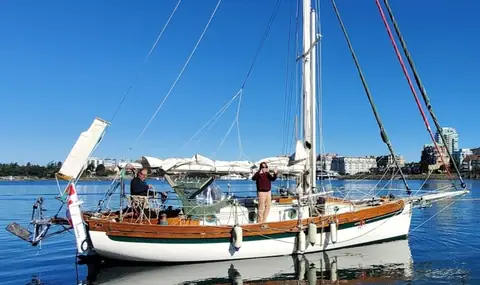
Bristol Channel Cutter 28
Bluewater Sailboats, 28 ft
Used $60K to $175K
A tiny Southern California yard that spent three decades building one traditional cutter slowly and well.
From 1976 to 2007 the Sam L. Morse Co. of Costa Mesa, California, hand-built about 128 Bristol Channel Cutters to Lyle Hess's design, giving a small boat an outsized reputation among ocean sailors.
The boats the Morse yard built descend from the pilot cutters that once worked England's Bristol Channel, heavy plumb-stemmed vessels with long bowsprits that had to keep the sea whatever the weather. Lyle Hess, a California designer, adapted that tradition for modern cruising sailors.
His designs became widely known thanks to Lin and Larry Pardey, who sailed engineless Hess cutters across oceans and wrote books that persuaded many readers a small, simple, strong boat was enough to see the world. That audience became the natural market for a production version.
The Sam L. Morse Co. started building the Bristol Channel Cutter in fiberglass in 1976. Output was never the point. Hulls were laid up with care, and teak interiors and bronze hardware were fitted largely by hand, so a single boat could occupy the shop for months. The company applied the same approach to a smaller Hess design, the Falmouth Cutter.
American production stopped in 2007 with 128 hulls completed. Somewhere between 30 and 45 additional boats were built in Canada, and in 2011 Cape George Marine Works finished a fresh hull using the original molds.
Although the yard built the Falmouth as well, its name is inseparable from the 28-foot Bristol Channel Cutter, the only one of its boats we cover. Our model page explains its keel, rig, motion at sea and accommodation, and records famous voyages such as the singlehanded circumnavigation of hull 102, Pixie. The short version is that owners accept modest speed and a snug cabin in exchange for a boat that inspires confidence when conditions turn bad.
Most of the boats are still sailing and few come up for sale, so a well-kept example tends to find a buyer quickly. Values have barely softened over the decades. A new boat tested by Cruising World in the mid-1990s carried a price that good used examples can still approach today, which says a great deal about how this builder's work is regarded.
No company supports the boats now. Owners rely on owner groups, copies of the original drawings and a handful of West Coast yards familiar with traditional construction. Many boats have covered serious ocean miles, so a thorough survey is essential.
The Sam L. Morse Co. in Costa Mesa, California, built the American boats between 1976 and 2007, and more were built later in Canada.
Roughly 128 were completed in the US, with an estimated 30 to 45 more from Canada and one later hull from Cape George Marine Works.
Lyle Hess, who based it on the traditional pilot cutters of England's Bristol Channel.
Yes. It also built the smaller Falmouth Cutter, another Lyle Hess design, using the same hand-finished approach.