Lagoon 46 Catamaran Review, Specs and Price Guide
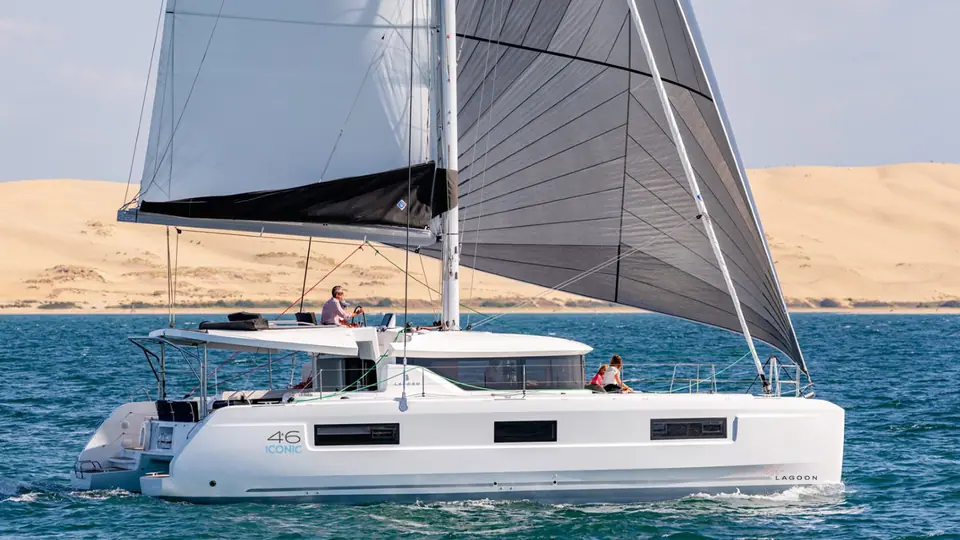
The catamaran that replaced the best-selling Lagoon 450 and moved the mast aft to make short-handed sailing easier.
- Length
- 45.9 ft13.99 m
- Beam
- 26.1 ft7.96 m
- Draft
- 4.4 ft1.35 m
- Cabins
- 3 or 4
- Used price
- $620K to $950K
On this page
- Overview
- Why the Lagoon 46 matters
- Flybridge, helm and sail handling
- Saloon, cockpit and the forward cockpit
- Three cabin owner layout versus four cabin charter layout
- How it sails
- Engines, tankage and systems
- What it costs to own
- Specifications
- Price and value
- Strengths and weaknesses
- Used buyer checklist
- Rivals
- Our verdict
- FAQ
A 46-foot VPLP cruising catamaran built in France since 2019, offered in three and four cabin layouts and sold heavily into both private ownership and charter fleets.
- Couples cruising long term
- Families with teenagers
- Charter management buyers
- First catamaran owners moving up from a monohull
Lagoon 46 by the numbers
- Sail area to displacement
- 22.6Plenty of sail for the weight, the boat should feel lively in light air.
- Displacement to length
- 165Light displacement for its length, quick but sensitive to added cruising weight.
- Theoretical hull speed
- 9.0 knDisplacement hull speed for the waterline. Light catamarans regularly sail faster than this because their slim hulls do not make a large bow wave.
- Length to beam ratio
- 1.76 : 1Catamaran overall proportions. Wider platforms resist pitching and heel.
Why the Lagoon 46 matters
The Lagoon 450 was one of the most successful cruising catamarans ever built, with roughly 800 boats delivered over a decade. Replacing it was never going to be a cosmetic job, and when the Lagoon 46 arrived in 2019 it carried the same overall footprint but a very different philosophy on deck.
The headline change is the rig. VPLP moved the mast well aft, closer to the center of the boat, and paired it with a larger, square-top mainsail and a self-tacking jib. On a 46-foot catamaran that matters, because a smaller headsail that tacks itself turns a two-handed beat up a channel from a choreographed event into something one person can handle from the helm.
Flybridge, helm and sail handling
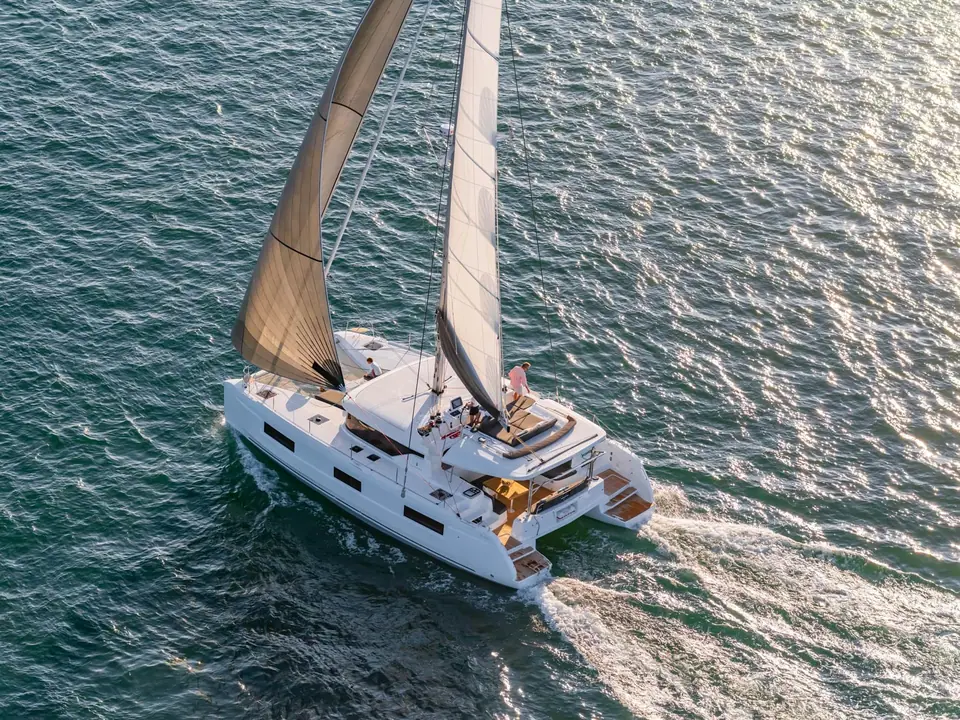
The helm station sits on the flybridge to starboard, with all halyards, sheets and reefing lines led back to winches within reach of the wheel. Owners coming from older Lagoons will notice that the bridge is larger and better protected, with a sunbathing area forward and enough seating for four or five people to stay with the skipper on passage.
Lagoon lowered the boom compared with the 450, which makes flaking the main and fitting the sail cover far less of a climb. The trade-off of a flybridge helm is visibility of the leeward bows in tight docking. Most buyers add a pair of bow cameras or simply learn to use the side decks as a sightline.
- All lines led to the flybridge helm
- Self-tacking jib on a track forward of the mast
- Square-top mainsail for more power aloft
- Electric primary winch is a near universal option
Saloon, cockpit and the forward cockpit
The aft cockpit is a single level with the saloon, divided by a large sliding glass door, so the whole main deck reads as one room in warm weather. There is a proper dining table to port, a lounge to starboard, and steps to both swim platforms.
A door at the front of the saloon opens to a forward cockpit with a sunpad and seating. On anchor this becomes the quietest spot on the boat, sheltered from the breeze funneling through the aft cockpit. The galley stays in the saloon on the 46 rather than moving to an aft position, which keeps the cook connected to the guests at the table.
Three cabin owner layout versus four cabin charter layout
Private buyers usually choose the three cabin owner's version, which dedicates the entire starboard hull to a master suite with a desk, sofa, generous storage and a large head with separate shower. Two guest doubles with their own heads share the port hull.
The four cabin version gives each corner its own double cabin and head, which is why it dominates charter fleets in the Caribbean, the Mediterranean and Southeast Asia. If you plan to put the boat into a charter management program, the four cabin boat is easier to fill and holds its resale value better in the ex-charter market.
How it sails
This is a comfortable, predictable cruising catamaran rather than a performance boat. In 12 to 15 knots of true wind it typically reaches at 8 to 9 knots, and with a code zero or gennaker on a broad reach double digit speeds are realistic. Close hauled it will point to around 50 degrees apparent, which is typical for a fixed keel production cat of this weight.
Because the jib is smaller than on the 450, light air performance upwind depends heavily on having a code zero aboard. Most private owners order one, and many charter boats do not, which is something to check when you compare listings.
Engines, tankage and systems
Standard power is a pair of 45 hp Yanmar diesels, with 57 hp versions available. The upgrade is worth having if you motor into chop often or plan long canal and coastal hops. At around 2,000 rpm on both engines expect roughly 7 to 8 knots while burning about 1.5 to 2 gallons per hour in total.
With 275 gallons of diesel and 159 gallons of water, the boat has enough range for island hopping, but a watermaker is close to essential for serious cruising with a full crew. Air conditioning requires a generator, and lithium battery banks combined with a solar arch have become the most popular refit on privately owned boats.
What it costs to own
Budget roughly 5 to 9 percent of the purchase price per year for insurance, berthing, maintenance and haul outs. Catamaran beam is the big variable: at nearly 26 feet wide, the Lagoon 46 needs a double slip or an end tie in most US marinas, and those can cost 50 to 100 percent more than a monohull berth of the same length.
On the other hand, two small diesels, no ballasted keel and a simple rig keep mechanical costs predictable. Antifouling, sail replacement roughly every eight to ten years of cruising, and the generator service schedule are the main recurring items.
Lagoon 46 specifications
| Length overall | 45.9 ft13.99 m |
|---|---|
| Waterline length | 45.5 ft13.87 m |
| Beam | 26.1 ft7.96 m |
| Draft | 4.4 ft1.35 m |
| Displacement | 34,767 lbs15,77 kg |
| Sail area | 1,507 sq ft140 m² |
| Fuel capacity | 275 gal1,04 L |
| Fresh water | 159 gal6 L |
| Cabins | 3 or 4 |
| Berths | 6 to 10 |
| Heads | 3 or 4 |
| Standard engines | 2 x Yanmar 45 hp diesel |
| Optional engines | 2 x Yanmar 57 hp diesel |
| Maximum power | 114 hp |
| Cruise speed | 8 knots |
| Hull type | Catamaran, twin hulls |
| Keel | Twin fixed fin keels |
| Rig | Fractional sloop with self-tacking jib, mast stepped aft |
| Hull construction | Vacuum-infused polyester and balsa sandwich |
| CE design category | A |
| Builder | Lagoon (Groupe Beneteau), France |
| Naval architect | VPLP Design |
| Other design credits | Patrick le Quément (exterior styling), Nauta Design (interior) |
| Production | 2019 to present |
| Status | In production |
Figures come from builder documentation and independent tests where available. Displacement is usually quoted light, so a loaded cruising boat will weigh more. Compare these specs with another model.
How much does a Lagoon 46 cost?
Sail-away prices for a new boat swing widely with the cabin count, generator, air conditioning, solar arch and electronics pack. Ex-charter four cabin boats leaving fleets after five years sit at the bottom of the used range, while privately owned three cabin boats with a lithium upgrade and low engine hours trade near the top.
Estimate your yearly cost
A planning estimate using common rules of thumb: insurance near 1.5 percent of value, maintenance near 3 percent, haul out and bottom paint by length. Your marina, region and use will move these numbers. Open the full cost calculator.
Lagoon 46 timeline
- 2014Lagoon 450 S and 450 F refresh, the boat the 46 would eventually replace
- 2019Lagoon 46 launched with an aft-stepped mast and self-tacking jib
- 2021Strong demand from charter fleets, production slots booked well ahead
- 2024Still a core model in the Lagoon range as the first ex-charter boats reach the brokerage market
Strengths and weaknesses
What owners like
- Self-tacking jib and aft mast make short-handed sailing simple
- Huge, single-level living space from aft cockpit through to the forward cockpit
- Excellent three cabin owner's layout
- Strong charter demand supports resale values
- Large dealer and service network worldwide
What to weigh up
- Flybridge helm limits visibility when docking
- Light air upwind performance needs a code zero
- Beam makes marina berths expensive and scarce
- Ex-charter boats can show heavy wear in high traffic areas
Used Lagoon 46 buyer checklist
Take this list to a viewing. Your ticks are saved in this browser so you can come back to it.
Always commission an independent marine survey and an engine survey before you buy. How a marine survey works.
Rivals to consider
Leopard 45
Has a forward cockpit with direct saloon access and a slightly lighter feel at the helm, but a lower flybridge.
Compare side by sideFountaine Pajot Elba 45
More performance oriented hulls and a more modern interior style, with a smaller flybridge.
Compare side by sideBali 4.6
Replaces the trampoline with a solid foredeck lounge and offers more interior volume for the length.
Compare side by sideOur verdict on the Lagoon 46
The Lagoon 46 is the safest choice in the 45 to 47 foot catamaran class. It is easy to sail with two people, spacious enough for guests, and liquid on the resale market. Buyers who want more speed should look at the Fountaine Pajot or Outremer ranges, but for comfortable long range cruising with predictable costs it is very hard to beat.
Lagoon 46 questions answered
How much does a Lagoon 46 cost?
A new Lagoon 46 typically sails away between about $900,000 and $1.25 million depending on cabin count and options. Used boats from 2019 onward generally list between roughly $620,000 and $950,000.
Is the Lagoon 46 a bluewater catamaran?
It carries a CE Category A rating and many owners have crossed the Atlantic and Pacific in one. Like any production catamaran it needs careful preparation, a watermaker and conservative reefing before an ocean passage.
What replaced the Lagoon 450?
The Lagoon 46 replaced the Lagoon 450 in 2019. It keeps a similar size but moves the mast aft and adds a self-tacking jib.
How many cabins does a Lagoon 46 have?
It is offered with three cabins in the owner's version or four cabins in the charter version, each with its own head.
How fast is the Lagoon 46 under sail?
Expect 8 to 9 knots reaching in moderate breeze and low double digits with a gennaker or code zero downwind.
Lagoon 46 photos
More sailing catamarans to explore
Lagoon 450
Sailing Catamarans, 46 ft
Used $250K to $580K
Catana 47
Sailing Catamarans, 46 ft
Used $450K to $720K
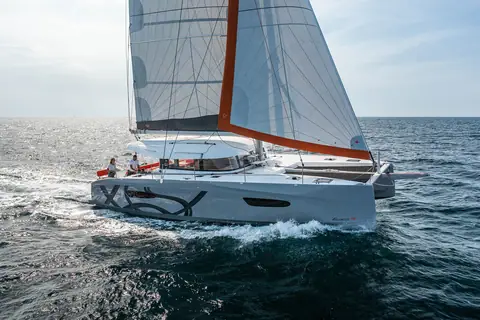
Excess 14
Sailing Catamarans, 46 ft
Used $540K to $800K
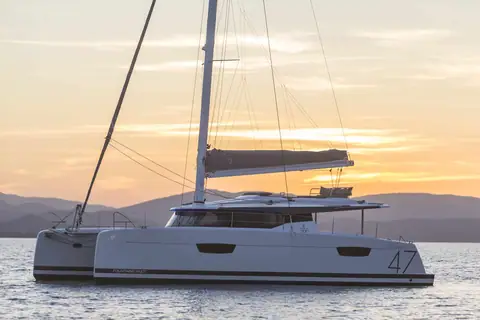
Fountaine Pajot Saona 47
Sailing Catamarans, 46 ft
Used $560K to $800K