Excess Catamarans Sailing Catamarans
Excess 11 Catamaran Review, Prices and Buying Advice
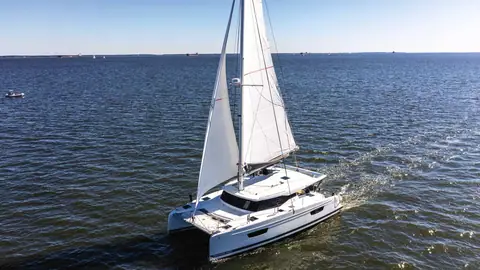
A clean-sheet 37-foot VPLP cat with tiller-like helms at the transoms, which beat a dozen bigger boats to Cruising World's 2021 top prize.
- Length
- 37.5 ft11.42 m
- Beam
- 21.6 ft6.59 m
- Draft
- 3.8 ft1.15 m
- Cabins
- 3 or 4
- Used price
- $340K to $560K
On this page
- Overview
- The Excess 11 catamaran that out-sailed bigger boats
- New tooling rather than a reworked Lagoon
- Self-tacking jib or overlapping genoa: two sail plans to know
- Steering from the transoms with Dyneema cables
- An owner's hull in a 37-foot cat
- Measured speeds on the Chesapeake
- Hybrid drive, Riders' Edition and a recyclable-resin hull
- Excess 11 for sale: what to pay and where value lies
- Specifications
- Price and value
- Strengths and weaknesses
- Used buyer checklist
- Rivals
- Our verdict
- FAQ
The Excess 11 is the 37 ft entry model of Groupe Beneteau's sail-first catamaran brand, launched in 2020. 19,845 lb light, twin aft helms, 3 or 4 cabins, diesel or hybrid power and an optional Pulse Line rig.
- Couples moving from a monohull to a cat
- Short-handed coastal and island cruising
- Buyers who want to steer rather than watch the autopilot
- Budget-conscious first catamaran owners
The Excess 11 catamaran that out-sailed bigger boats
When Cruising World's judges tested a dozen new boats for 2021, from million-dollar semicustom cruisers to big production monohulls, the overall winner was a 37 foot catamaran. The judges said no other nominee used space as well as the Excess 11, that only one boat in the fleet was cheaper, and that relative to its waterline none sailed better. Judge Mark Pillsbury compared the parent brand's Lagoons to a solid Buick and said the Excess actually lets you feel the wind and hear the water.
That verdict explains the whole concept. The Excess 11 catamaran is the entry point to Groupe Beneteau's Excess brand, built in Bordeaux and designed by VPLP for sailors who want catamaran living space without the condo-on-pontoons feel. It premiered at boot Dusseldorf in January 2020 and remains the best seller of a range that now also includes the Excess 13 and 14.
Excess 11 by the numbers
- Sail area to displacement
- 21.2Plenty of sail for the weight, the boat should feel lively in light air.
- Displacement to length
- 186Light displacement for its length, quick but sensitive to added cruising weight.
- Theoretical hull speed
- 8.1 knDisplacement hull speed for the waterline. Light catamarans regularly sail faster than this because their slim hulls do not make a large bow wave.
- Length to beam ratio
- 1.74 : 1Catamaran overall proportions. Wider platforms resist pitching and heel.
New tooling rather than a reworked Lagoon
The first two Excess models, the 12 and 15, were sportier derivatives of the Lagoon 40 and Lagoon 50 that shared their bridgedecks and inner hulls. The 11 was the first Excess drawn from scratch. SAIL describes twin chines running aft to add interior volume, a lower and sleeker profile than its siblings and a hard bimini with an unrounded edge chosen to save weight. Construction is three vacuum-infused sections with balsa coring in the deck and topsides.
Underneath, the keels are molded into the hull, filled with foam, capped and infused, with reinforced shoes that let the boat sit on its keels. They are engineered to break away in a severe side impact without compromising the hull's watertight integrity, so there are no keel bolts to worry about. Light displacement is 9,000 kg, or 19,845 pounds, which gives a displacement to length ratio of 187 according to SAIL.
Self-tacking jib or overlapping genoa: two sail plans to know
Early boats were sold with a square-top main and a self-tacking jib, about 829 square feet upwind on SAIL's test boat, with a 57 foot Z-Spar rig. In 2025 Excess introduced an overlapping genoa to give the boat more drive and feel, and the builder's current figures show a 57.5 square meter (619 sq ft) mainsail, a 32.5 square meter (350 sq ft) genoa and 90 square meters (969 sq ft) upwind. The Pulse Line package adds about 3 feet of mast and raises upwind area to 95.5 square meters (1,028 sq ft), and a 54 square meter Code 0 is optional on both.
For buyers, the jib type is a meaningful difference. The self-tacker makes the boat almost effortless for a couple, and testers praised it. The genoa boats are quicker in light air and point a little better, at the cost of grinding a sheet on every tack. Mast clearance is listed at 56 feet 8 inches, comfortably under the 65 foot bridges of the Intracoastal Waterway.
- LOA 37 ft 6 in (11.42 m), hull length 37 ft 2 in, beam 21 ft 7 in, draft 3 ft 9 in
- Light displacement 19,845 lb (9,000 kg)
- Fuel 2 x 200 L (106 US gal), water 300 L (79 US gal), black water 160 L
- CE category A for 8, B for 12, C for 16 people
Steering from the transoms with Dyneema cables
Like every Excess, the 11 has two wheels at the aft ends of the hulls and no flybridge. Each has a fold-up double seat, engine controls can be fitted to both sides, and the steering runs on short Dyneema cables rather than hydraulics, so the helm is light and tells you how the sails are balanced. The pleasant surprise for SAIL's tester was visibility: clear, untinted saloon glass lets you see through the cabin to the opposite bow, which many outboard-helm cats do not allow.
Testers did list small irritations. The optional accordion sunroof cannot be stood on, which makes stowing reefing lines in the lazy bag awkward, the hardtop nonskid stops short of slippery edges, and the anchor deploys from the forward crossbeam, which keeps chain off the hulls but carries weight well forward.
An owner's hull in a 37-foot cat
The Excess 11 comes in three or four-cabin versions, both with two heads. In the owner's layout the starboard hull becomes a suite with a large aft berth, about 2 by 2 meters according to the builder, cutaway corners so the bed is easy to make and get out of, and a big forward bathroom with a separate shower. The port hull has double cabins fore and aft sharing one large head and shower, which SAIL rightly preferred to two tiny wet heads.
The saloon and galley are compact but complete: an L-shaped settee forward, a real navigation station, an L-shaped galley with oven, two-burner hob and front-opening fridge. Every cabin gets a hull window with an opening port and a deck hatch. Cruising World's judges noted the forward tramps, effective cockpit and good galley as proof that nothing essential had been left out at this size.
Measured speeds on the Chesapeake
SAIL sailed the boat on Chesapeake Bay in 15 to 20 knots of true wind and flat water. At 70 degrees apparent in 15 knots the boat made 8 knots, carried speed well through tacks, and picked up about another knot with the Code 0 unrolled, peaking near 10 knots in gusts. Owners quoted by the builder say they sail faster than they motor from about 7 knots of apparent wind.
Under power the twin 29 hp Yanmars, set wide apart on a 21 foot 7 inch beam, gave 6.8 knots at wide open throttle and 3,100 rpm and a more economical 5.9 knots at 2,500 rpm, and the boat can walk sideways when needed. Those are modest numbers, so anyone planning long motoring legs should consider the hybrid or keep a close eye on the 106 gallon fuel supply.
Hybrid drive, Riders' Edition and a recyclable-resin hull
From summer 2025 Excess has offered the 11 with hybrid propulsion: two 10 kW electric pods, a 22 kVA generator, an 8 kVA charger-inverter and two lithium banks. The builder says the batteries give 2 to 5 hours of electric running, longer at reduced power, with the generator taking over for range. Cruising World noted the same system was planned for the Excess 13.
The Riders' Edition is an equipment pack aimed at wingfoilers, mountain bikers and anglers, with dedicated stowage for outdoor gear. In 2026 Excess also announced an Excess 11 built with recyclable Elium resin and recycled glass fiber, which it calls a first for a series-production catamaran. Expect these versions to carry a premium and to be rare on the brokerage market for several years.
Excess 11 for sale: what to pay and where value lies
SAIL listed its 2020 test boat at $450,000 as tested. New pricing has risen since, and we estimate $500,000 to $680,000 sail-away in the US depending on rig, cabins and hybrid power. Used Excess 11s from 2020 to 2024 generally ask between about $340,000 and $560,000, with charter-fleet four-cabin boats at the low end and privately owned three-cabin Pulse Line boats at the top.
Running costs are moderate for a cat this size: twin small diesels, saildrive service, rigging checks and a catamaran slip for a 21 foot 7 inch beam. Allow $22,000 to $40,000 a year depending on where you keep it. Because the 11 is in production with a strong dealer network, parts and know-how are easy to find.
Excess 11 specifications
| Length overall | 37.5 ft11.42 m |
|---|---|
| Waterline length | 36.3 ft11.05 m |
| Beam | 21.6 ft6.59 m |
| Draft | 3.8 ft1.15 m |
| Air draft | 56.7 ft17.27 m |
| Displacement | 19,845 lbs9, kg |
| Sail area | 969 sq ft90 m² |
| Fuel capacity | 106 gal4 L |
| Fresh water | 79 gal3 L |
| Cabins | 3 or 4 |
| Berths | 6 to 12 |
| Heads | 2 |
| Maximum persons | 8 |
| Standard engines | 2 x 29 hp Yanmar diesels with saildrives |
| Optional engines | Hybrid: 2 x 10 kW electric pods with a 22 kVA generator and lithium banks |
| Maximum power | 58 hp |
| Cruise speed | 5.9 knots |
| Top speed | 6.8 knots |
| Hull type | Catamaran with twin chines, flared topsides and raised bridgedeck |
| Keel | Twin low-aspect molded keels, foam-filled and designed to fail without breaching the hull |
| Rig | Fractional sloop, square-top main with overlapping genoa (self-tacking jib on earlier boats); Pulse Line taller rig optional |
| Hull construction | Vacuum-infused polyester with balsa core above the waterline |
| CE design category | A |
| Builder | Excess Catamarans (Construction Navale Bordeaux, Groupe Beneteau), France |
| Naval architect | VPLP Design |
| Other design credits | Patrick Le Quement (exterior styling), Nauta Design (interior) |
| Production | 2020 to present |
| Status | In production |
Figures come from builder documentation and independent tests where available. Displacement is usually quoted light, so a loaded cruising boat will weigh more. Compare these specs with another model.
How much does a Excess 11 cost?
SAIL's 2020 test boat was priced at $450,000 as tested, and Cruising World called it the second-least-expensive boat in its 2021 contest. Current US sail-away prices are higher after several years of inflation, with the hybrid package, Pulse Line rig and four-cabin charter fit-out moving boats to the top of the range. Early self-tacking-jib boats sell at a discount to the 2025 and later overlapping-genoa boats.
Estimate your yearly cost
A planning estimate using common rules of thumb: insurance near 1.5 percent of value, maintenance near 3 percent, haul out and bottom paint by length. Your marina, region and use will move these numbers. Open the full cost calculator.
Versions and options
- Standard rig, self-tacking jib (2020 to 2024)
- Square-top main and self-tacking jib, about 829 sq ft upwind on SAIL's test boat.
- Overlapping genoa (2025 on)
- Main 619 sq ft plus 350 sq ft genoa for 969 sq ft upwind.
- Pulse Line
- About 3 ft taller mast, 1,028 sq ft upwind with the genoa sail plan.
- Hybrid
- Twin 10 kW electric pods, 22 kVA generator and lithium storage in place of the diesels.
- Riders' Edition
- Outdoor-sports equipment pack with gear stowage for foils, bikes and fishing kit.
Excess 11 timeline
- 2020World premiere at boot Dusseldorf in January; SAIL test in December
- 2021Named Cruising World Overall Boat of the Year
- 2025Overlapping genoa option and hybrid propulsion introduced
- 2026Version with recyclable Elium resin and recycled glass fiber announced
Strengths and weaknesses
What owners like
- Clean-sheet VPLP hull with twin chines and good volume
- Light, direct Dyneema cable steering from aft helms
- Good visibility through untinted saloon glass to the far bow
- Genuine owner's hull layout in 37 feet
- 56 ft 8 in mast clearance fits under ICW bridges
- Hybrid and Pulse Line options for different priorities
What to weigh up
- Only 79 gallons of fresh water
- Modest motoring speed of about 6 knots at cruise
- Engine service points are hard to reach
- Slippery hardtop edges and short handrails
- Anchor weight carried far forward on the crossbeam
Used Excess 11 buyer checklist
Take this list to a viewing. Your ticks are saved in this browser so you can come back to it.
Always commission an independent marine survey and an engine survey before you buy. How a marine survey works.
Rivals to consider
Lagoon 40
Its Beneteau group sibling, roomier with a flybridge, slower and less engaging to steer.
Compare side by sideBali 4.0
Huge open-plan volume and a forward cockpit, a lifestyle cat rather than a sailor's boat.
Compare side by sideFountaine Pajot Isla 40
Popular charter and private cruiser with a bulkhead helm and more interior space.
Compare side by sideNautitech 40 Open
The closest concept with aft helms and a sporty brief, slightly longer and dearer.
Our verdict on the Excess 11
The Excess 11 is the most convincing argument yet that a small production catamaran can be fun to sail. It gives up some volume, fresh water and motoring speed against boxier rivals, and early boats have a few unpolished details on deck. In exchange you get direct steering, a light clean-sheet hull, a proper owner's hull and the option of hybrid power. If you are a monohull sailor who has resisted cats because they feel like driving a building, start your search here.
Excess 11 questions answered
How long is the Excess 11 catamaran?
It is 37 ft 6 in (11.42 m) overall with a 37 ft 2 in hull, 21 ft 7 in beam and 3 ft 9 in draft.
What does an Excess 11 cost?
SAIL's 2020 test boat was $450,000 as tested; we estimate new US prices of about $500,000 to $680,000 today and used boats from about $340,000.
Is there a hybrid Excess 11?
Yes. Since 2025 it can be ordered with two 10 kW electric pods, a 22 kVA generator and lithium batteries.
How fast is the Excess 11?
SAIL saw 8 knots at 70 degrees apparent in 15 knots of wind and about 9 to 10 knots with the Code 0. Under diesel power it made 6.8 knots flat out.
How many cabins does the Excess 11 have?
Three or four cabins, always with two heads; the three-cabin version dedicates the starboard hull to an owner's suite.
Who designed the Excess 11?
VPLP drew the hull, Patrick Le Quement styled the exterior and Nauta Design did the interior.
More sailing catamarans to explore
Lagoon 380
Sailing Catamarans, 38 ft
Used $150K to $310K
Lagoon 40
Sailing Catamarans, 39 ft
Used $280K to $490K
Broadblue 385
Sailing Catamarans, 39 ft
Used $150K to $330K
Fountaine Pajot Isla 40
Sailing Catamarans, 39 ft
Used $360K to $560K