Broadblue Catamarans Sailing Catamarans
Broadblue 385 Buyer's Guide, the British Bluewater Cat Since 2005
A 38-foot 8-inch Category A cruising catamaran with beachable keels, glass windows, sealed flotation compartments and a choice of two very different rigs.
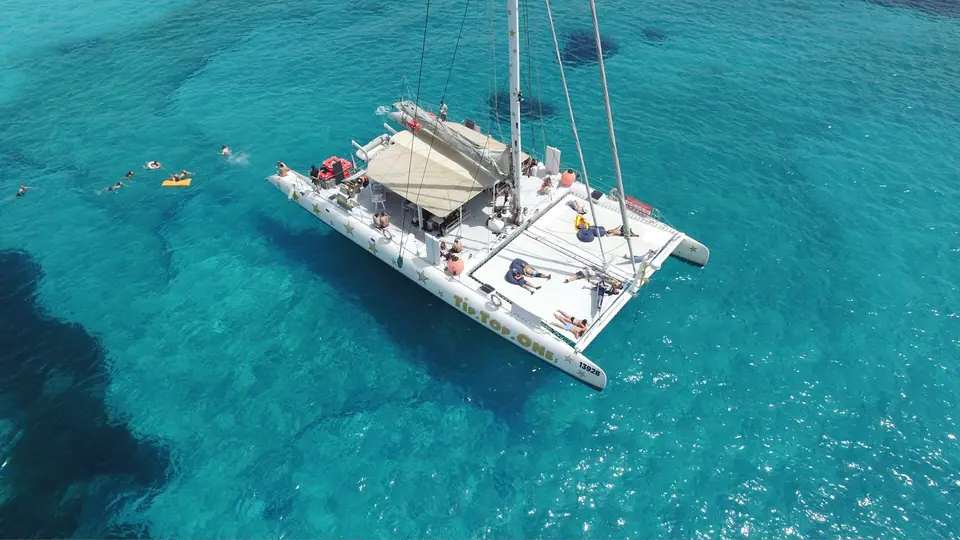
- Length
- 38.7 ft11.78 m
- Beam
- 19.6 ft5.98 m
- Draft
- 3.4 ft1.05 m
- Cabins
- 3 doubles, or 2 doubles in the owner's version
- Used price
- $150K to $330K
On this page
- Overview
- Broadblue 385, the boat that made the brand
- Original, MkII, Voyager 385 and S3
- Aft Rig or Sport Rig, the choice that defines the boat
- Flotation compartments, glass windows and beachable keels
- Galley forward, owner's office and a lot of storage
- A raised helm and a clear foredeck
- Running costs and who the 385 suits
- Specifications
- Price and value
- Strengths and weaknesses
- Used buyer checklist
- Rivals
- Our verdict
- FAQ
The Broadblue 385 is a 38-foot British cruising catamaran first built in 2005, with Polish-built hulls finished in the UK. Updated as the MkII, Voyager 385 and 385 S3, it remains Broadblue's best-known model.
- Couples planning ocean passages or the ARC
- Bahamas and tidal cruising where drying out is useful
- Buyers who want a cat that was never in charter
- Liveaboards who value storage over saloon volume
Broadblue 385 by the numbers
- Sail area to displacement
- 20.0Plenty of sail for the weight, the boat should feel lively in light air.
- Displacement to length
- 151Light displacement for its length, quick but sensitive to added cruising weight.
- Theoretical hull speed
- 8.0 knDisplacement hull speed for the waterline. Light catamarans regularly sail faster than this because their slim hulls do not make a large bow wave.
- Length to beam ratio
- 1.97 : 1Catamaran overall proportions. Wider platforms resist pitching and heel.
Broadblue 385, the boat that made the brand
When people search for a Broadblue 385 for sale, they are usually looking at one of the most widely traveled British cruising catamarans of the past two decades. Broadblue Catamarans was founded in 2001, and the 385 appeared in 2005, the year Yachting Monthly tested it and quoted a UK price of 166,000 to 178,000 pounds. Broadblue later called it its best-selling model, in active service worldwide, and in 2026 it still sits in the company's cruising range beside the 346 and 425.
The 385 was drawn for couples who want to cruise offshore and to cope with the weather around Britain, not for the charter fleets that shaped most cats of its era. Sailboatdata notes it as an updated version of the Prout 38, and the long bridgedeck, sturdy keels and conservative rig all echo that British multihull tradition. Hulls were molded in Poland and finished in the UK.
It reached the US early. In 2007 it was shown at the Miami Boat Show, Broadblue had a US distributor, and Cruising World reviewed it twice and quoted a price of $356,000. That is why a handful of 385s turn up in American and Caribbean listings today.
Original, MkII, Voyager 385 and S3
The 385 has been updated several times without changing its basic shape, and listing titles are not always precise. Here is how to read them.
Early boats from 2005 to about 2008 measure 11.78 meters (38 feet 8 inches) with twin 20 hp Volvo saildrives and the choice of Aft Rig or Sport Rig. Around 2011 Broadblue was marketing the Voyager 385, a new series that incorporated owner feedback and listed twin 30 hp diesels. Brokers often call boats of this period the MkII; one 2011 MkII owner's version on the market today measures 11.95 meters and runs twin Yanmar 3JH5E engines of 38 hp. By 2016 the model had become the 385 S3, specified at 11.96 meters with three double cabins, two heads, twin 20 hp saildrive diesels, an aft-stepped mast and a bowsprit, and Broadblue's 2019 site referred to it as the 385S3.
Beam, draft and displacement stayed essentially constant at 5.98 meters, 1.05 meters and 7,000 kilograms throughout, so the differences are in rig, engines and interior detail, while later boats are quoted at 11.95 to 11.96 meters overall.
Aft Rig or Sport Rig, the choice that defines the boat
Broadblue offered two sail plans. The Aft Rig steps the mast farther aft and pairs a small, high-aspect mainsail of about 304 square feet with a large genoa of about 534 square feet. It is easy for a couple to handle, needs reefing later, and keeps all lines led to the cockpit. The Sport Rig uses a much bigger, full-battened roachy main of about 644 square feet with a smaller headsail of 327 square feet, which gives more drive and better upwind performance.
Cruising World's Dave Reed saw 7 knots in only 7 knots of true wind on a beam reach with the Aft Rig and found the boat tacked through about 80 degrees apparent without fuss. His fellow tester Andrew Burton found the Aft Rig boat underpowered in very light air. The owner Reed spoke to, who was logging more than 8,000 miles a year and preparing for the 2008 ARC, said he would choose the Sport Rig next time for its windward ability. Our take: the Aft Rig suits short-handed coastal cruisers; serious passagemakers should look for a Sport Rig boat or one with a good gennaker.
Flotation compartments, glass windows and beachable keels
Broadblue built the 385 to EU Category A (Ocean) standards and made a point of the details. Below the waterline the hulls are solid laminate, about half an inch to 1.25 inches thick, with Kevlar reinforcement in high-load areas; above it the hulls and deck are cored with end-grain balsa, with plywood reinforcement under hardware. Cruising World counted five bulkheads and six sealed flotation compartments, and the windows are hardened glass in aluminum frames rather than acrylic.
The keels are molded integrally with the hulls and sealed off, so they act as crash boxes in a grounding, and each has a stainless steel shoe. The skeg-hung rudders are the same depth as the keels, which means the boat can sit on a beach for a bottom scrub or dry out on a tidal mooring, a big advantage in the Bahamas or anywhere a yard cannot haul a 20-foot-wide cat. Draft is only 3 feet 5 inches.
The trade-off is the long bridgedeck. It creates useful storage underneath, but with about 30 inches of clearance forward, Cruising World found it more prone to slamming than designs with a trampoline forward, especially crossing powerboat wakes.
Galley forward, owner's office and a lot of storage
The saloon is compact for a catamaran but light, with a U-shaped dinette seating six, a galley forward to port with a view out through the windows, and a nav station aft. Counter space is limited, a fair criticism from Cruising World, but the open layout makes the space feel bigger than it is.
Two hull layouts were offered. The three-cabin version has two doubles in the starboard hull and an owner's or guest double to port, with two heads. The owner's version gives each hull a large aft double with big hanging lockers; the port hull adds an office desk amidships and a large head with a separate shower forward, while the starboard hull can hold an extra refrigerator or freezer, space for a small washer-dryer, and a workbench where the second shower would be. Long-distance cruisers love that version, and brokers describe it as the sought-after one.
A raised helm and a clear foredeck
The helm seat is raised on the port side of the cockpit with good visibility and sail and engine controls within reach. An optional fiberglass bimini with roll-up clear panels forward gives shelter, and many boats in northern waters have one. The side decks are wide and uncluttered, a centerline step at the front of the coachroof eases access to the mast, and the solid foredeck extends most of the way to the bows with a centerline anchor and windlass.
Air draft is about 61 feet on the original specification, which clears the 65-foot fixed bridges of the US Intracoastal Waterway with little margin once masthead antennas and lights are added, so measure the actual boat before planning an ICW trip.
Running costs and who the 385 suits
Twin small diesels on saildrives keep fuel costs low, and Cruising World found the saildrive installation relatively quiet. Saildrive seals and diaphragms need periodic replacement, and on older boats the original Volvo units are now 20 years old. Budget roughly $15,000 to $32,000 a year in the US for a slip or mooring, insurance, haul-outs, engine and saildrive service and sail replacement, with marina costs the biggest variable because of the 19-foot 7-inch beam.
The 385 suits sailors who prize seakeeping and the ability to carry stores for long passages over outright speed. It is a better choice than a former charter cat for an ocean crossing, and a cheaper one than most newer cats of its size, but buyers who want big open-plan volume and fast passages will find more of both in a modern Lagoon or Leopard.
Broadblue 385 specifications
| Length overall | 38.7 ft11.78 m |
|---|---|
| Waterline length | 35.8 ft10.9 m |
| Beam | 19.6 ft5.98 m |
| Draft | 3.4 ft1.05 m |
| Air draft | 61 ft18.59 m |
| Displacement | 15,432 lbs7, kg |
| Sail area | 776 sq ft72.1 m² |
| Fuel capacity | 124 gal47 L |
| Fresh water | 125 gal475 L |
| Cabins | 3 doubles, or 2 doubles in the owner's version |
| Berths | 6 in doubles, plus pilot berths in the two-cabin layout |
| Heads | 2 with showers |
| Standard engines | 2 x 20 hp Volvo diesels with saildrives (early boats); 2 x 20 hp diesels with saildrives (385 S3) |
| Optional engines | 2 x 30 hp diesels on the Voyager 385; some boats have twin Yanmar 3JH5E 38 hp |
| Maximum power | 76 hp |
| Hull type | Cruising catamaran with long bridgedeck and integral keels |
| Keel | Twin integral low-aspect keels with stainless shoes, skeg-hung rudders of equal depth (beachable) |
| Rig | Fractional sloop, offered as the Aft Rig (small main, large genoa) or the Sport Rig (large roach main) |
| Hull construction | Solid GRP with Kevlar reinforcement below the waterline, end-grain balsa cored hull sides and deck |
| CE design category | A |
| Builder | Broadblue Catamarans (hulls built in Poland), United Kingdom |
| Naval architect | Stuart Davidsen (Broadblue's credited designer); Robert Underwood also credited on early boats |
| Other design credits | Developed from the Prout 38 lineage according to sailboatdata |
| Production | 2005 to present |
| Status | In production |
Figures come from builder documentation and independent tests where available. Displacement is usually quoted light, so a loaded cruising boat will weigh more. Compare these specs with another model.
How much does a Broadblue 385 cost?
Cruising World quoted a US price of $356,000 in 2007, when Broadblue had a US distributor. Broadblue's own brokerage has listed a 2005 boat at 179,950 pounds and a 2006 boat at 159,950 pounds, and Multihull World has a 2011 MkII owner's version in St. Maarten at $229,950. Rig type, engine upgrades, the owner's layout and a fiberglass bimini move prices; new boats are quoted on request.
Estimate your yearly cost
A planning estimate using common rules of thumb: insurance near 1.5 percent of value, maintenance near 3 percent, haul out and bottom paint by length. Your marina, region and use will move these numbers. Open the full cost calculator.
Versions and options
- Broadblue 385 (2005 to about 2008)
- 11.78 m LOA, twin 20 hp Volvo saildrives, Aft Rig or Sport Rig, three-cabin or owner's layout.
- Voyager 385 and MkII (about 2009 to 2012)
- New series based on owner feedback, marketed with twin 30 hp diesels; some boats fitted with Yanmar 3JH5E 38 hp. Quoted at 11.95 m by brokers.
- Broadblue 385 S3 (2016 on)
- 11.96 m LOA, three double cabins and two heads, twin 20 hp saildrive diesels, aft-stepped fractional rig with bowsprit, 2 x 225 L fuel.
Broadblue 385 timeline
- 2001Broadblue Catamarans founded in the UK
- 2005Broadblue 385 introduced and tested by Yachting Monthly
- 2007385 exhibited at the Miami Boat Show and reviewed by Cruising World, priced at $356,000
- 2009Broadblue revived by Mark Elliot and Mark Jarvis, who buy the tooling for the 385 and 42; 385 production stays in Poland
- 2016385 S3 listed with three double cabins and twin 20 hp saildrives
Strengths and weaknesses
What owners like
- Category A build with sealed flotation compartments and glass windows
- Beachable integral keels and only 3 foot 5 inch draft
- Owner's layout with office and workshop space is ideal for long-term cruising
- Two rig options to suit short-handed or performance-minded crews
- Low running costs with small twin diesels
- Proven on ocean passages including ARC crossings
What to weigh up
- Long bridgedeck with modest clearance slams in short seas and wakes
- Aft Rig boats are underpowered in light air
- Compact saloon and limited galley counter space
- Generations and specifications vary, complicating comparisons
- Small dealer network in North America
Used Broadblue 385 buyer checklist
Take this list to a viewing. Your ticks are saved in this browser so you can come back to it.
Always commission an independent marine survey and an engine survey before you buy. How a marine survey works.
Rivals to consider
Lagoon 380
The best-selling charter-era rival with more saloon volume and a bigger used market, but lighter build and no beachable keels.
Compare side by sideLeopard 38
A South African-built cat with more interior space and a forward cockpit, popular in charter fleets.
Fountaine Pajot Athena 38
A 1990s French cat with similar size and plenty of charter history, usually cheaper but more worn.
Broadblue 346
Broadblue's smaller sister, narrow enough for the French canals, with a galley up and a lower price.
Compare side by sideOur verdict on the Broadblue 385
The Broadblue 385 is a sensible, seaworthy British catamaran that has quietly crossed oceans for two decades. Its sealed flotation compartments, glass windows, beachable keels and owner-friendly layouts make it a stronger bluewater proposition than many charter-derived cats of the same size, while its long bridgedeck, compact saloon and modest light-air speed with the Aft Rig keep it from being the obvious choice for everyone. Pick the generation and rig that match your plans, survey the keels and deck core carefully, and a 385 is a lot of offshore cat for the money.
Broadblue 385 questions answered
How much is a Broadblue 385 for sale?
Recent listings range from about 159,950 pounds for a 2006 boat to $229,950 for a 2011 MkII. Expect roughly $150,000 to $330,000 depending on year, generation and equipment.
What is the difference between the Broadblue 385 Aft Rig and Sport Rig?
The Aft Rig uses a small main of about 304 square feet and a big genoa for easy handling, while the Sport Rig has a large roach main of about 644 square feet and a smaller headsail for more power and better windward performance.
Can a Broadblue 385 be beached?
Yes. The integral keels have stainless shoes and the skeg-hung rudders are the same depth, so the boat can sit on a beach or dry out on a tidal mooring.
Where is the Broadblue 385 built?
The hulls are built in Poland and finished in the UK, according to Cruising World and Broadblue.
How many cabins does the Broadblue 385 have?
Three double cabins with two heads, or an owner's version with two large doubles, an office area and extra storage.
Who designed the Broadblue 385?
Broadblue credits Stuart Davidsen, and early reviews also name Robert Underwood. Sailboatdata describes it as an updated version of the Prout 38.
More sailing catamarans to explore
Lagoon 40
Sailing Catamarans, 39 ft
Used $280K to $490K
Fountaine Pajot Isla 40
Sailing Catamarans, 39 ft
Used $360K to $560K
Bali 4.0
Sailing Catamarans, 39 ft
Used $260K to $380K
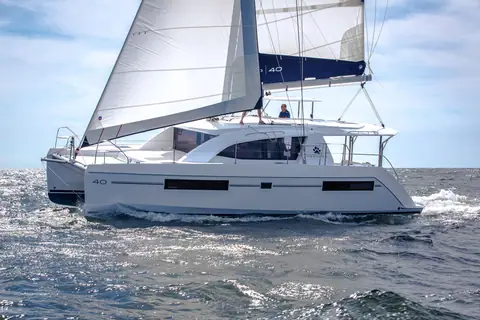
Leopard 40
Sailing Catamarans, 39 ft
Used $250K to $400K