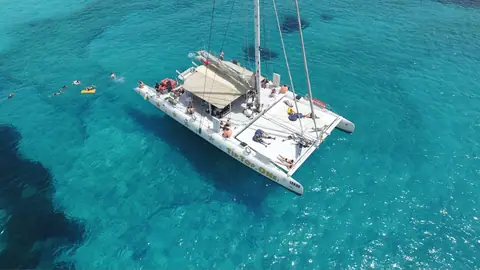
Broadblue 346
Sailing Catamarans, 34 ft
Used $240K to $360K
An Emsworth-based British brand building couple-friendly cruising catamarans in Poland, rescued from receivership in 2009.
Sailing Catamarans, 34 ft
Used $240K to $360K
Sailing Catamarans, 39 ft
Used $150K to $330K
Broadblue Catamarans was founded in 2001 and revived in 2009 by Mark Elliot and Mark Jarvis. Its best-known boats are the 38-foot Broadblue 385 and the canal-friendly 346, both built in Poland.
Broadblue began in 2001, when Mark Elliot put money from his furniture business into a catamaran yard. Growth was quick. By February 2007, when a private equity firm took a substantial stake, the company called itself the largest catamaran design and build firm in the UK, with Robert Underwood, Elliot and Stuart Davidsen on its board, plants in Britain and Poland, and a 385 heading to the Miami Boat Show to court American buyers.
The expansion did not last. A larger Broadblue 42 was farmed out to the Hillyard yard, which was also meant to develop a 50-footer that never left the drawing board. By early 2009 Hillyard had failed and Broadblue was in the hands of receivers. That spring Elliot returned with a new partner, Mark Jarvis of the Emsworth multihull brokerage Multihull World, and bought the trademark, the rights and the tooling for the 385 and 42. Sales moved to Emsworth, and the Ipswich office closed. Jarvis, who now serves as production director, told Yachting Monthly the lesson was that buyers wanted smaller catamarans than the industry liked to build.
Broadblue boats carry the habits of the old English multihull school, the one that produced Prout and Catalac: modest size, keels shallow enough to dry out on a beach or tidal mooring, real glass windows, a steering position the skipper can use without a flybridge and interiors suited to a couple living aboard. The 385 has always been built in Poland, and the smaller boat moved there from China when it became the 346.
We cover two models. The Broadblue 385 arrived in 2005 and became the company's best seller, updated over the years as the Voyager 385, the boat brokers call the MkII, and the 385 S3, with a choice of two rig layouts. The Broadblue 346 followed in 2018 as a reworked version of a design that began as the Voyager 10 in 2007 and was then sold as the Broadblue 345. Its beam keeps it inside the width limit of the French canals and lets it use monohull-sized berths.
In 2026 the cruising line lists the 346, the 385 and the 425, a long-range family cruiser introduced in early 2023. A separate performance line carries the Rapier name, with the Rapier 400 and Rapier 550. Earlier boats such as the 42 and the 435 appear on the used market but are rarer than the 385.
Broadblue is a niche brand in the US. A US distributor handled sales around 2007, and a few 385s came over then, but most boats today are in the UK, Europe and the Mediterranean, sold through the Emsworth office and Multihull World. That makes importing the normal route, so add shipping or a delivery passage, duty, survey travel and any 60 Hz conversion to the price.
The upside is value. We see used 385s from about $150,000 to $330,000 and 346s from about $240,000 to $360,000, well below a comparable new cat. Resale is steady among multihull sailors who know the brand but slower than for a Lagoon or Leopard, so buy well. Engines are Beta, Volvo or Yanmar units that any US yard can service.
The company is based in Emsworth, England, and its cruising catamarans are built in Poland.
Yes. After a 2009 rescue from receivership it continues to build the 346, 385 and 425, plus Rapier performance cats.
Yes, but most boats are in Europe, so expect to import one and budget for shipping, duty and electrical changes.
The 385 suits offshore cruising couples; the smaller 346 fits canals, shallow bays and tighter budgets.
Official website: broadblue.co.uk. Yatch US is independent and not affiliated with Broadblue Catamarans.