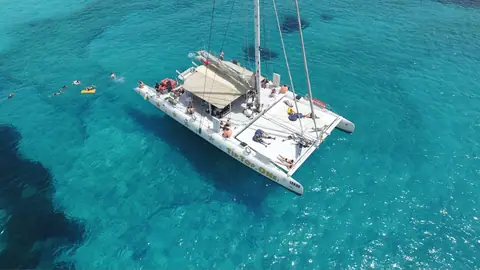
Catalac 8M
Sailing Catamarans, 27 ft
Used $18K to $42K
Discontinued British cruising catamarans with chined, keelless hulls, built at Tom Lack's Dorset yard and still sailed decades later.
Sailing Catamarans, 27 ft
Used $18K to $42K
Sailing Catamarans, 30 ft
Used $28K to $55K
Sailing Catamarans, 34 ft
Used $55K to $100K
Catalac catamarans were built by Tom Lack Catamarans at Christchurch, Dorset, from the early 1970s. The 8M, 9M and 10M are affordable, stable family cruisers with a loyal owner network.
Tom Lack learned the catamaran business in the 1960s building Bill O'Brien's Bobcat, a plywood family cat known for steadiness rather than speed. He wanted something quicker in fiberglass, so in 1968 he asked John Winterbotham of the design office MG Duff to draw one. Tom Lack Catamarans Ltd was formed in 1970 in a boatyard on the quay at Christchurch, Dorset, and remained a family firm run by Tom and Mary Lack with their sons Bruce and William.
The first result, the 9M, went on sale in 1971 and became the backbone of the business. A shorter 8M followed in 1975, the 10M with standing headroom arrived in 1984, and the range peaked with the 12M. In the Americas the same boats were sold by their length in feet, as the Catalac 27, 30, 34 and 41, which is worth remembering when you search listings.
Every Catalac shares the same idea. The hulls have hard chines, generous rocker and deep V sections forward, with flared bows to throw spray, and no keels at all. The V shape gives enough lateral grip to sail to windward and lets the boat settle level on a beach or drying mooring. Heavy laminate, tall topsides and large bridgedeck cabins give real volume for their length.
Lack was so confident in their stability that he offered a 10,000 pound reward to anyone who could document a Catalac flying a hull, and the reward was never claimed. Lightly loaded, the smaller boats are quicker than they look, but all of them lose that liveliness quickly when owners pack the deep end lockers.
Our three model pages cover the bulk of the fleet. The 9M is the original, with more than 250 built and a stepped sheer that identifies it. The 8M was cut down from the same hulls, with a straight sheer, a bigger cockpit and roughly 212 to 216 boats built. The 10M is the rare one, only 45 boats, and the model liveaboards want.
The Catalac name changed hands in the 1980s. LMI took over the range, revised and strengthened the 10M, and handled sales from Loddon in Norfolk as Catalac Cruising Catamarans Ltd. Hythe Marine Services also bought the 10M tooling and added sugar-scoop transoms to create the 11M. In the early 1990s a company called Blue Water Catalacs revived the 9M molds as the Catalac 900, a pilothouse version with inside steering.
Catalacs are far better known in Britain than in the US, but CatamaranSite estimates about 90 of the three main models are now in the Americas, many sailed or shipped over by their owners. That site tracks the market closely and records a median sold price of about $42,000 across the brand. We see 8Ms from roughly $18,000 to $42,000, 9Ms from $28,000 to $55,000 and 10Ms from $55,000 to $100,000, making them among the cheapest ocean-tested catamarans you can buy.
There is no factory support, so the Bobcat and Catalac Cruising Association and CatamaranSite's owner archive stand in for a service department. Expect every boat to have been repowered or modified.
No. Tom Lack's yard and the later builders that used the molds have all stopped, so every Catalac on the market is used.
Yes. 9Ms, 10Ms and 12Ms have crossed the Atlantic, though any boat this old needs a refit first.
It is the American name for the Catalac 9M; the 8M was sold as the Catalac 27 and the 10M as the Catalac 34.
Most sell for roughly $18,000 to $100,000, depending on model, engines and recent refit work.