Knowledge
Boating Terminology, 150 Terms Every Owner Should Know
A themed glossary of boating terminology for new and experienced owners, grouped by hull, deck, lines, sails, engines, navigation, rules of the road, anchoring, weather and ownership, with short plain-English definitions.
On this page
- The hull and its structure
- Directions and positions aboard
- Deck, hardware and fittings
- Lines, knots and rope handling
- Sails, rig and sail handling
- Engines, drives and hull behavior
- Navigation, charts and electronics
- Rules of the road, radio calls and seamanship
- Docking, mooring and anchoring
- Weather, tides and sea state
- Ownership, buying and accommodation
- FAQ
The hull and its structure
Boating terminology can sound like an old club's private language, but almost every word earns its place. On a moving boat, in wind, with engines running, short and unambiguous words prevent accidents. Shouting 'line on the starboard aft cleat' tells one person exactly what to do, while 'that rope on the right at the back' depends on which way they are facing.
The glossary groups 150 terms by theme, starting with the hull and working outward to deck gear, lines, sails, propulsion, navigation, the rules of the road, anchoring, weather and ownership. These first words are the ones a surveyor, broker or builder uses when describing what the boat is made of and how it meets the water.
| Term | Meaning |
|---|---|
| Hull | The watertight body of the boat, not counting deck, superstructure or rigging. |
| Bow | The front end of the boat. |
| Stern | The back end of the boat. |
| Transom | The flat or slightly curved surface across the stern, where outboards and swim platforms mount. |
| Keel | The backbone along the bottom of the hull. On sailboats, the fin or ballasted appendage that resists sideways drift. |
| Chine | The line where the bottom of the hull meets the sides, either a hard angle or a soft curve. |
| Deadrise | The angle of the hull bottom measured from horizontal, usually quoted at the transom. Higher deadrise means a softer ride in chop. |
| Freeboard | The height of the hull side from the waterline to the deck edge. |
| Bilge | The lowest interior part of the hull, where water collects and bilge pumps sit. |
| Bulkhead | A structural wall inside the hull that adds stiffness and can divide compartments. |
| Stringer | A lengthwise structural beam inside the hull bottom that carries engine and slamming loads. |
| Gunwale | The upper edge of the hull side, pronounced 'gunnel'. |
| Waterline | The line where the hull meets the water at rest. |
| Core | Lightweight material such as foam or balsa sandwiched between fiberglass skins. Wet core is a common survey finding. |
Directions and positions aboard
Positions aboard are fixed to the boat, not to the person speaking. That is the whole point of port and starboard.
| Term | Meaning |
|---|---|
| Port | The left side of the boat when facing the bow. Port running lights are red. |
| Starboard | The right side when facing the bow. Starboard running lights are green. |
| Forward | Toward the bow. |
| Aft | Toward the stern. |
| Abeam | At right angles to the boat's centerline, directly off the side. |
| Amidships | The middle of the boat, either lengthwise or across. |
| Athwartships | Running across the boat from side to side. |
| Astern | Behind the boat, or moving backward. |
| Windward | The side or direction the wind is coming from. Also called weather side. |
| Leeward | The side away from the wind, pronounced 'loo-ard'. |
| Below | Inside the boat, under the main deck. |
Deck, hardware and fittings
Deck gear is where most hands-on work happens, especially when docking. Knowing these names makes you a useful crew member on any boat.
| Term | Meaning |
|---|---|
| Cleat | A horn-shaped fitting that lines are secured to. |
| Chock | A guide on the deck edge that leads a dock or anchor line without chafe. |
| Windlass | A powered winch that raises and lowers the anchor. |
| Stanchion | A vertical post that supports lifelines or rails. |
| Lifeline | Wire or line strung between stanchions to keep people aboard. |
| Fender | A cushion hung over the side to protect the hull at a dock. |
| Davit | A small crane or arm used to raise and stow a dinghy. |
| Swim platform | The low platform at the stern for boarding from the water or a tender. |
| Cockpit | The open, usually lower area aft where the crew works or relaxes. |
| Helm | The steering station, or the wheel itself. |
| T-top | A rigid sunshade on a center console supported by a frame around the helm. |
| Flybridge | An upper helm station and lounging deck above the main cabin. |
Lines, knots and rope handling
On a boat, rope becomes a line the moment it has a job. A handful of knots covers almost every situation an owner meets.
| Term | Meaning |
|---|---|
| Line | Any rope in use aboard a boat. |
| Bitter end | The free end of a line or the inboard end of an anchor rode. |
| Cleat hitch | The standard figure-eight wrap used to secure a line to a cleat. |
| Bowline | A knot that forms a fixed loop that will not slip or jam, easy to untie after loading. |
| Clove hitch | A quick hitch around a post or rail, handy for fenders. |
| Round turn and two half hitches | A secure knot for tying to a ring or piling under load. |
| Figure-eight knot | A stopper knot tied in the end of a line to keep it from running out of a block. |
| Bow line | The dock line led from the bow, not to be confused with the bowline knot. |
| Spring line | A dock line led at an angle forward or aft to stop the boat surging along the dock. |
| Painter | The line attached to the bow of a dinghy. |
| Flake | To lay a line out in loose loops so it runs freely without tangling. |
Sails, rig and sail handling
Sailing has the deepest vocabulary of any part of boating. These are the terms you will see in every sailboat and catamaran review on this site.
| Term | Meaning |
|---|---|
| Mast | The vertical spar that carries the sails. |
| Boom | The horizontal spar along the bottom of the mainsail. |
| Standing rigging | Fixed wires or rods that hold the mast up, including shrouds and stays. |
| Shrouds | Wires supporting the mast from the sides. |
| Forestay | The wire from the bow to the masthead or near it, on which the jib sets. |
| Halyard | A line that hoists a sail. |
| Sheet | A line that trims a sail in or out. |
| Mainsail | The principal sail set behind the mast. |
| Jib | A triangular headsail set forward of the mast. A large overlapping jib is a genoa. |
| Spinnaker | A large, light, balloon-shaped sail for downwind sailing. An asymmetric version is often called a gennaker. |
| Furler | A system that rolls a sail around a stay or inside the mast or boom to set and stow it. |
| Reef | To reduce sail area as the wind builds. |
| Winch | A drum with a handle or motor that gives mechanical advantage on sheets and halyards. |
| Tack | To turn the bow through the wind. Also the lower forward corner of a sail. |
| Jibe | To turn the stern through the wind, swinging the boom across. |
| Close-hauled | Sailing as close to the wind as the boat can efficiently point. |
| Luff | The forward edge of a sail, or the flapping of a sail that is not trimmed in enough. |
| Heel | The sideways lean of a sailboat under wind pressure. |
| Weather helm | The tendency of a sailboat to turn into the wind, felt as pressure on the wheel or tiller. |
Engines, drives and hull behavior
Powerboat reviews revolve around these words. Understanding how drive type and hull form interact is the key to reading performance numbers honestly.
| Term | Meaning |
|---|---|
| Outboard | A self-contained engine and drive unit clamped to the transom or a bracket. |
| Sterndrive | An inboard engine linked through the transom to a steerable drive leg, also called inboard-outboard. |
| Pod drive | A steerable drive unit mounted under the hull, such as Volvo Penta IPS or Cummins Zeus, usually with joystick control. |
| Shaft | The rotating rod that carries power from the gearbox to the propeller. |
| Pitch | The theoretical distance a propeller advances in one revolution. Also the bow-up, bow-down motion of a boat. |
| Trim tabs | Adjustable plates at the transom that change running attitude and correct list. |
| Planing hull | A hull designed to rise up and skim on top of the water at speed. |
| Displacement hull | A hull that pushes through the water and is limited to roughly its hull speed. |
| Semi-displacement | A hull that can exceed hull speed with more power but does not fully plane efficiently. |
| Hull speed | The practical top speed of a displacement hull, about 1.34 times the square root of waterline length in feet, in knots. |
| Bow thruster | A small propeller in a tunnel near the bow that pushes the bow sideways for docking. |
| Joystick | A single control that coordinates engines, drives and thrusters to move the boat in any direction. |
| Gyrostabilizer | A spinning flywheel unit, such as a Seakeeper, that reduces rolling at rest and underway. |
| Raw-water impeller | The rubber pump vane that draws seawater to cool the engine, a routine replacement item. |
Rules of the road, radio calls and seamanship
These are the words that carry legal or safety weight. If a guest learns only one table, make it this one.
| Term | Meaning |
|---|---|
| Navigation Rules | The US Inland Rules and international COLREGS that govern how vessels avoid collision. |
| Stand-on vessel | The boat that must hold its course and speed in a crossing or overtaking situation. |
| Give-way vessel | The boat that must take early, obvious action to keep clear. |
| Underway | Not anchored, made fast to shore or aground, even if drifting. |
| Mayday | Radio distress call for grave and imminent danger to life or vessel. |
| Pan-pan | Radio urgency call for a serious situation that is not yet life-threatening. |
| Securite | Radio safety call for navigational or weather warnings, pronounced 'say-cure-ee-tay'. |
| Channel 16 | The VHF hailing and distress channel monitored by the Coast Guard. |
| Wake | The waves a boat leaves behind. Owners are legally responsible for wake damage. |
| No-wake zone | An area where boats must go slowly enough to make minimal wake. |
| Set and drift | The direction and speed of current acting on the boat. |
| Lee shore | A coast the wind is blowing toward, dangerous because the boat is pushed onto it. |
| Man overboard | The call and procedure when someone falls in, abbreviated MOB. |
Docking, mooring and anchoring
Every cruising day ends at a slip, a mooring or an anchor. These terms come up at every marina office and in every anchorage.
| Term | Meaning |
|---|---|
| Slip | A berth between docks or pilings where a boat ties up. |
| Mooring | A permanent anchor and buoy that a boat ties to. |
| Pennant | The short line from a mooring buoy to the boat's bow cleat. |
| Ground tackle | The anchor, chain, rode and related gear. |
| Rode | The line, chain or combination connecting the anchor to the boat. |
| Scope | The ratio of rode let out to water depth plus bow height. 5 to 1 or more is common for chain. |
| Snubber | A stretchy line attached to anchor chain to absorb shock and take load off the windlass. |
| Setting the anchor | Backing down gently so the anchor digs in. |
| Dragging | When the anchor fails to hold and the boat moves. |
| Med mooring | Docking stern-to a quay with an anchor or laid line holding the bow. |
Weather, tides and sea state
Marine forecasts use a compact language of their own. These are the terms that decide whether a day trip goes ahead.
| Term | Meaning |
|---|---|
| Fetch | The distance of open water over which wind blows and builds waves. |
| Swell | Long, regular waves generated by distant weather. |
| Chop | Short, steep wind waves, often on shallow bays and sounds. |
| Head sea | Waves coming from ahead. |
| Beam sea | Waves striking the side, the main cause of rolling. |
| Following sea | Waves coming from astern, which can cause broaching. |
| Small craft advisory | A National Weather Service alert that conditions are hazardous to small boats. Thresholds vary by region. |
| Beaufort scale | A 0 to 12 scale describing wind force and sea state. |
| Flood | The incoming, rising tidal current. |
| Ebb | The outgoing, falling tidal current. |
| Slack water | The brief period when tidal current is near zero. |
Ownership, buying and accommodation
Every listing, survey report and purchase agreement uses these terms. They also appear in the spec tables on our model pages.
| Term | Meaning |
|---|---|
| LOA | Length overall, the boat's full length from bow to stern. |
| LWL | Length at the waterline, which governs hull speed. |
| Beam | The boat's maximum width. |
| Draft | The depth from the waterline to the lowest point of the boat. |
| Air draft | The height from the waterline to the highest point, which decides bridge clearance. |
| Displacement | The weight of the boat, equal to the weight of water it displaces. |
| HIN | The 12-character hull identification number required on boats built in the US since 1972. |
| Documentation | Federal registration with the US Coast Guard, available to vessels of at least five net tons. |
| Survey | A professional inspection of condition and value before purchase or insurance. |
| Sea trial | A test run before closing to confirm the boat performs as represented. |
| Bareboat charter | Renting a boat without crew and skippering it yourself. |
| Crewed charter | Chartering a yacht with a professional captain and crew included. |
| Six-pack | Slang for the OUPV captain's license, allowing up to six paying passengers on an uninspected vessel. |
| Tender | A small boat used to get between the yacht and shore. |
| Head | A marine toilet or the bathroom aboard. Also the top corner of a sail. |
| Galley | The kitchen. |
| Stateroom | A private sleeping cabin. |
| V-berth | A V-shaped bed in the bow cabin. |
Models mentioned in this guide
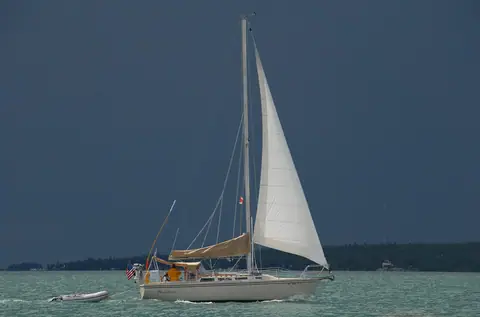
Catalina 30
Cruising Sailboats, 30 ft
Used $8K to $58K
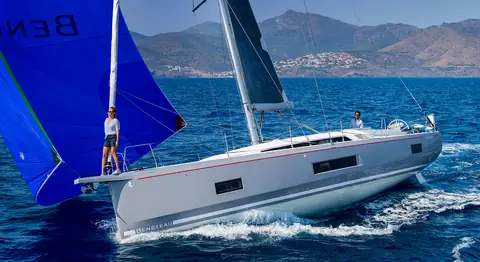
Beneteau Oceanis 46.1
Cruising Sailboats, 48 ft
Used $300K to $640K
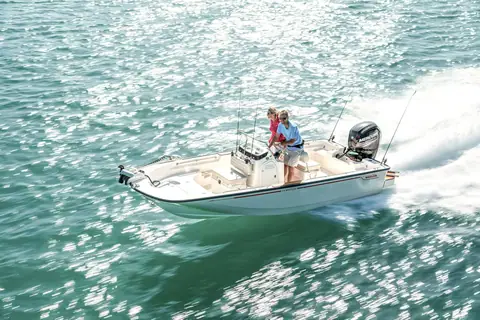
Boston Whaler 170 Montauk
Luxury Dayboats & Classics, 17 ft
Used $18K to $55K
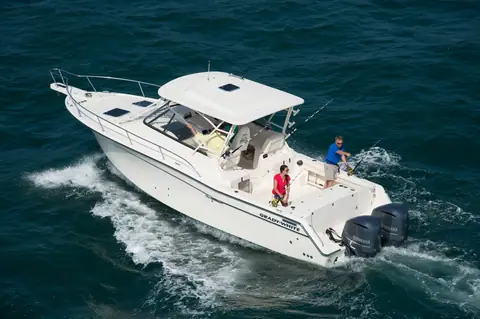
Grady-White Express 330
Center Consoles & Offshore Boats, 34 ft
Used $65K to $560K
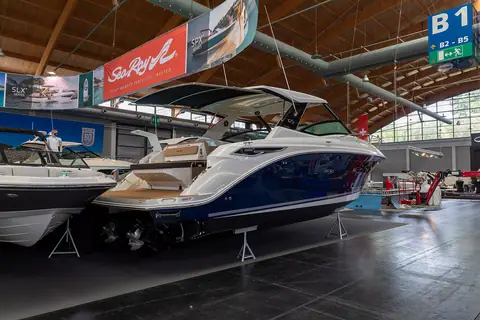
Sea Ray Sundancer 320
Sport Yachts & Express Cruisers, 33 ft
Used $210K to $480K
Frequently asked questions
Why do boaters say port and starboard instead of left and right?
Because port and starboard are fixed to the boat and never change with the direction a person faces. That removes confusion when crew are facing different ways.
What is the difference between a knot and a mile per hour?
A knot is one nautical mile per hour, and a nautical mile is about 6,076 feet versus 5,280 feet for a statute mile. So 20 knots is about 23 mph.
What does draft mean on a boat?
Draft is the vertical distance from the waterline to the lowest point of the hull, keel or running gear. It tells you the minimum water depth the boat needs.
What is the difference between Mayday and Pan-pan?
Mayday is for grave and imminent danger to life or the vessel. Pan-pan signals an urgent problem, such as engine failure in a shipping lane, that is not yet life-threatening.
Is a line the same as a rope?
Rope is the material. Once it has a job aboard, such as a dock line, sheet or halyard, sailors call it a line.
What does scope mean when anchoring?
Scope is the ratio of anchor rode let out to the depth of water plus the height of the bow. More scope gives a lower pull angle and better holding.
Keep reading
Types of Yachts Explained
A plain-English map of the main types of yachts sold in the US, from sailboats and catamarans to trawlers, sportfish…
KnowledgeBoat Hull Types Explained, Displacement, Planing and More
How the shape of a hull decides a boat's speed, ride, fuel burn and stability. Covers displacement, semi-displacement and…
BuyingBest Sailboats for Beginners
Our picks for the best first sailboats in the US market, grouped by how you want to sail, with real specs, typical used prices…
KnowledgeYacht Sizes Explained, From Small Yachts to Megayachts
Yacht size categories are informal, but the length thresholds behind them are not. This guide explains how yachts are measured…
KnowledgeWhat Is a Flybridge? Pros, Cons and Who Needs One
A flybridge is an upper helm and lounge deck above a boat's main cabin. This guide explains how it works, the main variations…