Knowledge
What Is a Flybridge? Pros, Cons and Who Needs One
A flybridge is an upper helm and lounge deck above a boat's main cabin. This guide explains how it works, the main variations, its real advantages and drawbacks, and which owners should choose one.
On this page
- The flybridge, defined in one minute
- What you actually find up top
- Open, enclosed, sedan bridge and the alternatives
- Why owners love the view from up there
- The physics and the price of adding a deck
- At what size does a flybridge make sense?
- Flybridge or express, the choice in practice
- Who really needs a flybridge
- Checking a flybridge on a used boat
- FAQ
The flybridge, defined in one minute
A flybridge is an open or partly enclosed deck on top of a boat's main cabin with a second helm station. You steer the boat from up there with full controls, instruments and usually a duplicate set of displays. On most modern yachts it is also the best party space on board, with a lounge, a table, sunpads and a wet bar or grill.
The name comes from the idea of a 'flying bridge', a lookout and steering position raised above the main deck. It is common on motor yachts, sportfishing yachts, trawlers and power catamarans. Express cruisers and center consoles do without one, and sailboats almost never have them, although some sailing catamarans now offer a raised flybridge-style helm and lounge.
When brokers say a boat is a 'flybridge model', they mean the upper deck is a primary feature, not an add-on. Builders often sell the same hull in two versions, such as a coupe or hardtop with a single lower helm and a flybridge version with two helms, so understanding the trade-off matters at purchase time.
What you actually find up top
A typical flybridge on a 45 to 60-foot motor yacht includes the items below. Larger yachts add a crane for the tender, a hot tub or a full outdoor galley, while trawlers keep it simple with a helm, a bench and a mast for the radar.
- Upper helm with wheel, throttles, joystick on pod or thruster boats, autopilot and multifunction displays.
- Companion seating near the helm so guests can ride up top without getting in the way.
- Dinette or U-shaped lounge with table, often convertible to a sunpad.
- Wet bar with sink, refrigerator or ice maker, and sometimes an electric grill.
- Hardtop, bimini or radar arch carrying antennas, lights and sun cover.
- On larger yachts, open aft deck space for a tender and davit or crane.
Open, enclosed, sedan bridge and the alternatives
Not every upper deck is the same. Builders use several names that overlap, and listings are not always consistent. The table sorts out the main configurations and the boats you usually find them on.
| Configuration | What it means | Where you see it | Typical trade-off |
|---|---|---|---|
| Open flybridge | Upper helm exposed to air, often under a hardtop or bimini | Sportfish, motor yachts 40 to 70 ft | Best views and fresh air, weather-dependent comfort |
| Enclosed flybridge | Upper helm inside hard walls and glass, air-conditioned | Larger motor yachts, Australian sportfish | All-weather use, more weight and height |
| Skylounge | Enclosed upper salon, often with a separate open aft deck | Motor yachts 70 ft and up, superyachts | Extra living room, significant cost |
| Sedan bridge | A sedan cruiser with a flybridge on top | Classic US cruisers 40 to 55 ft | Single-level salon plus upper helm |
| Express or hardtop | Single helm on the main deck, no upper station | Sport yachts, express cruisers | Lower profile and center of gravity, fewer viewpoints |
| Tower | Small open station high above the flybridge | Sportfishing yachts | Spotting fish and color changes, not for lounging |
Why owners love the view from up there
Height of eye is the flybridge's original reason to exist. Raising the helmsman several feet extends the distance to the visible horizon and changes the angle at which you look at the water. Shallow water, color changes over sand or grass, lobster pot floats and floating debris all become easier to read. On the Intracoastal Waterway or in the Bahamas, where reading the water by eye is a real skill, that view is a safety feature.
Docking is the second big benefit. From an upper helm with good sightlines to the stern and both sides, many owners can see the swim platform corners and the dock, which is hard from a lower helm buried behind a salon bulkhead. Sportfishing captains back down on fish from the bridge for the same reason, keeping the cockpit, the line angle and the boat's quarter in view at once.
Then there is lifestyle. On a sunny afternoon at anchor, the flybridge is usually where everybody ends up. It doubles the useful outdoor area of the boat and separates the social deck from the cockpit, where swimmers and the tender come and go.
The physics and the price of adding a deck
Every pound added high on a boat raises its center of gravity. Naval architects compensate with beam, hull form and ballast placement, and a well-designed flybridge yacht is entirely seaworthy, but the effects are noticeable. Motion at the upper helm is amplified because you sit farther from the boat's roll center. In a beam sea, guests on the flybridge feel more movement than those in the salon, so most crews retreat to the lower helm when the sea builds.
Windage is the second penalty. The tall, slab-sided profile of a flybridge yacht catches crosswinds, which makes slow-speed docking in a breeze harder unless the boat has thrusters or joystick control. Air draft goes up too. That matters for fixed bridges, covered boathouses, storage racks and trucking a smaller boat over the road.
Finally, two helms mean two of many things, including displays, engine gauges, control heads and wiring runs. Flybridge enclosures with clear vinyl curtains need care, since scratched, cloudy panels are a common complaint on used boats and replacement is not cheap.
| Advantage | Matching drawback |
|---|---|
| Superior visibility for docking, shallow water and fishing | More motion felt at the upper helm in rough water |
| Roughly doubles outdoor social space | Higher center of gravity and more windage |
| Second helm gives choice in heat, rain or cold | Duplicate electronics and controls to buy and maintain |
| Popular feature that supports resale on larger boats | Taller air draft limits some bridges and boathouses |
| Separates social deck from cockpit and swim platform | Canvas and clear enclosures wear out and need replacing |
At what size does a flybridge make sense?
Below roughly 35 feet, a flybridge eats so much of the boat's stability and weight budget that most modern builders skip it. Older designs such as compact sedan bridges and small trawlers did fit flybridges into the low to mid 30s, and some still sell well in the brokerage market, but they ride tall and can feel tender with a crowd up top.
Between about 40 and 60 feet the flybridge is at its most popular. This is the core of the motor yacht and sportfish market, where boats such as the Princess F55, Galeon 500 Fly and Viking 54 are built around the upper deck. Above 70 feet, the flybridge often grows into a skylounge or a full upper deck, and the conversation shifts from whether to have one to how it is laid out.
Flybridge or express, the choice in practice
Most buyers comparing boats in the 40 to 55-foot range end up choosing between a flybridge motor yacht and an express or hardtop sport yacht of similar length. The two cater to different habits, so start from how you will use the boat rather than how it looks at a boat show.
Express boats keep the whole crew on one level, which suits couples who run the boat alone and want to talk to guests while driving. They usually ride lower and faster for the same power. Flybridge boats offer more living space, more separation and a better view, which suits cruising families, owners who entertain and anyone who docks a big boat often.
| Priority | Flybridge yacht | Express or hardtop |
|---|---|---|
| Interior volume | Usually larger salon and more cabins | Lower profile, often more compact interior |
| Docking sightlines | Excellent from upper helm | Good with cameras and joystick, limited stern view |
| Handling in crosswind | More windage | Less windage |
| Ride height and motion | More motion felt at upper helm | Lower center of gravity |
| Social layout | Separate decks for different groups | Everyone together on one level |
| Bridge clearance | Taller air draft | Lower air draft |
Who really needs a flybridge
Some owners benefit far more than others. These are the profiles where the upper deck pays its way.
- Offshore anglers who need to see fish, birds and weed lines, and who back down on fish while watching the cockpit.
- Coastal cruisers on routes such as the ICW, the Bahamas or the Great Loop, where reading the water and spotting markers early matters.
- Families and owners who entertain, since the flybridge doubles the lounging space and splits age groups naturally.
- Owners who dock large boats short-handed and want a clear view of both quarters.
- Buyers in hot climates who value sitting above the cabin in a breeze rather than inside under air conditioning.
Checking a flybridge on a used boat
The upper deck is exposed to sun, rain and heavy foot traffic, so it ages faster than the interior. A surveyor will inspect it, but buyers can spot most issues on a first walk-through.
- Press on the flybridge deck and helm console for soft spots that suggest wet core.
- Look for stress cracks around the ladder base, hardtop legs and stanchion mounts.
- Check clear enclosure panels for clouding and zippers for corrosion.
- Run every control from the upper helm, including thrusters, trim tabs, windlass and horn.
- Confirm upper-helm electronics are networked with the lower helm and not a decade older.
- Inspect wiring and hydraulic steering lines where they pass through the bridge deck.
Models mentioned in this guide
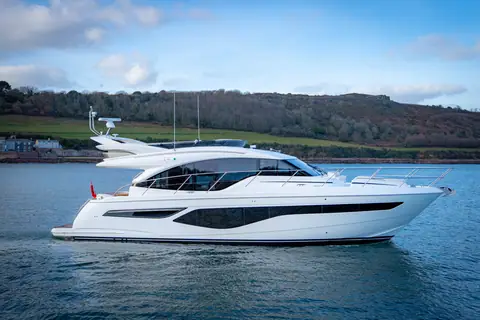
Princess F55
Motor Yachts, 58 ft
Used $1.35M to $2.7M
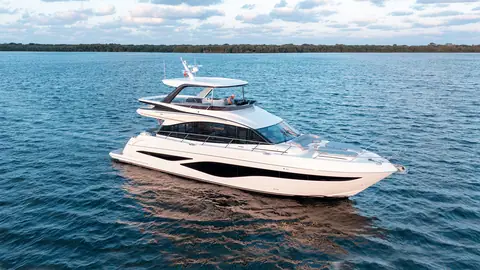
Princess F65
Motor Yachts, 67 ft
Used $2.6M to $3.9M
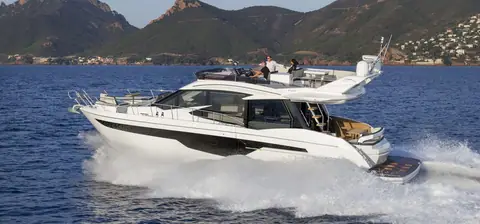
Galeon 500 Fly
Motor Yachts, 53 ft
Used $780K to $1.65M
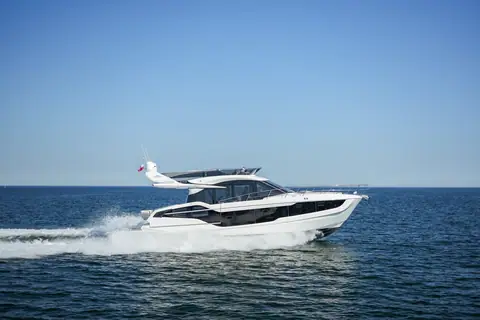
Galeon 440 Fly
Motor Yachts, 46 ft
Used $210K to $1.25M
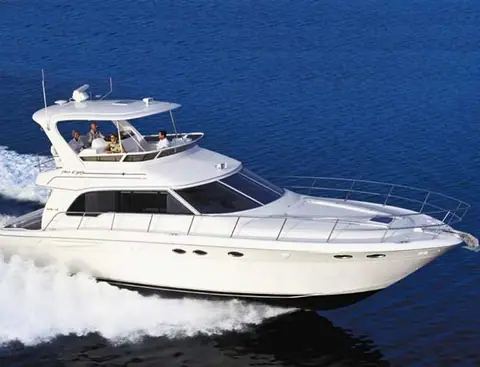
Sea Ray 480 Sedan Bridge
Motor Yachts, 51 ft
Used $200K to $350K
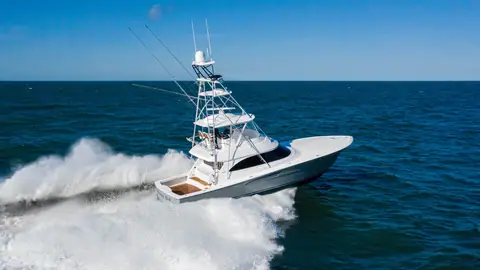
Viking 54 Convertible
Sportfishing Yachts, 55 ft
Used $1.05M to $4M
Frequently asked questions
What is a flybridge on a boat?
A flybridge is a raised deck on top of the main cabin with a second helm station and seating. It gives better visibility and adds a large social area.
Is a flybridge boat less stable?
A flybridge raises the center of gravity, but a properly designed flybridge yacht is fully seaworthy. You will feel more motion at the upper helm in rough water than on the main deck.
What is the difference between a flybridge and a sedan bridge?
A sedan bridge is a specific layout, a sedan cruiser with a single-level salon and helm plus a flybridge on top. All sedan bridges have flybridges, but not all flybridge yachts are sedan bridges.
What is an enclosed flybridge?
An enclosed flybridge has hard walls, glass windows and usually air conditioning, so the upper helm works in any weather. It adds weight and height compared with an open flybridge.
Is a flybridge worth it on a 40-foot boat?
Yes, if you cruise, fish offshore or entertain often, since 40 feet is roughly where a flybridge stops costing too much stability and space. Day boaters and couples often prefer an express.
Do flybridge boats hold their value better?
In the 45 to 70-foot motor yacht and sportfish segments, flybridge versions are in steady demand and generally resell well, while condition and engine hours still matter more than layout.
Keep reading
Types of Yachts Explained
A plain-English map of the main types of yachts sold in the US, from sailboats and catamarans to trawlers, sportfish…
KnowledgeYacht vs Boat, What Is the Difference?
There is no single legal line between a boat and a yacht. This guide explains how the industry, insurers, lenders, regulators…
KnowledgeYacht Sizes Explained, From Small Yachts to Megayachts
Yacht size categories are informal, but the length thresholds behind them are not. This guide explains how yachts are measured…
KnowledgeBoating Terminology, 150 Terms Every Owner Should Know
A themed glossary of boating terminology for new and experienced owners, grouped by hull, deck, lines, sails, engines…