Catalina Yachts Cruising Sailboats
Catalina 30 Sailboat Review, Generations and Used Prices
Roughly 6,450 hulls over three decades made the Catalina 30 the most produced 30-footer in the world and the yardstick every rival is measured against.
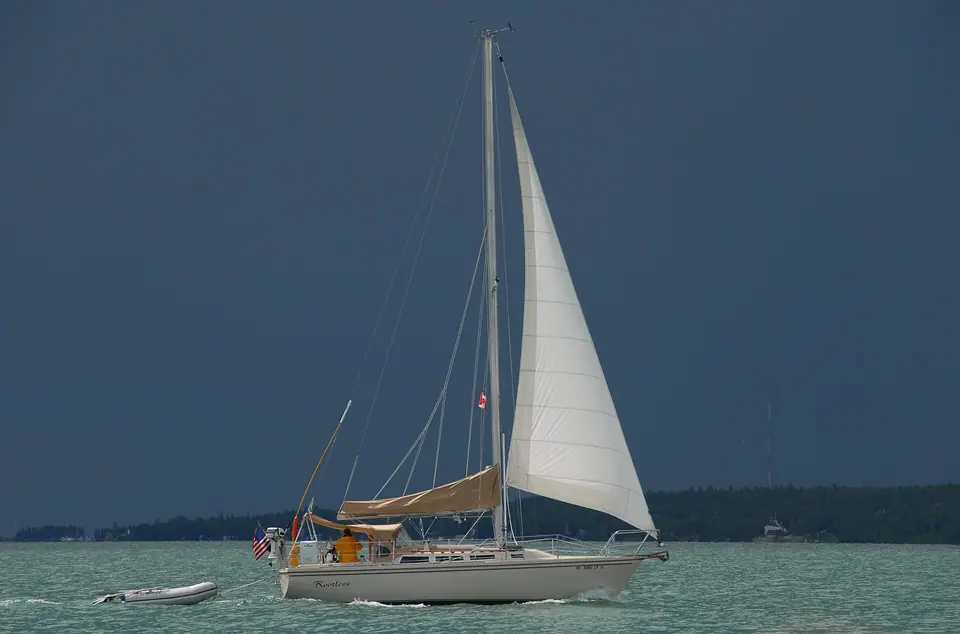
- Length
- 29.9 ft9.12 m
- Beam
- 10.8 ft3.3 m
- Draft
- 5.3 ft1.6 m
- Cabins
- 1 plus quarter berth
- Used price
- $8K to $58K
On this page
- Overview
- The Catalina 30, the boat half of America learned to cruise on
- Catalina 30 Mark I, Mark II and Mark III explained
- Three keels, a tall rig and a bowsprit
- Inside the Catalina 30: seven berths and a saloon that feels bigger
- Five engines in three decades
- Stiff, honest and a handful of weather helm
- Deck cores, compression posts and the keel joint
- The Chris-Craft Catalina 30 is a different boat entirely
- Catalina 30 sailboats for sale and what to pay
- Specifications
- Price and value
- Strengths and weaknesses
- Used buyer checklist
- Rivals
- Our verdict
- FAQ
Frank Butler's 30-foot masthead sloop, built from the mid-1970s to 2008 in Mark I, II and III versions with fin, shoal or wing keels, optional tall rig and a cabin with 6 ft 4 in headroom.
- First cruising boat for a family
- Coastal weekend cruising
- Club racing in PHRF cruising classes
- Budget liveaboards in protected waters
Catalina 30 by the numbers
- Sail area to displacement
- 15.2A cruising rig sized for comfort, so expect to motor in very light air.
- Displacement to length
- 291Moderate displacement, a classic cruising balance between load carrying and speed.
- Theoretical hull speed
- 6.7 knThe practical top speed of a displacement monohull under normal sailing, based on waterline length.
- Ballast ratio
- 41%A high ballast ratio, so the boat stands up well to a breeze.
- Capsize screening
- 2.00Below 2.0, the traditional threshold for offshore suitability.
- Motion comfort ratio
- 24.9A quicker motion in waves, typical of light, beamy hulls.
- Length to beam ratio
- 2.76 : 1A beamy hull with lots of volume for its length.
The Catalina 30, the boat half of America learned to cruise on
Ask a room of sailors whether they have ever sailed a Catalina 30 and most hands go up. Frank Butler's 30-footer entered production in the mid-1970s, sources variously date the first boats between 1972 and 1975, and the last hull, number 6454, was completed in May 2008. Practical Sailor described it as the world's most popular 30-footer, and no other boat of this size has been built in such numbers.
The appeal was never performance. It was volume. Butler put 10 feet 10 inches of beam into a 30-foot hull, gave it a long 25-foot waterline, and used the space for a saloon with 6 feet 4 inches of headroom, an enclosed head, a usable galley and berths for up to seven. In the late 1970s that was a family cruiser that felt like a 33-footer for the price of a 28. The Catalina 30 sloop became the default charter, sailing school and first cruising boat across the country, and it still is on the used market.
Catalina 30 Mark I, Mark II and Mark III explained
Despite three generations, the basic dimensions never changed: 29 feet 11 inches overall, 10 feet 10 inches of beam, about 10,200 pounds displacement and 5 feet 3 inches of standard draft. What changed was the deck, cockpit and detailing, and those changes drive prices.
The Mark I, built from 1975 to 1986, has a straight cockpit, tiller steering on early boats and end-boom mainsheet. The Catalina 30 Mk II arrived in September 1986 with a T-shaped cockpit and wide flat coamings designed around pedestal wheel steering, plus internal halyards. The Catalina 30 Mk III followed in 1994, slightly widening the hull aft to create a walk-through transom with a swim platform between the split backstays, wider coamings and stern rail seats, and the wing keel became standard.
- Mark I (1975 to 1986): straight cockpit, end-boom sheeting, widest choice of engines
- Mark II (1986 to 1993): T-cockpit, wheel steering, internal halyards, wing keel option from November 1986
- Mark III (1994 to 2008): walk-through transom, swim platform, wing keel standard
- Open transom details appear from around 1990 depending on the source
Three keels, a tall rig and a bowsprit
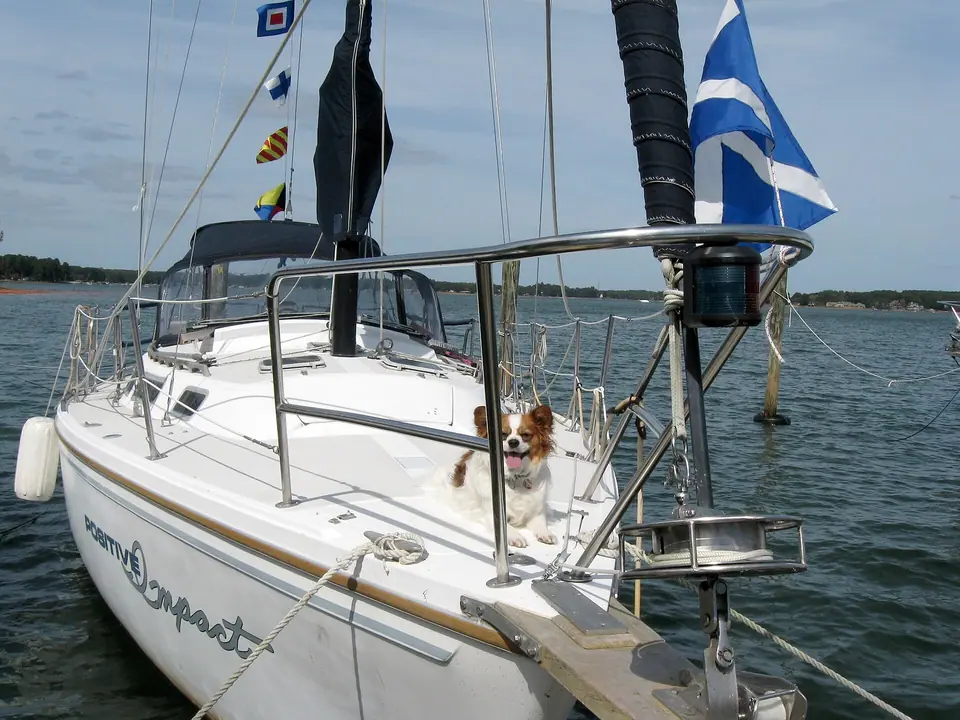
The International Catalina 30/309 Association lists three keels: the 5 foot 3 inch deep fin, an early shoal fin of about 4 feet 4 to 4 feet 5 inches, and a wing keel of 3 feet 10 inches introduced in late 1986. The deep fin points best. The wing keel is the logical choice in the Chesapeake, the Gulf Coast and Florida, and it is the most common keel on Mark III boats.
The tall rig adds 24 inches to the mast height and 6 inches to the boom, worth about 60 square feet of extra sail area, according to SpinSheet. An optional bowsprit extends the foretriangle base by roughly 32 inches for a bigger genoa or an asymmetric. In light-air regions the tall rig is a real advantage. In windy venues the standard rig is easier to manage short-handed.
Inside the Catalina 30: seven berths and a saloon that feels bigger
The Catalina 30 interior follows a layout most sailors know instinctively. A V-berth forward, then a head compartment, then a saloon with a drop-leaf or dinette table, the galley aft to one side of the companionway and a quarter berth to the other. Seven adult berths are listed, though five is a realistic crew. Three cockpit lockers and a large anchor locker provide more stowage than most 30-footers of the era.
Practical Sailor's owner surveys flagged ventilation as a weakness, especially leaky sliding head ports, and older iceboxes are poorly insulated. Engine noise below is noticeable because the engine sits amidships under the dinette seat. Many owners have added opening ports, a better icebox lining and new cushions, and those refits are the main difference between a tired boat and a pleasant one.
Five engines in three decades
No single feature affects a Catalina 30's value more than its engine. Early boats used the Atomic 4 gasoline engine, the two-cylinder Universal 5411 diesel and the Yanmar YSB12. Later boats received the Universal M-18 and then the three-cylinder Universal M-25, which became the only engine offered from October 1988. Practical Sailor's owners rated the Yanmar YSB12 and Universal 5411 underpowered and considered the Atomic 4 and Universal M-25 the most desirable.
A small diesel in a boat this size uses little fuel, which is why fuel is a minor line in the annual budget. Repowering a Mark I with a modern three-cylinder diesel is a five-figure job once installation is included, so a boat with a recent repower is often the better value even at a higher asking price.
Stiff, honest and a handful of weather helm
With about 4,200 pounds of ballast on 10,200 pounds of displacement, a ballast ratio around 0.41, the Catalina 30 is a stiff boat that stands up to its sail plan. Hull speed is about 6.7 knots. It is not as quick as a Pearson 30 or Ericson 30, but it is comfortable and predictable, which matters more to most owners.
Its known habit is a build-up of weather helm as it heels. Reefing the main early, flattening the sail and easing the traveler keep the helm light. Older boats also suffer from a genoa track position that gives a wide sheeting angle upwind, so inboard leads or a smaller headsail improve pointing noticeably.
Deck cores, compression posts and the keel joint
Thirty to fifty-year-old boats have predictable problems. SpinSheet's used boat review lists deteriorated deck cores, mast step compression fatigue, failed wooden spreaders on older boats, failed lower chainplate attachments, and leaks or separation at the keel to hull joint, the so-called Catalina smile. Early boats also had design weaknesses in the chainplate bulkheads and rudder that Catalina corrected by the late 1970s.
Original through-hulls on early boats used gate valves rather than proper seacocks. Hard groundings can stress the keel stub and the floors above it. A survey that includes a moisture meter on the deck, a look at the compression post and the bilge under the mast, and a check of the keel bolts is essential on any Catalina 30 for sale.
The Chris-Craft Catalina 30 is a different boat entirely
Search traffic for the Chris-Craft Catalina 30 overlaps with the sailboat, but the two are unrelated. Chris-Craft has used the Catalina name on powerboats for decades, including the 310 Catalina sedan cruiser of 1979 to 1981. The current Chris-Craft Catalina 30, built since 2018, is a premium twin-outboard center console, and its Catalina 30 Pilothouse sister reached 49 knots with optional twin 350 hp Mercury Verados in Yachting's test. If you are searching for a 30-foot Catalina sailboat, filter by builder Catalina Yachts.
Catalina 30 sailboats for sale and what to pay
In 2026 a project Mark I with an aging engine starts around $8,000, while tidy Mark I boats with a diesel sell for $12,000 to $20,000. Mark II boats generally fall between $15,000 and $32,000, and Mark III boats from $25,000 to the high $50,000s for the last model years. The Catalina 309, the newer design that succeeded the 30, costs more again.
Budget $6,000 to $14,000 per year for a slip, insurance, haul-out, bottom paint and engine service. The International Catalina 30/309 Association and Catalina Direct make parts easy to find, which keeps ownership costs predictable. That matters more now that Catalina Yachts has closed: production stopped in 2025 and the tooling was sold at auction in June 2026, so the association's tech notes and the aftermarket suppliers are the Catalina 30's support network from here on.
Catalina 30 specifications
| Length overall | 29.9 ft9.12 m |
|---|---|
| Waterline length | 25 ft7.62 m |
| Beam | 10.8 ft3.3 m |
| Draft | 5.3 ft1.6 m |
| Displacement | 10,2 lbs4,627 kg |
| Ballast | 4,2 lbs1,905 kg |
| Sail area | 446 sq ft41.4 m² |
| Fuel capacity | 21 gal79 L |
| Fresh water | 43 gal163 L |
| Cabins | 1 plus quarter berth |
| Berths | Up to 7 |
| Heads | 1 |
| Standard engines | Universal M-25 three-cylinder diesel (sole option from late 1988) |
| Optional engines | Earlier boats: Atomic 4 gasoline, Universal 5411, Yanmar YSB12, Universal M-18 |
| Hull type | Fiberglass monohull with fin keel and spade rudder |
| Keel | Deep fin 5 ft 3 in, shoal fin about 4 ft 4 to 4 ft 5 in, or wing keel 3 ft 10 in (from November 1986) |
| Rig | Masthead sloop, standard or tall rig, optional bowsprit |
| Hull construction | Solid fiberglass hull, cored fiberglass deck |
| Builder | Catalina Yachts, United States |
| Naval architect | Frank V. Butler |
| Other design credits | Catalina Yachts design team, led later by Gerry Douglas, for the Mark II and Mark III updates |
| Production | 1975 to 2008 |
| Status | Discontinued |
Figures come from builder documentation and independent tests where available. Displacement is usually quoted light, so a loaded cruising boat will weigh more. Compare these specs with another model.
How much does a Catalina 30 cost?
Generation sets the baseline: Mark I boats trade at roughly half the price of a Mark III. Within each generation, a healthy Universal M-25 diesel, a dry deck, wheel steering and recent sails add the most value, while an original Atomic 4 or an underpowered Universal 5411 pulls the price down unless it has been rebuilt.
Estimate your yearly cost
A planning estimate using common rules of thumb: insurance near 1.5 percent of value, maintenance near 3 percent, haul out and bottom paint by length. Your marina, region and use will move these numbers. Open the full cost calculator.
Catalina 30 timeline
- 1975Catalina 30 Mark I in full production with a range of engines
- Late 1970sFactory fixes for early chainplate bulkhead and rudder weaknesses; an early shoal fin of about 4 ft 5 in is offered alongside the deep fin
- 1986Mark II introduced in September with T-cockpit and wheel steering; wing keel follows in November
- 1988Universal M-25 becomes the only engine offered
- 1994Mark III adds walk-through transom and swim platform
- 2008Final hull, number 6454, completed in May
Strengths and weaknesses
What owners like
- Huge interior volume for a 30-footer
- Stiff and forgiving with a 0.42 ballast ratio
- Massive owner network and parts availability
- Choice of keels for deep or thin water
- Easy to resell in almost any US market
- Mark III transom makes boarding from a dinghy simple
What to weigh up
- Weather helm builds as it heels
- Slower than performance 30-footers of the same era
- Older boats prone to deck core and compression post issues
- Engine sits under the saloon, making noise and access a compromise
- Mark I boats often need a repower
Used Catalina 30 buyer checklist
Take this list to a viewing. Your ticks are saved in this browser so you can come back to it.
Always commission an independent marine survey and an engine survey before you buy. How a marine survey works.
Rivals to consider
Catalina 27
Cheaper and simpler, but notably smaller below and with a tight engine space.
Compare side by sideCatalina 320
The modern successor in spirit, with a more efficient hull, better engine access and a private aft cabin.
Compare side by sideHunter 33
A newer, roomier B&R rig cruiser with a saildrive and an arch, built from 2004.
Compare side by sidePearson 30
A faster and more race-oriented 1970s 30-footer with a tighter interior.
Our verdict on the Catalina 30
The Catalina 30 earned its numbers honestly. It offers more living space than any 30-footer of its era, sails predictably, and is supported by an owner community that has documented every repair. Its weaknesses, from weather helm to deck cores, are well known and manageable. For most buyers the sweet spot is a Mark II or early Mark III with a Universal M-25, a dry deck and a sorted keel joint. Pay for those three things and you will own one of the easiest sailboats in America to enjoy and to resell.
Catalina 30 questions answered
How much is a Catalina 30 worth?
Used Catalina 30s range from about $8,000 for project Mark I boats to the high $50,000s for late Mark III models. Most good boats sell for $15,000 to $40,000.
What is the difference between the Catalina 30 Mk II and Mk III?
The Mark II (1986 to 1993) introduced a T-cockpit and wheel steering. The Mark III (1994 to 2008) widened the stern for a walk-through transom and swim platform and made the wing keel standard.
How many Catalina 30s were built?
About 6,450, with the final hull numbered 6454, making it the most produced 30-foot sailboat in the world.
What engine is in a Catalina 30?
Early boats used the Atomic 4, Universal 5411 or Yanmar YSB12. From October 1988 the Universal M-25 diesel was standard.
Is the Chris-Craft Catalina 30 the same as the Catalina 30 sailboat?
No. The Chris-Craft Catalina 30 is a powerboat, currently a twin-outboard center console, and has no connection to Catalina Yachts.
Can a Catalina 30 sail offshore?
It is a coastal cruiser, though many have made offshore passages after rig, chainplate and hatch upgrades and careful preparation.
Catalina 30 photos
More cruising sailboats to explore
Hunter 30
Cruising Sailboats, 30 ft
Used $7K to $27K
Dufour 30 Classic
Cruising Sailboats, 31 ft
Used $22K to $42K
Bavaria 30 Cruiser
Cruising Sailboats, 31 ft
Used $38K to $62K
Beneteau Oceanis 30.1
Cruising Sailboats, 31 ft
Used $95K to $175K