Hanse Yachts Cruising Sailboats
Hanse 371 Review, Build Quality and Used Buyer's Guide
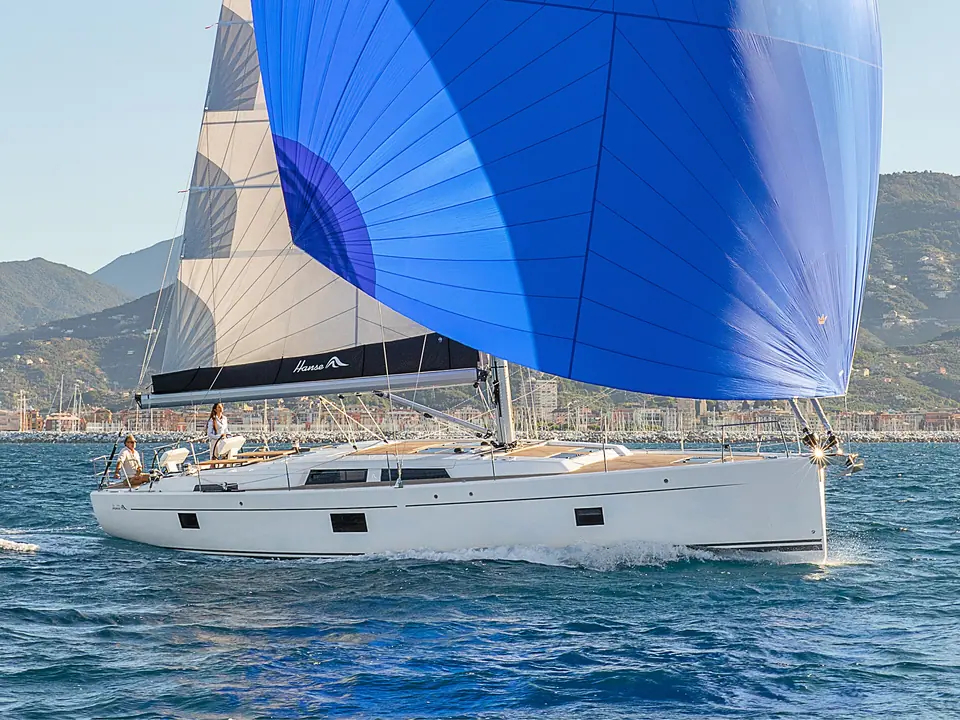
The 1999 design that paired Hanse with Judel/Vrolijk and proved a budget-priced German cruiser could be a genuine pleasure to helm.
- Length
- 36.9 ft11.25 m
- Beam
- 11.8 ft3.59 m
- Draft
- 6.5 ft1.98 m
- Cabins
- 2 standard, 3 optional
- Used price
- $55K to $90K
On this page
- Overview
- The Hanse 371 and the 1999 partnership that defined the brand
- How the 371 is put together
- A rig meant for two people and no overlapping genoa
- What two testers found at the helm
- Mahogany, cane doors and a table that does three jobs
- Niggles the reviewers flagged, and what they mean twenty years on
- 371, 371 DS and the Hanse 370 that followed
- Owning a Hanse 371 in North America
- Specifications
- Price and value
- Strengths and weaknesses
- Used buyer checklist
- Rivals
- Our verdict
- FAQ
A 37-foot fractional sloop built in Greifswald from 1999 to 2005, the first Hanse drawn by Judel/Vrolijk. Self-tacking jib, iron keel with a lead bulb, two cabins as standard and a reputation for sailing far better than its price suggested.
- Couples who enjoy sailing more than motoring
- Short-handed coastal cruising
- Club racing with a cruising interior
- Buyers who want a solid older boat on a budget
Hanse 371 by the numbers
- Sail area to displacement
- 20.4Plenty of sail for the weight, the boat should feel lively in light air.
- Displacement to length
- 173Light displacement for its length, quick but sensitive to added cruising weight.
- Theoretical hull speed
- 7.6 knThe practical top speed of a displacement monohull under normal sailing, based on waterline length.
- Ballast ratio
- 38%A typical ballast ratio for a cruising monohull.
- Capsize screening
- 2.00Below 2.0, the traditional threshold for offshore suitability.
- Motion comfort ratio
- 22.5A quicker motion in waves, typical of light, beamy hulls.
- Length to beam ratio
- 3.13 : 1Moderate proportions.
The Hanse 371 and the 1999 partnership that defined the brand
Before the Hanse 371, Michael Schmidt's Greifswald yard built boats from second-hand moulds. As Yachting World's David Harding recounted, the Aphrodite 29 became the Hanse 291, the Finngulf 33 became the Hanse 331 and a Bianca 42 with a shortened stem became the first Hanse 400. They sailed well and sold cheaply, but Schmidt knew they lacked the interior volume buyers wanted. His answer was to commission an all-new range from Judel/Vrolijk & Co., the German office behind Admiral's Cup winners, Whitbread 60s and America's Cup boats.
The Hanse 371, drawn in 1999, was the first result, and Hanse still calls it the award-winning model that opened a new era for the yard. It stayed in production until 2005, when the Hanse 370 took over. Anyone shopping for a Hanse 371 is looking at the ancestor of every modern Hanse, with the self-tacking jib and clean coachroof that later models made famous.
How the 371 is put together
Practical Sailor went through the construction in unusual detail. Hulls were laid up in a female mould with isophthalic polyester throughout, starting with a powder-bonded chopped strand mat to stop print-through, followed by three layers of 900-gram biaxial roving and a 600-gram mat. The topsides are cored with 22 mm balsa, while the keel area and through-hulls get 25 to 35 mm of solid glass. Hanse told the magazine it skipped vinylester because of cost and because its own tests showed iso resin resisting blisters as well; it offered a factory epoxy coating instead.
Below, a solid glass fishbone structure is bonded to the hull, and every bulkhead is tabbed to the hull on both sides and to the deck on one side. The hull-to-deck joint is an inward flange bedded in Sikaflex, with an aluminum toerail through-bolted on rectangular backing plates. The keel is the clever part: an iron casting with a lead bulb at the bottom, held by 11 bonded keel bolts under a stainless plate. Hanse claimed the bulb could shift about 1.5 cm aft in a hard grounding, sparing the hull. Practical Sailor relayed an owner's rock strike at speed that bent the wheel yet left damage only on the bottom of the keel.
A rig meant for two people and no overlapping genoa
The 9/10 fractional rig has two sets of swept spreaders and wire standing rigging. Z-Spar supplied masts until 2001, after which Isomat took over. A full-batten main and a roughly 90 percent self-tacking jib on a furler were standard, and Harding noted that relatively few owners ordered the optional overlapping genoa. Sailboatdata lists the main at 38 square meters and the self-tacker at 28.5, with an optional 40 square meter genoa and a roughly 100 square meter spinnaker.
The mainsheet sits mid-boom with the traveler on a 42-inch track forward of the companionway, and sheets run aft to clutches at the hatch. Hanse's production manager told Practical Sailor that a cockpit traveler would be faster but less appealing to cruisers, and Harding confirmed that two alternative mainsheet systems were offered. The split backstay keeps the open transom clear but came without an adjuster. Side decks are about 18 inches wide with the shrouds at the cabin base, and the forward port cockpit locker has no drain.
What two testers found at the helm
Practical Sailor sailed a 371 off Vancouver Island with the standard main and self-tacking jib. In 6 knots of wind the boat was just quick enough to stay off the engine, though the tester wanted a bigger headsail. Once the breeze reached 8 to 10 knots it beat to windward at 5 to 7 knots, sailing best at 12 to 15 degrees of heel with a light helm and identical manners on a reach.
Harding had the opposite problem: more than 25 knots of wind. With a slab in the main he held a steady 6.5 knots upwind, tacking through 80 to 85 degrees, and saw 9 knots when he bore away onto a reach, despite budget sails and a fixed two-blade prop. The Whitlock rod steering stayed finger light, the boat spun through 360 degrees in little more than a boat length, and when overpressed it simply rounded up a few degrees and recovered. His summary was that in performance for the money it probably topped the table.
- Displacement to length ratio of about 174 and sail area to displacement just under 21 (Yachting World)
- Motoring at full throttle, 3,400 rpm, a little under 7 knots with the Volvo 2030 saildrive
Mahogany, cane doors and a table that does three jobs
The interior is the warm, varnished style Hanse used at the time: mahogany veneer over plywood and foam-cored panels, a teak and holly sole, white gelcoat surfaces overhead and woven cane fronts on locker doors for ventilation. Harding thought it felt more American than European. There is more than 6 feet of headroom throughout, and the saloon measures about 11 feet on the centerline.
The galley sits to starboard at the foot of the companionway with a two-burner gimbaled stove and double sink. Forward is a C-shaped settee whose table converts to an 8 by 4 foot berth, and opposite is a freestanding 28-inch table with seats fore and aft that serves as chart table, cocktail table and dinner for two. The single head is a 3 by 4 foot compartment off the saloon. The forward cabin has a berth at least 6 feet long and a small dressing area; the aft cabin has a 6 ft 6 in by 6 ft double.
Rather than a three-cabin standard layout, Hanse offered three uses for the space aft of the galley: a separate 28 by 48 inch shower that doubles as a wet locker, a second aft cabin, or storage. Practical Sailor recommended the shower for anyone planning passages.
Niggles the reviewers flagged, and what they mean twenty years on
Neither magazine found much to fault structurally, and Harding said the worst he had heard about Hanse construction was relatively mild. He did find rough edges, a few areas of dry mat in lockers and signs of fast assembly, a shortage of handholds between the compression post and the galley, and an emergency tiller only 21 inches long that faced aft and would need blocks and lines to be useful. Families with young children were advised to order the acrylic panel that closes the transom opening.
On a boat now 20 to 26 years old, maintenance history matters more than those first impressions. The balsa-cored deck and topsides are the main survey item, especially around hardware owners added later. The saildrive seal and engine mounts deserve a close look, and original sails will be finished. Access is a bonus: the oversized companionway step lifts to expose a well-insulated engine box.
371, 371 DS and the Hanse 370 that followed
Sailboatdata carries two records. The main Hanse 371 entry lists 5,950 kg of displacement and 2,245 kg of ballast, while a second record labeled 371 DS lists 6,600 kg, 2,400 kg of lead ballast, 79 liters of fuel and 220 liters of water, plus optional drafts of 1.69 m and 1.08 m. The gap probably reflects lightship versus equipped weights or brochure revisions, so treat any single displacement figure with caution.
The Hanse 370 that replaced the 371 in 2006 is a different, beamier boat at 11.35 m by 3.75 m with a 7,200 kg displacement, and it sold in far greater numbers, about 950 according to sailboatdata. If you want the more slender, more traditional-looking hull, make sure the listing really is a 371. The 370 has the steeper stem and later Hanse styling, while the 371 has the flat sheer, elevated cabin trunk and varnished interior described here.
Owning a Hanse 371 in North America
Hanse began appointing dealers in Connecticut, Maryland, California and Vancouver from 2001, so a modest number of 371s were commissioned for this side of the Atlantic, and the rest arrive as imports. Parts are rarely a problem because the hardware is generic European kit: Whitlock steering components, Volvo or Yanmar saildrives and standard deck gear. Annual costs for a 37-footer of this age typically run $7,000 to $14,000 before slip fees vary by region, with sail replacement and saildrive service the big-ticket items.
For a couple who wants a boat that tacks itself and steers like a far pricier yacht, the 371 remains one of the better values among late-1990s European cruisers. Just plan around the 21-gallon fuel tank on long motoring legs.
Hanse 371 specifications
| Length overall | 36.9 ft11.25 m |
|---|---|
| Waterline length | 32.3 ft9.85 m |
| Beam | 11.8 ft3.59 m |
| Draft | 6.5 ft1.98 m |
| Displacement | 13,117 lbs5,95 kg |
| Ballast | 4,949 lbs2,245 kg |
| Sail area | 71 sq ft66 m² |
| Fuel capacity | 21 gal79 L |
| Fresh water | 58 gal22 L |
| Cabins | 2 standard, 3 optional |
| Berths | 4 to 6 |
| Heads | 1 |
| Standard engines | Yanmar 3GM30 diesel with saildrive (early boats commonly Volvo Penta MD2030) |
| Maximum power | 30 hp |
| Hull type | Fin-keel monohull with near-plumb bow, flat sheer and open reverse transom |
| Keel | Cast iron fin with bonded lead bulb, 6 ft 6 in standard draft, shallower options listed |
| Rig | 9/10 fractional sloop, two sets of swept spreaders, self-tacking jib on a furler, full-batten main |
| Hull construction | Hand-laid polyester laminate with 22 mm balsa-cored topsides and balsa-cored deck |
| CE design category | A |
| Builder | Hanse Yachts (Yachtzentrum Greifswald), Germany |
| Naval architect | Judel/Vrolijk & Co. |
| Production | 1999 to 2005 |
| Status | Discontinued |
Figures come from builder documentation and independent tests where available. Displacement is usually quoted light, so a loaded cruising boat will weigh more. Compare these specs with another model.
Performance data
| Conditions | Point of sail | Boat speed (kn) | Source |
|---|---|---|---|
| 8 to 10 kn true wind | Beat to windward | 5 to 7 | Practical Sailor |
| 25 kn plus, one reef | Upwind, tacking through 80 to 85 degrees | 6.5 | Yachting World |
| 25 kn plus, one reef | Bearing away to a reach | 9 | Yachting World |
| Under power, 3,400 rpm | Flat water | Just under 7 | Yachting World |
Figures as published by Practical Sailor (Vancouver Island test) and Yachting World (David Harding). Both test boats used standard sails and a fixed two-blade propeller.
How much does a Hanse 371 cost?
Practical Sailor quoted the Hanse 371 at $150,000 FOB the US East Coast with generous standard equipment, which put it below most German and Scandinavian rivals of the day. Today the spread between a tired early boat and a well-kept late one comes down to sails, the engine hours on the saildrive, deck core condition and whether the boat has the optional shower or third cabin. Expect fewer US listings than for Beneteau or Jeanneau boats of the same age, so many buyers end up looking at boats in Canada or the Great Lakes.
Estimate your yearly cost
A planning estimate using common rules of thumb: insurance near 1.5 percent of value, maintenance near 3 percent, haul out and bottom paint by length. Your marina, region and use will move these numbers. Open the full cost calculator.
Versions and options
- Two-cabin standard
- Forward and aft doubles, one head, with a large starboard locker aft that opens into the accommodation.
- Shower option
- A separate 28 by 48 inch shower aft of the galley, which also works as a wet locker, at the cost of some cockpit locker volume.
- Three-cabin option
- A second aft cabin reached from the galley, useful for families but it gives up the big locker.
Hanse 371 timeline
- 1999Hanse 371 designed by Judel/Vrolijk, the first all-new design of the partnership
- 2001Isomat replaces Z-Spar as rig supplier, and Hanse begins building a North American dealer network
- 2005Final model year of the 371
- 2006Hanse 370 replaces the 371 with a beamier hull and steeper stem
Strengths and weaknesses
What owners like
- Light, precise steering and exceptional maneuverability
- Lead bulb on an iron fin for better stiffness
- Self-tacking jib makes short-handed sailing simple
- Bulkheads bonded to hull and deck, solid structure
- Good engine access and sound insulation
- Strong performance for the money
What to weigh up
- Small fuel tank for long motoring legs
- Mainsheet and traveler out of the helmsman's reach
- Self-tacker lacks power in very light air and off the wind
- Few handholds between the companionway and saloon
- Limited supply on the US used market
Used Hanse 371 buyer checklist
Take this list to a viewing. Your ticks are saved in this browser so you can come back to it.
Always commission an independent marine survey and an engine survey before you buy. How a marine survey works.
Rivals to consider
Beneteau Oceanis Clipper 373
More volume and a larger US dealer footprint, but noticeably less engaging under sail.
Compare side by sideDehler 36
Another German performance cruiser, a little sportier and usually priced higher used.
Compare side by sideBeneteau First 36.7
A one-design racer-cruiser with a bigger racing following and a more Spartan interior.
Compare side by sideJeanneau Sun Odyssey 37
A conventional masthead cruiser of the same era with an easier resale market in the US.
Our verdict on the Hanse 371
The Hanse 371 is the boat that turned a mould-recycling startup into a serious builder, and it still delivers what Judel/Vrolijk drew it to do: sail quickly and obediently with two people and almost no effort. Its construction is honest rather than luxurious, with a few rough edges hidden in lockers, but the bonded bulkheads, through-bolted joint and lead-bulb keel are better than the price ever implied. Buy one for the helm feel and the simplicity of the self-tacker, budget for sails, saildrive work and a careful deck survey, and you get a two-cabin 37-footer that outsails most of what it shares a marina with.
Hanse 371 questions answered
When was the Hanse 371 built?
The Hanse 371 was designed in 1999 and built until 2005, when the Hanse 370 replaced it.
Who designed the Hanse 371?
Judel/Vrolijk & Co. It was the first Hanse they designed, the start of a partnership that lasted until Hanse moved to Berret-Racoupeau around 2021.
Is the Hanse 371 a good bluewater boat?
It is built to CE Category A and handles a blow well, but small tanks and a two-burner galley suit coastal and island cruising better than ocean passages.
What engine does the Hanse 371 have?
Practical Sailor lists a Yanmar 3GM30 as standard, and many boats, including both magazine test boats, have the Volvo Penta MD2030 on a saildrive.
How much is a used Hanse 371 worth?
Most US and Canadian asking prices fall roughly between $55,000 and $90,000, depending on year, sails, engine hours and deck condition.
Is the Hanse 371 the same as the Hanse 370?
No. The 370 that followed in 2006 is a beamier, heavier boat with a steeper stem and a different interior.
More cruising sailboats to explore
Beneteau Oceanis Clipper 373
Cruising Sailboats, 37 ft
Used $68K to $112K
Bavaria C38
Cruising Sailboats, 37 ft
Used $205K to $330K
Bavaria Cruiser 36
Cruising Sailboats, 37 ft
Used $70K to $106K
Bavaria Cruiser 37
Cruising Sailboats, 37 ft
Used $95K to $200K