Hunter Marine Cruising Sailboats
Hunter 30 Review, a 1970s Hunter Sailboat That Still Earns Its Keep
Hunter's first 30 footer came fully equipped, sold by the hundred and still offers more cruising per dollar than almost any 30 ft sailboat.
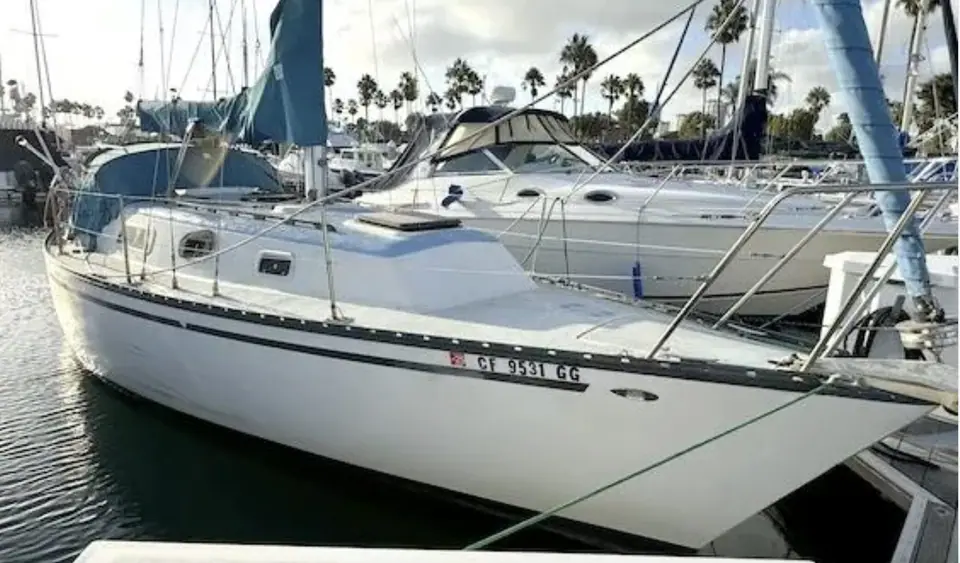
- Length
- 30.4 ft9.27 m
- Beam
- 10.2 ft3.1 m
- Draft
- 5.3 ft1.6 m
- Cabins
- 1 forward cabin plus saloon
- Used price
- $7K to $27K
On this page
- Overview
- The affordable fantasy that launched Hunter sailboats
- A MORC-era hull with a lot of room inside
- Better under sail than its reputation
- On deck: narrow side decks and painted nonskid
- Interior volume was the selling point
- Yanmar 12, 15 or 18, and the repower question
- The other Hunter 30s: 30-2, 30T and the 2006 boat
- Hunter boats after the company
- Specifications
- Price and value
- Strengths and weaknesses
- Used buyer checklist
- Rivals
- Our verdict
- FAQ
The original Hunter 30 is a John Cherubini designed masthead sloop built by Hunter Marine in Florida from 1973 to 1983, with about 1,000 completed. Later boats sold as the Hunter 30, now called the 30-2 and 30T, are different designs.
- First-time cruising boat owners on a tight budget
- Coastal weekenders and club racers
- Owners who enjoy doing their own upgrades
- Budget liveaboards in mild climates
Hunter 30 by the numbers
- Sail area to displacement
- 15.9A cruising rig sized for comfort, so expect to motor in very light air.
- Displacement to length
- 254Moderate displacement, a classic cruising balance between load carrying and speed.
- Theoretical hull speed
- 6.8 knThe practical top speed of a displacement monohull under normal sailing, based on waterline length.
- Ballast ratio
- 42%A high ballast ratio, so the boat stands up well to a breeze.
- Capsize screening
- 1.91Below 2.0, the traditional threshold for offshore suitability.
- Motion comfort ratio
- 25.1Moderate motion comfort, typical of modern cruisers.
- Length to beam ratio
- 2.99 : 1A beamy hull with lots of volume for its length.
The affordable fantasy that launched Hunter sailboats
Hunter sailboats began as a response to the 1973 oil embargo. Founded by Warren Luhrs as an offshoot of the Silverton powerboat business and based in Alachua, Florida, Hunter Marine set out to build sailboats in high volume at low prices by standardizing designs and changing tooling as little as possible. The boats were marketed as the affordable fantasy and came with a Cruise Pac of sails, dock lines, fenders, life jackets and extinguishers when rivals sold pulpits and lifelines as options.
The Hunter 30, drawn by John Cherubini, was one of the first three models alongside the 25 and 27. Sailboatdata and Wikipedia date production from 1973 to 1983, Practical Sailor from 1974, and about 1,000 were completed, some of them as the Quest 30, a bare-hull kit for owners to finish themselves. For many sailors who grew up in Florida in the 1970s and 1980s, the Hunter 30 was the boat they dreamed about, and Practical Sailor's recent owner survey found boats passed down through two generations, sailed to the Caribbean and back, and used as cheap homes through graduate school.
A MORC-era hull with a lot of room inside
Practical Sailor notes that the hull length is 29 ft 11 in, the maximum under the then-popular Midget Ocean Racing Club rule, with short overhangs giving a long 25 ft 9 in waterline. The beam, just over 10 feet, was moderate for the 1970s; the Catalina 30 is nine inches wider. The hull is very full to maximize interior volume, with a conventional fin keel drawing 5 ft 3 in, a shoal keel option and a keel and centerboard version, and a skeg ahead of the rudder.
Displacement is 9,700 pounds with 4,100 pounds of ballast, a ballast ratio of about 42 percent. Sail area on the standard masthead rig is 453 square feet; a tall rig, roughly 2 ft 10 in higher, was built for light-air areas. Practical Sailor cautions that company literature listed the same ballast for both keels, which would make the shoal boat more tender, and suggests the deep keel unless you really need the shallower draft.
Better under sail than its reputation
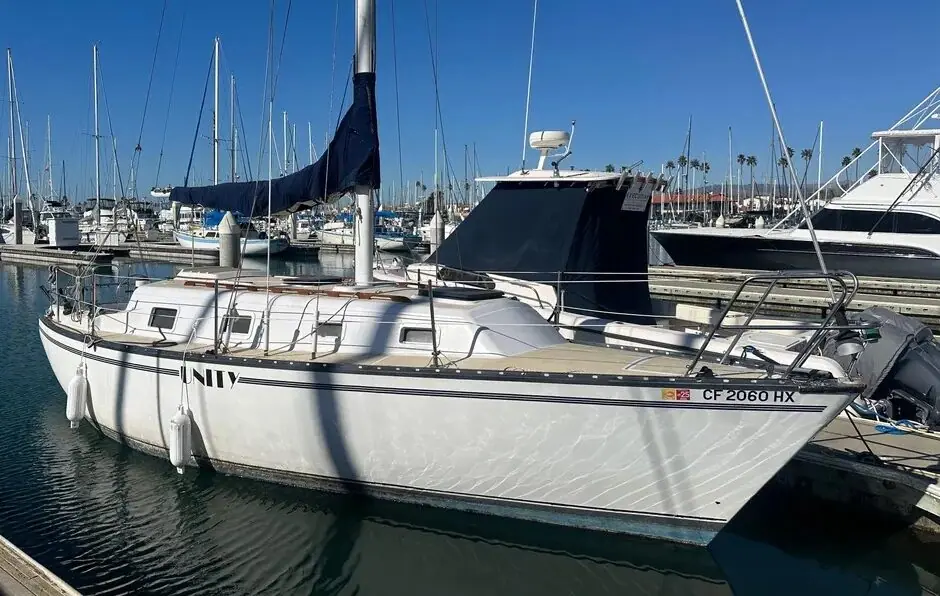
Practical Sailor raced a Hunter 30 in more than 20 knots of wind with old sails, almost no sail controls and a rough bottom, and still found it went to windward respectably in a serious fleet, reached and ran competitively, and took first in its main-and-jib class. The magazine described it as responsive and easy to steer, slightly under-rigged with its short mast, and better in a breeze than in light air. A 130 percent furling genoa suited heavy air; owners in light-air regions use 155 or 170 percent genoas.
Its PHRF rating of 186 in the New England fleet should be favorable, and Wikipedia lists ratings from 180 for the tall rig to 192 for the shoal boat. Rigged with modern sails and proper controls, it should keep pace with other 30 footers of its era such as the Pearson 30, the standard-rig Catalina 30 and the O'Day 30.
On deck: narrow side decks and painted nonskid
The wide cabinhouse shows where Cherubini's priorities lay. The side decks are narrow and getting past the chainplates to leeward under sail can mean climbing onto the cabin top. The foredeck is small, but 1978 and later boats have a self-draining anchor well large enough for two anchors. A wheel was standard, and a T-shaped cockpit replaced the original bench seats after the 1980 models; the older benches let you lie down but trap water and benefit from added drains.
Early Hunters used a painted-on nonskid aggregate rather than a molded pattern, so most boats have long since been repainted or covered with nonskid mat. Original deck gear was minimal: one pair of jib sheet winches, no main halyard winch, no vang, no backstay adjuster. Most surviving boats have been upgraded, and many are now rigged for singlehanding from the cockpit.
Interior volume was the selling point
Almost every owner Practical Sailor surveyed mentioned the space below, especially for the price. The layout is conventional: a V-berth forward with storage beneath, a roomy enclosed head with a shower and a hanging locker opposite, settee berths either side of a drop-leaf table, an L-shaped galley with the sink under the companionway, and a quarter berth to port with a small chart table at its head. Hunter was one of the first production builders to fit numerous opening ports as standard.
The finish is plain and the joinery was a common complaint, along with door hinges and hardware. The original alcohol stove, thin icebox insulation and small water tank have been replaced or upgraded on most boats. The teak veneer cabin sole cannot easily be repaired after water damage and often has to be replaced.
Yanmar 12, 15 or 18, and the repower question
For the first four years the standard engine was a 12 hp Yanmar, reliable but noisy and prone to vibration. After 1978 Hunter fitted a 15 hp Yanmar, later an 18 hp. Most owners considered the power minimal in a head sea. Engine access was criticized by almost everyone Practical Sailor surveyed, and the skeg ahead of the rudder means removing the shaft can require pulling the engine first.
Many boats have been repowered, commonly with a Yanmar 2QM15 or 2GM20F. A documented repower and a three-blade prop make a real difference to usability, though the larger prop costs some sailing speed. Fuel capacity is only about 12 gallons.
The other Hunter 30s: 30-2, 30T and the 2006 boat
Hunter sold the Hunter 30 name on several more boats. The Hunter 30 built from 1988 to 1992, now called the 30-2, is a 10,500 pound fractional-rigged boat with a wing keel drawing 4 ft 3 in, a walk-through reverse transom, 18 gallons of fuel and 37 of water. The Hunter 30T of 1991 to 1994 developed it with a T-shaped cockpit, a swim platform, an 18 hp diesel and sleeping for seven. Adding to the confusion, Wikipedia notes that the 2006 Hunter 31 was also marketed as a Hunter 30.
These later boats have more modern interiors and swim platforms, and owners searching for a hunter 30t sailboat are usually after that extra volume and the easier boarding. They trade a little higher than the Cherubini original but share none of its parts.
Hunter boats after the company
Hunter Marine went through Chapter 11 in 2012 and was sold to David Marlow, becoming Marlow-Hunter. Practical Sailor reports that the company is now closed. For a boat that left production in 1983 this changes little: parts are generic, the Yanmar engines are well supported, and a large network of owners shares refit knowledge. Expect roughly $4,500 to $11,000 a year for a slip or mooring, insurance, haul-out, engine service and small parts.
Hunter 30 specifications
| Length overall | 30.4 ft9.27 m |
|---|---|
| Waterline length | 25.8 ft7.85 m |
| Beam | 10.2 ft3.1 m |
| Draft | 5.3 ft1.6 m |
| Displacement | 9,7 lbs4,4 kg |
| Ballast | 4,1 lbs1,86 kg |
| Sail area | 453 sq ft42.1 m² |
| Fuel capacity | 12 gal45 L |
| Fresh water | 33 gal125 L |
| Cabins | 1 forward cabin plus saloon |
| Berths | 5 to 6 (V-berth, two settees, quarter berth) |
| Heads | 1 enclosed with shower |
| Standard engines | Yanmar diesel: 12 hp on early boats, 15 hp after 1978, later 18 hp |
| Hull type | Fin keel monohull with skeg-hung rudder |
| Keel | Fin keel 5 ft 3 in, shoal keel about 4 ft 3 in, or keel and centerboard |
| Rig | Masthead sloop, standard or tall rig |
| Hull construction | Solid fiberglass hull, balsa-cored deck, lead fin keel |
| Builder | Hunter Marine, United States |
| Naval architect | John Cherubini |
| Production | 1973 to 1983 |
| Status | Discontinued |
Figures come from builder documentation and independent tests where available. Displacement is usually quoted light, so a loaded cruising boat will weigh more. Compare these specs with another model.
How much does a Hunter 30 cost?
Practical Sailor put the average price of a Hunter 30 at about $12,000 in 2016, in line with the Catalina 30 and Pearson 30 of the same age. In 2026 the original Cherubini boat trades roughly between $7,000 and $20,000, with repowered, re-rigged boats with furling and refrigeration at the top. The later 30-2 and 30T, with their wing keels and walk-through transoms, generally ask more, up to the high $20,000s for good examples. A soft deck, a sagging cabin top at the mast or an original 12 hp engine pulls price down sharply.
Estimate your yearly cost
A planning estimate using common rules of thumb: insurance near 1.5 percent of value, maintenance near 3 percent, haul out and bottom paint by length. Your marina, region and use will move these numbers. Open the full cost calculator.
Versions and options
- Hunter 30 (1973 to 1983)
- Cherubini masthead sloop with fin, shoal or keel and centerboard options and a standard or tall rig.
- Quest 30
- Unfinished kit version of the same hull for owner completion.
- Hunter 30-2 (1988 to 1992)
- Fractional rig, wing keel, walk-through transom, 10,500 lb.
- Hunter 30T (1991 to 1994)
- Development of the 30-2 with a T-shaped cockpit, swim platform and 18 hp diesel.
Hunter 30 timeline
- 1973Hunter Marine starts in Alachua, Florida; the Cherubini Hunter 30 is among its first models
- 1978Anchor well added to the foredeck and a 15 hp Yanmar replaces the 12 hp
- 1980T-shaped cockpit becomes standard after the 1980 models
- 1983Production of the original Hunter 30 ends after about 1,000 boats
- 1988An all-new Hunter 30, now called the 30-2, is introduced
- 2012Hunter Marine is sold out of Chapter 11 and becomes Marlow-Hunter
Strengths and weaknesses
What owners like
- Very low purchase price for a diesel 30 footer
- Roomy interior with an enclosed head and shower
- Sails better than expected, especially in a breeze
- Large anchor well on 1978 and later boats
- Many already repowered and rigged for singlehanding
What to weigh up
- Narrow side decks and a small foredeck
- Poor engine access and minimal original power
- Variable original build quality and joinery
- Known compression post and delamination issues
- Small fuel and water tanks
Used Hunter 30 buyer checklist
Take this list to a viewing. Your ticks are saved in this browser so you can come back to it.
Always commission an independent marine survey and an engine survey before you buy. How a marine survey works.
Rivals to consider
Catalina 30
The best-selling rival, nine inches wider with a bigger parts and owner network.
Compare side by sidePearson 30
A livelier Bill Shaw design of the same era, often favored by club racers.
O'Day 30
A similar-sized, similarly priced 1970s cruiser with a comparable PHRF rating.
Hunter 33
The step up within the Hunter family for buyers wanting more space and a newer boat.
Compare side by sideOur verdict on the Hunter 30
The Hunter 30 was built to a price, and it shows in the joinery, the narrow decks and the cramped engine bay. Yet nearly fifty years later it still delivers what Hunter promised: a lot of boat for very little money, a roomy interior and a hull that sails better than many owners expect. Buy one that has already been repowered and re-rigged, check the deck, mast step and keel joint carefully, and it will make a capable, inexpensive coastal cruiser. Just be sure which Hunter 30 you are buying, because the later 30-2 and 30T are entirely different boats.
Hunter 30 questions answered
How much is a Hunter 30 sailboat worth?
Original 1973 to 1983 boats typically trade between about $7,000 and $20,000 in 2026. Practical Sailor put the average at about $12,000 in 2016.
Who designed the Hunter 30?
John Cherubini designed the original Hunter 30 and Hunter's other early boats.
What is the difference between the Hunter 30 and the Hunter 30T?
The Hunter 30T of 1991 to 1994 is a different, fractional-rigged design with a wing keel and a T-shaped cockpit, developed from the 1988 Hunter 30-2.
How many Hunter 30s were built?
About 1,000 of the original Cherubini Hunter 30 were built from 1973 to 1983, including some finished as Quest 30 kits.
What engine does the Hunter 30 have?
A Yanmar diesel: 12 hp for the first years, 15 hp after 1978 and later 18 hp. Many have since been repowered.
Are Hunter boats still made?
No. Hunter became Marlow-Hunter in 2012, and Practical Sailor reports the company has since closed.
Hunter 30 photos
More cruising sailboats to explore
Dufour 30 Classic
Cruising Sailboats, 31 ft
Used $22K to $42K
Catalina 30
Cruising Sailboats, 30 ft
Used $8K to $58K
Bavaria 30 Cruiser
Cruising Sailboats, 31 ft
Used $38K to $62K
Beneteau Oceanis 30.1
Cruising Sailboats, 31 ft
Used $95K to $175K