Oceanis 393 and Beneteau 393 Buyer's Guide
Born at the 2000 Paris show and built in France and South Carolina, the 39 footer that put a private suite forward and two heads in every boat.
- Length
- 39.3 ft11.99 m
- Beam
- 13 ft3.96 m
- Draft
- 6.3 ft1.9 m
- Cabins
- 2 or 3
- Used price
- $72K to $118K
On this page
- Overview
- Paris debut, South Carolina production
- A scaled-down 473 with a longer waterline
- Deep fin, shoal fin and why the shoal one weighs more
- A suite forward, and two ways to finish the back half
- A T-shaped cockpit and a traveler ahead of the dodger
- Westerbeke 40, tankage and how it was built
- Beneteau 393 for sale in 2026
- Specifications
- Price and value
- Strengths and weaknesses
- Used buyer checklist
- Rivals
- Our verdict
- FAQ
The Beneteau Oceanis 393, also sold as the Oceanis Clipper 393 and the Beneteau 393, is a Berret-Racoupeau 39 footer built from 2001 to 2007 with two or three cabins and two heads. Its hull later became the Cyclades 39.3.
- Couples who want an owner's suite
- Families who need two heads
- East Coast and Bahamas cruising with the shoal keel
Beneteau Oceanis Clipper 393 by the numbers
- Sail area to displacement
- 18.5Balanced power for coastal and offshore cruising.
- Displacement to length
- 177Light displacement for its length, quick but sensitive to added cruising weight.
- Theoretical hull speed
- 7.9 knThe practical top speed of a displacement monohull under normal sailing, based on waterline length.
- Ballast ratio
- 27%Relatively low ballast, form stability does more of the work.
- Capsize screening
- 2.02Above 2.0, so this hull leans toward coastal stability over ultimate offshore resistance.
- Motion comfort ratio
- 23.9A quicker motion in waves, typical of light, beamy hulls.
- Length to beam ratio
- 3.03 : 1Moderate proportions.
Paris debut, South Carolina production
The Oceanis 393 was unveiled at the Paris Boat Show in the winter of 2000 and, according to Beneteau USA's June 2001 announcement, had already passed 250 orders in Europe by that summer. It reached American shows that fall as the Beneteau 393 for the 2002 model year, and Wayne Burdick called it the first totally new model built at the recently expanded factory in Marion, South Carolina. Practical Sailor later reported 72 US orders in the first year.
Beneteau presented it as a smaller sister of the 473, which had won Cruising World's Best Production Cruiser over $200,000 award in 2001, and drew both with Berret-Racoupeau. In Europe the boat was sold as the Oceanis Clipper 393, in the US as the Beneteau 393 or Oceanis 393, and to the Moorings fleet as the Moorings 403.
Production totals differ by source. Practical Sailor says 600 were built between 2002 and 2007; PBO puts the total, counting both sides of the Atlantic, above 700. Either way the 393 was one of the most successful 39 footers of its decade, and the Beneteau 40 replaced it in 2007.
A scaled-down 473 with a longer waterline
Beneteau USA listed the 393 at 39 ft 4 in overall with a 35 ft 1 in waterline, a 13 ft beam and 17,152 lb of displacement. Burdick told Practical Sailor that the new boat had more than two feet of extra waterline over the Oceanis 381 it replaced, plus a sail area to displacement ratio raised from about 14.5 to about 16, and that the generous beam was a deliberate step toward form stability and speed.
Practical Sailor described the hull as relatively flat-bottomed, with powerful aft sections and an eased turn of the bilge, and noted that the 393 relies more on its 13 ft 1 in beam than on ballast, at a ballast ratio of about 31 percent. The trade-off of that flat bottom is a shallow bilge, though a deep sump keeps water away from the cabin sole.
Deep fin, shoal fin and why the shoal one weighs more
The 393 belongs to what PBO calls the third Oceanis generation, the models ending in 3 that began with the 473. Their big change was the option of deep, low center of gravity keels and higher aspect rudders, which improved handling, windward speed and ultimate stability over the lightly ballasted early Oceanis boats.
Two cast iron keels were offered: a deep fin drawing 6 ft 3 in and a shoal fin drawing 5 ft 1 in. To keep righting moment on the shallower keel, Beneteau added low-slung ballast; PBO lists about 4,650 lb for the deep keel and about 5,380 lb for the shoal. Shoal boats were popular in the US, and Beneteau USA's own spec listed the 5 ft 1 in draft as standard.
Thin-water cruisers will live happily with the shoal fin. For going farther afield, Practical Sailor recommended the deep keel, a classic main and close attention to the rig.
A suite forward, and two ways to finish the back half
Every 393 has the same forward end: an owner's cabin with an offset double berth, a small settee and a passage leading to a private head and shower right in the bow. It is an unusual arrangement for a 39 footer and one of the boat's best features. The saloon, with a U-shaped dinette for about eight, a central bench and three large deck windows overhead, is common to both versions, as is a second head aft.
In the two cabin version tested by Cruising World, a large athwartships double sits under the cockpit to starboard, a U-shaped galley lies to port by the companionway, and a navigation desk and a big bar and cabinet unit take the place of a starboard settee. That cabinet adds storage but costs a sea berth. In the three cabin version two fore-and-aft doubles sit under the cockpit, the chart table moves to port and a linear galley runs along the starboard side.
Practical Sailor called the choice too close to call. The three cabin boat has a bigger, dedicated navigation station and an extra hanging locker, but loses the good cockpit locker, and its linear galley is less secure at sea. For a couple, the two cabin boat with its U-shaped galley and huge aft double is our pick.
- Both layouts: forward suite with ensuite head, U-shaped dinette, second head aft
- Two cabins: athwartships aft double, U-shaped galley, bar cabinet, big cockpit locker
- Three cabins: two aft doubles, linear galley, larger chart table, extra hanging locker
A T-shaped cockpit and a traveler ahead of the dodger
Cruising World sailed a two cabin boat on Narragansett Bay in about 17 knots of gusty southwesterly and steep, tide-opposed waves. Hard on the wind it punched through at around 6.5 knots and the cockpit stayed surprisingly dry without a dodger; reaching, the fine entry and broad flat aft sections made it, in the reviewer's words, a blast. All lines lead aft, single-line reefing worked quickly and the T-shaped cockpit lets crew move easily around the single wheel.
Practical Sailor sailed one off Newport in 12 knots. Pinched to 30 degrees apparent it slid to leeward, but at about 40 degrees it was balanced and weatherly, tacking consistently inside 85 degrees, and the deep rudder resisted ventilating when pressed. Both magazines wanted a centerline foot brace, because the cockpit well is too wide to brace across.
The mainsheet traveler sits on the coachroof forward of the sprayhood, with the sheet handled at the companionway. That keeps the cockpit clear, but it means the helmsman cannot trim the main, which matters when sailing shorthanded.
Westerbeke 40, tankage and how it was built
US boats have a 40 hp Westerbeke diesel, and Cruising World found the boat handled exceptionally well under power in gusty harbor conditions. Access from beneath the companionway and both quarter cabins is very good. Beneteau USA listed 36 gallons of fuel and 119 gallons of water, while Practical Sailor quoted 35 and 130.
Construction is solid glass with a structural grid, a balsa-cored deck that is solid where hardware is mounted, and an inward-turned hull flange that takes the deck on a bed of sealant, bolted at cleats and stanchions and screwed on six inch centers elsewhere. The mast is deck-stepped with a babystay; Practical Sailor thought a 39 footer deserved a keel-stepped mast and advised owners to dote on the rig. The iron keel's coating must be kept intact so the metal never meets the water.
Beneteau 393 for sale in 2026
We estimate US asking prices of roughly $72,000 to $118,000 in 2026, with 2002 to 2003 boats at the lower end and well kept 2006 to 2007 boats at the top. European Clipper 393 listings we saw ranged from about 65,000 to 86,000 euros for 2001 to 2004 boats, and PBO puts typical UK sales at 70,000 to 90,000 pounds.
Running a 393 in the US costs about $9,500 to $18,000 a year. Beyond the usual slip, insurance and haul-out, budget for standing rigging and furling gear on any boat without recent receipts. If you see a Cyclades 39.3 at a lower price, remember it shares the hull but has a cored hull, twin wheels and a charter-only layout.
Beneteau Oceanis Clipper 393 specifications
| Length overall | 39.3 ft11.99 m |
|---|---|
| Waterline length | 35.1 ft10.69 m |
| Beam | 13 ft3.96 m |
| Draft | 6.3 ft1.9 m |
| Air draft | 51.5 ft15.7 m |
| Displacement | 17,152 lbs7,78 kg |
| Ballast | 4,65 lbs2,109 kg |
| Sail area | 771 sq ft75 m² |
| Fuel capacity | 36 gal135 L |
| Fresh water | 119 gal45 L |
| Cabins | 2 or 3 |
| Berths | 4 to 6, plus saloon |
| Heads | 2 |
| Standard engines | 40 hp Westerbeke diesel on US boats; sailboatdata and Wikipedia list a 40 hp Volvo for European boats |
| Hull type | Beamy fin keel monohull with balanced spade rudder |
| Keel | Cast iron fin: deep 6 ft 3 in (about 4,650 lb ballast) or shoal 5 ft 1 in (about 5,380 lb) |
| Rig | Masthead sloop on a deck-stepped mast, in-mast furling main standard, classic main optional |
| Hull construction | Solid fiberglass hull with bonded structural grid and liner; balsa-cored deck |
| CE design category | A8 / B10 |
| Builder | Beneteau (France, and Beneteau USA in Marion, South Carolina), France |
| Naval architect | Berret-Racoupeau Yacht Design |
| Production | 2001 to 2007 |
| Status | Discontinued |
Figures come from builder documentation and independent tests where available. Displacement is usually quoted light, so a loaded cruising boat will weigh more. Compare these specs with another model.
How much does a Beneteau Oceanis Clipper 393 cost?
Practical Sailor put the base price under $140,000 while the boat was new, and Cruising World's 2002 test boat with electronics came to $138,000. Today the two cabin layout, a deep keel, a classic main and documented engine and rigging work add the most value. European listings we reviewed ran from about 65,000 to 86,000 euros.
Estimate your yearly cost
A planning estimate using common rules of thumb: insurance near 1.5 percent of value, maintenance near 3 percent, haul out and bottom paint by length. Your marina, region and use will move these numbers. Open the full cost calculator.
Versions and options
- Two cabin
- Owner's suite forward, athwartships double aft, U-shaped galley, bar cabinet and large cockpit locker.
- Three cabin
- Two aft doubles, linear galley to starboard, larger chart table to port.
- Deep and shoal keels
- 6 ft 3 in deep fin or 5 ft 1 in shoal fin with extra low ballast.
- Moorings 403
- Charter version for the Moorings fleet.
- Cyclades 39.3
- 2007 charter derivative on the same hull with twin wheels and a balsa-cored hull.
Beneteau Oceanis Clipper 393 timeline
- 2000Shown at the Paris Boat Show as the Oceanis Clipper 393
- 2001Beneteau USA announces the 393 for fall shows, built in Marion, South Carolina
- 2002Cruising World tests the 393; first US model year
- 2007Production ends; the Beneteau 40 replaces it and the hull becomes the Cyclades 39.3
Strengths and weaknesses
What owners like
- Owner's suite with private head in the bow
- Two heads in both layouts
- Long waterline and good reaching speed
- Bright saloon with large deck windows
- Choice of deep or heavier shoal keel
- Excellent engine access
What to weigh up
- Mainsheet not reachable from the helm
- Cockpit too wide to brace without a foot block
- Deck-stepped mast relies on a babystay
- Shallow bilge
- In-mast furling main on most boats limits windward performance
Used Beneteau Oceanis Clipper 393 buyer checklist
Take this list to a viewing. Your ticks are saved in this browser so you can come back to it.
Always commission an independent marine survey and an engine survey before you buy. How a marine survey works.
Rivals to consider
Jeanneau Sun Odyssey 40
Sister-group French rival from the same period.
Bavaria 40
PBO's chosen alternative, sold in large numbers in Europe from 2000 with two heads in both layouts.
Catalina 387
American-built rival with a more traditional interior.
Beneteau Cyclades 39.3
Twin-wheel charter version on the same hull, usually cheaper.
Compare side by sideOur verdict on the Beneteau Oceanis Clipper 393
The Beneteau 393 is one of the best value cruisers of the early 2000s. Its owner's suite with a private head forward is still unusual at 39 ft, it has two heads in every version, a long waterline and a hull that reaches well and stays dry. The weak spots are the deck-stepped rig, a mainsheet the helmsman cannot reach and a cockpit with nowhere to brace. Choose a two cabin boat with a sound rig and a healthy engine, add a foot brace, and it is a comfortable, capable coastal cruiser that will hold its value well.
Beneteau Oceanis Clipper 393 questions answered
Is the Beneteau 393 the same as the Oceanis 393 and Clipper 393?
Yes. Oceanis Clipper 393 was the European name, Beneteau 393 and Oceanis 393 were used in the US, and the Moorings 403 was the charter version.
How many Beneteau 393s were built?
Practical Sailor says 600 between 2002 and 2007; PBO says more than 700 in Europe and North America.
What engine does the Beneteau 393 have?
US-built boats have a 40 hp Westerbeke; sailboatdata and Wikipedia list a 40 hp Volvo, typical of European boats.
What is the draft of the Oceanis 393?
6 ft 3 in with the deep keel or 5 ft 1 in with the shoal keel.
How much is a Beneteau 393 for sale?
About $72,000 to $118,000 in the US in 2026.
What replaced the Beneteau 393?
The Berret-Racoupeau Beneteau 40, or Oceanis 40, in 2007.
Photos from the Beneteau range
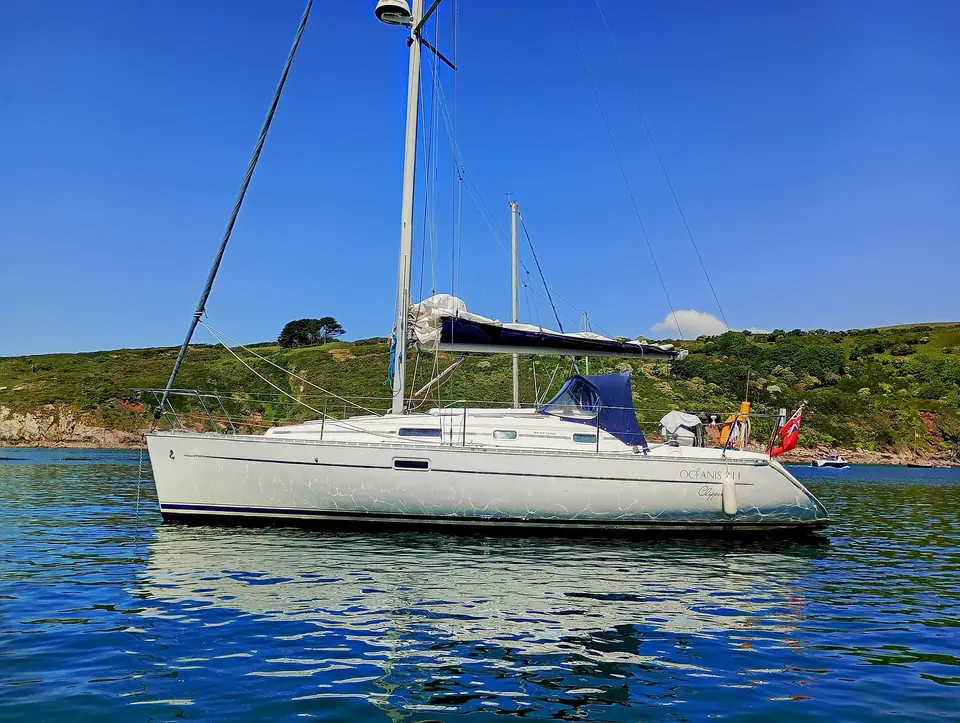
We have not found a freely licensed photo of the Beneteau Oceanis Clipper 393 yet, so these show other Beneteau boats, each captioned with the boat pictured.
More cruising sailboats to explore
Elan Impression 40.1
Cruising Sailboats, 39 ft
Used $120K to $235K
Beneteau Cyclades 39.3
Cruising Sailboats, 39 ft
Used $65K to $105K
Delphia 40
Cruising Sailboats, 39 ft
Used $70K to $115K
Dufour 390 Grand Large
Cruising Sailboats, 39 ft
Used $175K to $260K
Other Beneteau models
- Beneteau 49
- Beneteau 50
- Beneteau 57
- Beneteau 343
- Beneteau Antares 5.80
- Beneteau Antares 6
- Beneteau Antares 6.80
- Beneteau Antares 7
- Beneteau Antares 7.30
- Beneteau Antares 7.60
- Beneteau Antares 7.80
- Beneteau Antares 8
- Beneteau Antares 8.00
- Beneteau Antares 8.05
- Beneteau Antares 8.60
- Beneteau Antares 8.80
- Beneteau Antares 9
- Beneteau Antares 9.80
- Beneteau Antares 10.80
- Beneteau Antares 11
- Beneteau Antares 12
- Beneteau Antares 13.80
- Beneteau Antares 30
- Beneteau Antares 32
- Beneteau Antares 36
- Beneteau Antares 42
- Beneteau Antares 620 HB
- Beneteau Antares 650 HB
- Beneteau Antares 750 HB
- Beneteau Cyclades 39.3
- Beneteau Cyclades 43.3 and 43.4
- Beneteau Cyclades 50.5
- Beneteau First 18 SE
- Beneteau First 20
- Beneteau First 21.7
- Beneteau First 24
- Beneteau First 25
- Beneteau First 25.7
- Beneteau First 27
- Beneteau First 27.7
- Beneteau First 30
- Beneteau First 31.7
- Beneteau First 35
- Beneteau First 36
- Beneteau First 36.7
- Beneteau First 38
- Beneteau First 40
- Beneteau First 40.7
- Beneteau First 44
- Beneteau First 45
- Beneteau First 47.7
- Beneteau First 53
- Beneteau First 211
- Beneteau First 235
- Beneteau First 285
- Beneteau First 305
- Beneteau First 310
- Beneteau First 345
- Beneteau Flyer 6
- Beneteau Flyer 7
- Beneteau Flyer 8
- Beneteau Flyer 9
- Beneteau Flyer 10
- Beneteau Flyer 12
- Beneteau Flyer 500
- Beneteau Flyer 550
- Beneteau Flyer 650
- Beneteau Flyer 701
- Beneteau Flyer 750
- Beneteau Grand Trawler 62
- Beneteau Gran Turismo 32
- Beneteau Gran Turismo 36
- Beneteau Gran Turismo 40
- Beneteau Gran Turismo 41
- Beneteau Gran Turismo 44
- Beneteau Gran Turismo 45
- Beneteau Monte Carlo 6
- Beneteau Oceanis 30.1
- Beneteau Oceanis 31
- Beneteau Oceanis 34
- Beneteau Oceanis 34.1
- Beneteau Oceanis 35
- Beneteau Oceanis 35.1
- Beneteau Oceanis 36 CC
- Beneteau Oceanis 37
- Beneteau Oceanis 38
- Beneteau Oceanis 38.1
- Beneteau Oceanis 40
- Beneteau Oceanis 40 CC
- Beneteau Oceanis 41
- Beneteau Oceanis 41.1
- Beneteau Oceanis 42
- Beneteau Oceanis 42 CC
- Beneteau Oceanis 43
- Beneteau Oceanis 44 CC
- Beneteau Oceanis 45
- Beneteau Oceanis 46
- Beneteau Oceanis 46.1
- Beneteau Oceanis 48
- Beneteau Oceanis 50
- Beneteau Oceanis 51.1
- Beneteau Oceanis 54
- Beneteau Oceanis 55
- Beneteau Oceanis 58
- Beneteau Oceanis 311
- Beneteau Oceanis 320
- Beneteau Oceanis 321
- Beneteau Oceanis 323
- Beneteau Oceanis 331
- Beneteau Oceanis 350
- Beneteau Oceanis 351
- Beneteau Oceanis 370
- Beneteau Oceanis 390
- Beneteau Oceanis 400
- Beneteau Oceanis 411
- Beneteau Oceanis 423
- Beneteau Oceanis 430
- Beneteau Oceanis 440
- Beneteau Oceanis 461
- Beneteau Oceanis 473
- Beneteau Oceanis 500
- Beneteau Oceanis 510
- Beneteau Oceanis Clipper 361
- Beneteau Oceanis Clipper 373
- Beneteau Oceanis Clipper 381
- Beneteau Oceanis Yacht 54
- Beneteau Oceanis Yacht 60
- Beneteau Oceanis Yacht 62
- Beneteau Sense 43
- Beneteau Sense 46
- Beneteau Sense 50
- Beneteau Sense 55
- Beneteau Swift Trawler 30
- Beneteau Swift Trawler 34
- Beneteau Swift Trawler 35
- Beneteau Swift Trawler 41
- Beneteau Swift Trawler 44
- Beneteau Swift Trawler 48
- All Beneteau models