Beneteau Sport Yachts & Express Cruisers
Beneteau Antares 730, History, Specs and Restoration Buying Notes
A 24 ft semi-planing diesel pilothouse from the late 1980s, drawn by Andre Beneteau, with an owner's double forward and a deck saloon that sleeps two more.
- Length
- 24 ft7.3 m
- Beam
- 8.7 ft2.65 m
- Cruise
- 2.6 ft0.8 m
- Cabins
- 1 owner's cabin forward plus deck saloon
- Used price
- $10K to $28K
On this page
- Overview
- Where the Antares 730 fits in Beneteau's history
- Andre Beneteau's semi-planing hull
- Two double berths in 24 feet
- Deck details aimed at fishermen
- Engines and what to expect underway
- Buying a 7.30 as a restoration project
- Running costs and the boats that followed
- Specifications
- Price and value
- Strengths and weaknesses
- Used buyer checklist
- Rivals
- Our verdict
- FAQ
The Antares 7.30 belongs to Beneteau's second Antares generation (1987 to 1990). It is 7.30 m (24 ft) overall, 2.65 m wide, about 2,200 kg, with a single inboard diesel of up to 105 hp, berths for four and a long keel that protects hull and propeller.
- Restoration-minded buyers
- Fishing and pottering at modest speed
- Couples who want a classic look
- Owners in tidal harbors who may dry out
Beneteau Antares 7.30 by the numbers
- Horsepower per ton
- 43 hpStrong power to weight for a planing hull.
- Displacement hull speed
- 5.9 knThe efficient cruising speed for a displacement hull of this waterline.
- Length to beam ratio
- 2.76 : 1A beamy hull with lots of volume for its length.
Where the Antares 730 fits in Beneteau's history
Beneteau splits its Antares story into generations, and the Antares 730 belongs to the short second one, 1987 to 1990. Beneteau's own retrospective says that from 1987 seaworthiness and habitability became the hallmarks of the range, and the 7.30 is a good example: a 24 ft diesel launch that its brochure says can go urchin diving off Porquerolles or drop lobster pots off Belle-Ile and still offer an owner's cabin, a deck saloon, a galley and a toilet.
Its siblings in that generation were the Antares 5.60, 6.40, 8.00, 8.60, 9.20, 10.20 and 11.20. The 11.20 is the famous one; Beneteau notes that Luc Besson's crew used an Antares 11.20 to film the dolphins in The Big Blue in 1988. The 7.30 is the modest member of the family, which is exactly why it is worth understanding before you buy one as a project.
Andre Beneteau's semi-planing hull
The brochure credits Andre Beneteau with the design and describes a fast semi-planing hull that does not need much power and is remarkably stable. As on professional fishing boats, a long keel gives excellent directional stability, useful when trolling, and protects the hull and propeller so the boat can take the ground. Pinched forward sections let the hull pass gently through a short chop, and a tulip-shaped, flared bow throws spray aside.
Beneteau also pointed out that France's sea rescue service, the SNSM, had chosen Antares boats for part of its fleet, a strong endorsement for a builder selling seaworthiness. The brochure's structural drawing shows a hull stiffened according to load paths, like a traditional wooden boat: 15 mm longitudinal members are encapsulated in polyester along the full length, extra stringers stiffen the topsides, and the deck and coachroof are balsa-cored sandwich for rigidity and insulation.
- LOA 7.30 m (23 ft 11 in), hull 6.95 m, waterline 6.00 m
- Maximum beam 2.65 m (8 ft 8 in), draft 0.80 m (2 ft 7 in)
- Displacement about 2,200 kg (4,850 lbs)
- Maximum engine power 105 hp (92 kW)
- Sleeps four; French 3rd category approval for 4 or 7 persons
Two double berths in 24 feet
The headline feature, according to the brochure, is that a boat this size offers a double cabin for the owner forward and a deck saloon that converts at night into a second double, with a galley corner and a separate toilet. The deck saloon is reached from the cockpit through a sliding door and seats four to five around the dinette with a panoramic view, ventilated by sliding side windows and an opening roof panel.
The helm is a proper little bridge: a sheathed wheel, engine instruments, an electrical panel and space for electronics. The galley has a sink and stove, and the joinery is warm varnished wood with the patterned upholstery of its era. Treat any 7.30 interior as dated but repairable; foam, fabrics and headliners are the usual first jobs.
Deck details aimed at fishermen
Beneteau was proud of the small details. The aft bench has two retractable wooden panels that clear the cockpit when you want to fish. The self-bailing cockpit is deep enough to feel secure, and a large lockable hold under the floor swallows gear. If the steering fails, an emergency tiller fits through an aft hatch, which the brochure notes trolling fishermen will appreciate.
Two steps on each side lead to the side decks, hand rails are well placed, and a solid stainless rail runs from the bow to the cockpit. Forward, a stainless stem fitting with built-in fairleads and a roller makes anchoring easy, and the anchor lives in a dedicated well.
Engines and what to expect underway
Beneteau's spec table gives a 105 hp (92 kW) maximum and the copy speaks of brilliant performance even with a diesel of moderate power. Engine choices varied by market and year, and after more than 35 years many boats have been repowered, so verify what is actually installed, its hours and the shaft, coupling and stern gear.
We have no published speed or fuel figures for the 7.30 and will not invent them. As a guide to the breed, Beneteau's 2004 sheet for the 6.22 m Antares 620 inboard quoted about 12 knots cruising and 18 knots flat out with an 85 hp diesel, and the larger 7.60 was quoted at about 18 knots cruise and 24 knots top with 200 hp. A heavier, lower-powered 7.30 should sit closer to the slower end of that range, happiest at a semi-planing cruise rather than flat out.
Buying a 7.30 as a restoration project
Every Antares 730 for sale today is a late-1980s boat, so judge it as you would any classic diesel launch. The hull itself is usually sound; the risk is in the engine, the wiring, the fuel tank and anything wooden. Ask for a survey with moisture readings in the deck around fittings, and pull the floor panels to see the stringers, tank straps and bilge.
Original fuel and water tank capacities were not given in the brochure we read, so confirm them on the boat. Tank replacement is a common job on boats of this age and worth pricing before you make an offer.
Running costs and the boats that followed
A small diesel is economical, but old systems eat money. We estimate 4,000 to 10,000 dollars a year for a 7.30 kept afloat in Europe, including mooring, haul-out and antifouling, insurance and engine service, with a one-off refit budget on top. Parts for the hull and deck hardware are generic; engine parts depend on what is installed.
If you like the idea but not the age, the third-generation Antares 7.60 offers a similar diesel formula with an enclosed heads with shower and a 200 hp ceiling, and later boats such as the 2000s Antares 7 brought Patrice Sarrazin's modern styling to the same size.
Beneteau Antares 7.30 specifications
| Length overall | 24 ft7.3 m |
|---|---|
| Waterline length | 19.7 ft6 m |
| Beam | 8.7 ft2.65 m |
| Draft | 2.6 ft0.8 m |
| Displacement | 4,85 lbs2,2 kg |
| Cabins | 1 owner's cabin forward plus deck saloon |
| Berths | 4 (forward double plus convertible saloon dinette) |
| Heads | 1 toilet compartment |
| Maximum persons | 7 |
| Standard engines | Single inboard diesel on a shaft, maximum 105 hp (92 kW) |
| Maximum power | 105 hp |
| Hull type | Semi-planing monohull with long keel protecting hull and propeller, flared bow |
| Hull construction | Polyester (GRP) hull with encapsulated longitudinal stiffeners; balsa-cored sandwich deck and coachroof |
| CE design category | Pre-CE French 3rd category (4 persons sleeping, 7 aboard) |
| Builder | Chantiers Beneteau, France |
| Naval architect | Andre Beneteau |
| Production | 1987 to 1990 |
| Status | Discontinued |
Figures come from builder documentation and independent tests where available. Displacement is usually quoted light, so a loaded cruising boat will weigh more. Compare these specs with another model.
How much does a Beneteau Antares 7.30 cost?
We found no Antares 7.30 listed for sale when we checked, so these are estimates based on comparable Antares diesels of the 1990s, which ask around 17,000 to 30,000 euros in France. On a boat this old the engine and its history decide the price: a recent diesel repower can double the value of a boat with a tired original engine. Expect almost all candidates to be in France or elsewhere in Europe.
Estimate your yearly cost
A planning estimate using common rules of thumb: insurance near 1.5 percent of value, maintenance near 3 percent, haul out and bottom paint by length. Your marina, region and use will move these numbers. Open the full cost calculator.
Versions and options
- Antares 7.30 (1987 to 1990)
- Single version with inboard diesel up to 105 hp, owner's double cabin, convertible deck saloon, galley and toilet.
Beneteau Antares 7.30 timeline
- 1977Andre Beneteau launches the first Antares, the 7.50
- 1987Second Antares generation begins, including the Antares 7.30
- 1988The Antares 11.20 enters production and appears in The Big Blue
- 1990Second generation ends and the third Antares generation begins
Strengths and weaknesses
What owners like
- Two double berths and a toilet on a 24 ft hull
- Long keel protects propeller and allows grounding
- Economical semi-planing diesel formula
- Andre Beneteau design with SNSM credibility
- Low purchase price
What to weigh up
- Late-1980s systems and wiring
- Tank capacities and engine fitment vary
- No published performance data
- Very rare outside Europe
Used Beneteau Antares 7.30 buyer checklist
Take this list to a viewing. Your ticks are saved in this browser so you can come back to it.
Always commission an independent marine survey and an engine survey before you buy. How a marine survey works.
Rivals to consider
Beneteau Antares 7.60
The 1990s successor in spirit, heavier with up to 200 hp and an enclosed head with shower.
Compare side by sideJeanneau Merry Fisher 750
Jeanneau's wheelhouse boat of a similar length, the usual French alternative.
Arvor 230
A Brittany-built diesel fishing pilothouse with a similar working-boat character.
C-Dory 25 Cruiser
An American pocket cruiser of similar length if you would rather not import.
Compare side by sideOur verdict on the Beneteau Antares 7.30
The Antares 7.30 is a small piece of Beneteau history: an Andre Beneteau semi-planing diesel launch with two doubles, a toilet and a keel you can lean on, from the years when Antares became a cruising name. It is cheap to buy and full of practical touches, but every example is now a project, and the engine, tanks and wiring will decide whether it is a bargain. Buy the best-documented one you can find, and only if you enjoy bringing a classic back.
Beneteau Antares 7.30 questions answered
When was the Beneteau Antares 7.30 built?
Beneteau places it in the second Antares generation, from 1987 to 1990.
What engine does the Antares 730 have?
A single inboard diesel on a shaft, with a maximum of 105 hp (92 kW). Many boats have been repowered, so check the actual engine.
How many people does the Antares 7.30 sleep?
Four: an owner's double forward and a deck saloon dinette that converts to a second double.
How big is the Antares 7.30?
7.30 m (about 24 ft) overall, 6.95 m hull length, 6.00 m waterline, 2.65 m beam and 0.80 m draft, at about 2,200 kg.
Who designed the Antares 7.30?
Andre Beneteau, who drew the Antares semi-planing hulls of that era.
Is the Antares 730 the same as the Antares 7.60?
No. The 7.60 belongs to the following generation, with a larger hull, up to 200 hp and a heads compartment with shower.
Photos from the Beneteau range
We have not found a freely licensed photo of the Beneteau Antares 7.30 yet, so these show other Beneteau boats, each captioned with the boat pictured.
More sport yachts & express cruisers to explore
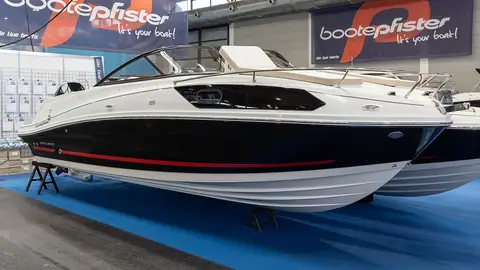
Bayliner 245 Cruiser
Sport Yachts & Express Cruisers, 24 ft
Used $12K to $48K
Beneteau Antares 7.80
Sport Yachts & Express Cruisers, 24 ft
Used $40K to $65K
Beneteau Antares 750 HB
Sport Yachts & Express Cruisers, 24 ft
Used $38K to $55K
Beneteau Flyer 701
Sport Yachts & Express Cruisers, 23 ft
Used $15K to $36K
Other Beneteau models
- Beneteau 49
- Beneteau 50
- Beneteau 57
- Beneteau 343
- Beneteau Antares 5.80
- Beneteau Antares 6
- Beneteau Antares 6.80
- Beneteau Antares 7
- Beneteau Antares 7.60
- Beneteau Antares 7.80
- Beneteau Antares 8
- Beneteau Antares 8.00
- Beneteau Antares 8.05
- Beneteau Antares 8.60
- Beneteau Antares 8.80
- Beneteau Antares 9
- Beneteau Antares 9.80
- Beneteau Antares 10.80
- Beneteau Antares 11
- Beneteau Antares 12
- Beneteau Antares 13.80
- Beneteau Antares 30
- Beneteau Antares 32
- Beneteau Antares 36
- Beneteau Antares 42
- Beneteau Antares 620 HB
- Beneteau Antares 650 HB
- Beneteau Antares 750 HB
- Beneteau Cyclades 39.3
- Beneteau Cyclades 43.3 and 43.4
- Beneteau Cyclades 50.5
- Beneteau First 18 SE
- Beneteau First 20
- Beneteau First 21.7
- Beneteau First 24
- Beneteau First 25
- Beneteau First 25.7
- Beneteau First 27
- Beneteau First 27.7
- Beneteau First 30
- Beneteau First 31.7
- Beneteau First 35
- Beneteau First 36
- Beneteau First 36.7
- Beneteau First 38
- Beneteau First 40
- Beneteau First 40.7
- Beneteau First 44
- Beneteau First 45
- Beneteau First 47.7
- Beneteau First 53
- Beneteau First 211
- Beneteau First 235
- Beneteau First 285
- Beneteau First 305
- Beneteau First 310
- Beneteau First 345
- Beneteau Flyer 6
- Beneteau Flyer 7
- Beneteau Flyer 8
- Beneteau Flyer 9
- Beneteau Flyer 10
- Beneteau Flyer 12
- Beneteau Flyer 500
- Beneteau Flyer 550
- Beneteau Flyer 650
- Beneteau Flyer 701
- Beneteau Flyer 750
- Beneteau Grand Trawler 62
- Beneteau Gran Turismo 32
- Beneteau Gran Turismo 36
- Beneteau Gran Turismo 40
- Beneteau Gran Turismo 41
- Beneteau Gran Turismo 44
- Beneteau Gran Turismo 45
- Beneteau Monte Carlo 6
- Beneteau Oceanis 30.1
- Beneteau Oceanis 31
- Beneteau Oceanis 34
- Beneteau Oceanis 34.1
- Beneteau Oceanis 35
- Beneteau Oceanis 35.1
- Beneteau Oceanis 36 CC
- Beneteau Oceanis 37
- Beneteau Oceanis 38
- Beneteau Oceanis 38.1
- Beneteau Oceanis 40
- Beneteau Oceanis 40 CC
- Beneteau Oceanis 41
- Beneteau Oceanis 41.1
- Beneteau Oceanis 42
- Beneteau Oceanis 42 CC
- Beneteau Oceanis 43
- Beneteau Oceanis 44 CC
- Beneteau Oceanis 45
- Beneteau Oceanis 46
- Beneteau Oceanis 46.1
- Beneteau Oceanis 48
- Beneteau Oceanis 50
- Beneteau Oceanis 51.1
- Beneteau Oceanis 54
- Beneteau Oceanis 55
- Beneteau Oceanis 58
- Beneteau Oceanis 311
- Beneteau Oceanis 320
- Beneteau Oceanis 321
- Beneteau Oceanis 323
- Beneteau Oceanis 331
- Beneteau Oceanis 350
- Beneteau Oceanis 351
- Beneteau Oceanis 370
- Beneteau Oceanis 390
- Beneteau Oceanis 400
- Beneteau Oceanis 411
- Beneteau Oceanis 423
- Beneteau Oceanis 430
- Beneteau Oceanis 440
- Beneteau Oceanis 461
- Beneteau Oceanis 473
- Beneteau Oceanis 500
- Beneteau Oceanis 510
- Beneteau Oceanis Clipper 361
- Beneteau Oceanis Clipper 373
- Beneteau Oceanis Clipper 381
- Beneteau Oceanis Clipper 393
- Beneteau Oceanis Yacht 54
- Beneteau Oceanis Yacht 60
- Beneteau Oceanis Yacht 62
- Beneteau Sense 43
- Beneteau Sense 46
- Beneteau Sense 50
- Beneteau Sense 55
- Beneteau Swift Trawler 30
- Beneteau Swift Trawler 34
- Beneteau Swift Trawler 35
- Beneteau Swift Trawler 41
- Beneteau Swift Trawler 44
- Beneteau Swift Trawler 48
- All Beneteau models