Beneteau Performance Sailboats
Beneteau First 45 Review and Used Buying Guide
Philippe Briand's 46-footer split the difference between the cruising First 50 and the raceboat First 34.7, and it still sails like a thoroughbred.
- Length
- 46.2 ft14.07 m
- Beam
- 13.8 ft4.19 m
- Draft
- 7.8 ft2.39 m
- Cabins
- 3 (owner's cabin forward, two doubles aft)
- Used price
- $185K to $290K
On this page
- Overview
- Why the Beneteau First 45 sits between two very different sisters
- Hull shape, ratios and what the numbers predict
- Test sail results from San Francisco Bay and the Solent
- A crew-friendly deck with a German mainsheet
- Owner's cabin forward, two doubles aft
- How Beneteau built it
- Running a 46 ft performance cruiser
- Finding a good one on the brokerage market
- Specifications
- Price and value
- Strengths and weaknesses
- Used buyer checklist
- Rivals
- Our verdict
- FAQ
The Beneteau First 45 is a Philippe Briand designed performance cruiser launched for 2008, with a 54 hp Yanmar, three cabins, a choice of three keels and a carbon rig option. It sells today only on the brokerage market.
- Couples who cruise fast and race occasionally
- IRC and PHRF club racers who want a comfortable boat
- Owners stepping up from a 35 to 40 ft First
- Coastal and island cruising
Beneteau First 45 by the numbers
- Sail area to displacement
- 18.5Balanced power for coastal and offshore cruising.
- Displacement to length
- 198Light displacement for its length, quick but sensitive to added cruising weight.
- Theoretical hull speed
- 8.3 knThe practical top speed of a displacement monohull under normal sailing, based on waterline length.
- Ballast ratio
- 34%A typical ballast ratio for a cruising monohull.
- Capsize screening
- 1.87Below 2.0, the traditional threshold for offshore suitability.
- Motion comfort ratio
- 29.3Moderate motion comfort, typical of modern cruisers.
- Length to beam ratio
- 3.36 : 1Moderate proportions.
Why the Beneteau First 45 sits between two very different sisters
When buyers search for the Beneteau 45 First, they nearly always mean the Philippe Briand boat that arrived for the 2008 season, not the Bruce Farr First 45f5 of 1990. Beneteau had launched the big First 50 in 2006 as a cruiser with a racing name, and the First 34.7 was a club racer with bunks. The First 45 was pitched squarely between them. Yachting World, testing it in 2008, called it a fast cruiser and noted that Beneteau insisted it was different from both siblings even though it borrowed the 50's long coachroof, the molded eyebrows over the windows and the pale, minimalist interior.
Its US debut came at Strictly Sail Pacific in Oakland in spring 2008, and Cruising World's Mark Pillsbury summed up the brief neatly: a boat for the cruiser who relishes performance and the racer who wants both trophies and comfort. That dual personality is still the reason to buy one. Beneteau now files the model under its 2006 to 2016 First generation, and a European inventory list dated July 2013 shows the yard was still offering it five years after launch.
Hull shape, ratios and what the numbers predict
Briand drew a sharp entry, broad shoulders and a slight chine in the aft quarters, a shape Cruising World described as designed to heel to a point and then accelerate with every puff. Yachting World added that the hull was optimized for IRC, picking up waterline length as it heels. On paper it is a 46 ft 2 in boat with a 13 ft 9 in beam and a waterline of 38 ft 7 in.
Sailboatdata lists a sail area to displacement ratio of 19.7, a ballast ratio near 37 percent and a displacement to length ratio of 182. Those are honest performance cruiser numbers rather than raceboat figures, and they line up with how testers described the boat: quick and responsive, but not twitchy. Beneteau's own EC light displacement is 11,545 kg (25,445 lb), heavier than the 10,600 kg figure printed in some magazine spec boxes, so expect the real boat to sit a little deeper than the brochure ratios suggest once cruising gear is aboard.
Test sail results from San Francisco Bay and the Solent
Neither magazine got a breezy day. Cruising World sailed in 10 to 11 knots on San Francisco Bay with a flat, brand-new main and saw about 6 knots over the ground, tacking through just under 100 degrees, gaining a knot or more when cracked off to a reach. Later in the afternoon the breeze built into the high teens and the boat settled and surged with the puffs. Yachting World sailed in 9 to 12 knots dropping to about 7 and found the boat typically returned half the wind speed close-hauled, tacked through 80 degrees in the stronger breeze, and made about 6 knots under symmetric spinnaker at roughly 85 degrees.
Both testers flagged the traveler. Yachting World found small traveler adjustments changed speed by as much as half a knot, and Cruising World could fine-tune course with a tug on the traveler lines. The helm itself was described as direct with moderate feedback, and the balanced spade rudder on self-aligning bearings is responsive enough that the boat spins in about a boat length under power. Under its 54 hp Yanmar the 45 cruised at around 6.5 knots and was remarkably quiet, according to Yachting World, though the broad transom slaps uncomfortably when backing into small waves.
A crew-friendly deck with a German mainsheet
The deck is all business: flush hatches, a fold-away anchor roller, an open transom and twin wheels with a floor-mounted traveler just forward of them. The mainsheet is split and led German style forward along the boom, down to the deck and back to winches at each helm, so a lone watchkeeper can trim the main from the wheel. Harken 60 primaries sit within reach of the helms on the test boat, with halyards and control lines led to coachroof winches.
There are quirks. Yachting World thought the cockpit winches were placed for crew rather than for the helmsman, and the optional removable aft beam was useless as a seat because the lifelines pass over it. Cruising World's tester could not understand the chart plotter mounted at ankle height behind the port wheel. Many owners have since moved displays onto the binnacles or added a pod. Teak cockpit and side decks were common, which looks right on this boat but needs budgeting at 15 to 18 years old.
- Non-overlapping jib on a furler in cruising mode; genoa tracks and spinnaker gear for racing
- Optional taller regatta rig, rod rigging and carbon mast
- Liferaft locker in the cockpit sole and twin lazarettes behind the helms
- Emergency tiller and chain and cable steering to a quadrant
Owner's cabin forward, two doubles aft
Below, the 45 has one main arrangement. The owner's cabin is forward with an island double reached by steps on both sides, a hanging locker and an en suite head with a separate shower stall. Aft there are two double cabins under the cockpit, the port one slightly roomier than the starboard. A day head to port at the foot of the companionway doubles as a wet locker for crew coming off watch.
The saloon puts an L-shaped settee and an oddly shaped table to port with two bolt-down stools, a straight settee to starboard that makes a reasonable sea berth with a lee cloth, and an outboard-facing nav station whose swiveling seat also serves the dinner table. The L-shaped galley to starboard has a front-opening fridge plus a top-loading icebox, and the nav station sits behind a wall of joinery that splits the saloon. Headroom runs from about 6 ft 4 in to 6 ft 6 in. Yachting World called the pale, minimalist styling a love-it-or-hate-it choice, and the soft PVC hanging lockers in the aft cabins look shabby next to the rest of the joinery.
How Beneteau built it
Cruising World reported a solid glass hull laid up with biaxial and unidirectional fabrics, plus a structural inner liner bonded and glassed in that carries keel, mast and chainplate loads. Bulkheads are bonded all the way around to hull and deck. The deck is an infused balsa sandwich with solid glass under hardware, and the hull to deck joint uses mechanical fasteners and polyurethane adhesive. The keel-stepped mast lands on the liner.
That liner approach is efficient and stiff when new, but it is also why a hard grounding deserves careful survey. Any sign of cracking or separation at the liner around the keel bolts is a reason to pull the boat and inspect, and insurers increasingly ask for a keel bolt report on liner-built performance boats of this era.
Running a 46 ft performance cruiser
The 53 gallon fuel tank and 151 gallon fresh water capacity (Beneteau's figures) suit coastal cruising and island hopping rather than long ocean passages without a watermaker. The Yanmar saildrive is easy to service but its bellows seal has a fixed replacement interval, and many First 45s are now on their first or second. Sail costs dominate the budget for anyone who races: a laminate main and jib for this rig easily run to five figures.
Expect roughly $16,000 to $32,000 a year in the US for slip, insurance, haul-out, bottom paint, engine service and routine rigging, excluding sails and depreciation. Owners who race should add a sail replacement cycle on top.
Finding a good one on the brokerage market
The First 45 was never a volume seller in the US, so the pool of boats is thin and many listings are in France, the UK and the Mediterranean. Prices hold reasonably well because the shape still looks contemporary and because racing owners value the deep keel and carbon rig options. Compare carefully against the newer First 44 if your budget stretches, and against the older First 47.7 if you want more interior volume for less money.
When you inspect, ask for the build sheet. The same hull could leave the factory as a shallow-keel cruiser with an aluminum mast or as a deep-keel, rod-rigged regatta boat, and those two boats belong in different price brackets.
Beneteau First 45 specifications
| Length overall | 46.2 ft14.07 m |
|---|---|
| Waterline length | 38.6 ft11.76 m |
| Beam | 13.8 ft4.19 m |
| Draft | 7.8 ft2.39 m |
| Air draft | 68.1 ft20.76 m |
| Displacement | 25,445 lbs11,545 kg |
| Ballast | 8,543 lbs3,875 kg |
| Sail area | 1,002 sq ft93.1 m² |
| Fuel capacity | 53 gal2 L |
| Fresh water | 151 gal57 L |
| Cabins | 3 (owner's cabin forward, two doubles aft) |
| Berths | 6 in cabins plus saloon settees |
| Heads | 2 (forward en suite with separate shower, aft day head) |
| Maximum persons | 12 |
| Standard engines | Yanmar 54 hp diesel with saildrive |
| Maximum power | 54 hp |
| Cruise speed | 6.5 knots |
| Hull type | Fin keel performance monohull with fine bow, broad aft sections and a slight chine on the quarters |
| Keel | Cast iron fin and bulb at 7 ft 10 in standard; 6 ft 7 in short keel or 9 ft lead deep keel optional |
| Rig | Fractional sloop, keel-stepped aluminum mast with three sets of swept spreaders; taller regatta rig and carbon mast optional |
| Hull construction | Solid fiberglass hull with bonded structural inner liner; infused balsa-cored deck |
| CE design category | A |
| Builder | Beneteau, France |
| Naval architect | Philippe Briand (P. Briand Yacht Design) |
| Other design credits | Interior design credited to Veerle Battiau in Beneteau's 2013 inventory list |
| Production | 2008 to present |
| Status | Discontinued |
Figures come from builder documentation and independent tests where available. Displacement is usually quoted light, so a loaded cruising boat will weigh more. Compare these specs with another model.
How much does a Beneteau First 45 cost?
Cruising World listed the First 45 at $430,000 to $450,000 in 2008 and 2009, before sails, because Beneteau sold the First series without canvas. Today the spread is driven less by age than by spec: a carbon mast, deep lead keel and a recent laminate wardrobe can add tens of thousands, while tired teak, an original saildrive seal and stretched rigging pull a boat toward the bottom of the range. Few hulls are listed in the US at any one time, so many buyers end up importing from Europe.
Estimate your yearly cost
A planning estimate using common rules of thumb: insurance near 1.5 percent of value, maintenance near 3 percent, haul out and bottom paint by length. Your marina, region and use will move these numbers. Open the full cost calculator.
Versions and options
- Standard cruising configuration
- Aluminum keel-stepped mast, 7 ft 10 in cast iron keel, 135 percent genoa sail plan with 597 sq ft classic main.
- Regatta rig
- Taller aluminum mast with I of 18.35 m, 105 percent jib and larger main and spinnaker, often paired with rod rigging and a PBO backstay.
- Carbon mast option
- Carbon spar with aluminum boom and rod rigging; the most desirable racing spec on the used market.
- Keel options
- Short cast iron keel at 6 ft 7 in, standard cast iron at 7 ft 10 in, or lead deep keel at 9 ft.
Beneteau First 45 timeline
- 2006Beneteau launches the First 50, which sets the styling the 45 later follows
- 2008First 45 makes its US debut at Strictly Sail Pacific in Oakland; Yachting World publishes its test in August
- 2009Cruising World runs its full review, listing a price of about $450,000
- 2013Beneteau's European inventory list still offers the First 45
- 2016End of the First generation in which Beneteau files the 45
Strengths and weaknesses
What owners like
- Fast, responsive Briand hull that tracks well with a light helm
- German mainsheet lets the helmsman trim the main from either wheel
- Genuine owner's cabin with en suite and separate shower
- Three keels and a carbon rig option let you buy a cruiser or a racer
- Quiet under power with tight turning
- Clean, modern lines that have aged well
What to weigh up
- Cockpit winches set up for crew, not the helmsman
- Ankle-height plotter location on early boats
- Teak decks and cockpit now due for attention on many hulls
- Pale minimalist interior and fabric lockers will not suit everyone
- Small US fleet makes comparison shopping difficult
Used Beneteau First 45 buyer checklist
Take this list to a viewing. Your ticks are saved in this browser so you can come back to it.
Always commission an independent marine survey and an engine survey before you buy. How a marine survey works.
Rivals to consider
Beneteau First 44
The modern Roberto Biscontini replacement with more volume and a newer interior, at a much higher price.
Compare side by sideBeneteau First 47.7
Older Farr design with a bigger interior and single wheel, usually cheaper per foot.
Compare side by sideDehler 46
German performance cruiser with a later build date and stiffer price.
Compare side by sideJ/122
American contemporary with a cleaner racing pedigree but a smaller interior.
Grand Soleil 44
Italian alternative with more luxurious finish, newer and costlier.
Our verdict on the Beneteau First 45
The Beneteau First 45 is one of the better buys among mid-2000s racer-cruisers because it really does both jobs. It points well, responds to a light hand, and still offers a proper owner's suite and two usable aft doubles. The catch is that no two boats are alike: keel, rig and sail inventory decide whether you are buying a fast family cruiser or a serious IRC contender, and they decide the price too. Buy the configuration that matches how you sail, budget for teak and rigging on a boat of this age, and the 45 will reward you with more pace and helm feel than most cruisers its size.
Beneteau First 45 questions answered
Who designed the Beneteau First 45?
Philippe Briand's office, P. Briand Yacht Design, drew the hull and rig. Beneteau's 2013 inventory list credits the interior design to Veerle Battiau.
When was the Beneteau First 45 built?
It was launched for the 2008 season and was still listed in Beneteau's European inventory in 2013. Beneteau files it under its 2006 to 2016 First range.
What engine does the First 45 have?
A 54 hp Yanmar diesel with a saildrive and a folding three-blade propeller. Testers saw about 6.5 knots cruising under power.
Is the First 45 the same boat as the First 45f5?
No. The First 45f5 is a 1990 Bruce Farr design with a different hull and interior. The modern First 45 is the Briand boat from 2008.
How much is a used Beneteau First 45?
Expect roughly $185,000 to $290,000 in 2026, with spec and condition mattering more than year. The 2008 to 2009 list price was about $430,000 to $450,000 without sails.
How deep is the First 45 keel?
The standard cast iron fin draws 7 ft 10 in. A short keel draws 6 ft 7 in and the lead deep keel draws 9 ft.
Photos from the Beneteau range
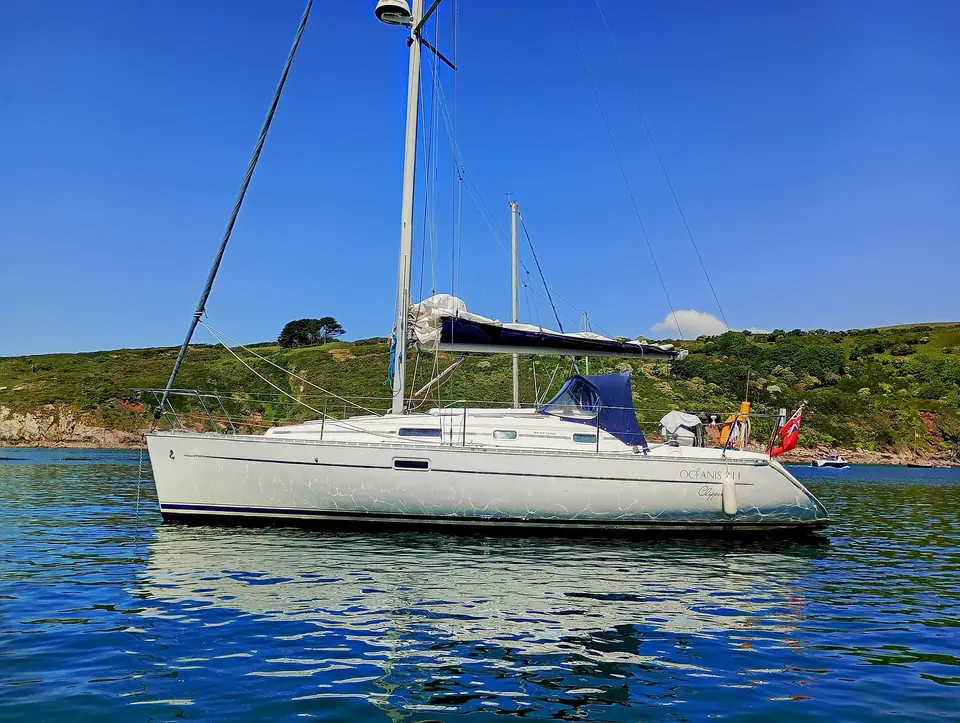
We have not found a freely licensed photo of the Beneteau First 45 yet, so these show other Beneteau boats, each captioned with the boat pictured.
More performance sailboats to explore
Beneteau First 44
Performance Sailboats, 46 ft
Used $400K to $630K

Elan 45
Performance Sailboats, 45 ft
Used $75K to $135K
J/44
Performance Sailboats, 45 ft
Used $100K to $200K
Dehler 46
Performance Sailboats, 48 ft
Used $330K to $520K
Other Beneteau models
- Beneteau 49
- Beneteau 50
- Beneteau 57
- Beneteau 343
- Beneteau Antares 5.80
- Beneteau Antares 6
- Beneteau Antares 6.80
- Beneteau Antares 7
- Beneteau Antares 7.30
- Beneteau Antares 7.60
- Beneteau Antares 7.80
- Beneteau Antares 8
- Beneteau Antares 8.00
- Beneteau Antares 8.05
- Beneteau Antares 8.60
- Beneteau Antares 8.80
- Beneteau Antares 9
- Beneteau Antares 9.80
- Beneteau Antares 10.80
- Beneteau Antares 11
- Beneteau Antares 12
- Beneteau Antares 13.80
- Beneteau Antares 30
- Beneteau Antares 32
- Beneteau Antares 36
- Beneteau Antares 42
- Beneteau Antares 620 HB
- Beneteau Antares 650 HB
- Beneteau Antares 750 HB
- Beneteau Cyclades 39.3
- Beneteau Cyclades 43.3 and 43.4
- Beneteau Cyclades 50.5
- Beneteau First 18 SE
- Beneteau First 20
- Beneteau First 21.7
- Beneteau First 24
- Beneteau First 25
- Beneteau First 25.7
- Beneteau First 27
- Beneteau First 27.7
- Beneteau First 30
- Beneteau First 31.7
- Beneteau First 35
- Beneteau First 36
- Beneteau First 36.7
- Beneteau First 38
- Beneteau First 40
- Beneteau First 40.7
- Beneteau First 44
- Beneteau First 47.7
- Beneteau First 53
- Beneteau First 211
- Beneteau First 235
- Beneteau First 285
- Beneteau First 305
- Beneteau First 310
- Beneteau First 345
- Beneteau Flyer 6
- Beneteau Flyer 7
- Beneteau Flyer 8
- Beneteau Flyer 9
- Beneteau Flyer 10
- Beneteau Flyer 12
- Beneteau Flyer 500
- Beneteau Flyer 550
- Beneteau Flyer 650
- Beneteau Flyer 701
- Beneteau Flyer 750
- Beneteau Grand Trawler 62
- Beneteau Gran Turismo 32
- Beneteau Gran Turismo 36
- Beneteau Gran Turismo 40
- Beneteau Gran Turismo 41
- Beneteau Gran Turismo 44
- Beneteau Gran Turismo 45
- Beneteau Monte Carlo 6
- Beneteau Oceanis 30.1
- Beneteau Oceanis 31
- Beneteau Oceanis 34
- Beneteau Oceanis 34.1
- Beneteau Oceanis 35
- Beneteau Oceanis 35.1
- Beneteau Oceanis 36 CC
- Beneteau Oceanis 37
- Beneteau Oceanis 38
- Beneteau Oceanis 38.1
- Beneteau Oceanis 40
- Beneteau Oceanis 40 CC
- Beneteau Oceanis 41
- Beneteau Oceanis 41.1
- Beneteau Oceanis 42
- Beneteau Oceanis 42 CC
- Beneteau Oceanis 43
- Beneteau Oceanis 44 CC
- Beneteau Oceanis 45
- Beneteau Oceanis 46
- Beneteau Oceanis 46.1
- Beneteau Oceanis 48
- Beneteau Oceanis 50
- Beneteau Oceanis 51.1
- Beneteau Oceanis 54
- Beneteau Oceanis 55
- Beneteau Oceanis 58
- Beneteau Oceanis 311
- Beneteau Oceanis 320
- Beneteau Oceanis 321
- Beneteau Oceanis 323
- Beneteau Oceanis 331
- Beneteau Oceanis 350
- Beneteau Oceanis 351
- Beneteau Oceanis 370
- Beneteau Oceanis 390
- Beneteau Oceanis 400
- Beneteau Oceanis 411
- Beneteau Oceanis 423
- Beneteau Oceanis 430
- Beneteau Oceanis 440
- Beneteau Oceanis 461
- Beneteau Oceanis 473
- Beneteau Oceanis 500
- Beneteau Oceanis 510
- Beneteau Oceanis Clipper 361
- Beneteau Oceanis Clipper 373
- Beneteau Oceanis Clipper 381
- Beneteau Oceanis Clipper 393
- Beneteau Oceanis Yacht 54
- Beneteau Oceanis Yacht 60
- Beneteau Oceanis Yacht 62
- Beneteau Sense 43
- Beneteau Sense 46
- Beneteau Sense 50
- Beneteau Sense 55
- Beneteau Swift Trawler 30
- Beneteau Swift Trawler 34
- Beneteau Swift Trawler 35
- Beneteau Swift Trawler 41
- Beneteau Swift Trawler 44
- Beneteau Swift Trawler 48
- All Beneteau models