J/70 Sportboat Specs, Price and Ownership Guide
A 22-foot, ramp-launchable sportboat with a carbon rig that turned into the biggest one-design keelboat class of the last decade.
- Length
- 22.8 ft6.93 m
- Beam
- 7.4 ft2.25 m
- Draft
- 4.8 ft1.45 m
- Cabins
- Small cuddy for storage
- Used price
- $30K to $70K
On this page
- Overview
- Why the J70 took over one-design racing
- Alan Johnstone's design, a keelboat that behaves like a dinghy
- What it is like to sail, upwind grind and downwind release
- Professionals, Corinthians and how the class keeps both happy
- Towing, launching and storing a 1,750-pound race boat
- What a J70 program costs per season
- Reading the used J70 market
- Specifications
- Price and value
- Strengths and weaknesses
- Used buyer checklist
- Rivals
- Our verdict
- FAQ
Alan Johnstone's 2012 sportboat. 1,800 plus boats in more than 30 countries, a lifting keel, carbon mast and asymmetric spinnaker, and Worlds that routinely draw 80 to 100 boats.
- Competitive one-design racers
- Dinghy sailors stepping up
- Sailing leagues and yacht club fleets
- Families who want a fast daysailer
J/70 by the numbers
- Sail area to displacement
- 24.9Racing level power, needs active reefing as the breeze builds.
- Displacement to length
- 91Ultralight. Built for speed, keep payload to a minimum.
- Theoretical hull speed
- 6.1 knThe practical top speed of a displacement monohull under normal sailing, based on waterline length.
- Ballast ratio
- 36%A typical ballast ratio for a cruising monohull.
- Capsize screening
- 2.45Above 2.0, so this hull leans toward coastal stability over ultimate offshore resistance.
- Motion comfort ratio
- 8.9A quicker motion in waves, typical of light, beamy hulls.
- Length to beam ratio
- 3.08 : 1Moderate proportions.
Why the J70 took over one-design racing
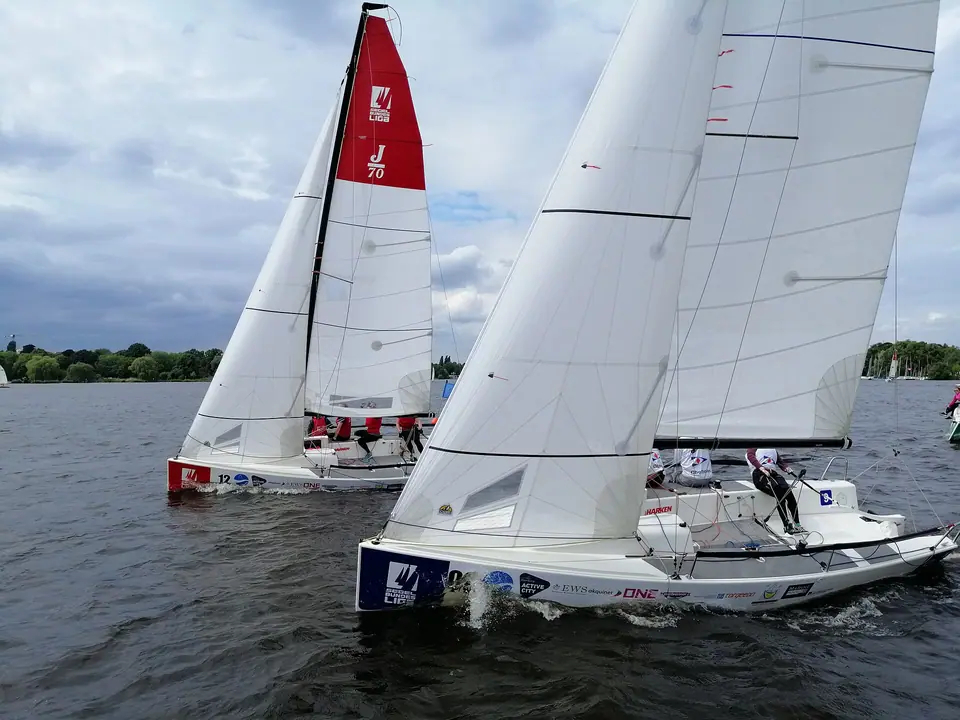
When J/Boats launched the J70 in 2012, the brief was simple: a boat that a family could tow behind a six-cylinder car, launch at a public ramp, rig in minutes and race against the best sailors in the world. Fourteen years later J/Boats calls it the most prolific sportboat in the world, with more than 1,800 boats sailing in over 30 countries.
The numbers at the top end are remarkable. The first world championship in Newport in 2014 drew 86 boats, Porto Cervo in 2017 drew 161, and the 2026 Worlds in Cascais reached about 100 entries. No other keelboat class of the last decade has filled start lines like that, and the J70 is also the boat of choice for national sailing leagues and the Sailing Champions League across Europe.
Alan Johnstone's design, a keelboat that behaves like a dinghy
Alan Johnstone, son of co-founder Rod, drew a 22 foot 9 inch hull with a 20.5-foot waterline, a 7.4-foot beam and a displacement of just 1,750 pounds. The key is the vertical lifting keel: 630 pounds of lead on a fin that draws 4 feet 9 inches when down and lifts with a removable worm-gear crane so the boat sits low on its trailer. J/Boats lists a sail area to displacement ratio of 25, and the displacement to length ratio works out to about 91, numbers that put it firmly in planing sportboat territory.
CCF Composites in Rhode Island built the first boats, which SAIL tested off Bristol, with an infused composite hull and a Southern Spars carbon package covering mast, boom and retractable sprit. SAIL Magazine's 2013 Best Boats judges called the construction quality excellent and described the boat as nimble and manageable with an easy helm even with the lee rail buried.
What it is like to sail, upwind grind and downwind release
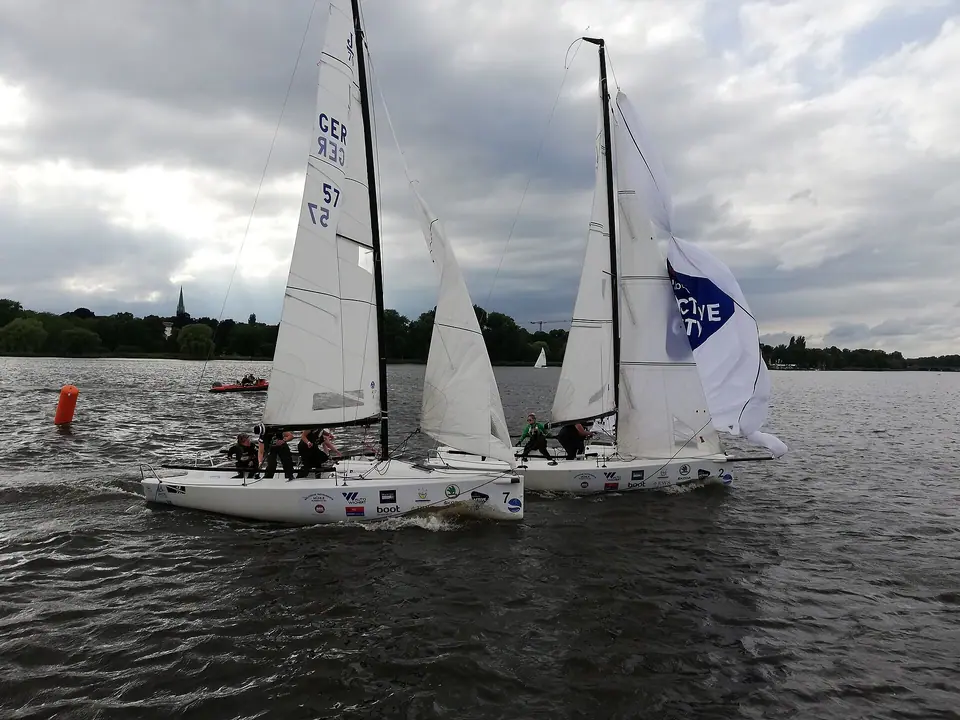
Upwind the J70 is a small, light boat with a big rig, so it rewards hiking, constant mainsheet and backstay work, and good steering through waves. Class rules limit hiking posture to reduce the physical punishment, which is part of why teams with older owners can stay competitive.
Downwind is where the boat earns its reputation. The masthead asymmetric spinnaker is about 491 square feet, more than double the upwind sail area, and once the breeze is up the boat planes readily. Teams that master gybing angles and wave riding make big gains, which is exactly the skill set that transfers from dinghy racing.
- Upwind sail area 226 sq ft, mainsail and jib
- Asymmetric spinnaker about 491 sq ft on a carbon sprit
- Crew of 3 to 5, US Sailing lists an ideal combined crew weight around 740 lb
- Three-sail racing inventory with a masthead A-sail
Professionals, Corinthians and how the class keeps both happy
Big fleets attract professional sailors, and the J70 has plenty of them at the top of Worlds and North American championship results. The class answers that with separate Open, Corinthian, Women's and Youth divisions at major events, so amateur teams have something real to race for.
Recent world champions show how international the circuit has become: Peter Duncan won twice for the United States (2017 and 2021), Switzerland's Kilian Wagen won in Monaco in 2022, Great Britain's Chris Grube in St. Petersburg in 2023, Douglas Newhouse in Palma in 2024, Laura Grondin in Buenos Aires in 2025, and Brazil's Haroldo Solberg in Cascais in 2026. If you are buying to race, decide early which division you will aim for, because it shapes your crew, coaching and sail budget.
Towing, launching and storing a 1,750-pound race boat
J/Boats says most six-cylinder vehicles can tow a J70, it fits through standard garage doors, and it can be launched from a ramp with the keel up. The deck-stepped carbon mast is light enough for a team to raise without a crane. That versatility is a huge part of the class's appeal and its resale value.
Shipping is the hidden cost of buying in a hot market. The Seattle fleet reports a January 2025 truck transport from St. Petersburg, Florida to Seattle at about $4,200 and a 2023 quote of roughly $7,300 to ship a boat by container, and says demand there will outstrip supply for years. Shopping nationally is often cheaper than waiting for a local boat.
What a J70 program costs per season
At the local level a J70 is still affordable. Dry storage on the trailer, insurance, class dues and a new jib or spinnaker every season or two put a club program around $6,000 to $10,000 a year. The 2.5 horsepower outboard, gas or electric, costs little to run.
A national circuit is different. Teams chasing results at Charleston Race Week, the Bacardi series, the North Americans and the Worlds buy new sails often, use professional coaching, and spend heavily on travel and boat transport. Those programs easily reach $25,000 to $30,000 a year or more, before any professional crew fees.
Reading the used J70 market
Because the J70 is still in production and the class has been strong since day one, used values have held up better than almost any small sailboat. Early hulls still compete, so a 2013 boat is not obsolete, but it has probably been raced hard and trailered thousands of miles.
The Seattle fleet's advice is worth repeating: look for osmotic blisters, damage on the underside of the hull from trailers and hoists, and any deterioration around the keel box and keel attachment, and remember that refurbishing a neglected boat up to race-ready standard can cost more than the price gap to a better one.
J/70 specifications
| Length overall | 22.8 ft6.93 m |
|---|---|
| Waterline length | 20.5 ft6.24 m |
| Beam | 7.4 ft2.25 m |
| Draft | 4.8 ft1.45 m |
| Displacement | 1,75 lbs794 kg |
| Ballast | 63 lbs286 kg |
| Sail area | 226 sq ft21 m² |
| Cabins | Small cuddy for storage |
| Heads | None |
| Standard engines | Outboard, 2.5 hp minimum, gas or electric |
| Hull type | Planing sportboat hull with open transom and transom-hung rudder |
| Keel | Vertical lifting keel with lead bulb and kelp cutter |
| Rig | Fractional sloop, deck-stepped carbon mast and boom, retractable carbon sprit, masthead asymmetric spinnaker |
| Hull construction | Infused fiberglass sandwich construction |
| Builder | J/Boats with licensed builders CCF Composites (USA), J/Composites (France) and J/Boats Argentina, United States |
| Naval architect | Alan Johnstone |
| Production | 2012 to present |
| Status | In production |
Figures come from builder documentation and independent tests where available. Displacement is usually quoted light, so a loaded cruising boat will weigh more. Compare these specs with another model.
How much does a J/70 cost?
The base boat price covers neither trailer nor sails, so a realistic sail-away figure with a class sail inventory, Triad trailer, outboard and racing electronics lands in the $75,000 to $95,000 range. On the used side, the Seattle fleet puts a race-ready boat with good rigging, sails under three years old, an electric outboard and a trailer at $40,000 to $65,000 (2025). Early 2012 to 2014 hulls with tired sails sit below that, and nearly new boats from championship programs sit above it.
Estimate your yearly cost
A planning estimate using common rules of thumb: insurance near 1.5 percent of value, maintenance near 3 percent, haul out and bottom paint by length. Your marina, region and use will move these numbers. Open the full cost calculator.
J/70 timeline
- 2012J70 launched, built by CCF Composites in Bristol, Rhode Island
- 2013Named a SAIL Magazine Best Boats pick, praised for build quality and easy handling
- 2014First World Championship in Newport with 86 boats
- 2017Worlds in Porto Cervo draw 161 boats
- 2024Worlds in Palma de Mallorca with 95 entries
- 2026Worlds in Cascais, Portugal, with about 100 entries
Strengths and weaknesses
What owners like
- Largest and deepest sportboat class in the world
- Ramp-launchable lifting keel and easy towing
- Planes downwind and teaches modern asymmetric technique
- Strong resale values backed by continued production
- Corinthian, women's and youth divisions at major events
What to weigh up
- Top events are crowded with professionals
- Sail and travel budgets climb fast at the national level
- Small cabin offers storage only, no overnighting
- Wet and physical upwind in a breeze
- Used boats in hot markets are scarce and need shipping
Used J/70 buyer checklist
Take this list to a viewing. Your ticks are saved in this browser so you can come back to it.
Always commission an independent marine survey and an engine survey before you buy. How a marine survey works.
Rivals to consider
J/80
Bigger and heavier with a fixed keel and a real cabin, cheaper to buy used, with its biggest fleets in France and Spain.
Compare side by sideJ/22
A fraction of the price, three or four crew, but a fixed keel and an older symmetric-spinnaker rig.
Compare side by sideMelges 24
Faster and more extreme, with a strong international class, but more demanding and more expensive to campaign.
Beneteau First 27
A small performance boat with more interior comfort and a lifting keel, aimed more at daysailing and club racing.
Compare side by sideOur verdict on the J/70
The J70 is the default answer for anyone who wants top-level one-design keelboat racing in a package that can be towed and ramp-launched. It is fast, well built and supported by a class that runs huge events on every continent, and its resale values reflect that. The only real caution is budget discipline: the boat is affordable, but the circuit can become expensive quickly. Buy the best-kept hull you can afford, decide which division you are racing in, and enjoy the deepest fleet in small-boat sailing.
J/70 questions answered
How much does a J70 cost?
A new J70 typically lands around $75,000 to $95,000 sail-away once sails, trailer, outboard and electronics are added to the base boat. Used J70s typically sell for about $30,000 to $70,000.
How many people sail a J70?
Three to five, with an ideal combined crew weight of about 740 pounds according to US Sailing's class profile.
Can you ramp launch a J70?
Yes. The lifting keel lets it sit low on its trailer and launch from most public ramps, and J/Boats says most six-cylinder vehicles can tow it.
How many J70s have been built?
J/Boats reports more than 1,800 boats sailing in over 30 countries since the 2012 launch.
Who builds the J70?
CCF Composites in the United States, J/Composites in France and J/Boats Argentina build the boat under license from J/Boats.
Does the J70 have a cabin?
There is a small cuddy for sail storage and shelter, but it is not designed for overnighting.
J/70 photos
More performance sailboats to explore
J/22
Performance Sailboats, 23 ft
Used $3K to $22K
Ontario Yachts Sonar
Performance Sailboats, 23 ft
Used $8K to $35K
Pearson Ensign
Performance Sailboats, 23 ft
Used $2K to $35K
Beneteau First 235
Performance Sailboats, 23 ft
Used $5K to $14K