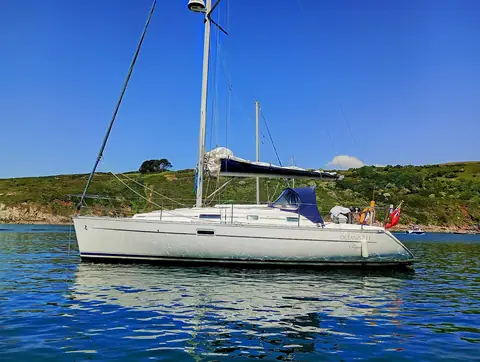
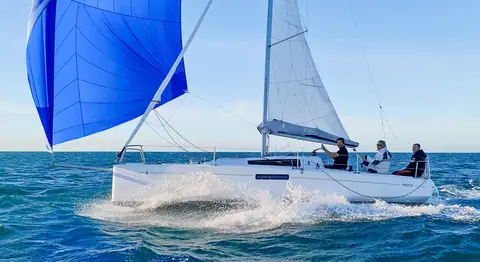
Colgate 26 Sailboats Performance Sailboats
Colgate 26 Sailboat, the Unsinkable Trainer Explained
Steve Colgate and Jim Taylor's 25-foot 8-inch foam-filled sport boat, built to teach sailing, race one-design and survive beginners.

- Length
- 25.7 ft7.82 m
- Beam
- 8.5 ft2.59 m
- Draft
- 4.5 ft1.37 m
- Cabins
- 1 (open cuddy)
- Used price
- $12K to $40K
On this page
- Overview
- Why the Colgate 26 exists at all
- The Navy 26 and the academy fleets
- The numbers behind the hull
- A cockpit designed around the instructor
- Rig, deck gear and the small cuddy
- Who built it, and who builds it now
- Buying a used Colgate 26
- Specifications
- Price and value
- Strengths and weaknesses
- Used buyer checklist
- Rivals
- Our verdict
- FAQ
The Colgate 26 is a 25-foot 8-inch fractional sloop designed in 1996 by Steve Colgate and Jim Taylor for Offshore Sailing School, with positive foam flotation, a 1,050-pound lead bulb keel and use at the U.S. Naval Academy.
- Sailing schools and community programs
- Families teaching kids to sail
- One-design club racing
- Daysailing on lakes and bays
Colgate 26 by the numbers
- Sail area to displacement
- 28.6Racing level power, needs active reefing as the breeze builds.
- Displacement to length
- 145Light displacement for its length, quick but sensitive to added cruising weight.
- Theoretical hull speed
- 6.0 knThe practical top speed of a displacement monohull under normal sailing, based on waterline length.
- Ballast ratio
- 40%A high ballast ratio, so the boat stands up well to a breeze.
- Capsize screening
- 2.47Above 2.0, so this hull leans toward coastal stability over ultimate offshore resistance.
- Motion comfort ratio
- 10.7A quicker motion in waves, typical of light, beamy hulls.
- Length to beam ratio
- 3.02 : 1Moderate proportions.
Why the Colgate 26 exists at all
The Colgate 26 was born out of frustration. Steve and Doris Colgate's Offshore Sailing School taught thousands of students in a pair of Solings, an Olympic keelboat the school used from 1964 until 1996. Steve told SAIL magazine that by then they were tired of the Soling's flaws as a teaching platform, not least its ability to sink and the way instructors had to stand on the aft deck, which sometimes meant they went swimming. Steve Colgate, an Olympic and America's Cup sailor, wanted a boat that would forgive beginners, keep instructors aboard and still be rewarding to race.
Unable to find one, he teamed with naval architect Jim Taylor, whose work ranges from Sabre cruising boats to a run of successful 1990s 40-foot racer-cruisers. The result, launched in 1996, was the Colgate 26: a 25-foot 8-inch fractional sloop with positive foam flotation, a deep self-bailing cockpit and a bulb keel. Colgate insisted it meet Offshore Sailing School's insurance requirements, which he said would meet or exceed any standard an individual or fleet owner would set.
The numbers behind the hull
On paper the Colgate 26 is a light, stiff sport boat. Sailboatdata lists 25 feet 8 inches overall, 20 feet on the waterline, an 8-foot 6-inch beam, 2,600 pounds displacement and 1,050 pounds of lead ballast in a bulb on a 4-foot 6-inch fin. A shoal version draws 3 feet 6 inches and carries 1,250 pounds of ballast for 2,800 pounds total. Reported sail area is 338 square feet; sailboatdata notes that before 2005 the figure was given as 283 square feet.
Those numbers translate into a sail area to displacement ratio of about 28.7 and a ballast ratio of about 40 percent, which is lively but stiff, and a displacement to length ratio of about 145, firmly in light-displacement territory. The capsize screening value of 2.48 and comfort ratio of 10.7 are reminders that this is a daysailer and buoy racer, not an offshore boat. Hull speed works out to roughly 6 knots, though like most light boats with a big spinnaker it will exceed that off the wind.
- LOA 25 ft 8 in, LWL 20 ft, beam 8 ft 6 in
- Draft 4 ft 6 in standard, 3 ft 6 in shoal
- Displacement 2,600 lb, ballast 1,050 lb lead (standard keel)
- Sail area 338 sq ft; asymmetrical package quoted at 782 sq ft with the kite
- Keel bolted with eight 1/2-inch stainless bolts
A cockpit designed around the instructor
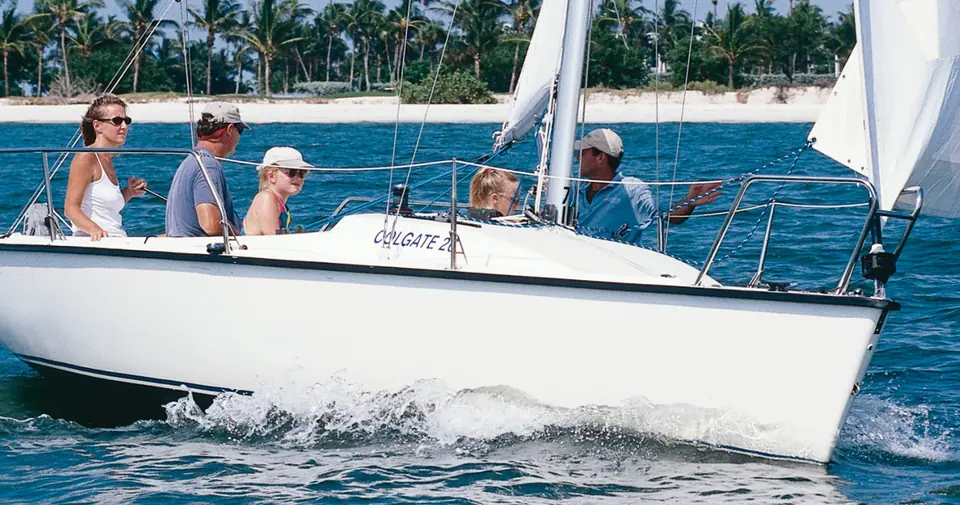
The genius of the Colgate 26 is in the cockpit. Instructors stand aft behind the traveler, where they can ease the mainsheet quickly if needed while students steer, trim and handle the boat. A solid vang keeps the boom from dropping on anyone's head when the mainsail is lowered, and the transom sits only inches above the water, which makes retrieving a person in the water far easier than on a typical keelboat. The cockpit and the port and starboard seat lockers are self-bailing.
That rescue-friendly design has a real story attached. According to the class website, in 1999 three Offshore Sailing School students sailing a Colgate 26 rescued two hypothermic mariners in Chicago Harbor and received US Sailing's Arthur B. Hanson Rescue Medal.
Rig, deck gear and the small cuddy
The sail-away package described on the class website includes an anodized aluminum mast and boom on a hinged mast step for easy rigging, a Harken roller-furling jib, two Harken number 20 self-tailing winches, five rope clutches, a traveler with a 4:1 mainsheet, a spinnaker pole with lift and foreguy, and a stainless bow pulpit with lifelines. Sails include a main, jib and symmetrical spinnaker; an asymmetrical spinnaker and pole are offered as an upgrade.
Below is a simple cuddy with V-berths, two quarter berths, an insulated ice chest and a portable head. It is fine for changing, stowing gear and the odd overnight, but nobody should mistake it for a pocket cruiser. Power is a small outboard on a transom bracket; the class literature lists the bracket but no specific motor.
Who built it, and who builds it now
For years Precision Boat Works in Florida built the Colgate 26, but Steve Colgate told SAIL that Precision stopped producing it in 2008. Sailboatdata lists Waterline Systems as the builder from 2020. In 2024 SAIL reported that the molds were with Steve Colgate and that new boats would be built by Tartan Yachts in Painesville, Ohio, updated with an asymmetrical spinnaker and a new pole while keeping the fundamental design. SAIL listed a sail-away price of $87,500.
The current class website still advertises that Tartan-built sail-away package, but its home page also says the Colgate 26 molds are now available for a new owner to take the design forward. In practice that means a new boat is possible but not a sure thing, and most buyers will be shopping the used market.
Buying a used Colgate 26
Most used Colgate 26s come from three pools: private owners, sailing schools and military or academy fleets. School and academy boats can be bargains, but they have usually been sailed hard by beginners, so expect gelcoat damage, worn hardware and tired sails. Privately owned boats often have newer sails and better upkeep. Our estimate for typical asking prices is $12,000 to $40,000, with sails and trailer condition explaining much of the spread.
Ownership is cheap by keelboat standards. Budget about $2,500 to $6,500 a year for a mooring or dry sail spot, insurance, a small outboard, bottom work and sail replacement spread over time. Owners who want to race should check local fleet activity first; the boat shines in one-design competition but has a small national footprint.
Colgate 26 specifications
| Length overall | 25.7 ft7.82 m |
|---|---|
| Waterline length | 20 ft6.1 m |
| Beam | 8.5 ft2.59 m |
| Draft | 4.5 ft1.37 m |
| Displacement | 2,6 lbs1,179 kg |
| Ballast | 1,05 lbs476 kg |
| Sail area | 338 sq ft31.4 m² |
| Cabins | 1 (open cuddy) |
| Berths | 4 (V-berths and two quarter berths) |
| Heads | Portable head |
| Standard engines | Small outboard on a transom bracket |
| Hull type | Light-displacement monohull, self-bailing cockpit, positive foam flotation |
| Keel | Fin keel with lead bulb, 4 ft 6 in; shoal version 3 ft 6 in |
| Rig | Fractional sloop, aluminum mast and boom, roller-furling jib, symmetrical or asymmetrical spinnaker |
| Hull construction | Fiberglass with positive foam flotation |
| Builder | Precision Boat Works (original); later Waterline Systems and Tartan Yachts, United States |
| Naval architect | Jim Taylor |
| Other design credits | Steve Colgate (concept and requirements) |
| Production | 1996 to present |
| Status | Limited production |
Figures come from builder documentation and independent tests where available. Displacement is usually quoted light, so a loaded cruising boat will weigh more. Compare these specs with another model.
How much does a Colgate 26 cost?
The class website quotes a new Colgate 26 built by Tartan Yachts at an all-up sail-away price of $87,500, but it also says the molds are available to a new owner, so new-boat availability is uncertain. Used prices are our estimates and depend mostly on sail inventory, deck condition, trailer and whether the boat came from a school or Navy fleet with heavy use. Boats with the asymmetrical spinnaker upgrade and newer sails command the top of the range.
Estimate your yearly cost
A planning estimate using common rules of thumb: insurance near 1.5 percent of value, maintenance near 3 percent, haul out and bottom paint by length. Your marina, region and use will move these numbers. Open the full cost calculator.
Versions and options
- Standard keel
- 4-foot 6-inch draft, 1,050 lb lead bulb ballast, 2,600 lb displacement.
- Shoal keel
- 3-foot 6-inch draft, 1,250 lb ballast, 2,800 lb displacement.
- Navy 26
- The U.S. Naval Academy's name for its Colgate 26 training and racing fleet.
- Tartan-built update (2024 on)
- Announced with an asymmetrical spinnaker and new pole, quoted at $87,500 sail-away.
Colgate 26 timeline
- 1964Offshore Sailing School begins teaching in Solings
- 1996Steve Colgate and Jim Taylor develop the Colgate 26
- 1999Colgate 26 crew earns US Sailing's Arthur B. Hanson Rescue Medal in Chicago Harbor
- 2008Precision Boat Works stops building the 26
- 2024SAIL reports new boats to be built by Tartan Yachts at $87,500 sail-away
Strengths and weaknesses
What owners like
- Positive foam flotation makes it unsinkable
- Cockpit and low transom designed for safe instruction and rescue
- Lively light-displacement performance with a 40 percent ballast ratio
- Simple, rugged rig with a hinged mast step
- Proven in Naval Academy and sailing school fleets
- Trailerable 8-foot 6-inch beam
What to weigh up
- Uncertain new-boat production
- Small class outside a few regions
- Minimal cuddy, not a cruiser
- School and academy boats may be heavily worn
- Few independent performance tests published
Used Colgate 26 buyer checklist
Take this list to a viewing. Your ticks are saved in this browser so you can come back to it.
Always commission an independent marine survey and an engine survey before you buy. How a marine survey works.
Rivals to consider
J/22
Smaller, larger class and a common sailing-school and match-racing platform.
Compare side by sidePearson Ensign
Classic full-keel daysailer with a deep cockpit and a long racing history.
Compare side by sideOur verdict on the Colgate 26
The Colgate 26 is one of the few boats designed from a clean sheet around how people actually learn to sail. It is unsinkable, forgiving, easy to rescue someone from and still quick enough to race, which is why the Naval Academy and Offshore Sailing School built fleets around it. Its weaknesses are a tiny cuddy, a small class and an uncertain future for new production. For a family or club that wants a safe, lively daysailer, a well-kept used Colgate 26 is an excellent buy.
Colgate 26 questions answered
Who designed the Colgate 26?
Steve Colgate, founder of Offshore Sailing School, developed it with naval architect Jim Taylor in 1996.
Is the Colgate 26 unsinkable?
Yes. It has positive foam flotation, and the class describes it as safe and unsinkable.
Why is the Colgate 26 called the Navy 26?
The U.S. Naval Academy uses the design for training and its Colgate racing fleet, where it is known as the Navy 26.
How much does a Colgate 26 cost?
SAIL reported a Tartan-built sail-away price of $87,500 in 2024. Used boats typically sell for about $12,000 to $40,000.
What are the Colgate 26 specs?
LOA is 25 feet 8 inches, beam 8 feet 6 inches, draft 4 feet 6 inches (3 feet 6 inches shoal), displacement 2,600 pounds and sail area 338 square feet.
Is the Colgate 26 still being built?
New boats were announced from Tartan Yachts in 2024, but the class website now says the molds are available for a new owner, so availability is uncertain.