J/109 for Sale, a Broker's Guide to Buying the Best Racer-Cruiser J/Boats Built
A 35-foot sprit boat with two private cabins, a real galley and an offshore racing record, built from 2001 to 2012 and still in demand.
- Length
- 35.3 ft10.74 m
- Beam
- 11.5 ft3.51 m
- Draft
- 7 ft2.13 m
- Cabins
- 2
- Used price
- $90K to $175K
On this page
- Overview
- Looking at a J109 for sale? Start with what it is
- Why the J109 is 3,200 pounds heavier than a J105
- The two-cabin interior buyers pay extra for
- A racing record from the Solent to Chicago
- Handling, rig loads and the crew you need
- Engine, rigging and the big-ticket refit items
- Who the J109 suits, and who should keep looking
- Specifications
- Price and value
- Strengths and weaknesses
- Used buyer checklist
- Rivals
- Our verdict
- FAQ
A Johnstone-designed 35-foot racer-cruiser. Nearly 400 built from 2001 to 2012, two cabins, a 7-foot keel and a sprit. 2025 asking prices ranged from about $99,000 to $165,000.
- PHRF and ORC racers who also weekend
- Distance and offshore racing
- Families moving up from a J105 or J30
- Buyers wanting strong resale
Looking at a J109 for sale? Start with what it is
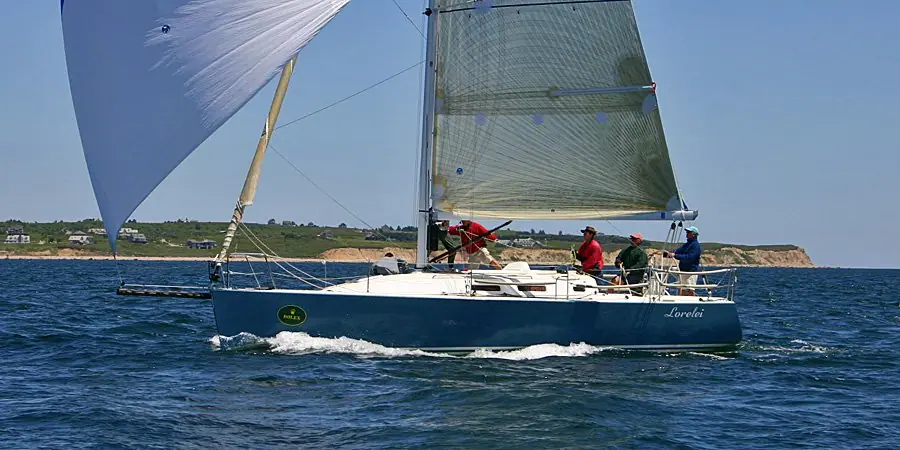
A J109 for sale is usually the most interesting listing in the 35-foot racer-cruiser segment, because few boats manage the same balance. It has the speed and sprit-launched asymmetric of a J105, but adds a private aft cabin, a proper galley, a forward-facing navigation station and a usable head. Alan Johnstone took the lead on the design, working with his father Rod, and drew it to win under handicap rules and still take a family away for a long weekend.
Nearly 400 were built between 2001 and 2012, with TPI in Rhode Island building the North American boats. That run is long enough to give a steady supply of boats, but small enough that well-kept examples rarely sit on the market. As a broker, I tell buyers to expect $90,000 to $175,000 for most boats today, with the best prepared race boats and lightly used cruisers both commanding premiums for different reasons.
J/109 by the numbers
- Sail area to displacement
- 21.0Plenty of sail for the weight, the boat should feel lively in light air.
- Displacement to length
- 172Light displacement for its length, quick but sensitive to added cruising weight.
- Theoretical hull speed
- 7.4 knThe practical top speed of a displacement monohull under normal sailing, based on waterline length.
- Ballast ratio
- 36%A typical ballast ratio for a cruising monohull.
- Capsize screening
- 2.07Above 2.0, so this hull leans toward coastal stability over ultimate offshore resistance.
- Motion comfort ratio
- 20.4A quicker motion in waves, typical of light, beamy hulls.
- Length to beam ratio
- 3.07 : 1Moderate proportions.
Why the J109 is 3,200 pounds heavier than a J105
The J109 displaces 10,900 pounds, about 3,200 more than the J105, and that weight went into accommodation, tankage and stability rather than sloppy construction. It carries 3,900 pounds of lead in a 7-foot bulb fin, giving a ballast ratio near 36 percent, and a 30.5-foot waterline on a 35-foot 3-inch hull. A shoal keel drawing 5 feet 9 inches was offered for shallower harbors.
Construction follows TPI's best practice of the period: SCRIMP resin infusion, Baltek ContourKore end-grain balsa core, biaxial and unidirectional glass, vinylester resin, and structural bulkheads bonded to both hull and deck. The keel is cast lead bolted and bonded to a molded stub, and the rudder is a high-aspect spade.
The two-cabin interior buyers pay extra for
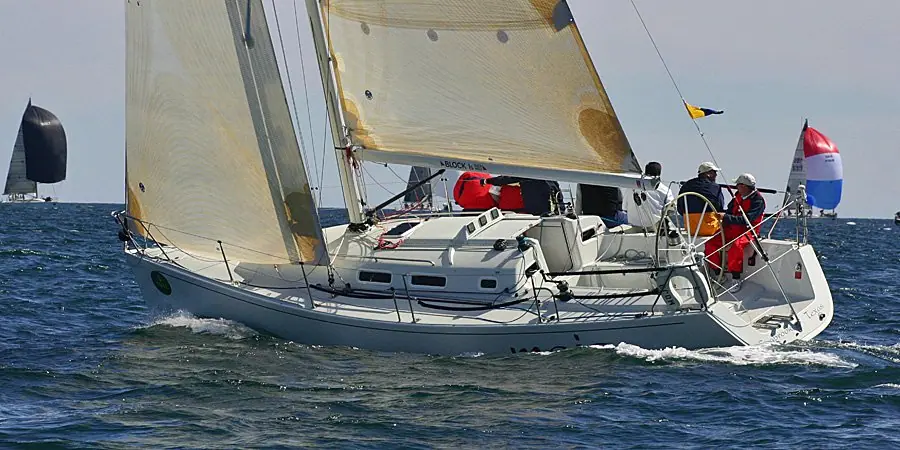
This is where the J109 earns its premium. There is a V-berth cabin forward with storage, a private aft cabin with a double berth, and an optional pull-out double in the main cabin. The L-shaped galley has a double sink, a two-burner propane stove with oven and pressure water, and the navigation station faces forward with a proper chart table. The head sits aft near the companionway, close to the cockpit for wet crew. J/Boats describes the interior as having standing headroom.
Practical Sailor's owners, who raced and cruised a 2004 boat named Kind of Blue in Southern California and San Francisco Bay, judged the systems adequate for short cruising but small for longer trips: 18.5 gallons of diesel, 21 to 25 gallons of water and an 80 amp-hour house bank as delivered. Many owners have added battery capacity, and that is worth checking on any boat you look at.
A racing record from the Solent to Chicago
J/Boats says a well-sailed J109 is difficult to beat under any handicap system, whether PHRF, IRC or ORC, and the boat has won its class or overall in a long list of offshore races in Australia, Hong Kong, the Caribbean, North America and Europe. The featured Practical Sailor boat raced on a PHRF rating of 72.
One-design fleets have been strongest in the UK, where Solent racing and Cowes Week have long had J109 starts, in France at the SPI Ouest series, and in the US on the Great Lakes, Chesapeake Bay, New England and Long Island Sound. The US class still runs a North American championship, held at Pequot Yacht Club in Southport, Connecticut in 2022 and in Chicago in 2025 with nine teams.
Handling, rig loads and the crew you need
The J109 has a solid, confident feel at the helm and points well, especially with barber haulers or inhaulers for the jib, which were not standard. Its big asymmetric gives it a real speed edge reaching and running. The continuous rod rigging is led inboard for tight sheeting angles, and a hydraulic backstay controls mast bend.
J/Boats marketed the design as good for short-handed sailing, and under jib and main it is. Racing with the spinnaker is another matter. Practical Sailor's owners found three people the minimum and six preferable for spinnaker work, and noted that loads build fast. The large wheel can also make life awkward for shorter helmsmen moving around the cockpit.
Engine, rigging and the big-ticket refit items
Early boats were delivered with a Yanmar 3GM30 diesel of about 27 horsepower driving a saildrive with a folding prop, under the aft berth in an insulated compartment. Yanmar replaced the GM series during the J109's production run, and J/Boats' own spec sheet lists a 30-horsepower Volvo Penta D1-30 saildrive, so check exactly which engine a given boat carries and its hours. Saildrive diaphragm and seal replacement on the manufacturer's schedule is essential on any of them.
The rod rigging is the item that most often surprises buyers. On a boat that is 14 to 25 years old, a rig without documented rod or fitting replacement should be priced as if it needs the work. Practical Sailor also noted that some original deck gear, including mainsheet components, proved undersized for hard racing in a breeze and has been upgraded on many boats.
Who the J109 suits, and who should keep looking
The ideal J109 owner races in PHRF or ORC, does a couple of distance races a season, and takes the family out for weekends without pretending the boat is a long-range cruiser. For that sailor it is close to perfect, and its handicap competitiveness has kept resale strong.
If you mainly want one-design racing in the US, the J105 offers bigger fleets for less money. If you want pure speed, the J111 is significantly quicker. If you want to cruise for weeks at a time, the small tanks, 7-foot draft and racing orientation argue for a more cruising-focused boat.
J/109 specifications
| Length overall | 35.3 ft10.74 m |
|---|---|
| Waterline length | 30.5 ft9.3 m |
| Beam | 11.5 ft3.51 m |
| Draft | 7 ft2.13 m |
| Air draft | 53.5 ft16.31 m |
| Displacement | 10,9 lbs4,944 kg |
| Ballast | 3,9 lbs1,769 kg |
| Sail area | 644 sq ft59.8 m² |
| Fuel capacity | 19 gal7 L |
| Fresh water | 21 gal79 L |
| Cabins | 2 |
| Berths | 4 to 6 (V-berth, aft double, optional pull-out double in saloon) |
| Heads | 1 |
| Standard engines | Yanmar 3GM30 diesel, about 27 hp, with saildrive and folding prop |
| Optional engines | J/Boats spec sheet lists a Volvo Penta D1-30 (30 hp) with saildrive |
| Maximum power | 30 hp |
| Hull type | Fiberglass monohull with fin keel and high-aspect spade rudder |
| Keel | Lead bulb fin, 7 ft standard draft, 5 ft 9 in shoal option |
| Rig | Fractional sloop, tapered aluminum mast, continuous rod rigging, carbon retractable sprit, asymmetric spinnaker |
| Hull construction | SCRIMP-infused E-glass with Baltek ContourKore balsa core and vinylester resin |
| Builder | Tillotson Pearson (TPI) for J/Boats (North American boats), United States |
| Naval architect | Alan Johnstone with Rod Johnstone |
| Production | 2001 to 2012 |
| Status | Discontinued |
Figures come from builder documentation and independent tests where available. Displacement is usually quoted light, so a loaded cruising boat will weigh more. Compare these specs with another model.
How much does a J/109 cost?
Practical Sailor's February 2025 snapshot shows how wide the J109 market is: a 2005 boat asking $99,000 in New York, another 2005 at $159,500 in Long Beach, a 2006 at $164,900 in Vancouver and a 2007 at $139,900 in New Rochelle. Median asking price across recent listings sits around $134,000. Sails, electronics, engine hours and whether the rod rigging has been replaced explain most of the spread, more than model year.
Estimate your yearly cost
A planning estimate using common rules of thumb: insurance near 1.5 percent of value, maintenance near 3 percent, haul out and bottom paint by length. Your marina, region and use will move these numbers. Open the full cost calculator.
J/109 timeline
- 2001J109 introduced as a racer-cruiser sister to the J105, built by TPI
- 2004Hull 129, Kind of Blue, launched; later profiled by Practical Sailor
- 2012Production ends after nearly 400 boats
- 2022North American championship sailed at Pequot Yacht Club, Southport, Connecticut
- 2025North Americans in Chicago with nine teams
Strengths and weaknesses
What owners like
- Two private cabins and a proper galley for a 35-foot race boat
- Competitive under PHRF, IRC and ORC
- Solid infused construction with strong resale
- Stable 7-foot bulb keel and confident helm
- Sprit and asymmetric make downwind sailing simpler than a pole
- Proven offshore racing record worldwide
What to weigh up
- Small fuel, water and battery capacity for cruising
- Needs a sizable crew to race with the spinnaker
- Rod rigging replacement is expensive on older boats
- 7-foot standard draft restricts some harbors
- Large wheel crowds the cockpit
Used J/109 buyer checklist
Take this list to a viewing. Your ticks are saved in this browser so you can come back to it.
Always commission an independent marine survey and an engine survey before you buy. How a marine survey works.
Rivals to consider
J/105
Lighter, cheaper and with much bigger US one-design fleets, but a far more basic interior.
Compare side by sideJ/111
Faster, newer and more race-focused, with a less cruising-friendly interior and a higher price.
Compare side by sideX-Yachts X4.3
A newer, more luxurious Danish performance cruiser at a much higher price.
Compare side by sideBeneteau First 36.7
A comparable racer-cruiser with a one-design history and typically lower prices, but less offshore pedigree.
Compare side by sideOur verdict on the J/109
The J109 is the J/Boats design I recommend most often to buyers who need one boat to do everything well. It races hard under handicap, sails like a much lighter boat downwind, and has the second cabin that makes weekends easy. Older boats are now at the age where rigging, engines and electronics need money, so buy on documented condition rather than price. A well-sorted J109 at a fair number is one of the best long-term holds in the 35-foot segment.
J/109 questions answered
How much does a J109 cost?
Most J109s for sale ask between about $90,000 and $175,000. A February 2025 snapshot showed 2005 to 2007 boats listed from $99,000 to $164,900.
How many J109s were built?
Nearly 400 between 2001 and 2012, with TPI in Rhode Island building the North American boats.
Is the J109 a good cruising boat?
It is good for weekends and short cruises with two private cabins and a real galley, but its 18.5-gallon fuel and roughly 21-gallon water tanks limit longer trips.
What engine is in a J109?
Early boats have a Yanmar 3GM30 of about 27 horsepower on a saildrive. Check the engine model on any specific boat, since Yanmar updated its range during production and the J/Boats spec sheet also lists a 30-horsepower Volvo Penta D1-30.
What is the J109's draft?
Seven feet with the standard keel, or 5 feet 9 inches with the shoal option.
Is the J109 still raced as a one-design?
Yes. The class runs a North American championship, held in Chicago in 2025, and fleets race in the UK, Ireland, France and the Netherlands.
J/109 photos
More performance sailboats to explore
Dehler 34
Performance Sailboats, 35 ft
Used $165K to $265K
Beneteau First 35
Performance Sailboats, 36 ft
Used $95K to $165K

Elan 350
Performance Sailboats, 35 ft
Used $85K to $135K
Elan E4
Performance Sailboats, 35 ft
Used $150K to $235K