J/30 Buyer's Guide: Specs, Class Racing and Prices
The J/24's bigger sibling: a 30 foot family boat that sailed with 35 to 40 footers and still fills one-design starting lines.
- Length
- 29.8 ft9.09 m
- Beam
- 11.2 ft3.41 m
- Draft
- 5.3 ft1.6 m
- Cabins
- 1 (V-berth forward) plus saloon and quarter berth
- Used price
- $8K to $35K
On this page
- Overview
- The J30 that followed the J/24 into family sailing
- Why a fractional rig made a 30 footer easy and fast
- SORC results and the 1979 Fastnet
- A real cruising interior in a race boat
- Built to last, but check the core
- One-design racing on a budget
- Buying a J30 for sale in 2026
- Specifications
- Price and value
- Strengths and weaknesses
- Used buyer checklist
- Rivals
- Our verdict
- FAQ
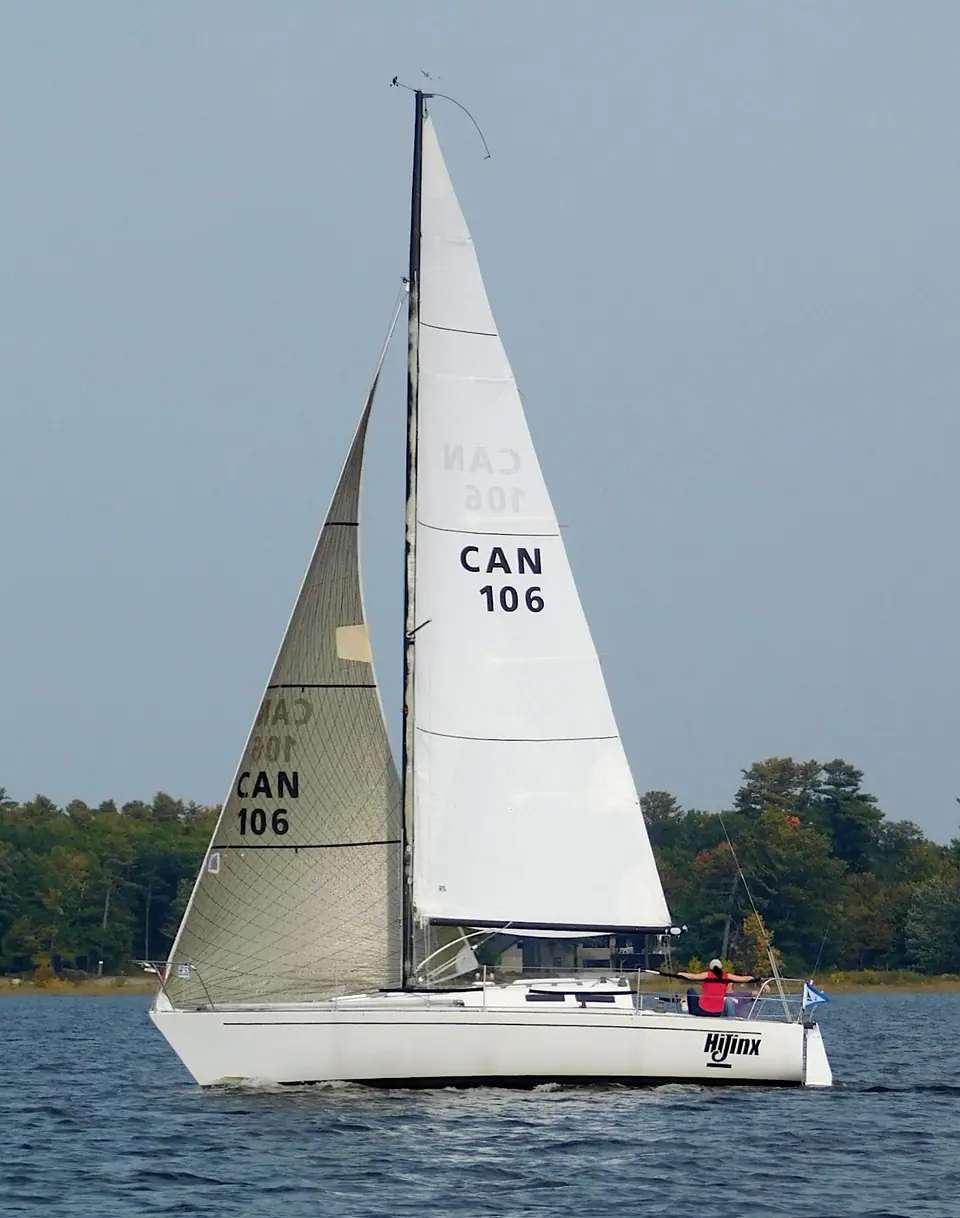
The J/30 is a 29 ft 10 in fractional sloop designed by Rod Johnstone and built by Tillotson Pearson from 1979 to 1986 or 1987, with about 545 hulls. It remains an active one-design class, especially on the Chesapeake.
- Budget one-design racers
- Families who race and cruise
- Wednesday night and PHRF sailors
- First keelboat owners willing to learn crew work
The J30 that followed the J/24 into family sailing
After the J/24 made J/Boats famous, Rod Johnstone designed the J/30 in 1978 for a broader goal: a boat an entire family would enjoy, whether daysailing, cruising or racing. J/Boats' own brochure cited research that active sailing families split their 76 days a year on the water roughly equally between those three activities, and argued that a slow boat eventually loses the young while a pure racer cannot serve a nice meal. The result was introduced in 1979.
Tillotson Pearson built the boats, and the production numbers depend on whom you ask. J/Boats says it was built to hull 546 with a last model year of 1987, Sailing World has said both 545 and 546 hulls, and Wikipedia gives hull 545 in 1986. Either way, more than 540 J/30s exist, and the J/30 Class Association still organizes one-design racing and an annual North American Championship.
J/30 by the numbers
- Sail area to displacement
- 19.4Balanced power for coastal and offshore cruising.
- Displacement to length
- 200Light displacement for its length, quick but sensitive to added cruising weight.
- Theoretical hull speed
- 6.7 knThe practical top speed of a displacement monohull under normal sailing, based on waterline length.
- Ballast ratio
- 30%A typical ballast ratio for a cruising monohull.
- Capsize screening
- 2.34Above 2.0, so this hull leans toward coastal stability over ultimate offshore resistance.
- Motion comfort ratio
- 16.4A quicker motion in waves, typical of light, beamy hulls.
- Length to beam ratio
- 2.67 : 1A beamy hull with lots of volume for its length.
Why a fractional rig made a 30 footer easy and fast
J/Boats' tech specs list 29 ft 10 in overall, 25 ft on the waterline, a beamy 11 ft 2 in, 5 ft 3 in of draft and 7,000 lb displacement with 2,100 lb of ballast. Sail area is 444 sq ft, giving a sail area to displacement ratio of 19 and a displacement to length ratio of 200. Sailboatdata notes a fin keel with a transom-hung rudder.
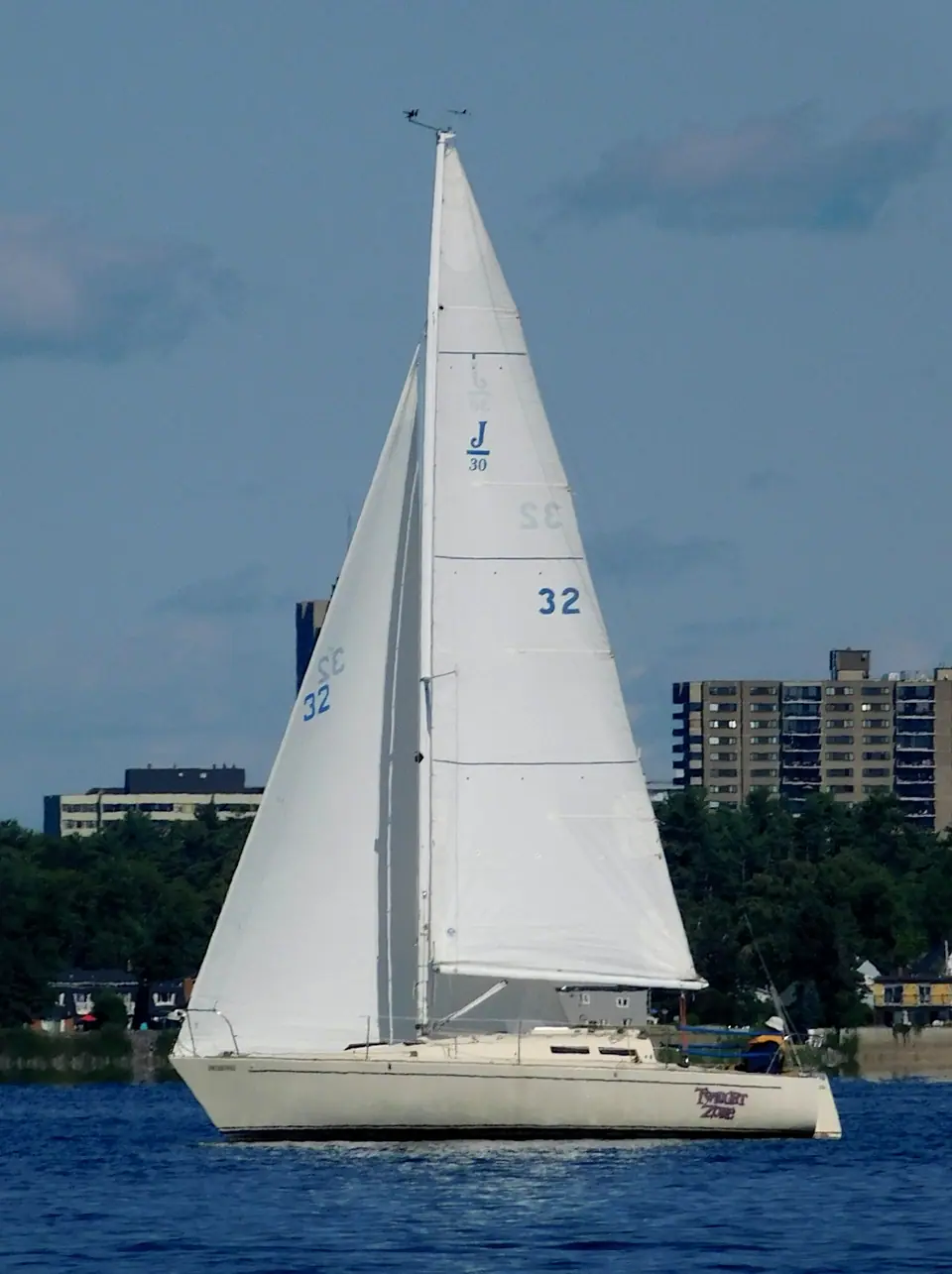
The key idea was the fractional rig. By making the mainsail larger and the jibs smaller, J/Boats said, a 12 year old could hoist and trim the No. 1 genoa, and the jibs were smaller than those on a C&C 26 or Pearson 28. Bending the tapered mast with the backstay adjuster flattens the main and depowers the boat, so one headsail covers a wide wind range. The company claimed the J/30 sailed with 35 to 40 footers and finished a football field ahead of an average 30 foot cruiser after a mile, making 40 to 50 mile daily runs easy.
SORC results and the 1979 Fastnet
The J/30 earned its offshore credentials almost immediately. J/Boats says a J/30 was the top stock production boat at the rough 1979 SORC, finishing 3rd and 4th overall in fleet. The same year two J/30s were caught in the Fastnet storm that killed 15 sailors. Hull 10, Juggernaut, had been shipped to England as a pattern for Westerly Marine's UK production and was entered in the race; hull 29 was being sailed single-handed from Bermuda to England by Texan Bill Wallace and met the storm entering the Channel. Both survived.
Owners have also used the boat for longer cruises. J/Boats publishes an account of a J/30 sailed from Connecticut to the Yucatan, the Virgin Islands and back, some 6,000 miles, which earned the boat respect from the yard crews who saw it go.
A real cruising interior in a race boat
What surprised buyers in 1979 was how much boat there is below. J/Boats lists standing headroom, an enclosed head with a full length mirror and fresh water shower, 29 enclosed cabinets and lockers plus 16 open shelves, 5.5 inch thick settee cushions, and an icebox that holds ice for 11 days. Later boats got an L-shaped galley with an optional propane oven and a cruising cockpit seating three or four a side. Sailing World adds hot water to the list of cruising amenities.
The 15 hp diesel pushes the boat at about 6.3 knots according to J/Boats. It is a realistic family weekender for two adults and two children, and a credible coastal cruiser for a couple who do not mind a simple boat.
Built to last, but check the core
J/Boats' slogan for the J/30 was Built to Last, Not to a Price. Hull and deck use Lloyd's-approved Contourkore balsa sandwich, the mast is stepped on the keel, chainplates anchor into a full structural fiberglass bulkhead, and the hull-to-deck joint is bonded, bolted, then bolted again through the teak toerail cap. Original gear included Barient winches, Harken mainsheet and vang tackles, a Headfoil jibstay and Kenyon spars, with standing rigging a size larger than necessary.
The weak point is the balsa. Sailing World warns that many J/30s suffer core rot from water entering around the chainplates, a repair it estimated could cost about $3,000 professionally, and today it can cost more. Doug Stryker, an Annapolis racer, found and fixed wet spots in the hull and deck of his hull 526. Assume any J/30 has some moisture until a surveyor with a meter proves otherwise.
One-design racing on a budget
The class remains strongest on the Chesapeake. Sailing World reported that Annapolis drew 19 boats to a recent North American Championship, its best turnout since the early 2000s, with Eastport Yacht Club fleet numbers more than doubling in a few years and 10 to 15 boats expected at local events. Pocket fleets race in New England and the deep South.
The boats race with a crew of six to eight, about 1,400 lb in total, and a symmetric spinnaker, which makes crew work a real skill. Class rules require a Dacron main, holding down sail costs, though Sailing World put a set of new laminated racing sails at about $9,000. For a sailor who wants competitive, affordable one-design racing in a boat they can also take cruising, few options compare.
Buying a J30 for sale in 2026
Prices are low enough that the boat itself is rarely the main cost. Focus on deck and hull moisture, chainplates, the rudder and its fittings, keel attachment, engine condition and the sail inventory. A boat with fresh class-legal sails and a sound deck is worth far more than a cheap boat that needs both. Annual running costs in the US are about $4,000 to $10,000 for a slip or mooring, insurance, haul-out and maintenance, with racing sails and regatta fees on top.
J/30 specifications
| Length overall | 29.8 ft9.09 m |
|---|---|
| Waterline length | 25 ft7.62 m |
| Beam | 11.2 ft3.41 m |
| Draft | 5.3 ft1.6 m |
| Displacement | 7, lbs3,175 kg |
| Ballast | 2,1 lbs953 kg |
| Sail area | 444 sq ft41.2 m² |
| Cabins | 1 (V-berth forward) plus saloon and quarter berth |
| Berths | 5 to 6 |
| Heads | 1 enclosed with shower |
| Standard engines | 15 hp inboard diesel |
| Maximum power | 15 hp |
| Cruise speed | 6.3 knots |
| Hull type | Beamy moderate displacement fin keel monohull |
| Keel | Fixed fin keel with transom-hung rudder, 5 ft 3 in draft |
| Rig | Fractional sloop, keel-stepped tapered mast with backstay adjuster |
| Hull construction | Fiberglass with Contourkore end-grain balsa core in hull and deck |
| Builder | Tillotson Pearson Inc. (TPI) for J/Boats, USA |
| Naval architect | Rodney S. Johnstone |
| Production | 1979 to 1987 |
| Status | Discontinued |
Figures come from builder documentation and independent tests where available. Displacement is usually quoted light, so a loaded cruising boat will weigh more. Compare these specs with another model.
How much does a J/30 cost?
Sailing World once put the average J/30 selling price at about $28,000. More recently an Annapolis class racer said boats put away wet can be found for $5,000 to $6,000, while a turnkey boat with good sails and maintained gear can cost as little as $22,000, and about $26,000 buys a boat ready to win. In 2026 sail inventory, deck core condition around the chainplates and engine health drive almost all of the price difference between hulls.
Estimate your yearly cost
A planning estimate using common rules of thumb: insurance near 1.5 percent of value, maintenance near 3 percent, haul out and bottom paint by length. Your marina, region and use will move these numbers. Open the full cost calculator.
Versions and options
- Early J/30 (1979 on)
- Original interior and cockpit, the boats that raced the 1979 SORC and Fastnet.
- Later J/30
- L-shaped galley with optional propane oven and a revised cruising cockpit seating three to four per side, as described in J/Boats literature.
- UK-built boats
- Westerly Marine began UK production using hull 10 as a pattern.
J/30 timeline
- 1978Rod Johnstone designs the J/30
- 1979J/30 introduced; top stock production boat at the SORC; two J/30s survive the Fastnet storm
- 1986Production winds down at about hull 545 to 546; J/Boats lists 1987 as the last model year
- 2017Doug Stryker wins the J/30 class at the Annapolis NOOD as the fleet rebuilds
Strengths and weaknesses
What owners like
- Fast, especially in a breeze
- Easy-to-handle fractional rig with small jibs
- Real cruising interior with standing headroom
- Active, affordable one-design class
- Strong offshore history
- Very low purchase price
What to weigh up
- Balsa core rot around chainplates is common
- Symmetric spinnaker needs a practiced crew
- Downwind helm feel is vague compared with modern boats
- Every boat is now more than 35 years old
Used J/30 buyer checklist
Take this list to a viewing. Your ticks are saved in this browser so you can come back to it.
Always commission an independent marine survey and an engine survey before you buy. How a marine survey works.
Rivals to consider
J/24
Smaller, cheaper and the bigger class, but a racing boat with a basic cuddy rather than a cruising interior.
Compare side by sideCatalina 30
A roomier, more popular cruiser that is far slower and rarely raced one-design.
Compare side by sideHunter 30
A cruising-focused 30 footer for buyers who put interior space ahead of speed.
Compare side by sideTartan 30
A Sparkman and Stephens contemporary with a classic look and steady PHRF results.
Our verdict on the J/30
The J/30 delivered exactly what Rod Johnstone promised: a 30 footer fast enough to keep teenagers interested, easy enough for a family crew and comfortable enough for a week away. Four decades later it remains one of the best value racer-cruisers in the US, with an active class that rewards good crew work rather than big budgets. Its only real enemy is water in the balsa core, so survey carefully, budget for sails, and enjoy one of the most capable 30 footers ever built.
J/30 questions answered
How much is a J30 for sale?
Most J/30s sell for roughly $8,000 to $35,000 in 2026. Racers report project boats from $5,000 to $6,000 and turnkey race-ready boats from about $22,000 to $26,000.
How many J/30s were built?
About 545 to 546, built by Tillotson Pearson from 1979 to 1986 or 1987 depending on the source.
What is the J/30 PHRF rating?
Typically about 141 to 145 depending on the PHRF district.
How many crew does a J/30 need to race?
Usually six to eight, around 1,400 lb in total, with a symmetric spinnaker.
What are common J/30 problems?
Water in the balsa core, especially around the chainplates, is the most common issue. Check engine condition and sail age as well.
Can a J/30 be cruised?
Yes. It has standing headroom, an enclosed head with shower and a galley, and owners have cruised them thousands of miles.
J/30 photos
More performance sailboats to explore
Shields One-Design
Performance Sailboats, 30 ft
Used $6K to $70K
J/88
Performance Sailboats, 29 ft
Used $80K to $150K
Beneteau First 30
Performance Sailboats, 31 ft
Used $150K to $195K
Beneteau First 305
Performance Sailboats, 31 ft
Used $14K to $36K