Nordic Folkboat Performance Sailboats
Nordic Folkboat, the 1942 Committee Design That Outlived Its Critics
A 25-foot clinker-planked Scandinavian sloop with a long keel, iron ballast over half its weight and one of the oldest active one-design classes in sailing.
- Length
- 25.2 ft7.68 m
- Beam
- 7.2 ft2.2 m
- Draft
- 3.9 ft1.19 m
- Cabins
- Small cuddy cabin
- Used price
- $5K to $45K
On this page
- Overview
- A wartime contest, 58 entries and no winner
- Lapstrake planks, a long keel and half the weight in iron
- Slow on paper, steady when it blows
- Racing a Folkboat in the United States
- Small boat, outsized voyages
- The cabin is for elves
- International Folkboat, Contessa 26 and other offspring
- Buying a Folkboat for sale in the US
- Specifications
- Price and value
- Strengths and weaknesses
- Used buyer checklist
- Rivals
- Our verdict
- FAQ
The Nordic Folkboat is a 25-foot 2-inch long-keel sloop born from a 1941 Scandinavian design contest and launched in 1942. More than 4,000 were built in wood and fiberglass, and the class still races in Europe and on San Francisco Bay.
- One-design racing on windy bays
- Daysailing and simple weekending
- Classic boat enthusiasts
- Sailors learning boat handling
A wartime contest, 58 entries and no winner
The Nordic Folkboat began with a problem. In 1941, with neutral Sweden surrounded by war, the Scandinavian Yacht Racing Union wanted a small, affordable, seaworthy keelboat that families could cruise and race. Shipping magnate Sven Salén, an Olympic bronze medalist in the Six Metre class, pushed the idea and promoted a design contest that drew 58 entries. The judges could not pick a winner and awarded several, including designs by Knud Olsen, Jac M. Iversen, Alfons Kvarnström and O. W. Dahlström.
Salén then asked a young naval architect, Tord Sundén, to merge the best features into one set of plans, which were published without a designer's name. Construction of the first boat began at the Arendals yard in Gothenburg in October 1941, and it was launched on April 23, 1942, dodging ice floes in the harbor. Sundén later claimed the design as his own, a dispute that followed him until his death in 1999 and was never fully settled.
Classic Boat has called the Nordic Folkboat a nautical Volkswagen Beetle and the most influential sailing yacht of all time. Danish champion Paul Elvstrøm admitted that at first nobody seemed to like them, and that it took a while for people to discover how seaworthy they are and how well they perform when it is rough.
Nordic Folkboat by the numbers
- Sail area to displacement
- 13.4A cruising rig sized for comfort, so expect to motor in very light air.
- Displacement to length
- 249Moderate displacement, a classic cruising balance between load carrying and speed.
- Theoretical hull speed
- 5.9 knThe practical top speed of a displacement monohull under normal sailing, based on waterline length.
- Ballast ratio
- 52%A high ballast ratio, so the boat stands up well to a breeze.
- Capsize screening
- 1.78Below 2.0, the traditional threshold for offshore suitability.
- Motion comfort ratio
- 22.1A quicker motion in waves, typical of light, beamy hulls.
- Length to beam ratio
- 3.49 : 1Moderate proportions.
Lapstrake planks, a long keel and half the weight in iron
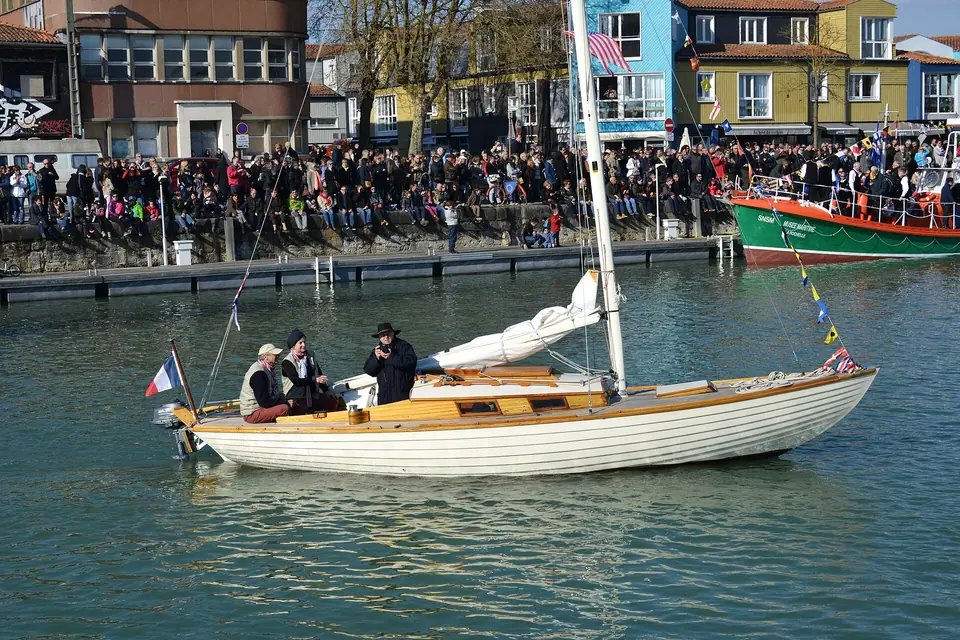
The original boats were built of clinker (lapstrake) planking, typically larch or Douglas fir, over a long keel with a cut-away forefoot. The stem is spooned and raked, the transom sharply angled and the rudder hung on the keel and steered by tiller. Typical boats displace 4,255 pounds and carry 2,205 pounds of iron ballast, a ballast ratio just over 50 percent, which explains the class reputation for carrying full sail in 20 to 25 knots.
By the mid-1970s, timber costs and competition from fiberglass boats were killing sales. Erik Andreasen and Sven Svendsen created fiberglass Folkboats molded to the exact shape of the clinker hull, with the same weight and weight distribution, so plastic and wooden boats could race together without handicap. Purists objected, but Andreasen, nicknamed Mr. Folkboat, is widely credited with saving the class. More than 950 fiberglass Folkboats had been built by 2001.
Slow on paper, steady when it blows
Nobody buys a Nordic Folkboat for speed. The 7/8 fractional sloop rig carries about 220 square feet of sail, a 159-square-foot main and a 61-square-foot jib, on a 19.7-foot waterline, so the theoretical hull speed is only about 6 knots. Sailboatdata calculates a sail area to displacement ratio near 13.4, firmly in the under-canvased category. Soundings described the boat as old, small, heavy and under-fast, with no spinnaker in the class.
What it does well is behave. Richard Sherwood noted that Folkboats have raced in 40 knots of wind, and the long keel tracks straight when lighter boats are reefing or running for cover. Classic Boat's Theo Rye praised its seakindly manners, deep cockpit and nicely balanced helm. The Portsmouth Yardstick number of 103.2 gives handicap racers a benchmark, but most Folkboat racing is strict one-design with two or three crew.
Racing a Folkboat in the United States
Sweden, Denmark and Germany remain the heart of the class, with branches of the Nordic Folkboat International Association there and in Australia. In North America, Scandinavian immigrants started fleets, and the most active by far is on San Francisco Bay. Its short waterline, long keel and small rig suit the Bay's stiff summer westerlies and strong currents.
The San Francisco fleet was constituted in 1957 and Wednesday night racing began in 1961. Soundings reported about 80 members in 2012, roughly half of them active sailors, and an International Cup held every other year since the late 1960s that draws European crews. Because new boats are not built locally, the fleet relies partly on Europeans who ship boats over for the regatta and sell them afterward. A 1994 count put about 110 Folkboats sailing in the US.
Small boat, outsized voyages
Folkboats were never intended for ocean crossings. The original cockpit is not self-bailing, which Practical Sailor flagged as raising the risk of offshore ambitions. Yet the hull's seaworthiness has tempted sailors for decades.
Blondie Hasler raced Jester, a heavily modified Folkboat with an enclosed deck, junk rig and his own self-steering gear, to second place in the first single-handed transatlantic race in 1960, finishing in 48 days behind Francis Chichester. In 1965 Sharon Sites Adams sailed the wooden Folkboat Sea Sharp alone from Los Angeles to Hawaii in 39 days, becoming the first woman to single-hand that route. She added lifelines, pulpits, extra winches, a self-bailing cockpit with scuppers, stronger rigging, bilge pumps and rudimentary self-steering first, which is a useful checklist for anyone thinking of doing something similar.
The cabin is for elves
Practical Sailor joked that the headroom was ideal for the elves of Scandinavian folklore, and that is close to the truth. Interiors vary widely. Race boats are kept bare for weight, while cruising boats usually have two settee berths and sometimes a V-berth forward. The head is often a bucket, cooking is camping style, and the usual way to add space is a boom tent over the cockpit.
Plenty of Baltic sailors still cruise Folkboats for weeks at a time, so it can be done. Just treat the Folkboat as a weekender and daysailer with a cuddy, not a pocket cruiser like a Contessa 26 or Cape Dory 25.
International Folkboat, Contessa 26 and other offspring
Do not confuse the Nordic Folkboat with its descendants. Sundén redesigned the boat for fiberglass as the International Folkboat, which appeared around 1967 to 1969 and became known in Europe as the Marieholm IF. It has a more modern profile, more interior space and more sail area. The Marieholm 26 followed in 1976. In Britain, Jeremy Rodgers and David Sadler used the Folkboat as the basis for the Contessa 26 in 1965, and Kim Holman's 1959 Stella was a Folkboat-inspired design for the North Sea. The Knarr is often listed as a successor.
Buying a Folkboat for sale in the US
Most Folkboats for sale in the US are on the West Coast, particularly around San Francisco Bay and Puget Sound. Fiberglass boats are the practical choice for most buyers, with simpler maintenance and the same racing status as wood. Wooden boats are cheaper to buy and lovely to look at, but they demand regular varnish, plank and fastening work.
Keel bolts are the big issue. Soundings reported that corroded keel bolts are a common malady of wooden Folkboats, and Sharon Sites Adams's old boat nearly sank on its mooring when its bolts started to let go. Budget roughly $2,500 to $9,000 a year for a slip or trailer storage, insurance, sails and maintenance, with wooden boats at the top of that range.
Nordic Folkboat specifications
| Length overall | 25.2 ft7.68 m |
|---|---|
| Waterline length | 19.7 ft6 m |
| Beam | 7.2 ft2.2 m |
| Draft | 3.9 ft1.19 m |
| Displacement | 4,255 lbs1,93 kg |
| Ballast | 2,205 lbs1, kg |
| Sail area | 22 sq ft20.4 m² |
| Cabins | Small cuddy cabin |
| Berths | 2 settee berths, sometimes a V-berth forward (up to 4) |
| Heads | None standard (portable or bucket) |
| Standard engines | None (sailing only) |
| Optional engines | Small outboard, on a bracket or in a well, or rare small inboard |
| Hull type | Displacement monohull with spooned raked stem and sharply angled transom |
| Keel | Modified long keel with cut-away forefoot, iron ballast of 2,205 lb, keel-hung rudder with tiller |
| Rig | 7/8 fractional Bermuda sloop with wooden spars on most boats (aluminum masts available), 159 sq ft main and 61 sq ft jib |
| Hull construction | Clinker-planked wood, or fiberglass molded to replicate the clinker hull |
| Builder | Many builders; Folkebådcentralen (Denmark) and today Haubold Yachting (Germany), Sweden (origin), Denmark and Germany |
| Naval architect | Plans drawn by Tord Sundén from awarded entries in the 1941 Scandinavian design contest |
| Other design credits | Awarded entries by Knud Olsen, Jac M. Iversen, Alfons Kvarnström and O. W. Dahlström; project championed by Sven Salén |
| Production | 1942 to present |
| Status | Limited production |
Figures come from builder documentation and independent tests where available. Displacement is usually quoted light, so a loaded cruising boat will weigh more. Compare these specs with another model.
How much does a Nordic Folkboat cost?
US asking prices range from a few thousand dollars for tired wooden boats needing keel bolts and planking work to roughly $30,000 to $45,000 for well-sorted fiberglass race boats or restored woodies. New boats are built to order in Europe, and Soundings reported that the San Francisco fleet relies on European sailors shipping boats over and selling them after the International Cup. Sails, spars and trailer often matter as much as the hull itself.
Estimate your yearly cost
A planning estimate using common rules of thumb: insurance near 1.5 percent of value, maintenance near 3 percent, haul out and bottom paint by length. Your marina, region and use will move these numbers. Open the full cost calculator.
Versions and options
- Wooden clinker Nordic Folkboat
- The original 1942 construction in larch or fir planking, built by artisan yards such as Boerresen, Brandt-Moeller, Lind and Ove Kaae.
- Fiberglass Nordic Folkboat
- Mid-1970s onward, molded to the exact clinker hull shape and weight so it races with wooden boats without handicap.
Nordic Folkboat timeline
- 1941Scandinavian design contest attracts 58 entries; Tord Sundén merges the awarded designs
- 1942First Folkboat launched at Arendals yard in Gothenburg on April 23
- 1957San Francisco Bay Folkboat fleet constituted
- 1960Blondie Hasler's modified Folkboat Jester finishes second in the first single-handed transatlantic race
- 1965Sharon Sites Adams sails the Folkboat Sea Sharp alone from Los Angeles to Hawaii
- 1970sFiberglass Folkboats replicating the clinker hull enter the class
Strengths and weaknesses
What owners like
- Exceptionally seakindly for its size
- Ballast ratio over 50 percent
- Strict one-design class with wood and fiberglass racing equally
- Easy to single-hand
- Low purchase and running costs
- Timeless looks
What to weigh up
- Slow and under-canvased in light air
- Very limited headroom and accommodation
- Original cockpit is not self-bailing
- Wooden boats need constant maintenance and keel bolt checks
Used Nordic Folkboat buyer checklist
Take this list to a viewing. Your ticks are saved in this browser so you can come back to it.
Always commission an independent marine survey and an engine survey before you buy. How a marine survey works.
Rivals to consider
Contessa 26
A Folkboat-derived British pocket cruiser with more interior and a proven offshore record.
Compare side by sidePearson Ensign
American full-keel daysailer with a big open cockpit and an active one-design class.
Compare side by sideJ/24
Much faster modern one-design keelboat with a spinnaker and a far larger US racing scene.
Compare side by sideOur verdict on the Nordic Folkboat
The Nordic Folkboat endures because it does a few things very well: it is affordable, forgiving, seaworthy far beyond its size and fun to race in strong wind. It is slow, cramped and in wood demands real care, so it is not a starter cruiser. For a sailor who wants a classic one-design to race on a windy bay, or a simple, handsome daysailer that will look after its crew, few boats offer as much character for so little money.
Nordic Folkboat questions answered
Who designed the Nordic Folkboat?
It came from a 1941 Scandinavian design contest. Tord Sundén drew the final plans from the awarded entries, but the plans were published without a designer's name and credit remains disputed.
How big is a Nordic Folkboat?
It is 25 feet 2 inches long with a 19.7-foot waterline, a 7-foot 3-inch beam and 3-foot 11-inch draft, displacing about 4,255 pounds.
Is a Folkboat safe offshore?
The hull is very seaworthy, but the original cockpit is not self-bailing. Ocean voyagers such as Sharon Sites Adams added a self-bailing cockpit, lifelines and stronger rigging first.
How much does a Folkboat for sale cost?
US asking prices range from a few thousand dollars for project boats to about $30,000 to $45,000 for well-sorted fiberglass race boats or restored wooden ones.
What is the difference between a Nordic Folkboat and an International Folkboat?
The International Folkboat is Sundén's later fiberglass redesign with more interior space and sail area; the Nordic Folkboat is the original 1942 clinker design.
Where are Folkboats raced in the US?
San Francisco Bay has the largest and most active Folkboat fleet outside Europe, racing since 1957.