Cape Dory Yachts Cruising Sailboats
Cape Dory 25 and 25D, Two Very Different Classics Compared
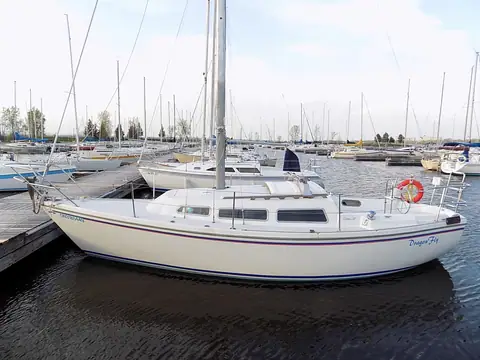
Same length, same builder, completely different boats. The Stadel-designed Cape Dory 25 is a weekender; Alberg's 25D is a tiny cruising yacht.
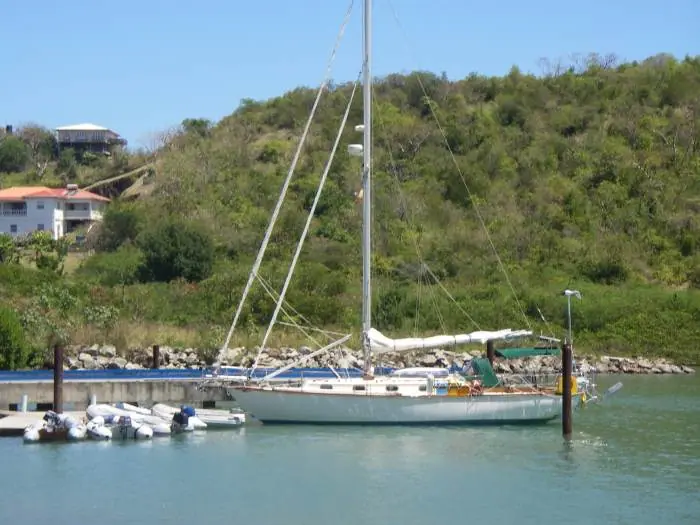
- Length
- 24.8 ft7.57 m
- Beam
- 7.3 ft2.21 m
- Draft
- 3 ft0.91 m
- Cabins
- 1 (V-berth forward, open main cabin)
- Used price
- $5K to $32K
On this page
- Overview
- Cape Dory, the builder that never chased fashion
- The original 25, a Stadel hull from Allied's Greenwich 24
- Tender at first, then locked in
- Living with the outboard well
- The 25D, Alberg's miniature cruising yacht
- Inside each boat: stooping room versus real headroom
- Construction strengths and the usual problems
- Which one to buy, and what it costs to keep
- Specifications
- Price and value
- Strengths and weaknesses
- Used buyer checklist
- Rivals
- Our verdict
- FAQ
The Cape Dory 25 is a George Stadel designed long-keel weekender built from 1973 to 1982 (845 boats). Its namesake, the Alberg designed 25D (1981 to 1985, 189 boats), is wider, heavier and diesel powered.
- Daysailing and weekending in classic style
- Singlehanders on protected waters
- Couples wanting a pocket cruiser (25D)
- First keelboat owners on a budget
Cape Dory 25 by the numbers
- Sail area to displacement
- 16.8Balanced power for coastal and offshore cruising.
- Displacement to length
- 306Heavy displacement. Slow to accelerate but steady and sea kindly with a full load.
- Theoretical hull speed
- 5.7 knThe practical top speed of a displacement monohull under normal sailing, based on waterline length.
- Ballast ratio
- 43%A high ballast ratio, so the boat stands up well to a breeze.
- Capsize screening
- 1.83Below 2.0, the traditional threshold for offshore suitability.
- Motion comfort ratio
- 22.0A quicker motion in waves, typical of light, beamy hulls.
- Length to beam ratio
- 3.42 : 1Moderate proportions.
Cape Dory, the builder that never chased fashion
Cape Dory Yachts was founded by Andrew Vavolotis in 1963 in Bridgewater, Massachusetts, later moved to Taunton and folded in 1992. In between it built thousands of boats, from the Cape Dory 10 dinghy and the Typhoon to cruisers up to 45 ft, most of them drawn by Carl Alberg with long keels, keel-hung rudders, narrow beam and pretty sheerlines. Practical Sailor described Cape Dory as one of the most conservative firms in the industry and noted fierce owner loyalty, with many owners trading up within the line rather than changing builders.
The Cape Dory 25 is one of the few Cape Dorys that is not an Alberg design, and that is where confusion starts. Two different boats carry the 25 name, and buyers who do not know the difference can end up paying a 25D price for a 25, or dismissing a 25D as a cramped weekender.
The original 25, a Stadel hull from Allied's Greenwich 24
George Stadel designed the hull, which Allied Boat Company built as the Greenwich 24. Vavolotis bought the molds during one of Allied's business troubles (Wikipedia dates the sale to 1972), raised the freeboard for headroom, which also added about 7 inches to the length and waterline, redesigned the deck, coachroof and interior, and put the Cape Dory 25 into production in 1973. Cape Dory built 845 of them in East Taunton through 1982.
Good Old Boat points out that early and late boats differ. Boats before about 1979 had plastic or aluminum non-opening ports, no bridge deck and a lower aspect rig; later boats gained a substantial bridge deck and bronze opening ports. If you plan to sail in open water, a later boat with the bridge deck is the one to buy.
Tender at first, then locked in
With a 7 ft 3 in beam and slack bilges, the 25 heels quickly, but its 1,700 lb of lead and short, low rig make it stiff once it settles. Good Old Boat's test sail in 15 to 20 knots with a reef and a working jib found it heeled to about 15 degrees and then stuck there, while keeping up with 30 footers. Owners report average speed for the size and say a 150 percent genoa is essential in light air.
The original boom uses roller reefing, which Practical Sailor criticized for poor sail shape and binding in a rising wind. Converting to slab (jiffy) reefing is one of the most worthwhile upgrades.
Living with the outboard well
The 25 has an outboard well at the aft end of the cockpit. It accepts engines up to 15 hp, but most owners use a 9.9 hp unit, which is plenty. Practical Sailor's owner survey was frank about the drawbacks: the engine compartment cover must stay open for air, the well resonates loudly, and with the propeller aft of the rudder there is no prop wash to help steering at low speed. Many owners said the boat barely maneuvers in reverse.
Modern four-stroke outboards are heavier and taller than the two-strokes the well was designed for, and some need modification to fit with the lid closed. Measure before you buy a new engine.
The 25D, Alberg's miniature cruising yacht
In the fall of 1981 Cape Dory introduced the 25D, and the D stands for diesel. Practical Sailor stressed that the only thing it shares with the 25 is overall length. Carl Alberg designed it: it is about 9 inches wider at 8 ft, 6 inches deeper at 3 ft 6 in, carries about 350 lb more ballast, displaces 5,120 lb and has a mast about 4 ft 6 in taller with a higher aspect mainsail. It cost about 50 percent more than the 25 new, and Cape Dory built 189 through 1985.
Power is a raw-water-cooled Yanmar 1QM of 7.5 hp, weighing just 154 lb, fed from a 13 gallon tank that Practical Sailor estimated would give over 50 hours of running, or roughly 250 miles. The 25D also has a full molded liner, a compression post under the deck-stepped mast, jiffy reefing, an anchor well and seacocks on all underwater through-hulls.
The 25D's reputation reaches beyond coastal sailing. Wikipedia records boats singlehanded across both the Atlantic (New York to Ireland) and the Pacific (California to Australia).
Inside each boat: stooping room versus real headroom
The Cape Dory 25 interior is honest about its purpose. Practical Sailor called it a minimal short-term cruiser for two adults and two children, with stooping headroom, a sharply tapered V-berth too small for two adults, a cramped toilet compartment separated by a curtain and folding doors, and settee berths without backrests. The galley is two small platforms at the foot of the settees, with the sink over the port berth and a small icebox under the companionway step.
The 25D is a revelation by comparison. By dropping the sole into the bilge, Alberg found about 5 ft 11 in of headroom, and he eliminated the forward cabin entirely in favor of a large head compartment with 5 ft 9 in headroom, two hanging lockers and space for a shower. The main cabin has properly angled, padded settee backs, ash hull lining, a quarter berth and four opening bronze ports. Its weak spot is the galley, with a sink tucked under the bridge deck and an alcohol stove that Practical Sailor disliked.
- Cape Dory 25: 24 gallons of water, outboard, V-berth plus two settees
- Cape Dory 25D: 20 gallons of water, 13 gallons of diesel, no forward cabin, big head forward
- Both: teak toerails, handrails and coamings, bronze hardware by Cape Dory's Spartan Marine division
Construction strengths and the usual problems
Both boats have solid mat and roving hulls, lead ballast cast into a hollow keel molding and glassed over, and balsa-cored decks. Practical Sailor rated workmanship very good and called the 25D probably one of the strongest boats of its size. Its reservations were the hull-to-deck joint, bonded with a semi-rigid compound and only incidentally fastened by toerail screws and hardware bolts, and the mix of bronze castings, stainless bolts and aluminum backing plates.
Rudder removal is awkward because the bronze heel fitting must be ground off and the rudder dropped out of the bottom, so check the rudder carefully before you buy rather than after.
Which one to buy, and what it costs to keep
If you want a handsome, inexpensive daysailer and weekender with classic looks, the Cape Dory 25 is hard to fault and costs little to buy. If you want to cruise for a week or more, or sail open water, pay up for a 25D. Good Old Boat reported that the 25D sells for almost three times the price of a 25, and in our view it is worth it for anyone who will sleep aboard.
Annual costs are modest: roughly $3,000 to $7,500 for a mooring or small slip, insurance, haul-out, bottom paint and teak care. The teak trim needs regular attention, and an aging outboard on the 25 or a raw-water-cooled Yanmar on the 25D are the main mechanical risks.
Cape Dory 25 specifications
| Length overall | 24.8 ft7.57 m |
|---|---|
| Waterline length | 18 ft5.49 m |
| Beam | 7.3 ft2.21 m |
| Draft | 3 ft0.91 m |
| Displacement | 4, lbs1,814 kg |
| Ballast | 1,7 lbs771 kg |
| Sail area | 264 sq ft24.5 m² |
| Fresh water | 24 gal91 L |
| Cabins | 1 (V-berth forward, open main cabin) |
| Berths | 4 (tapered V-berth and two settee berths) |
| Heads | 1 toilet compartment with curtain and folding doors |
| Standard engines | Outboard in a cockpit well, commonly a 9.9 hp Johnson or Evinrude |
| Optional engines | 25D: Yanmar 1QM 7.5 hp inboard diesel |
| Maximum power | 15 hp |
| Hull type | Long-keel displacement monohull with spoon bow and raised counter |
| Keel | Full long keel with internal lead ballast and keel-hung rudder |
| Rig | Masthead sloop, deck-stepped mast, roller reefing boom (jiffy reefing on the 25D) |
| Hull construction | Solid hand-laid fiberglass hull, balsa-cored deck, internal lead ballast |
| Builder | Cape Dory Yachts, East Taunton, Massachusetts, USA |
| Naval architect | George H. Stadel Jr. (Cape Dory 25); Carl Alberg (Cape Dory 25D) |
| Other design credits | Hull derived from Allied's Greenwich 24, redesigned by Cape Dory owner Andrew Vavolotis |
| Production | 1973 to 1982 |
| Status | Discontinued |
Figures come from builder documentation and independent tests where available. Displacement is usually quoted light, so a loaded cruising boat will weigh more. Compare these specs with another model.
How much does a Cape Dory 25 cost?
This page covers two boats with very different values. The outboard-powered Cape Dory 25 is an inexpensive classic, while Good Old Boat reported that the 25D sells for almost three times as much, reflecting its inboard diesel and true cruising interior; Practical Sailor noted the 25D was priced about 50 percent higher than the 25 when new. Bands for 1983 and 1985 below refer to the 25D. Teak condition, sails and the outboard or diesel matter more than year. Ranges are our estimates.
Estimate your yearly cost
A planning estimate using common rules of thumb: insurance near 1.5 percent of value, maintenance near 3 percent, haul out and bottom paint by length. Your marina, region and use will move these numbers. Open the full cost calculator.
Versions and options
- Cape Dory 25, early (1973 to about 1978)
- Non-opening ports, no bridge deck, lower aspect rig.
- Cape Dory 25, late (about 1979 to 1982)
- Bronze opening ports and a substantial bridge deck.
- Cape Dory 25D (1981 to 1985)
- Alberg design, 8 ft beam, 5,120 lb, Yanmar 1QM diesel, big forward head instead of a V-berth; later sold by C. W. Hood Yachts as the Octavia 25.
Cape Dory 25 timeline
- 1963Andrew Vavolotis founds Cape Dory
- 1973Cape Dory 25 enters production using the Greenwich 24 hull
- 1981Cape Dory 25D introduced in the fall
- 1982Cape Dory 25 production ends after 845 boats
- 198525D production ends after 189 boats
- 1992Cape Dory Yachts closes
Strengths and weaknesses
What owners like
- Classic Stadel and Alberg lines
- Stiff once heeled thanks to a high ballast ratio
- Solid hand-laid hull and bronze hardware
- Inexpensive to buy and run (25)
- Genuine small cruiser with real headroom (25D)
What to weigh up
- Cramped, low interior on the 25
- Noisy outboard well and poor reverse handling on the 25
- Roller reefing boom on the original 25
- Weak galley on the 25D
- Rudder removal is a major job
Used Cape Dory 25 buyer checklist
Take this list to a viewing. Your ticks are saved in this browser so you can come back to it.
Always commission an independent marine survey and an engine survey before you buy. How a marine survey works.
Rivals to consider
Contessa 26
A British-Canadian Folkboat derivative, narrower and more seaworthy, with less room below.
Compare side by sideNordic Folkboat
Good Old Boat's benchmark comparison; lovely to sail but even more spartan.
Compare side by sideCom-Pac 23
Trailerable full-keel pocket cruiser with a similar traditional look.
Compare side by sidePacific Seacraft Dana 24
A much more expensive, more capable pocket cruiser, closer in spirit to the 25D.
Compare side by sideOur verdict on the Cape Dory 25
The Cape Dory 25 is one of the prettiest inexpensive keelboats in America, but it is a weekender, not a cruiser. The 25D is the boat to buy if you want to live aboard for more than a night: Alberg turned the same length into a miniature yacht with headroom, a private head and a diesel. Know which one you are looking at, price it accordingly, and either will reward you with classic Cape Dory manners for decades.
Cape Dory 25 questions answered
What is the difference between the Cape Dory 25 and 25D?
They are different designs. The 25 is a Stadel-designed outboard weekender; the 25D is an Alberg design that is wider, heavier, deeper and has an inboard diesel and a cruising interior.
How many Cape Dory 25s were built?
845 Cape Dory 25s were built from 1973 to 1982, and 189 of the 25D from 1981 to 1985.
How much is a Cape Dory 25 worth?
We estimate most Cape Dory 25s ask about $5,000 to $13,000, and 25Ds roughly $15,000 to $32,000 depending on condition.
Does the Cape Dory 25 have an inboard engine?
No. The 25 uses an outboard in a cockpit well, typically 9.9 hp. The 25D has a 7.5 hp Yanmar 1QM diesel.
Who designed the Cape Dory 25?
George Stadel, based on Allied's Greenwich 24. Carl Alberg designed the unrelated 25D.
What does the Cape Dory 25 interior look like?
A tapered V-berth, a small toilet compartment, two settee berths and a minimal galley, with stooping headroom. The 25D has about 5 ft 11 in headroom and a large forward head.
More cruising sailboats to explore
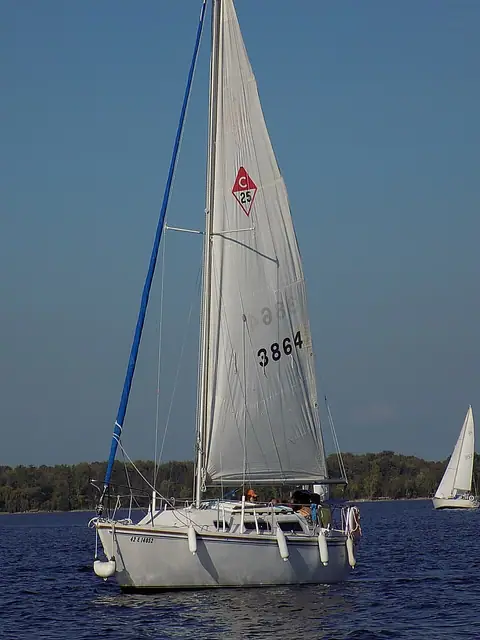
Catalina 25
Cruising Sailboats, 25 ft
Used $4K to $20K
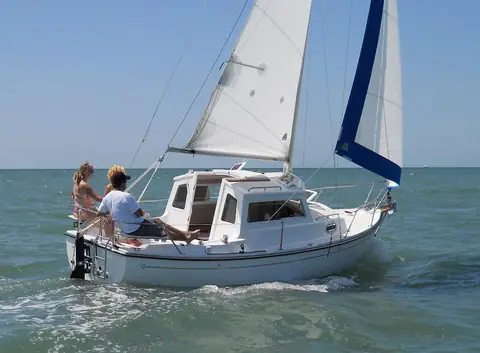
Com-Pac 23
Cruising Sailboats, 24 ft
Used $6K to $32K
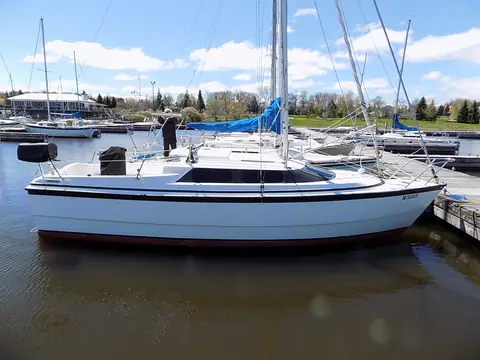
MacGregor 26X
Cruising Sailboats, 26 ft
Used $9K to $25K
Catalina 27
Cruising Sailboats, 27 ft
Used $3K to $20K