Catalina Yachts Cruising Sailboats
Catalina 25 for Sale Buyer's Guide, Specs and Values
Nearly 6,000 were built, so the real question is not whether to buy a Catalina 25 but which keel, rig and model year to hunt for.
- Length
- 25 ft7.62 m
- Beam
- 8 ft2.44 m
- Draft
- 4 ft1.22 m
- Cabins
- 1 plus quarter berth
- Used price
- $4K to $20K
On this page
- Overview
- Why there is always a Catalina 25 for sale near you
- Five keels over one production run
- Standard rig or tall rig, and the weather helm question
- Catalina 25 interior: dinette or twin settees
- The 1987 makeover and why later hulls command more
- Pushing 4,500 pounds with an outboard
- Trailering a Catalina 25 is possible, not casual
- What Catalina 25 sailboats for sale cost in 2026
- Specifications
- Price and value
- Strengths and weaknesses
- Used buyer checklist
- Rivals
- Our verdict
- FAQ
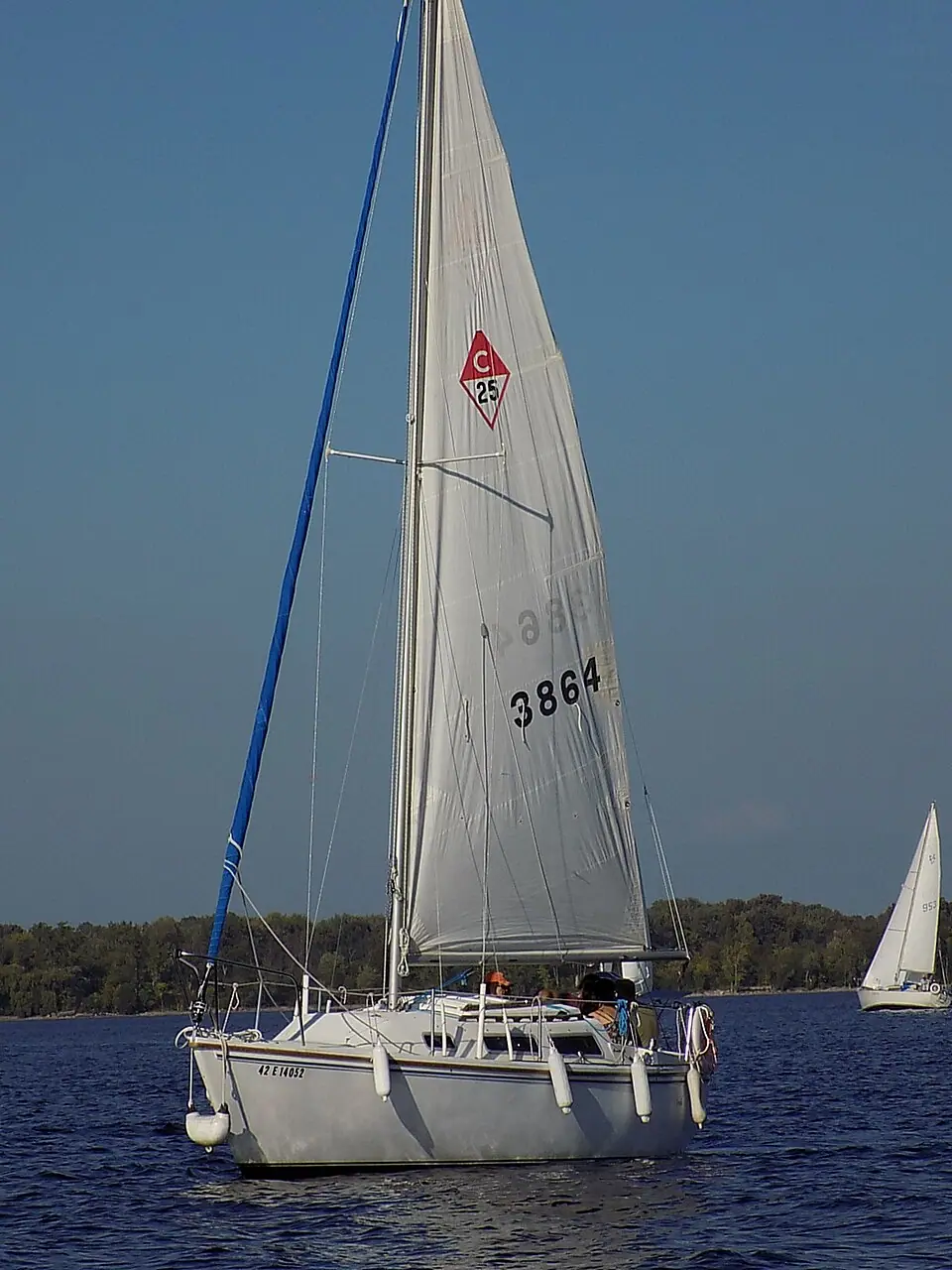
The Catalina 25 is a 25-foot Frank Butler pocket cruiser built from the late 1970s to the early 1990s with swing, fin and wing keels, standard or tall rigs, and a pop-top that gives 6 feet 4 inches of headroom.
- Families stepping up from a 22-footer
- Lake and bay weekend cruising
- Budget-minded first cruising boat
- Owners who trailer to seasonal storage
Catalina 25 by the numbers
- Sail area to displacement
- 15.7A cruising rig sized for comfort, so expect to motor in very light air.
- Displacement to length
- 186Light displacement for its length, quick but sensitive to added cruising weight.
- Theoretical hull speed
- 6.3 knThe practical top speed of a displacement monohull under normal sailing, based on waterline length.
- Ballast ratio
- 42%A high ballast ratio, so the boat stands up well to a breeze.
- Capsize screening
- 1.93Below 2.0, the traditional threshold for offshore suitability.
- Motion comfort ratio
- 19.1A quicker motion in waves, typical of light, beamy hulls.
- Length to beam ratio
- 3.13 : 1Moderate proportions.
Why there is always a Catalina 25 for sale near you
Search for a Catalina 25 for sale almost anywhere in the United States and you will find several within driving distance. That is simply arithmetic. Catalina built somewhere between about 5,300 and 6,000 of them from the late 1970s to the early 1990s (Practical Sailor cites 5,332 sold from 1976 to 1990, Wikipedia 5,866 built from 1978 to 1994), and Wikipedia describes it as the most popular sailboat in its size range ever built in the US. Frank Butler took the formula of the Catalina 22, stretched it to 25 feet, added 8 feet of beam, an enclosed head and a real galley, and kept the price within reach of the same families who had started on the smaller boat.
Practical Sailor's verdict has aged well: not fancy or fast, but economical, a fair sailer and roomy for its size. That is exactly what most buyers want from a lake or bay cruiser. The challenge is that 'Catalina 25' covers a wide range of boats, from early cast iron swing keel models with self-tapped hatches to the much improved post-1987 boats, and the price differences between them are justified.
Standard rig or tall rig, and the weather helm question
Catalina offered a standard and a tall rig. The tall mast is about two feet taller and the boom attaches roughly a foot lower, which adds useful sail area for light summer air. Practical Sailor lists PHRF ratings of around 228 seconds per mile for the standard rig and around 222 for the tall rig, and Wikipedia gives 225 for the fin keel boat. Either way you are looking at a theoretical hull speed of about 6.3 knots.
Both rigs develop strong weather helm in 15 knots or more, and owners agree on the fix: reef early. The low boom on the tall rig is a real head-knocker in the cockpit, so if you sail mostly in breezy places like San Francisco Bay or the Great Lakes in the fall, the standard rig is the more relaxing boat. For light-air lakes in the Southeast and Midwest, the tall rig is the better buy.
Catalina 25 interior: dinette or twin settees
Two layouts were offered. The dinette version puts a table and facing seats on one side of the saloon, which makes meals more sociable and converts into a double berth. The settee version has opposing benches and feels more open. A V-berth forward, an enclosed head, a small galley with a sink and room for a two-burner stove, and an aft quarter berth complete the plan.
Headroom is 5 feet 6 inches with the pop-top closed and 6 feet 4 inches with it raised. The pop-top was optional until 1987 and standard afterwards. It is heavy, and some owners rarely lift it, but with a canvas skirt it can stay up at anchor in rain. Never sail with it raised: a knockdown with the top open could flood the cabin.
Be skeptical of the berth count. The aft double is really a wide single quarter berth, and Practical Sailor notes the port settee is short for an adult. Two adults and two children is a realistic weekend crew. The icebox was redesigned in 1983, and later boats hold ice noticeably longer.
The 1987 makeover and why later hulls command more
Catalina reworked the 25 for the 1987 model year with a more contemporary deck, a refined interior with less teak and more molded fiberglass, jiffy reefing as standard and a more sophisticated electrical system. Early hulls also had a forward hatch held with self-tapping screws until 1983, and a hull to deck joint fastened the same way, both frequent leak sources.
For most buyers, a 1987 or later boat is worth $3,000 to $5,000 more than an otherwise similar early boat, mainly because it needs fewer fixes in the first two seasons. If you want an earlier boat, look for one where the previous owner has already replaced turnbuckles, rebedded the deck hardware and dealt with the windows.
Pushing 4,500 pounds with an outboard
Most Catalina 25s use an outboard on a folding transom bracket. A 6 hp engine gives about 5.5 knots and an 8 to 9.9 hp engine about 6 knots, according to owner reports gathered by Good Old Boat. Choose a 25-inch extra-long shaft over the standard 20-inch version, because the prop ventilates in steep chop and the engine sits a long reach from the helm.
Remote throttle and shift controls are a valuable upgrade. A small number of boats were fitted with an inboard diesel of about 10 hp, but Practical Sailor found it disappointing for speed, and it complicates maintenance on a boat this size. Electric outboards are a growing retrofit for lake boats that rarely motor more than a mile.
Trailering a Catalina 25 is possible, not casual
The 25 is trailerable in the sense that it fits the legal road width at 8 feet of beam. In practice the towing weight with trailer, outboard, gear and provisions is roughly 6,000 to 7,800 pounds, which calls for a full-size pickup or a large SUV. Mast stepping is a two-person job with a gin pole. Most owners trailer once or twice a year, to and from winter storage, and keep the boat in a slip or on a mooring during the season.
If you want to tow every weekend, the Catalina 22 or a MacGregor 26 is a more sensible choice. If you want a boat that can move between lakes a few times a year and saves you winter storage fees, a swing or wing keel Catalina 25 on a good tandem axle trailer is a strong value.
What Catalina 25 sailboats for sale cost in 2026
Used Catalina 25 prices run from about $4,000 for a tired early swing keel boat needing work to about $20,000 for a late, well-equipped fin or wing keel boat with a trailer. Most clean, sailable boats change hands between $7,000 and $14,000. Older pricing references from Practical Sailor and Good Old Boat show the same shape: early boats under $8,000, late 1980s equipped boats in the mid teens.
Annual costs are modest. Expect roughly $3,000 to $8,000 a year for a slip or mooring, insurance, bottom paint, outboard service and small parts, depending on region. Catalina Direct and the Catalina 25/250 owners association keep parts, manuals and upgrade advice easy to find, which keeps labor costs down for owners willing to do their own work. Catalina Yachts itself is gone, having halted production in 2025 before its tooling was auctioned in June 2026, but a 25 built in the 1980s has relied on that association and aftermarket network for decades, so the closure changes little for owners or for resale.
Catalina 25 specifications
| Length overall | 25 ft7.62 m |
|---|---|
| Waterline length | 22.2 ft6.76 m |
| Beam | 8 ft2.44 m |
| Draft | 4 ft1.22 m |
| Displacement | 4,55 lbs2,064 kg |
| Ballast | 1,9 lbs862 kg |
| Sail area | 27 sq ft25.1 m² |
| Cabins | 1 plus quarter berth |
| Berths | 5 |
| Heads | 1 enclosed |
| Standard engines | Outboard on folding transom bracket, typically 6 to 9.9 hp |
| Optional engines | Small inboard diesel (about 10 hp Universal) on a minority of late boats |
| Hull type | Fiberglass monohull pocket cruiser |
| Keel | Fin keel (4 ft), wing keel (2 ft 10 in) or cast iron swing keel (2 ft 8 in up) |
| Rig | Masthead sloop, standard or tall rig |
| Hull construction | Solid fiberglass with full molded interior liner |
| Builder | Catalina Yachts, United States |
| Naval architect | Frank V. Butler |
| Production | 1978 to 1991 |
| Status | Discontinued |
Figures come from builder documentation and independent tests where available. Displacement is usually quoted light, so a loaded cruising boat will weigh more. Compare these specs with another model.
How much does a Catalina 25 cost?
Late boats from the 1987 redesign onward, especially wing or fin keel versions with a pop-top enclosure, newer sails and a four-stroke outboard, set the top of the market. Early swing keel boats with cast iron keels, original turnbuckles and blistered bottoms sit near the floor. A matching trailer adds real value because few generic trailers fit the hull.
Estimate your yearly cost
A planning estimate using common rules of thumb: insurance near 1.5 percent of value, maintenance near 3 percent, haul out and bottom paint by length. Your marina, region and use will move these numbers. Open the full cost calculator.
Catalina 25 timeline
- 1978Catalina 25 introduced as a larger family cruiser than the Catalina 22
- 1983Improved icebox and through-bolted forward hatch replace early details
- 1987Redesigned deck, refined interior and standard pop-top
- 1990sProduction winds down; sources put the total between about 5,300 and 6,000 boats
- 1995Catalina 250 takes over as the company's 25-foot trailerable cruiser
Strengths and weaknesses
What owners like
- Huge supply of boats keeps prices reasonable
- Pop-top gives 6 ft 4 in headroom at anchor
- Choice of keel to suit shallow or deep home waters
- Enclosed head and real galley in a 25-footer
- Strong owners association and parts support
- Stable, forgiving handling for families
What to weigh up
- Heavy weather helm above 15 knots without early reefing
- Too heavy for casual weekly trailering
- Swing keel versions need regular keel maintenance
- Aluminum-framed windows and screwed hardware leak with age
- Outboard prop ventilates in chop
Used Catalina 25 buyer checklist
Take this list to a viewing. Your ticks are saved in this browser so you can come back to it.
Always commission an independent marine survey and an engine survey before you buy. How a marine survey works.
Rivals to consider
Catalina 22
Lighter and genuinely easy to tow every weekend, but far more cramped below.
Compare side by sideCatalina 27
Inboard engine, more headroom and a better motion in chop, at the cost of slip-only ownership.
Compare side by sideMacGregor 26X
Lighter on the trailer and much faster under power, but less pleasant as a pure sailboat.
Compare side by sideO'Day 25
A similar era family cruiser with a keel and centerboard, built in smaller numbers.
Our verdict on the Catalina 25
The Catalina 25 is the sensible middle of the American pocket cruiser market: big enough for a family weekend, cheap to buy, simple to maintain and supported by one of the largest owner communities in sailing. Its weaknesses are well documented and fixable, from weather helm to leaky windows. Spend a little more for a 1987 or later hull with a lead fin or wing keel, a good trailer and a long-shaft four-stroke, and you will own a boat that is easy to sell when you move up.
Catalina 25 questions answered
How much is a Catalina 25 worth?
Most used Catalina 25s sell for $7,000 to $14,000, with project boats from about $4,000 and the best late models with trailers near $20,000.
Can a Catalina 25 be trailered?
Yes, its 8-foot beam is road legal, but the total towing weight is roughly 6,000 to 7,800 pounds, so you need a full-size truck and most owners tow only occasionally.
What is the best Catalina 25 keel?
For most sailors a fixed fin or wing keel is best because it avoids swing keel maintenance. Choose the swing keel only if you trailer often or sail very shallow water.
How much headroom is in a Catalina 25?
About 5 feet 6 inches with the pop-top down and 6 feet 4 inches with it raised.
What replaced the Catalina 25?
The Catalina 250, a newer Gerry Douglas design with water ballast and fixed keel versions, followed in the mid-1990s.
Catalina 25 photos
More cruising sailboats to explore

Cape Dory 25
Cruising Sailboats, 25 ft
Used $5K to $32K
MacGregor 26X
Cruising Sailboats, 26 ft
Used $9K to $25K
Com-Pac 23
Cruising Sailboats, 24 ft
Used $6K to $32K
Catalina 27
Cruising Sailboats, 27 ft
Used $3K to $20K