Catalina Yachts Cruising Sailboats
Catalina 22 Sailboat Review, Specs and Used Buying Guide
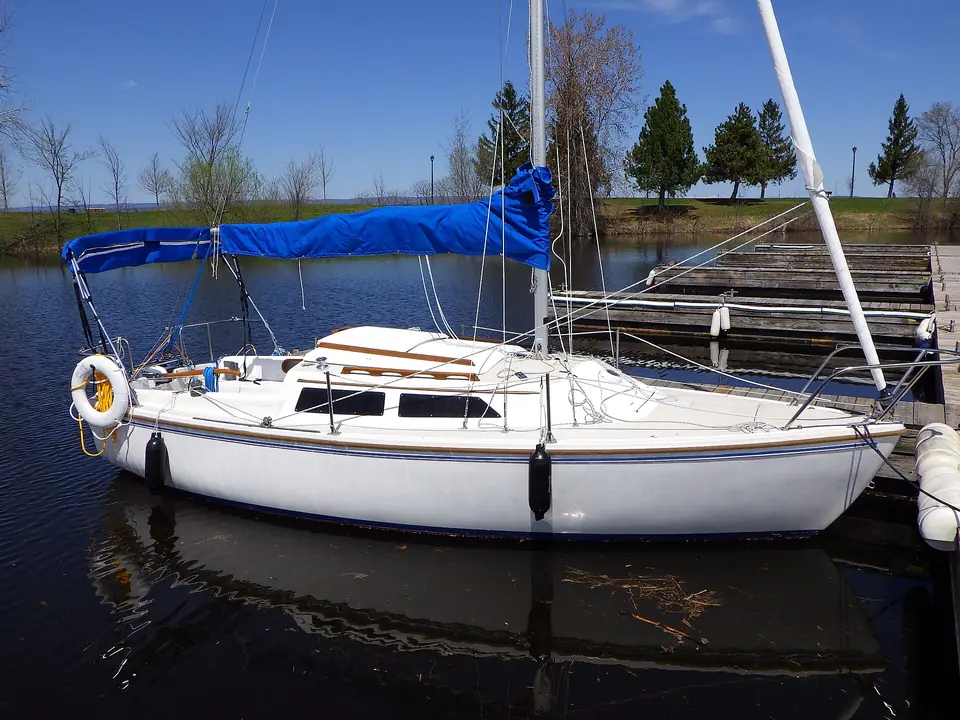
Frank Butler's 1969 pop-top trailer sailer, built in the tens of thousands and still the default first keelboat for American sailors.
- Length
- 21.5 ft6.55 m
- Beam
- 7.7 ft2.34 m
- Draft
- 5 ft1.52 m
- Cabins
- 1 (open plan with V-berth)
- Used price
- $3K to $40K
On this page
- Overview
- The Catalina 22 and Frank Butler's bet on the backyard sailor
- Original, New Design, Mark II and Sport: telling the generations apart
- Swing keel, wing keel or fixed fin under a Catalina 22
- Catalina 22 interior: pop-top headroom and a V-berth for two
- How a Catalina 22 sails: hull speed, weather helm and a PHRF near 270
- Trailer, tow vehicle and the 20-minute mast raising
- Racing with the Catalina 22 National Sailing Association
- Catalina 22 for sale: what $5,000, $15,000 and $35,000 buy in 2026
- Annual cost of keeping a 22-footer
- Owning a Catalina 22 after the factory closed
- Specifications
- Price and value
- Strengths and weaknesses
- Used buyer checklist
- Rivals
- Our verdict
- FAQ
The Catalina 22 is a 21.5-foot swing keel trailer sailer built from 1969 until Catalina Yachts shut down in 2025. Four generations, a strong one-design class and deep parts support keep it a top first keelboat.
- First-time sailboat owners
- Lake and bay weekend sailors
- Budget one-design racing
- Families trailering to different waters
The Catalina 22 and Frank Butler's bet on the backyard sailor
Frank Butler did not set out to design a classic. In 1969 he wanted a boat a young family could keep in the driveway, tow behind the family sedan, launch at a public ramp and sleep aboard for a weekend. The Catalina 22 was the answer, and it essentially built Catalina Yachts. By 2009 about 15,000 had been delivered, making it one of the most produced keelboats in the world.
The recipe was simple: a beamy 21.5-foot fiberglass hull, a cast iron swing keel that cranks up to leave about 20 inches of draft, a masthead sloop rig on a hinged mast step, and a pop-top cabin. None of it was revolutionary. The package at a working-family price was, and Catalina kept building it while rivals came and went.
Practical Sailor notes that the Catalina 22 sits in the US Sailing Hall of Fame, and its real legacy is cultural. Thousands of sailors who now own 40-footers learned to tack, reef and anchor on one, and that owner network is worth more than any single feature of the boat.
Catalina 22 by the numbers
- Sail area to displacement
- 19.8Balanced power for coastal and offshore cruising.
- Displacement to length
- 139Light displacement for its length, quick but sensitive to added cruising weight.
- Theoretical hull speed
- 5.9 knThe practical top speed of a displacement monohull under normal sailing, based on waterline length.
- Ballast ratio
- 24%Relatively low ballast, form stability does more of the work.
- Capsize screening
- 2.34Above 2.0, so this hull leans toward coastal stability over ultimate offshore resistance.
- Motion comfort ratio
- 11.5A quicker motion in waves, typical of light, beamy hulls.
- Length to beam ratio
- 2.80 : 1A beamy hull with lots of volume for its length.
Original, New Design, Mark II and Sport: telling the generations apart
The name stayed the same for more than half a century, but the boat did not, and listings rarely say which generation you are looking at.
The original boats from 1969 to 1985 are the lightest and most common. In 1986 Catalina introduced what owners call the New Design, a more substantial hull and deck that fixed many early weaknesses and added a wing keel option. The 1995 Mark II was a larger rework, with a longer overall length of about 23.8 feet when the reverse transom and hardware are counted, a revised interior and fixed fin or wing keels as standard, with the swing keel still available. One-design racers grumbled because the Mark II did not match the class measurements of the older boats.
Catalina responded in 2004 with the Catalina 22 Sport, built specifically to match the original dimensions and weight so that it could race on level terms with older class boats, while adding a sharper look and modern hardware. The Sport was the last version Catalina built, staying in the range until the company halted production in 2025. Practical Sailor's review notes that it brought rakish styling and a fully battened mainsail while sticking closely to the original boat's dimensions and weight.
Swing keel, wing keel or fixed fin under a Catalina 22
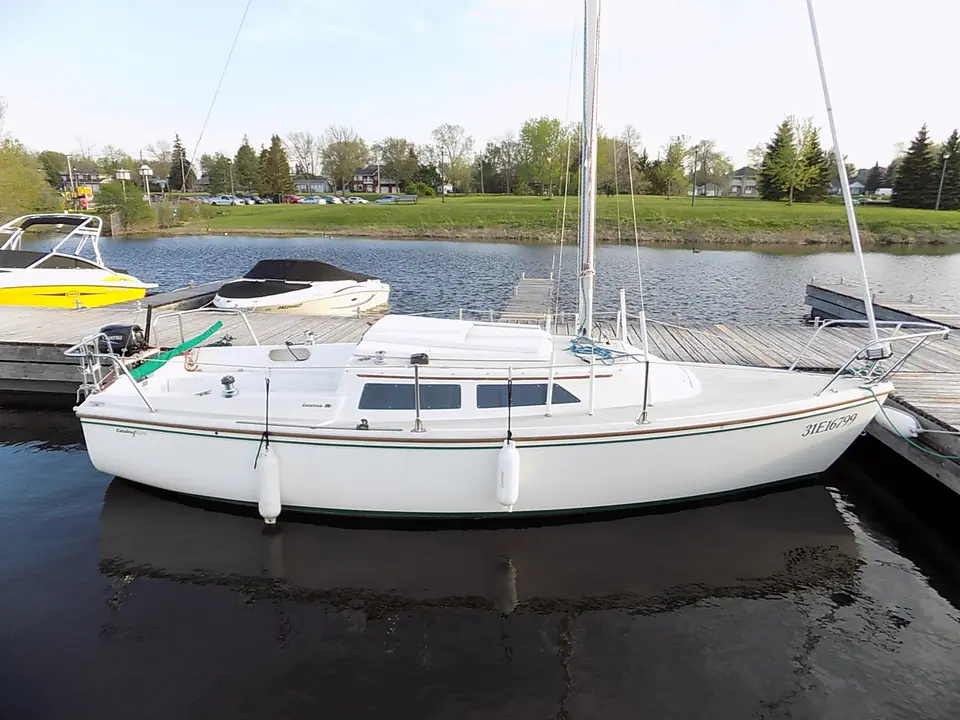
About nine in ten original Catalina 22 buyers chose the swing keel, and it remains the configuration most people mean when they say Catalina 22. The keel is a heavy cast iron plate that pivots on a pin through a hanger bolted to the hull and is raised by a winch and wire pennant in the cabin. Down, it gives 5 feet of draft and real lateral resistance. Up, the boat floats in about 20 inches of water and slides onto a shallow, low trailer, which is the whole point of the design.
The price of that convenience is maintenance. The pivot pin hole can elongate on boats that rock on a mooring all summer, hanger bolts loosen or seize, and the pennant cable needs periodic replacement, which means lifting the boat to reach the top of the keel. A neglected swing keel is the most common reason a cheap Catalina 22 becomes an expensive one.
Wing keel and fixed fin boats are simpler and point a little better, but they need a deeper trailer and a better ramp. If the boat lives in a slip all season, a fixed keel is the low-maintenance choice. If it lives on its trailer, buy a swing keel and budget to keep it healthy.
Catalina 22 interior: pop-top headroom and a V-berth for two
Below decks the Catalina 22 interior is a single open cabin. A V-berth fills the bow with a portable toilet under the forward cushions, settees run down both sides, and many boats carry a small galley module with a sink on the starboard side while the port side converts to a dinette for two. A quarter berth tunnels aft under the cockpit. The one-piece fiberglass liner, an early Catalina hallmark, is easy to clean but hides wiring and fasteners.
Headroom is the big compromise. With the hatch closed you are hunched over, but the pop-top, fitted to about 90 percent of the boats sold, lifts roughly 10 inches on pipe supports and transforms the cabin at anchor. A canvas enclosure for the pop-top is a worthwhile find on a used boat because it lets you leave the top raised in rain.
Be realistic about sleeping numbers. Two adults, or two adults with two small children, is the comfortable weekend limit, whatever the brochure berth count says.
How a Catalina 22 sails: hull speed, weather helm and a PHRF near 270
Nobody buys a Catalina 22 for speed. A 19.3-foot waterline gives a hull speed of about 5.9 knots, and an average PHRF near 270 seconds per mile puts it well behind a J/22 or Capri 22. Still, with a sail area to displacement ratio near 20, a clean boat with a good 150 percent genoa feels lively in 8 to 12 knots of breeze.
As the wind builds the boat develops weather helm. The old class trick is counterintuitive: raise the swing keel a little in a blow, which moves the center of lateral resistance aft and lightens the helm, and reef the main early. A 7-foot cockpit is long enough for four adults, and the mainsheet runs to a traveler bar on the stern, which keeps it out of the way of guests. A capsize screening value of about 2.3 confirms the design brief: lakes, bays and sounds, not open ocean.
Under power, a 4 to 6 hp long-shaft four-stroke on the transom bracket pushes the boat close to hull speed on flat water. A short-shaft engine will ventilate as soon as the stern lifts in a chop.
Trailer, tow vehicle and the 20-minute mast raising
The Catalina 22 weight question comes up constantly, and the honest answer is that the boat alone is around 2,250 to 2,500 pounds depending on generation and keel, and the complete rig on the road, with trailer, outboard, fuel, anchor and gear, usually lands well over 3,000 pounds. Plenty of midsize SUVs and pickups handle that easily. A small crossover with a 1,500-pound tow rating does not, regardless of what the seller says.
A proper Catalina 22 trailer has bunks matched to the swing keel hull and a low frame so the boat floats off at a normal ramp. Galvanized trailers survive salt water far better than painted steel. Check the axle, bearings, tire date codes and winch strap, because a trailer rebuild can run $1,500 to $3,000.
Stepping the mast is a one-person job with practice and a gin pole. Most owners get from parking lot to launch in 30 to 45 minutes once they have a routine, though a roller furler makes the mast heavier to raise.
Racing with the Catalina 22 National Sailing Association
The Catalina 22 is one of the few small cruisers with a genuine one-design racing class. The Catalina 22 National Sailing Association organizes regional fleets, regional championships and an annual National Championship Regatta, and its rules are the reason the Sport model exists. If you enjoy club racing, this is a large part of the boat's appeal: competitive sailing on a modest budget, with a class that values tuning and crew work over expensive sails.
Class racing shapes the used market too. Boats with recent class-legal sails and a faired keel change hands among racers at a premium, so ask whether the sails were cut for racing or cruising.
Catalina 22 for sale: what $5,000, $15,000 and $35,000 buy in 2026
At the bottom of the market, roughly $3,000 to $7,000 buys an original 1970s or early 1980s swing keel boat, often with a marginal trailer, tired sails and an old two-stroke. A keel service, rigging, sails and trailer work can easily double that price.
Between $8,000 and $16,000 you are into New Design and Mark II boats, frequently with a newer four-stroke, roller furling and some updated running rigging. This is the sweet spot for most first-time buyers. Above about $18,000 you are looking at Catalina 22 Sport models, which in clean condition with a galvanized trailer can still ask $25,000 to $40,000. There is no longer a factory-new alternative, because Catalina stopped building boats in 2025, so a recent Sport with a sorted trailer is the top of the market and the closest thing to a new boat you can buy.
Many of the best deals are private sales through sailing clubs and the Catalina 22 for sale Craigslist ads every lake town sees each spring. Bring a flashlight and someone who can crank the keel up and down for you.
Annual cost of keeping a 22-footer
Kept on its trailer at home and launched at a public ramp, a Catalina 22 can cost as little as $1,500 a year for insurance, registration, trailer upkeep and outboard service. Put it in a lake slip or on a mooring and the total climbs to $4,000 to $6,000 in many US markets. Parts are cheap because Catalina Direct and aftermarket suppliers stock everything from keel pennants to rudder castings, and a new main and jib from a loft run roughly $1,500 to $2,500 for the pair.
Owning a Catalina 22 after the factory closed
Catalina Yachts no longer exists. Michael Reardon acquired the company in April 2025, management announced a temporary production pause that October, and the Largo, Florida facility was locked down after an eviction on October 22, 2025. In May 2026 the Butler family announced the liquidation of the factory contents, and the remaining assets, tooling and unfinished hulls went under the hammer at a public auction on June 9, 2026, ending 57 years of boatbuilding. No successor company has taken over, so the Catalina 22 Sport is out of production and there is no dealer to order a new one from.
For most owners the practical change is small, because the Catalina 22 has not depended on the factory for years. The Catalina 22 National Sailing Association holds the class rules, tuning guides and decades of technical articles, owner forums cover every repair, and aftermarket suppliers such as Catalina Direct stock keel pennants, rudder parts, hatches and rigging. Sails, outboards and trailer parts were always generic. The real loss is for owners of the newest Sport models: with the builder liquidated, any remaining factory warranty is effectively gone, so a recent boat should be surveyed as carefully as an old one.
Values have held up better than the headline might suggest. Catalina 22 prices are set by the fleets that race and cruise them, not by a showroom, and as long as the class keeps running regattas and the parts pipeline stays open, a well-kept boat with a good trailer remains easy to sell.
Catalina 22 specifications
| Length overall | 21.5 ft6.55 m |
|---|---|
| Waterline length | 19.3 ft5.89 m |
| Beam | 7.7 ft2.34 m |
| Draft | 5 ft1.52 m |
| Displacement | 2,25 lbs1,021 kg |
| Ballast | 55 lbs249 kg |
| Sail area | 212 sq ft19.7 m² |
| Cabins | 1 (open plan with V-berth) |
| Berths | 4 to 5 |
| Heads | Portable toilet under the V-berth |
| Standard engines | Outboard on a transom bracket, typically 3 to 6 hp |
| Hull type | Trailerable fiberglass monohull |
| Keel | Cast iron swing keel (about 20 in to 5 ft draft), with fixed fin (3 ft 6 in) and wing keel versions offered over the years |
| Rig | Masthead sloop, deck-stepped mast with tabernacle-style hinge for trailering |
| Hull construction | Solid hand-laid fiberglass with a molded fiberglass interior liner |
| Builder | Catalina Yachts, United States |
| Naval architect | Frank V. Butler |
| Other design credits | Catalina Yachts design team (Mark II and Sport revisions) |
| Production | 1969 to 2025 |
| Status | Discontinued |
Figures come from builder documentation and independent tests where available. Displacement is usually quoted light, so a loaded cruising boat will weigh more. Compare these specs with another model.
How much does a Catalina 22 cost?
Age matters less than generation and keel type. Pre-1986 swing keel boats with tired sails and a rusty keel are the bottom of the market, while post-2004 Sport models with a galvanized trailer, modern outboard and roller furling trade at three to five times that money. A good trailer can easily be worth 20 to 30 percent of an older boat's asking price, so price the package, not the hull. With Catalina closed and no new boats coming, late Sport models are now the newest Catalina 22s anyone can buy, and active class fleets keep demand for them steady.
Estimate your yearly cost
A planning estimate using common rules of thumb: insurance near 1.5 percent of value, maintenance near 3 percent, haul out and bottom paint by length. Your marina, region and use will move these numbers. Open the full cost calculator.
Catalina 22 timeline
- 1969Frank Butler launches the Catalina 22, the boat that establishes Catalina Yachts
- 1980Sail magazine singles out the Catalina 22 as a breakthrough trailer cruiser
- 1986New Design hull and wing keel option introduced
- 1995Catalina 22 Mark II replaces the original layout
- 2004Catalina 22 Sport arrives, built to original one-design dimensions
- 2009Production passes roughly 15,000 boats
- 2025Catalina pauses production in October and its factory is locked down, ending Catalina 22 Sport building; the tooling is auctioned in June 2026
Strengths and weaknesses
What owners like
- Enormous owner network and parts supply
- Swing keel version launches from almost any ramp
- Pop-top gives usable headroom at anchor
- Active one-design racing class with national championships
- Low purchase price and low annual costs
- Forgiving, predictable handling for new sailors
What to weigh up
- Slow by modern standards, PHRF around 270
- Swing keel hardware needs regular attention
- Cramped for more than two adults overnight
- Narrow side decks and low lifelines
- Older boats often carry portable gas tanks in poorly isolated lockers
- No factory support or warranty since Catalina closed in 2025
Used Catalina 22 buyer checklist
Take this list to a viewing. Your ticks are saved in this browser so you can come back to it.
Always commission an independent marine survey and an engine survey before you buy. How a marine survey works.
Rivals to consider
J/22
Far faster and a stronger racing class, but a minimal cabin and fixed keel make it a daysailer rather than a weekender.
Compare side by sideCatalina 25
The natural step up, with real standing headroom under the pop-top and room for a family, at roughly twice the towing weight.
Compare side by sideMacGregor 26X
Water ballast and a big outboard turn it into a fast powerboat, but it sails with less finesse than a Catalina 22.
Compare side by sideCapri 22
Catalina's own performance 22-footer with a deep fin keel, quicker and more pointy upwind but less trailer-friendly.
Our verdict on the Catalina 22
The Catalina 22 is not fast, roomy or especially refined, and it does not need to be. It is the most proven entry point into keelboat sailing in America, with a parts supply and owner community that no rival can match, a one-design class for those who want to race, and a swing keel that lets you sail somewhere new every weekend. Buy the best trailer and keel condition you can afford rather than the newest boat, and a well-sorted Catalina 22 will teach you more about sailing per dollar than almost anything else on the water.
Catalina 22 questions answered
How much does a Catalina 22 weigh?
A Catalina 22 weighs roughly 2,250 to 2,500 pounds depending on the generation and keel. With trailer, outboard and gear the towing weight usually exceeds 3,000 pounds.
How much is a used Catalina 22 worth?
Older swing keel boats sell for about $3,000 to $9,000, Mark II boats for about $9,000 to $16,000, and Catalina 22 Sport models from roughly $17,000 to $40,000 depending on age and trailer.
What is the difference between the Catalina 22 and the Catalina 22 Sport?
The Sport, introduced in 2004, is a modern version built to match the original boat's class dimensions and weight, with updated styling and hardware. It was the last Catalina 22 built before the company closed in 2025.
Can you still buy a new Catalina 22?
No. Catalina Yachts halted production in 2025 and its tooling was auctioned in June 2026, so every Catalina 22 for sale is now a used boat. Parts and support come from the class association and aftermarket suppliers such as Catalina Direct.
Can you sleep on a Catalina 22?
Yes. It has a V-berth, two settees and a quarter berth, and the pop-top gives near standing headroom at anchor. Two adults are comfortable for a weekend, four is tight.
What size outboard does a Catalina 22 need?
Most owners use a 4 to 6 hp four-stroke with a long shaft, which pushes the boat close to its 5.9 knot hull speed on flat water.
Catalina 22 photos
More cruising sailboats to explore
Rhodes 22
Cruising Sailboats, 22 ft
Used $8K to $32K
Com-Pac 23
Cruising Sailboats, 24 ft
Used $6K to $32K
Cape Dory 25
Cruising Sailboats, 25 ft
Used $5K to $32K
Catalina 25
Cruising Sailboats, 25 ft
Used $4K to $20K