Bristol Yachts Cruising Sailboats
Bristol 40 Review, a Ted Hood Classic Among Bristol Sailboats for Sale
A CCA-era Ted Hood cruiser with long overhangs, a lead keel or keel-centerboard, sloop or yawl rig, and a price that undercuts most 40-footers.
- Length
- 40.2 ft12.24 m
- Beam
- 10.8 ft3.28 m
- Draft
- 5.4 ft1.64 m
- Cabins
- 2 (forward cabin and main saloon)
- Used price
- $25K to $60K
On this page
- Overview
- Why the Bristol 40 keeps turning up among Bristol sailboats for sale
- Pearson roots and a twenty-year run
- Keel, centerboard and the stability question
- How a Bristol 40 sails
- Atomic 4 or diesel: the engine question
- Deck, cockpit and a smaller interior than you expect
- Survey priorities on a boat built in the 1970s or 1980s
- Specifications
- Price and value
- Strengths and weaknesses
- Used buyer checklist
- Rivals
- Our verdict
- FAQ
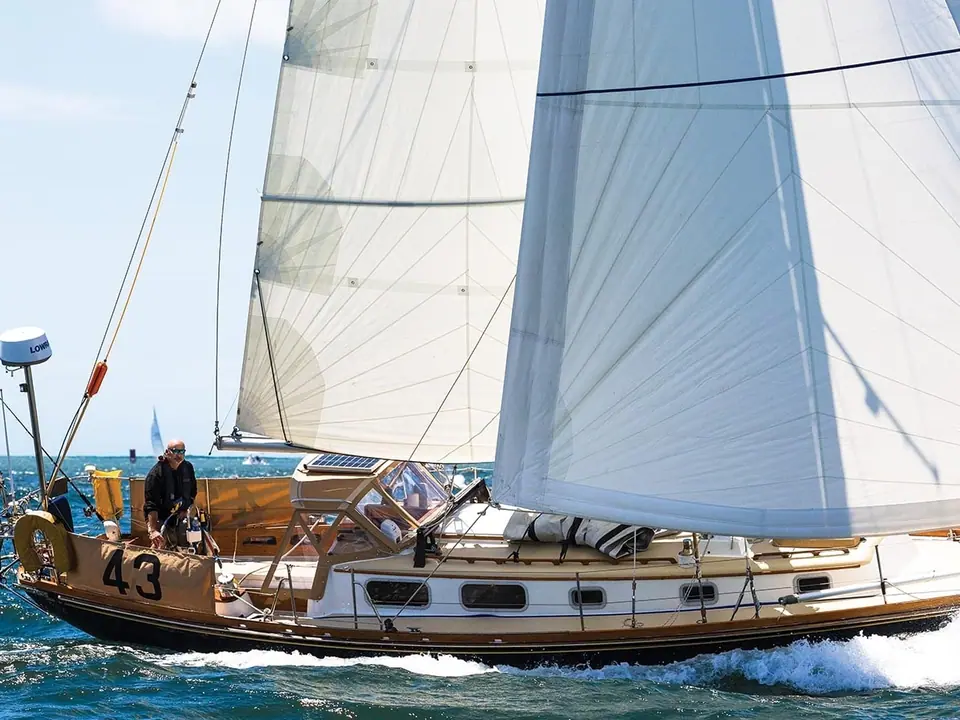
The Bristol 40 is a Ted Hood-designed 40-foot cruiser built by Bristol Yachts from the early 1970s to 1986, about 150 boats. Narrow, heavy and handsome, it offers a 130-gallon water supply and classic looks for around $30,000 to $55,000.
- Couples who value classic looks and sea motion
- Coastal and island cruising, especially with the centerboard
- Sailors with DIY skills and a refit budget
Bristol 40 by the numbers
- Sail area to displacement
- 16.4Balanced power for coastal and offshore cruising.
- Displacement to length
- 376Heavy displacement. Slow to accelerate but steady and sea kindly with a full load.
- Theoretical hull speed
- 7.0 knThe practical top speed of a displacement monohull under normal sailing, based on waterline length.
- Ballast ratio
- 37%A typical ballast ratio for a cruising monohull.
- Capsize screening
- 1.65Below 2.0, the traditional threshold for offshore suitability.
- Motion comfort ratio
- 36.7A slow, easy motion in a seaway, kind to crews on long passages.
- Length to beam ratio
- 3.74 : 1A slim, easily driven hull.
Why the Bristol 40 keeps turning up among Bristol sailboats for sale
Browse Bristol sailboats for sale and the Bristol 40 is the one that stops people. It has the profile of a 1960s ocean racer, long overhangs, a sweet sheer, low freeboard and a narrow trunk cabin, and it sells for roughly the price of a new outboard on a big center console. Practical Sailor's 2026 video put it bluntly: a 40-foot Ted Hood design for around $40,000, and then asked why.
The answer is that the Bristol 40 is a 40-footer in length only. Practical Sailor wrote that going below feels like stepping onto a modern 33-foot boat, because the CCA rule of the era put about 30 percent of a boat's length into overhangs. With a 27-foot 6-inch waterline and a 10-foot 9-inch beam, its working dimensions are those of today's 35-footers.
That does not make it a bad buy. It makes it a specific one: a handsome, seakindly traditional cruiser for a couple who value looks, motion and tracking over cabin volume.
Pearson roots and a twenty-year run
Bristol Yachts was the second act of Clint Pearson, one of the cousins behind Pearson Yachts. Cruising World notes that Bristols were built after Clint and Everett Pearson sold Pearson Yachts, which is why early Bristols share so much design and construction DNA with early Pearsons. Sailboatdata.com records about 4,400 Bristol Yachts built between 1965 and 1997, when the company stopped production.
The 40 grew out of the Bristol 39, one of the company's first models, which entered production in 1966. According to Practical Sailor the boat was renamed the Bristol 40 beginning with 1972 models, with slightly fuller aft sections and a different stemhead fitting; sailboatdata.com lists 1970 as the first Bristol 40 and 58 Bristol 39s before it. The last Bristol 40 was built in 1986. About 150 were built, 149 by sailboatdata's count.
Measured carefully, Practical Sailor found the 39 and the 40 to be about 39 feet 8 inches long excluding pulpit and roller, which matches Cruising World's published LOA. Sailboatdata's 40.16-foot figure includes the stemhead.
Keel, centerboard and the stability question
Buyers choose between two underwater shapes. The fixed version has a modified full keel drawing 5 feet 4 inches, with 6,500 pounds of lead poured into a molded keel cavity rather than bolted on. The keel-centerboard version draws 4 feet with the board up and 7 feet 10 inches down, ideal for Chesapeake and Bahamas cruising. A Constellation-style rudder sits slightly above the bottom of the keel, so the boat grounds on the keel first.
Practical Sailor calls the boat fairly tippy, as you would expect of a narrow hull with modest ballast. The keel version loses positive stability at about 120 degrees, which the magazine called the absolute minimum it would consider for serious offshore work, and the only centerboard boat rated under IMS showed about 110 degrees. Ballast is 37 percent of displacement and the displacement-to-length ratio is about 376, which explains the easy motion in a seaway.
In other words, this is a capable coastal and island cruiser, and Bristol 40s have made offshore passages, but owners planning ocean crossings should treat the stability numbers seriously.
- Displacement 17,580 lb, ballast 6,500 lb lead
- LWL 27 ft 6 in, beam 10 ft 9 in
- Range of positive stability about 120 degrees (keel) and 110 degrees (centerboard, one IMS boat)
- Hull speed about 7.0 knots
How a Bristol 40 sails
Practical Sailor rates the Bristol 40 as close in speed to an original Hinckley Bermuda 40 yawl and about 30 seconds a mile slower than a Cal 40. Like most CCA boats it is a strong reaching boat without the rounding-up habit of modern wide-sterned designs, but it tends to squat and dig a hole running downwind. A full-keel Bristol 40 won the 1983 Marion-Bermuda Race, which was mostly close reaching in light to moderate wind.
The boat is sensitive to sail area, so a modern roller-furling headsail makes shorthanded sailing easier. Many were built as yawls. The mizzen helps balance the helm and carries a radar or mizzen staysail, but Practical Sailor notes that it adds windage and makes the boat tippier, a cost upwind.
Atomic 4 or diesel: the engine question
Early boats left the factory with a Universal Atomic 4 gasoline engine of about 30 hp, and parts are still available, as Cruising World points out via Moyer Marine. Later boats got a range of diesels, including Westerbeke 4-91, 4-107 and 4-108 units, the Perkins 4-108 and Volvo MD2B or MD3B engines, and many owners have repowered with modern Yanmars.
Fuel capacity is only about 30 gallons, in a tank under the cockpit sole above the engine. Early diesel boats used black-iron tanks that can rust out, while later boats had aluminum. Practical Sailor estimated about 180 miles of range under power with a Perkins 4-108. Access to the stuffing box is very tight, the engine compartment has no sound insulation, and the small propeller aperture limits prop size, so handling in reverse is poor on most boats. A feathering prop helps.
Deck, cockpit and a smaller interior than you expect
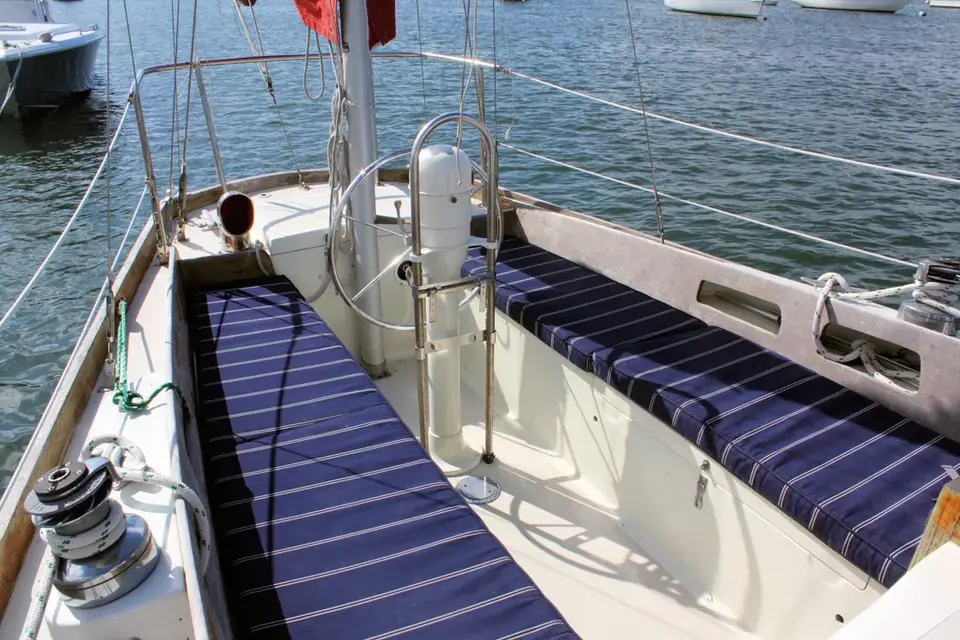
The cockpit is huge, with seats almost 7 feet long and a well narrow enough to brace your feet, but the scuppers are small and there is no bridgedeck, so Practical Sailor advises securing the bottom dropboard offshore. Exterior teak includes the toerails, eyebrows, handrails and coamings. The molded basket-weave nonskid is not very grippy.
Below, Cruising World describes the essentials of a proper offshore layout in a compact package: separate cabins, sea berths, an enclosed head and a divided galley aft. Water capacity is a generous 130 gallons in two fiberglass tanks, more than many modern 40-footers carry. Headroom, storage and elbow room, however, are those of a mid-30s boat.
Survey priorities on a boat built in the 1970s or 1980s
Construction is solid fiberglass mat and woven roving, typical of the time. Practical Sailor's owner survey found no major structural flaws, but plenty of leaks from ports, deck hardware and the hull-to-deck joint. Expect to rebed hardware, and look for water stains in lockers and rust on through-fastenings. Colored gelcoat on 1970s boats was not colorfast and faded badly, and decks can show cracks around stanchion bases and voids at sharp corners.
Original quarter chocks are screwed rather than bolted to the toerail and can tear out. Chainplates for the lower shrouds do not line up perfectly with the shroud load, which can fatigue them and cause leaks. None of this is unusual for the age, but it adds up, and it is why prices stay low.
Bristol 40 specifications
| Length overall | 40.2 ft12.24 m |
|---|---|
| Waterline length | 27.5 ft8.39 m |
| Beam | 10.8 ft3.28 m |
| Draft | 5.4 ft1.64 m |
| Displacement | 17,58 lbs7,974 kg |
| Ballast | 6,5 lbs2,948 kg |
| Sail area | 694 sq ft64.5 m² |
| Fuel capacity | 31 gal117 L |
| Fresh water | 13 gal492 L |
| Cabins | 2 (forward cabin and main saloon) |
| Heads | 1 enclosed |
| Standard engines | Universal Atomic 4, 30 hp gasoline |
| Optional engines | Westerbeke 4-91, 4-107 or 4-108, Perkins 4-108, Volvo MD2B or MD3B diesels |
| Hull type | CCA-rule displacement hull with long overhangs |
| Keel | Modified full keel with 6,500 lb of encapsulated lead (5 ft 4 in draft), or keel-centerboard drawing 4 ft 0 in up and 7 ft 10 in down |
| Rig | Masthead sloop or yawl, cutter also offered; untapered keel-stepped mast with single spreaders |
| Hull construction | Solid fiberglass hull with encapsulated lead ballast |
| Builder | Bristol Yachts, United States |
| Naval architect | Ted Hood |
| Other design credits | Bristol 39 predecessor credited to Ted Hood and Dieter Empacher |
| Production | 1970 to 1986 |
| Status | Discontinued |
Figures come from builder documentation and independent tests where available. Displacement is usually quoted light, so a loaded cruising boat will weigh more. Compare these specs with another model.
How much does a Bristol 40 cost?
Cruising World put typical asking prices at $29,000 to $49,000, and Practical Sailor's 2026 video notes boats around $40,000. Engine type matters a great deal: a boat still on its original Atomic 4 gas engine is worth less than one with a sound diesel. Paint, rigging age, deck core condition and the state of the teak swing prices by tens of thousands of dollars.
Estimate your yearly cost
A planning estimate using common rules of thumb: insurance near 1.5 percent of value, maintenance near 3 percent, haul out and bottom paint by length. Your marina, region and use will move these numbers. Open the full cost calculator.
Versions and options
- Bristol 39 (1966 to about 1971)
- The near-identical predecessor; 58 built according to sailboatdata.com, early boats with Atomic 4 or Graymarine gas engines.
- Keel or keel-centerboard
- Fixed modified full keel drawing 5 ft 4 in, or keel-centerboard drawing 4 ft up and 7 ft 10 in down.
- Sloop, yawl or cutter
- Masthead sloop was standard, many boats were yawls with about 707 sq ft of sail, and a cutter rig was also offered.
Bristol 40 timeline
- 1966Bristol 39 enters production as one of Bristol Yachts' first models
- 1972Practical Sailor dates the renaming to Bristol 40 from 1972 models; sailboatdata lists the first 40 in 1970
- 1983A full-keel Bristol 40 wins the Marion-Bermuda Race
- 1986Last Bristol 40 built, after about 150 boats
- 1997Bristol Yachts ceases production
Strengths and weaknesses
What owners like
- Classic Ted Hood CCA lines that still turn heads
- Encapsulated lead keel and solid fiberglass hull
- Easy motion and good reaching performance
- 130 gallons of water for extended cruising
- Keel-centerboard option for thin water
- Low purchase price for a 40-foot boat
What to weigh up
- Interior volume of a modern 33 to 35-footer
- Modest stability range for serious offshore work
- Only about 30 gallons of fuel
- Poor handling in reverse and tight engine access
- Age-related leaks from ports, hardware and hull-deck joint
Used Bristol 40 buyer checklist
Take this list to a viewing. Your ticks are saved in this browser so you can come back to it.
Always commission an independent marine survey and an engine survey before you buy. How a marine survey works.
Rivals to consider
Hinckley Bermuda 40
The classic CCA keel-centerboarder of the same era, higher quality and several times the price.
Compare side by sideTartan 37
A later, beamier S&S design with more interior and better upwind performance.
Compare side by sideCape Dory 36
An Alberg full-keel cruiser with a sturdier offshore reputation and similar interior volume.
Compare side by sideValiant 40
A purpose-built bluewater cruiser with far more stability and tankage, at a higher price.
Compare side by sideOur verdict on the Bristol 40
The Bristol 40 is the cheapest way to own a genuinely beautiful 40-foot Ted Hood cruiser, and for coastal and island sailing it is a lovely, easy-moving boat. Just do not mistake it for a modern 40-footer: the interior is small, fuel is limited, and the stability range is modest for ocean work. Buy one with a sound deck, a diesel and documented rigging, keep the centerboard version in mind for thin water, and it will repay you in admiring looks and sweet reaching.
Bristol 40 questions answered
Who designed the Bristol 40?
Ted Hood, building on the Bristol 39 that sailboatdata credits to Hood and Dieter Empacher.
How many Bristol 40s were built?
About 150, with sailboatdata listing 149 between 1970 and 1986.
Is the Bristol 40 a bluewater boat?
It has crossed oceans, but Practical Sailor puts the keel version's stability range at about 120 degrees, the minimum it would accept for serious offshore work.
What does a Bristol 40 cost?
Cruising World cites $29,000 to $49,000, and Practical Sailor notes boats around $40,000 in 2026.
What engine does the Bristol 40 have?
Early boats used the Atomic 4 gas engine; later boats had Westerbeke, Perkins or Volvo diesels, and many have been repowered.
How much water and fuel does it carry?
About 130 gallons of water in two fiberglass tanks and about 30 gallons of fuel.