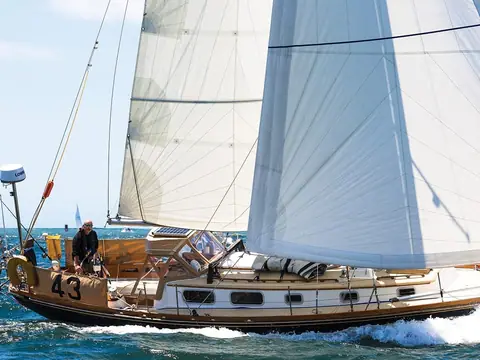
Bristol 40
Cruising Sailboats, 40 ft
Used $25K to $60K
Heavily built fiberglass cruising sailboats from Bristol, Rhode Island, produced from the mid-1960s until the yard closed in 1997.
Bristol Yachts built conservative, heavily laid-up cruising sailboats in Bristol, Rhode Island, from 1964 to 1997. Founder Clint Pearson drew on designers such as Carl Alberg, Halsey Herreshoff and Ted Hood.
Clint Pearson had already helped invent the fiberglass sailboat business once. With his cousin Everett he started Pearson Yachts in the 1950s, then sold equity to Grumman Allied Industries in 1961 to fund growth. Clint left in 1964, bought the struggling Sailstar company in West Warwick, Rhode Island, and moved it into the old Herreshoff yard. By 1966 the business was renamed Bristol Yacht Company and the Sailstar name was dropped. Production eventually settled on Popasquash Road in Bristol, Rhode Island, next to Pearson's own home and a small marina.
That Pearson lineage matters to buyers because early Bristols share construction ideas and even design talent with early Pearsons. Carl Alberg drew the first Bristol 27, Halsey Herreshoff designed a run of CCA-rule boats from 22 to 34 feet, and Ted Hood penned the Bristol 32 and the 39 that became the Bristol 40. Later Hood and Dieter Empacher designs carried decimal names such as 35.5 and 41.1. Bristol moved into custom boats over 50 feet in the early 1990s, but the company went bankrupt and closed in 1997 after building more than 4,400 boats.
Bristols were built heavier than many production boats of their day. Typical features include fully encapsulated lead ballast, keel-stepped masts, skeg-hung or keel-hung rudders, interior furniture bonded to the hull and bronze seacocks. They were never the fastest boats in a PHRF fleet, but they carry their sail well and have an easy motion, which is why so many are still sailing coastal New England, the Chesapeake and the Great Lakes.
The Bristol 40 we cover is the best example of the formula. Built from about 1970 to 1986, with roughly 150 hulls, it evolved from the near-identical Bristol 39 of 1966. It is a narrow, heavy Ted Hood design with long overhangs, offered with a fixed modified full keel drawing 5 feet 4 inches or a keel-centerboard drawing 4 feet up and 7 feet 10 inches down, and rigged as a masthead sloop, yawl or cutter. Early boats used a Universal Atomic 4 gas engine, later ones a Westerbeke, Perkins or Volvo diesel. A full-keel Bristol 40 won the Marion-Bermuda Race in 1983, a reminder that these boats were built for offshore work.
With no factory since 1997, every Bristol is a used boat, and the brand is an orphan in the strict sense. Parts support comes from owner groups, rigging and canvas shops and the usual suppliers of Westerbeke and Perkins parts. Resale is steady rather than strong: buyers pay for condition, not the badge. A Bristol 40 typically asks around $25,000 to $60,000 in 2026, and the engine, rig and deck core matter far more than the model year.
A survey on a 40 to 55 year old Bristol should focus on the following.
Clint Pearson, co-founder of Pearson Yachts, who left Pearson in 1964, bought Sailstar and renamed the company Bristol Yacht Company in 1966.
No. Bristol Yachts went bankrupt and closed in 1997, so all Bristols are bought on the used market.
Many are capable coastal and offshore cruisers thanks to heavy layups and encapsulated keels, and a Bristol 40 won the 1983 Marion-Bermuda Race. Any boat this old needs a careful survey first.
No. The Bristol Channel Cutter is a Lyle Hess design built by Sam L. Morse Co. in California and has no connection to Bristol Yachts of Rhode Island.