Beneteau Oceanis 46.1 Review, Specs and Used Buying Guide
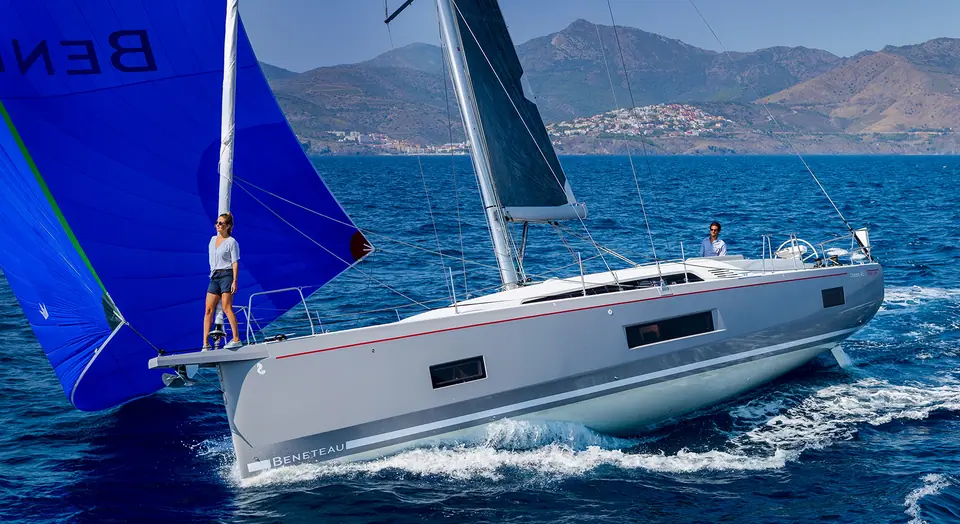
Beneteau's chined, twin-rudder 46-footer that replaced the Oceanis 45 and turned out to sail far better than its boxy topsides suggest.
- Length
- 47.9 ft14.6 m
- Beam
- 14.8 ft4.5 m
- Draft
- 7.8 ft2.35 m
- Cabins
- 3 to 5
- Used price
- $300K to $640K
On this page
- Overview
- Following an 800-boat bestseller
- Why the stepped hull is more than a styling trick
- Three keels, two rigs and the First Line question
- What the sea trials actually recorded
- Cockpit, side decks and short-handed sailing
- Below decks, from owner's version to five cabin charter boat
- Engine, tankage and the bluewater question
- Ownership costs and how values are holding up
- Specifications
- Price and value
- Strengths and weaknesses
- Used buyer checklist
- Rivals
- Our verdict
- FAQ
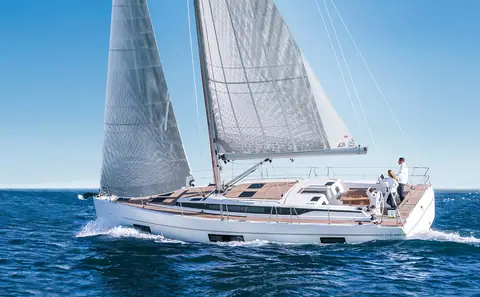
A Finot-Conq designed 47-foot family cruiser built in France from 2018 to 2025, with a stepped hull, twin rudders, three keel choices and three to five cabins. Now replaced by the Oceanis 47.
- Couples cruising the East Coast and Bahamas
- Families moving up from a 40-footer
- Owners who want a sailing boat, not a motorsailer
- Charter management buyers
Following an 800-boat bestseller
The Beneteau Oceanis 46.1 had a hard act to follow. The Oceanis 45 it replaced sold more than 800 hulls, which made it one of the most common 45-footers in charter fleets and US marinas. When Beneteau unveiled the 46.1 in 2018 for the 2019 model year, the brief was obvious: keep the volume and the price point, but give owners a boat that actually sails well.
Beneteau handed the hull to Finot-Conq, the Brittany studio best known for Open 60 ocean racers, and the deck and interior to Nauta Design in Milan. The result looks like a typical high-freeboard cruiser at the dock, but under the waterline it is one of the more interesting shapes of its generation.
Production ran until 2025, when the Oceanis 47 was unveiled at the Cannes Yachting Festival as its replacement. The used market now holds the full run of model years, and a well-kept 46.1 costs a fraction of a new Oceanis 47 while giving up very little in sailing ability.
Beneteau Oceanis 46.1 by the numbers
- Sail area to displacement
- 18.0Balanced power for coastal and offshore cruising.
- Displacement to length
- 128Light displacement for its length, quick but sensitive to added cruising weight.
- Theoretical hull speed
- 8.8 knThe practical top speed of a displacement monohull under normal sailing, based on waterline length.
- Ballast ratio
- 26%Relatively low ballast, form stability does more of the work.
- Capsize screening
- 2.07Above 2.0, so this hull leans toward coastal stability over ultimate offshore resistance.
- Motion comfort ratio
- 22.3A quicker motion in waves, typical of light, beamy hulls.
- Length to beam ratio
- 3.24 : 1Moderate proportions.
Why the stepped hull is more than a styling trick
Look at the topsides and you will see a pronounced step, or chine, running from the bow almost to the transom. Pascal Conq used it to move volume from below the waterline to above it. The boat carries its maximum beam further forward and higher than the Oceanis 45, which buys roughly half a meter of extra interior width where you need it, in the forward cabin and saloon, without widening the waterline or adding wetted surface.
The narrow entry at the waterline lets the 46.1 slip through chop instead of slamming, while the flared sections above it supply form stability once the boat heels. Twin rudders keep grip, and testers on both sides of the Atlantic noticed the same thing: the helm stays light and the boat refuses to round up when pressed. A displacement to length ratio of about 128 puts it in the brisk cruiser category.
The trade-off is ballast. With 6,028 pounds on the standard iron fin, the ballast ratio is only about 26 percent. The hull shape does the stability work, so the 46.1 sails flatter early but should be reefed earlier than an older, deeper, heavier design when the breeze gets into the mid-20s.
Three keels, two rigs and the First Line question
The configuration of a used 46.1 matters more than its model year. US boats were very often ordered with the 5 ft 9 in shoal keel, which is the right choice for the Chesapeake, Florida and the Bahamas but costs pointing ability. The standard 7 ft 9 in iron fin is the best all-round compromise, and the First Line package added an 8 ft 8 in lead bulb keel, a taller mast, a genoa in place of the self-tacker, a bowsprit for flying sails and upgraded hardware.
Beneteau claimed the First Line package delivers 28 percent more sail area, which transforms light air performance in places like Southern California and the Gulf Coast. The catch is draft: 8 ft 8 in rules out many East Coast anchorages.
- Standard: in-mast furling main, self-tacking jib, 7 ft 9 in iron fin
- Shoal: same rig, 5 ft 9 in keel with 6,746 lb of ballast
- First Line: taller mast, genoa, bowsprit, 8 ft 8 in lead bulb keel
- Air draft is 66 ft 8 in standard and 69 ft 11 in with the tall rig; Cruising World notes an ICW-friendly 63 ft 6 in mast was also offered
What the sea trials actually recorded
The 46.1 has been tested more widely than most production cruisers, and the numbers are consistent. Off Newport, a shoal keel boat made 6 to 6.3 knots close hauled in 7.8 to 8.3 knots of true wind, and 8.5 knots once the code zero was unrolled. On Chesapeake Bay in about 10 knots of breeze, Cruising World tacked upwind at 7.6 knots under the 107 percent genoa and hovered around 9 knots on a reach with the code zero set.
In heavier air off Barcelona, a First Line boat sailed upwind at more than 7.5 knots in 15 knots true with a two-meter swell, then surfed at 12 to 14.5 knots downwind in 20 knots true. SAIL's light air test on Narragansett Bay was less flattering, with 4.5 knots on a close reach in about 6 knots of wind, but just over 8 knots with the code zero in 11 knots.
Under power, the standard 57 hp Yanmar pushed SAIL's test boat at 6.9 knots at 2,200 rpm, and Cruising World logged a fast cruise of 8 knots. With only 53 gallons of diesel, this is a sailing boat that motors when it must rather than a motorsailer, and owners planning long calms should look for a boat ordered with Beneteau's optional extra fuel or water tankage.
Cockpit, side decks and short-handed sailing
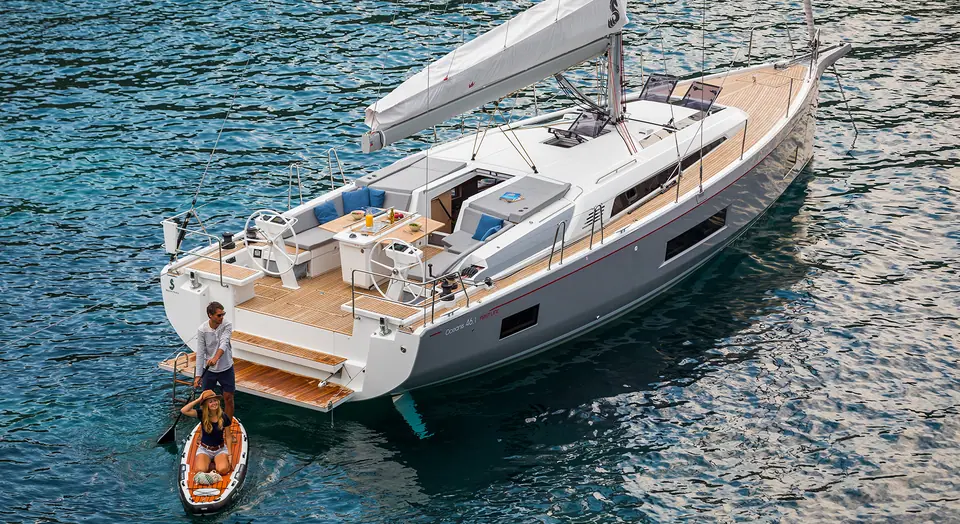
Nauta drew a wide, two-wheel cockpit with a large central table, fixed seating forward and a fold-down transom that becomes a swim platform. Raised bulwarks and wide side decks make going forward safer than on many rivals, and the life raft lives low in the cockpit where it can actually be deployed in an emergency.
With the standard self-tacking jib and in-mast furling main, a couple can tack and reef the boat without leaving the helm area. Most US boats have at least one electric primary winch, and SAIL found every winch within reach of the wheels. Testers found the steering silky and well balanced, though one Newport test boat had a rudder alignment problem that gave it a slight pull to port, a reminder to check rudder toe on any twin rudder boat.
Criticisms are minor. The raised panel aft of the cockpit can leave a tall helmsman stretching for the wheel, and the deep quarter lockers expose steering gear and electronics to whatever you throw in, so fit a partition before loading them with fenders.
Below decks, from owner's version to five cabin charter boat
The forward owner's cabin is the star of the interior. Beneteau borrowed it from the larger Oceanis 48, and it has an island queen berth with standing room at the foot, shelving outboard and a separate shower stall and head. The saloon berths are about 15 cm (6 inches) longer on each side than in the Oceanis 45, which makes them usable sea berths for a six-foot crew.
Layouts range from three cabins and two heads, the typical private owner choice in the US, to five cabins and three or four heads for charter. An optional in-line galley to port, in place of the settee, makes room for a third head so each aft cabin gets its own. Purists will miss a traditional chart table, which was replaced in most boats by a small laptop desk.
Finish is good where you look and basic where you do not. Yachting World noted bare plywood in the aft lockers and sole boards without gaskets that creaked underfoot. Check whether a previous owner has fitted gaskets or felt, because the noise gets old quickly on passage.
Engine, tankage and the bluewater question
Standard power is a 57 hp Yanmar on a saildrive, with an 80 hp Yanmar optional. For a boat of 23,000 pounds, the 57 is adequate in flat water and the 80 is worth having if you plan to motor into the short seas of the Gulf Stream or the Pacific Northwest. Fuel burn at cruising rpm is modest, but the small standard tank still limits motoring range, so long calms call for planning.
Tankage is the weak point for long-range cruising: 53 gallons of fuel and 98 gallons of water. That covers a week of coastal cruising with four aboard, but serious cruisers will want a watermaker, extra fuel and lithium batteries. The boat is CE Category A, yet its stowage reflects a design aimed first at coastal and island cruising.
Ownership costs and how values are holding up
Expect yearly costs of about $24,000 to $48,000 for insurance, a 50-foot slip, haul out and bottom paint, engine and saildrive service, and routine maintenance. The saildrive diaphragm replacement Yanmar recommends every seven years is a hull-out job and should be factored into the budget on early boats.
Values have held well. A privately owned 2019 to 2021 boat in the US typically asks $330,000 to $520,000, while European ex-charter boats appear for under €200,000, though importing one adds transport, duty and 230 volt conversion costs. With the Oceanis 47 now in dealers at a much higher price, late 46.1s should hold value strongly.
Beneteau Oceanis 46.1 specifications
| Length overall | 47.9 ft14.6 m |
|---|---|
| Waterline length | 43.4 ft13.23 m |
| Beam | 14.8 ft4.5 m |
| Draft | 7.8 ft2.35 m |
| Air draft | 66.7 ft20.33 m |
| Displacement | 23,356 lbs10,597 kg |
| Ballast | 6,028 lbs2,734 kg |
| Sail area | 92 sq ft85.5 m² |
| Fuel capacity | 53 gal2 L |
| Fresh water | 98 gal37 L |
| Cabins | 3 to 5 |
| Berths | 6 to 10 |
| Heads | 2 to 4 |
| Standard engines | Yanmar 57 hp diesel, saildrive |
| Optional engines | Yanmar 80 hp diesel |
| Maximum power | 80 hp |
| Cruise speed | 6.9 knots |
| Top speed | 8 knots |
| Hull type | Monohull with full-length stepped chine and twin rudders |
| Keel | Cast iron fin 7 ft 9 in (standard), shoal fin 5 ft 9 in, or lead bulb performance keel 8 ft 8 in (First Line) |
| Rig | Fractional sloop, in-mast furling main and self-tacking jib standard; taller mast, genoa and bowsprit with First Line |
| Hull construction | Fiberglass, polyester resin with balsa-cored deck |
| CE design category | A |
| Builder | Beneteau (Groupe Beneteau), France |
| Naval architect | Finot-Conq (Pascal Conq) |
| Other design credits | Nauta Design (deck styling and interior) |
| Production | 2018 to 2025 |
| Status | Discontinued |
Figures come from builder documentation and independent tests where available. Displacement is usually quoted light, so a loaded cruising boat will weigh more. Compare these specs with another model.
Performance data
| Condition | True wind (kn) | Boat speed (kn) | Test |
|---|---|---|---|
| Close hauled, shoal keel | 7.8 to 8.3 | 6 to 6.3 | Yachting World, Newport |
| Code zero reach, shoal keel | about 8 | 8.5 | Yachting World, Newport |
| Close hauled, 107% genoa | about 10 | 7.6 | Cruising World |
| Reaching, code zero | about 10 | about 9 | Cruising World |
| Upwind, First Line | 15 | 7.5+ | Yachting World, Barcelona |
| Downwind surfing, First Line | 20 | 12 to 14.5 | Yachting World, Barcelona |
| Motoring at 2,200 rpm | n/a | 6.9 | SAIL |
Figures as published by SAIL, Cruising World and Yachting World test crews. Light air results vary heavily with keel and sail plan.
How much does a Beneteau Oceanis 46.1 cost?
Cruising World put the base price at about $320,000, SAIL quoted $450,000 sail-away for a typical US boat in 2019, and Cruising World's well-optioned test boat came in at $520,000. On the brokerage market, ex-charter five cabin boats trade well below privately owned three cabin boats, and First Line boats with the deep keel and tall rig carry a premium of roughly $30,000 to $60,000.
Estimate your yearly cost
A planning estimate using common rules of thumb: insurance near 1.5 percent of value, maintenance near 3 percent, haul out and bottom paint by length. Your marina, region and use will move these numbers. Open the full cost calculator.
Versions and options
- Standard
- Self-tacking jib, in-mast furling main, 7 ft 9 in iron fin keel and 57 hp Yanmar. The most common private owner spec.
- Shoal draft
- 5 ft 9 in keel with heavier ballast. Popular on the US East Coast and in the Bahamas, at some cost in pointing.
- First Line
- Taller mast, genoa, bowsprit, deeper lead bulb keel at 8 ft 8 in and upgraded deck gear, for roughly 28 percent more sail area.
- Charter layouts
- Four or five cabins with three or four heads, sold heavily into charter fleets and now common on the brokerage market.
Beneteau Oceanis 46.1 timeline
- 2018Oceanis 46.1 unveiled as the replacement for the Oceanis 45, with a Finot-Conq stepped hull
- 2019First US deliveries, SAIL quotes $450,000 sail-away
- 2021Strong charter fleet orders as the model becomes Beneteau's core mid-size cruiser
- 2025Production ends and the Oceanis 47 replaces it at the Cannes Yachting Festival
Strengths and weaknesses
What owners like
- Sails much better than its volume suggests, with a light twin rudder helm
- Excellent forward owner's cabin taken from the larger Oceanis 48
- Three keel choices to suit shallow or deep cruising grounds
- Easy short-handed handling with the self-tacking jib
- Strong resale and a large supply of used boats
- Wide side decks and raised bulwarks
What to weigh up
- Small fuel and water tanks for long-range cruising
- Low ballast ratio means early reefing
- Unfinished surfaces and noisy sole boards in places
- No traditional chart table
- Ex-charter boats can be heavily worn
Used Beneteau Oceanis 46.1 buyer checklist
Take this list to a viewing. Your ticks are saved in this browser so you can come back to it.
Always commission an independent marine survey and an engine survey before you buy. How a marine survey works.
Rivals to consider
Jeanneau Sun Odyssey 440
Sister brand with a walk-around deck and slightly smaller hull. Lighter and nimble, but less interior volume.
Compare side by sideHanse 460
Beamier, more modern interior and a single rudder, with excellent self-tacking jib handling and a higher price.
Compare side by sideDufour 470
Heavier and more stable, with bigger tanks and a single rudder, but slower in light air.
Compare side by sideBavaria C45
Similar size and price, with a wide chined hull and good space, but a weaker resale record in the US.
Our verdict on the Beneteau Oceanis 46.1
The Oceanis 46.1 is the best-sailing mass-market 46-footer Beneteau has built, and one of the smartest used buys in its class. The stepped hull gives it space and stability without the sluggishness of older high-volume cruisers, the forward cabin is excellent, and the choice of keels lets you match the boat to your cruising ground. Its limits are tankage and ballast, so do not buy it for high-latitude passages. For coastal and island cruising, a privately owned three cabin boat with the standard keel and a code zero is the one to find.
Beneteau Oceanis 46.1 questions answered
Is the Beneteau Oceanis 46.1 still in production?
No. It was built from 2018 to 2025 and replaced by the Oceanis 47, which debuted at the Cannes Yachting Festival in 2025.
How much is a used Oceanis 46.1?
Most US boats ask between about $300,000 and $640,000 depending on year, layout and keel. European ex-charter boats can be found for less than $250,000.
Who designed the Oceanis 46.1?
The hull is by Finot-Conq, led by Pascal Conq, and the deck and interior styling are by Nauta Design.
What is the draft of the Oceanis 46.1?
The standard keel draws 7 ft 9 in, the shoal keel 5 ft 9 in and the First Line performance keel 8 ft 8 in.
How fast is the Oceanis 46.1?
In about 10 knots of wind Cruising World recorded 7.6 knots close hauled and around 9 knots reaching under code zero. A First Line boat surfed at more than 14 knots in 20 knots of wind.
Is the Oceanis 46.1 a bluewater boat?
It is CE Category A and has crossed oceans, but its small tanks and modest ballast make it better suited to coastal and island cruising unless you add a watermaker and extra fuel.
Beneteau Oceanis 46.1 photos
More cruising sailboats to explore
Hanse 460
Cruising Sailboats, 48 ft
Used $400K to $680K
Beneteau Oceanis 48
Cruising Sailboats, 48 ft
Used $230K to $400K
Bavaria 47 Ocean
Cruising Sailboats, 48 ft
Used $110K to $160K
Beneteau Oceanis 46
Cruising Sailboats, 47 ft
Used $160K to $250K
Other Beneteau models
- Beneteau 49
- Beneteau 50
- Beneteau 57
- Beneteau 343
- Beneteau Antares 5.80
- Beneteau Antares 6
- Beneteau Antares 6.80
- Beneteau Antares 7
- Beneteau Antares 7.30
- Beneteau Antares 7.60
- Beneteau Antares 7.80
- Beneteau Antares 8
- Beneteau Antares 8.00
- Beneteau Antares 8.05
- Beneteau Antares 8.60
- Beneteau Antares 8.80
- Beneteau Antares 9
- Beneteau Antares 9.80
- Beneteau Antares 10.80
- Beneteau Antares 11
- Beneteau Antares 12
- Beneteau Antares 13.80
- Beneteau Antares 30
- Beneteau Antares 32
- Beneteau Antares 36
- Beneteau Antares 42
- Beneteau Antares 620 HB
- Beneteau Antares 650 HB
- Beneteau Antares 750 HB
- Beneteau Cyclades 39.3
- Beneteau Cyclades 43.3 and 43.4
- Beneteau Cyclades 50.5
- Beneteau First 18 SE
- Beneteau First 20
- Beneteau First 21.7
- Beneteau First 24
- Beneteau First 25
- Beneteau First 25.7
- Beneteau First 27
- Beneteau First 27.7
- Beneteau First 30
- Beneteau First 31.7
- Beneteau First 35
- Beneteau First 36
- Beneteau First 36.7
- Beneteau First 38
- Beneteau First 40
- Beneteau First 40.7
- Beneteau First 44
- Beneteau First 45
- Beneteau First 47.7
- Beneteau First 53
- Beneteau First 211
- Beneteau First 235
- Beneteau First 285
- Beneteau First 305
- Beneteau First 310
- Beneteau First 345
- Beneteau Flyer 6
- Beneteau Flyer 7
- Beneteau Flyer 8
- Beneteau Flyer 9
- Beneteau Flyer 10
- Beneteau Flyer 12
- Beneteau Flyer 500
- Beneteau Flyer 550
- Beneteau Flyer 650
- Beneteau Flyer 701
- Beneteau Flyer 750
- Beneteau Grand Trawler 62
- Beneteau Gran Turismo 32
- Beneteau Gran Turismo 36
- Beneteau Gran Turismo 40
- Beneteau Gran Turismo 41
- Beneteau Gran Turismo 44
- Beneteau Gran Turismo 45
- Beneteau Monte Carlo 6
- Beneteau Oceanis 30.1
- Beneteau Oceanis 31
- Beneteau Oceanis 34
- Beneteau Oceanis 34.1
- Beneteau Oceanis 35
- Beneteau Oceanis 35.1
- Beneteau Oceanis 36 CC
- Beneteau Oceanis 37
- Beneteau Oceanis 38
- Beneteau Oceanis 38.1
- Beneteau Oceanis 40
- Beneteau Oceanis 40 CC
- Beneteau Oceanis 41
- Beneteau Oceanis 41.1
- Beneteau Oceanis 42
- Beneteau Oceanis 42 CC
- Beneteau Oceanis 43
- Beneteau Oceanis 44 CC
- Beneteau Oceanis 45
- Beneteau Oceanis 46
- Beneteau Oceanis 48
- Beneteau Oceanis 50
- Beneteau Oceanis 51.1
- Beneteau Oceanis 54
- Beneteau Oceanis 55
- Beneteau Oceanis 58
- Beneteau Oceanis 311
- Beneteau Oceanis 320
- Beneteau Oceanis 321
- Beneteau Oceanis 323
- Beneteau Oceanis 331
- Beneteau Oceanis 350
- Beneteau Oceanis 351
- Beneteau Oceanis 370
- Beneteau Oceanis 390
- Beneteau Oceanis 400
- Beneteau Oceanis 411
- Beneteau Oceanis 423
- Beneteau Oceanis 430
- Beneteau Oceanis 440
- Beneteau Oceanis 461
- Beneteau Oceanis 473
- Beneteau Oceanis 500
- Beneteau Oceanis 510
- Beneteau Oceanis Clipper 361
- Beneteau Oceanis Clipper 373
- Beneteau Oceanis Clipper 381
- Beneteau Oceanis Clipper 393
- Beneteau Oceanis Yacht 54
- Beneteau Oceanis Yacht 60
- Beneteau Oceanis Yacht 62
- Beneteau Sense 43
- Beneteau Sense 46
- Beneteau Sense 50
- Beneteau Sense 55
- Beneteau Swift Trawler 30
- Beneteau Swift Trawler 34
- Beneteau Swift Trawler 35
- Beneteau Swift Trawler 41
- Beneteau Swift Trawler 44
- Beneteau Swift Trawler 48
- All Beneteau models