Beneteau Performance Sailboats
Beneteau First 30 (2025) Review, the Planing Cruiser and Its Two Namesakes
Sam Manuard's 6,700 lb planing cruiser revives the name Beneteau first used in 1977, and it really does lift onto the plane in moderate breeze.
- Length
- 30.7 ft9.35 m
- Beam
- 9.8 ft2.99 m
- Draft
- 6.5 ft1.98 m
- Cabins
- 2 (forward double cabin and an aft double under the cockpit)
- Used price
- $150K to $195K
On this page
- Overview
- Which Beneteau First 30 are you looking at?
- From Slovenian sportboats to a Beneteau cruiser
- What planing in 13 knots of wind actually feels like
- Heel, a busy kite and other honest caveats
- Cruising cockpit or racing cockpit
- Painted GRP, cork floors and magnetic doors
- How Beneteau keeps it near 6,700 lb
- The 1977 Mauric original and the 2010 Juan K boat
- Price, running costs and the right owner
- Specifications
- Price and value
- Strengths and weaknesses
- Used buyer checklist
- Rivals
- Our verdict
- FAQ
The current Beneteau First 30 is a 30 ft 8 in Samuel Manuard design built by the Seascape team in Slovenia since 2025. It weighs about 6,700 lb, planes in 13 to 14 knots of true wind and starts at $167,351 in the US.
- Dinghy and foil sailors moving into keelboats
- Weekend coastal cruising for a couple
- Club racing and fun regattas
- Sailors who value speed over interior volume
Beneteau First 30 by the numbers
- Sail area to displacement
- 26.5Racing level power, needs active reefing as the breeze builds.
- Displacement to length
- 126Light displacement for its length, quick but sensitive to added cruising weight.
- Theoretical hull speed
- 7.2 knThe practical top speed of a displacement monohull under normal sailing, based on waterline length.
- Ballast ratio
- 35%A typical ballast ratio for a cruising monohull.
- Capsize screening
- 2.08Above 2.0, so this hull leans toward coastal stability over ultimate offshore resistance.
- Motion comfort ratio
- 16.9A quicker motion in waves, typical of light, beamy hulls.
- Length to beam ratio
- 3.13 : 1Moderate proportions.
Which Beneteau First 30 are you looking at?
Type beneteau 30 first into a listings site and you will get three unrelated boats. Beneteau used the name for its debut sailboat of 1977, for a Juan Kouyoumdjian racer-cruiser launched in 2010, and since January 2025 for the Samuel Manuard planing cruiser most people now mean. This page covers the new boat in depth and gives the older two their own section, so their numbers never get mixed up.
The 2025 First 30 measures 30 ft 8 in on deck (9.35 m), weighs about 6,700 lb light and stretches to 33 ft 11 in with its fixed bowsprit. Beneteau calls it the first planing cruiser, and the independent tests we read largely back that up. It was a SAIL Top 10 Best Boats winner for 2026 and the smallest, least expensive entry in Cruising World's 2026 Boat of the Year fleet.
From Slovenian sportboats to a Beneteau cruiser
The new First 30 is really a Seascape product with a Beneteau badge. Seascape was founded in 2009 by Mini Transat sailors Andraz Mihelin and Kristian Hajnsek and built light Manuard sportboats from 14 to 27 ft. Beneteau took the company over around 2018 (its own accounts say 2017 and 2018) and rebadged those boats as Firsts. The First 36 followed in 2022, and the First 30 is a scaled-down version developed and built by the same team in Slovenia.
Manuard drew the hull, Lorenzo Argento did the styling, SITO the interior and Pure Design and Engineering the structure. Mihelin now runs the First range, and Beneteau's marketing chief told SAIL that the boat's real competition is a wing foil or a kiteboard, not another keelboat. That explains both what it is and what it leaves out.
What planing in 13 knots of wind actually feels like
Three independent tests line up well. Yachting World sailed the boat for two days in Denmark and logged 6 to 6.5 knots upwind, 8 to 9-plus knots two-sail reaching and 8 to 13-plus knots under spinnaker. In a Force 5 it never came off the plane under the fractional kite, holding 10.5 to 13.5 knots, and in 20 knots plus it averaged 13 to 14 knots for a long spell. In only 10 to 13 knots of true wind under the masthead kite it still planed almost continuously at 8 to 10 knots, with the wake separating at about 8.4 knots.
Cruising World's Herb McCormick saw 6-plus knots upwind on Chesapeake Bay and more than 12 knots under kite, with the helm going light at speed; Beneteau's ambassador told him the boat had touched 19 knots. SAIL's tester, in 12 to 22 knots, found the planing smooth and quick but the boat over-canvassed at times with main and gennaker up until a reef went in.
Upwind it tacks through about 80 to 85 degrees and holds the low 6s in 8 to 10 knots of breeze. Pinch above that and the planing hull stalls and parks, a trait SAIL thought would make a good teacher. Under power the 14 hp Yanmar pushed Cruising World's boat past 6 knots at 2,500 rpm.
Heel, a busy kite and other honest caveats
The reviews agree on the weak spots. At 9 ft 9 in the hull is narrow for a modern 30-footer, and even with a ballast ratio near 35 percent and a deep keel it heels hard close-hauled. Yachting World described a workout for the helm, braced on molded foot supports against the lifelines. Backstay, cunningham and outhaul depower the bendy Z-Spars mast well enough that the tester never needed a reef.
Spinnaker work is busy without an autopilot or a sock, and both Yachting World and SAIL rounded up while distracted. The helm cannot reach both jib sheets, and short-handed crews will want the sheets led aft. Buyers moving from a heavy cruiser should expect to sail actively once the breeze passes 15 knots.
Cruising cockpit or racing cockpit
Beneteau offers two deck plans. The cruising version uses a mainsheet bridle and German sheeting so the cockpit floor stays clear; the racing version adds a traveler and a direct fine-tune mainsheet. Controls run to two clutches each side of the companionway, the jib is on a furler, and twin foam-cored rudders of the type used on Class 40 racers connect to a simple tiller.
The cockpit locker swallows an inflatable and a sail, the open transom has a swim platform, and the boat is certified Category A for two people and Category B for six. Steering gear is reached through tight panels from the locker and the port aft cabin, worth checking before fitting an autopilot.
Painted GRP, cork floors and magnetic doors
Below decks the First 30 is honest about priorities. Much of the interior is painted fiberglass, with cork flooring on the hull in the galley, a veneer table and plywood bulkheads slotted into a liner. Yachting World found it wipe-clean and functional, if plain where lining meets bare hull.
The forward double matches the First 36's in size, according to Beneteau. The saloon settees are 2 m long with backrests that fold outboard, and the table seats six. The galley has a gimbaled two-burner stove, a sink, a fold-down extension and an icebox or optional fridge, and the enclosed head has a marine toilet and shower. The aft double under the cockpit is cramped for two adults, as both Yachting World and SAIL noted.
Headroom is 1.81 m (5 ft 11 in) at the foot of the companionway. Thin magnetic panels replace doors, and stowage comes from removable textile lockers that cost extra.
How Beneteau keeps it near 6,700 lb
The hull and deck are vacuum-infused around a PVC foam core with vinylester and polyester skins, and a glass composite grid spreads the loads of the cast iron T-keel. Cruising World counts 17 separate molds. The standard keel draws 6 ft 6 in; the shoal keel draws 5 ft 6 in and carries about 2,910 lb of ballast against roughly 2,359 lb.
Power is a 14 hp Yanmar 2YM15 on a saildrive with a 10.5 gallon tank, and sailboatdata lists an optional 5 kW Krautler electric motor. Water is 26.4 gallons. Lifting the companionway steps reaches the oil, impeller and belt, but Yachting World warns that gearbox oil and filter changes will be awkward. Bridge clearance is 48 ft 3 in.
The 1977 Mauric original and the 2010 Juan K boat
The original First 30 grew from Impensable, the 1973 Half Ton Cup winner. Beneteau bought the molds, André Mauric reworked the keel, coachroof and interior, and the boat appeared at the 1977 Paris show. It is a 29 ft 4 in masthead sloop of about 7,600 lb with a skeg-hung rudder, sold in the US as the Beneteau R/C 30. Beneteau's history says 824 were sold; sailboatdata and Yachting Monthly put it near 1,000. European asking prices run about 6,000 to 18,500 euros and US listings are rare.
The Juan Kouyoumdjian First 30 was unveiled at Annapolis in October 2010, with input from Michel Desjoyeaux, and built until about 2015. It is 32 ft 2 in overall with a plumb bow, sprit, chine, twin rudders, a backstay-free square-top main, an optional carbon mast and a 20 hp Yanmar 3YM20, and it displaces about 8,267 lb. SAIL saw well over 5.5 knots close-hauled in light air. Beneteau's own retrospective calls it a failure, so numbers are small; a Swiss listing for a 2011 boat asked 75,000 francs.
Between them came Jean Berret's First 30 E of 1981 to 1984 and then the First 305. To tell the namesakes apart, look aft: a skeg-hung rudder means 1977, a very wide transom with twin rudders and swept spreaders means 2010, and an open stern behind a low coachroof means 2025.
Price, running costs and the right owner
Beneteau America lists the First 30 from $167,351 before taxes. Sails, electronics, commissioning and options take a realistic sail-away figure to $185,000 to $215,000, and Cruising World's test boat came to about $200,000. Early used boats trade close to that because the order book filled quickly.
Budget roughly $7,000 to $16,000 a year for a slip, insurance, a haul-out, a clean planing bottom and sail wear, which grows quickly if you race. The ideal owner is an active sailor, often from dinghies or windsurfing, who wants speed and simple weekends aboard. Families who prize stowage and an upright ride will be happier in an Oceanis 30.1.
Beneteau First 30 specifications
| Length overall | 30.7 ft9.35 m |
|---|---|
| Waterline length | 28.7 ft8.75 m |
| Beam | 9.8 ft2.99 m |
| Draft | 6.5 ft1.98 m |
| Air draft | 48.3 ft14.71 m |
| Displacement | 6,7 lbs3,04 kg |
| Ballast | 2,359 lbs1,07 kg |
| Sail area | 589 sq ft54.7 m² |
| Fuel capacity | 11 gal4 L |
| Fresh water | 26 gal1 L |
| Cabins | 2 (forward double cabin and an aft double under the cockpit) |
| Berths | 4 in cabins plus two 2 m (6 ft 7 in) saloon settees |
| Heads | 1 enclosed marine head with shower |
| Maximum persons | 6 |
| Standard engines | Yanmar 2YM15 diesel, 14 hp, saildrive |
| Optional engines | Krautler 5 kW (6.7 hp) 48 V electric motor |
| Maximum power | 14 hp |
| Cruise speed | 6 knots |
| Hull type | Light, chined planing monohull with twin rudders |
| Keel | Cast iron T-keel, 6 ft 6 in (1.98 m) standard; shoal version 5 ft 6 in (1.68 m) with about 2,910 lb of ballast |
| Rig | Fractional sloop, Z-Spars aluminum mast with two spreader sets, fixed bowsprit, adjustable backstay; main 304 sq ft, jib 285 sq ft |
| Hull construction | Vacuum-infused GRP sandwich with PVC foam core, vinylester/polyester skins, cast iron T-keel |
| CE design category | A (2 people) / B (6 people) |
| Builder | Beneteau (built by the First/Seascape team in Slovenia), Slovenia |
| Naval architect | Samuel Manuard |
| Other design credits | Lorenzo Argento (design), SITO (interior), Pure Design & Engineering (structure) |
| Production | 2025 to present |
| Status | In production |
Figures come from builder documentation and independent tests where available. Displacement is usually quoted light, so a loaded cruising boat will weigh more. Compare these specs with another model.
How much does a Beneteau First 30 cost?
Beneteau's US site lists the First 30 from $167,351 before taxes, and Cruising World's well equipped Boat of the Year test boat came to about $200,000. Sails, electronics, the racing cockpit and the electric drive option push the final figure. With only 2025 and 2026 hulls in circulation and more than 100 sold early, used boats are scarce and trade close to new, so a resale market has barely formed yet.
Estimate your yearly cost
A planning estimate using common rules of thumb: insurance near 1.5 percent of value, maintenance near 3 percent, haul out and bottom paint by length. Your marina, region and use will move these numbers. Open the full cost calculator.
Versions and options
- Cruising cockpit
- Mainsheet bridle and German sheeting with a clear cockpit floor, aimed at day sailing and cruising.
- Racing cockpit
- Adds a mainsheet traveler with a direct fine-tune system for club racing.
- Shoal keel
- Cast iron keel drawing 5 ft 6 in (1.68 m) with heavier ballast of about 2,910 lb.
Beneteau First 30 timeline
- 1977André Mauric's First 30, based on the half tonner Impensable, launches Beneteau's sailboat line at the Paris show
- 2010Juan Kouyoumdjian First 30 debuts at the Annapolis boat show
- 2018Beneteau takes over Seascape and rebadges its sportboats as Firsts
- 2025Manuard-designed First 30 planing cruiser launches in January; more than 100 sold by its US debut
- 2026Named among SAIL's Top 10 Best Boats and sailed in Cruising World's Boat of the Year fleet
Strengths and weaknesses
What owners like
- Planes readily in moderate wind without a race crew
- Light, infused foam-cored build at about 6,700 lb
- Category A certification unusual for a 30-footer
- Real head with shower and a full-size forward double
- Base price well below most new 30 ft performance boats
- Two cockpit layouts suit both cruisers and club racers
What to weigh up
- Heels steeply upwind on a narrow hull
- Aft double berth is tight for two adults
- Minimal interior stowage unless you buy the textile lockers
- Small 10.5 gallon fuel tank and awkward gearbox servicing
- Busy downwind work without an autopilot or spinnaker sock
Used Beneteau First 30 buyer checklist
Take this list to a viewing. Your ticks are saved in this browser so you can come back to it.
Always commission an independent marine survey and an engine survey before you buy. How a marine survey works.
Rivals to consider
Pogo 30
Beamier French planing cruiser that Yachting World credits with pioneering the concept about a decade earlier.
Jeanneau Sun Fast 30 One Design
Sister-group one-design aimed at short-handed offshore racing rather than cruising.
Dehler 30 One Design
Race-first 30-footer with a sprit and twin rudders, built for doublehanded offshore events.
Compare side by sideJ/99
Slightly larger short-handed racer-cruiser with a stronger rating pedigree and a higher price.
Compare side by sideOur verdict on the Beneteau First 30
The 2025 Beneteau First 30 does what its marketing promises, which sets it apart. Three experienced testers saw it plane in moderate wind with a small crew, run downwind at double-digit speeds and then motor home to a real head and a decent forward double. The price is a narrow, tender boat upwind, a cramped aft cabin, painted GRP below and a busy kite set without electronic help. For sailors who measure a day by speed and grins it is the most interesting production 30-footer in years and good value at its base price; for anyone who wants space and an upright ride, the Oceanis 30.1 is the better buy.
Beneteau First 30 questions answered
How fast is the Beneteau First 30?
Yachting World logged 6 to 6.5 knots upwind and 10.5 to 13.5 knots planing under spinnaker in a Force 5, and Beneteau reports a top speed of 19 knots so far.
How much does a new Beneteau First 30 cost?
Beneteau's US site lists it from $167,351 before taxes; Cruising World's well equipped test boat came to about $200,000.
Where is the First 30 built?
In Slovenia, by the former Seascape team that Beneteau took over and that also builds the First 36.
Can you cruise on a First 30?
Yes, for coastal trips. It has two double cabins, an enclosed head with shower and Category A certification, though stowage and the aft berth are limited.
Is the new First 30 related to the 1977 First 30?
Only by name. The 1977 boat was an André Mauric masthead half tonner; the 2025 boat is a Samuel Manuard planing design built to revive the badge.
What engine does the First 30 have?
A 14 hp Yanmar 2YM15 diesel on a saildrive, with a 5 kW Krautler electric motor listed as an option.
Photos from the Beneteau range
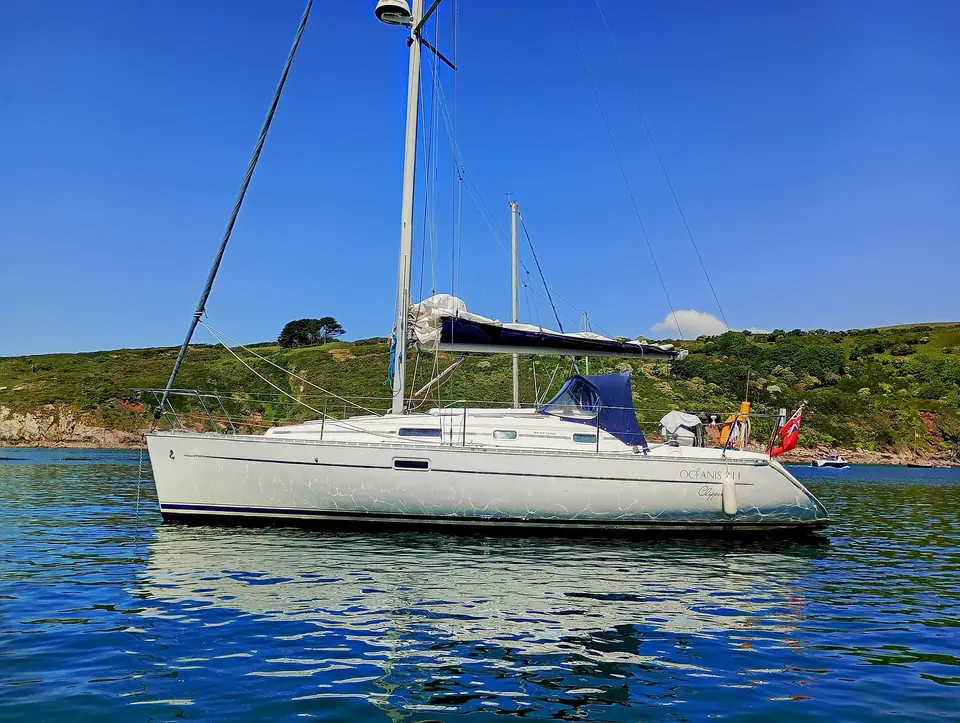
We have not found a freely licensed photo of the Beneteau First 30 yet, so these show other Beneteau boats, each captioned with the boat pictured.
More performance sailboats to explore
Beneteau First 305
Performance Sailboats, 31 ft
Used $14K to $36K
Beneteau First 310
Performance Sailboats, 31 ft
Used $18K to $42K
Shields One-Design
Performance Sailboats, 30 ft
Used $6K to $70K
Beneteau First 31.7
Performance Sailboats, 32 ft
Used $30K to $78K
Other Beneteau models
- Beneteau 49
- Beneteau 50
- Beneteau 57
- Beneteau 343
- Beneteau Antares 5.80
- Beneteau Antares 6
- Beneteau Antares 6.80
- Beneteau Antares 7
- Beneteau Antares 7.30
- Beneteau Antares 7.60
- Beneteau Antares 7.80
- Beneteau Antares 8
- Beneteau Antares 8.00
- Beneteau Antares 8.05
- Beneteau Antares 8.60
- Beneteau Antares 8.80
- Beneteau Antares 9
- Beneteau Antares 9.80
- Beneteau Antares 10.80
- Beneteau Antares 11
- Beneteau Antares 12
- Beneteau Antares 13.80
- Beneteau Antares 30
- Beneteau Antares 32
- Beneteau Antares 36
- Beneteau Antares 42
- Beneteau Antares 620 HB
- Beneteau Antares 650 HB
- Beneteau Antares 750 HB
- Beneteau Cyclades 39.3
- Beneteau Cyclades 43.3 and 43.4
- Beneteau Cyclades 50.5
- Beneteau First 18 SE
- Beneteau First 20
- Beneteau First 21.7
- Beneteau First 24
- Beneteau First 25
- Beneteau First 25.7
- Beneteau First 27
- Beneteau First 27.7
- Beneteau First 31.7
- Beneteau First 35
- Beneteau First 36
- Beneteau First 36.7
- Beneteau First 38
- Beneteau First 40
- Beneteau First 40.7
- Beneteau First 44
- Beneteau First 45
- Beneteau First 47.7
- Beneteau First 53
- Beneteau First 211
- Beneteau First 235
- Beneteau First 285
- Beneteau First 305
- Beneteau First 310
- Beneteau First 345
- Beneteau Flyer 6
- Beneteau Flyer 7
- Beneteau Flyer 8
- Beneteau Flyer 9
- Beneteau Flyer 10
- Beneteau Flyer 12
- Beneteau Flyer 500
- Beneteau Flyer 550
- Beneteau Flyer 650
- Beneteau Flyer 701
- Beneteau Flyer 750
- Beneteau Grand Trawler 62
- Beneteau Gran Turismo 32
- Beneteau Gran Turismo 36
- Beneteau Gran Turismo 40
- Beneteau Gran Turismo 41
- Beneteau Gran Turismo 44
- Beneteau Gran Turismo 45
- Beneteau Monte Carlo 6
- Beneteau Oceanis 30.1
- Beneteau Oceanis 31
- Beneteau Oceanis 34
- Beneteau Oceanis 34.1
- Beneteau Oceanis 35
- Beneteau Oceanis 35.1
- Beneteau Oceanis 36 CC
- Beneteau Oceanis 37
- Beneteau Oceanis 38
- Beneteau Oceanis 38.1
- Beneteau Oceanis 40
- Beneteau Oceanis 40 CC
- Beneteau Oceanis 41
- Beneteau Oceanis 41.1
- Beneteau Oceanis 42
- Beneteau Oceanis 42 CC
- Beneteau Oceanis 43
- Beneteau Oceanis 44 CC
- Beneteau Oceanis 45
- Beneteau Oceanis 46
- Beneteau Oceanis 46.1
- Beneteau Oceanis 48
- Beneteau Oceanis 50
- Beneteau Oceanis 51.1
- Beneteau Oceanis 54
- Beneteau Oceanis 55
- Beneteau Oceanis 58
- Beneteau Oceanis 311
- Beneteau Oceanis 320
- Beneteau Oceanis 321
- Beneteau Oceanis 323
- Beneteau Oceanis 331
- Beneteau Oceanis 350
- Beneteau Oceanis 351
- Beneteau Oceanis 370
- Beneteau Oceanis 390
- Beneteau Oceanis 400
- Beneteau Oceanis 411
- Beneteau Oceanis 423
- Beneteau Oceanis 430
- Beneteau Oceanis 440
- Beneteau Oceanis 461
- Beneteau Oceanis 473
- Beneteau Oceanis 500
- Beneteau Oceanis 510
- Beneteau Oceanis Clipper 361
- Beneteau Oceanis Clipper 373
- Beneteau Oceanis Clipper 381
- Beneteau Oceanis Clipper 393
- Beneteau Oceanis Yacht 54
- Beneteau Oceanis Yacht 60
- Beneteau Oceanis Yacht 62
- Beneteau Sense 43
- Beneteau Sense 46
- Beneteau Sense 50
- Beneteau Sense 55
- Beneteau Swift Trawler 30
- Beneteau Swift Trawler 34
- Beneteau Swift Trawler 35
- Beneteau Swift Trawler 41
- Beneteau Swift Trawler 44
- Beneteau Swift Trawler 48
- All Beneteau models