J/24 Sailboat, the Keelboat That Built J/Boats
A 24-foot keelboat built in a Connecticut garage in the 1970s that became the most widely sailed keelboat class in the world.
- Length
- 24 ft7.32 m
- Beam
- 8.9 ft2.71 m
- Draft
- 4 ft1.22 m
- Cabins
- 1
- Used price
- $3K to $30K
On this page
- Overview
- From a Stonington garage to 5,400 boats
- Why a 3,100-pound boat still wins races
- Five people, 400 kilos and a class built for amateurs
- The J24 sailboat interior, honest and bare
- Buying by era, the early boats and the fixes
- Campaign economics for a five-person team
- Where the J24 fleets are strongest
- Specifications
- Price and value
- Strengths and weaknesses
- Used buyer checklist
- Rivals
- Our verdict
- FAQ
Rod Johnstone's 1977 one-design keelboat. Over 5,400 built by licensed builders on several continents, raced with five crew under a 400 kg limit, and sold today from a few thousand dollars to around $30,000.
- Club one-design racing
- Young teams sharing costs
- Sailing schools and collegiate programs
- Racers who want a world-level circuit
J/24 by the numbers
- Sail area to displacement
- 19.6Balanced power for coastal and offshore cruising.
- Displacement to length
- 173Light displacement for its length, quick but sensitive to added cruising weight.
- Theoretical hull speed
- 6.0 knThe practical top speed of a displacement monohull under normal sailing, based on waterline length.
- Ballast ratio
- 31%A typical ballast ratio for a cruising monohull.
- Capsize screening
- 2.45Above 2.0, so this hull leans toward coastal stability over ultimate offshore resistance.
- Motion comfort ratio
- 12.2A quicker motion in waves, typical of light, beamy hulls.
- Length to beam ratio
- 2.69 : 1A beamy hull with lots of volume for its length.
From a Stonington garage to 5,400 boats
Every J24 sailboat traces back to Ragtime, a 24-footer Rod Johnstone built on weekends in his garage in Stonington, Connecticut, in the mid 1970s. Johnstone was selling advertising for Soundings at the time and had learned yacht design through the Westlawn correspondence course. The prototype launched in 1976 and was fast enough that Everett Pearson, co-founder of Pearson Yachts and owner of TPI, agreed to build it in exchange for exclusive US rights.
Rod and his brother Bob, then a marketing vice president at AMF, founded J/Boats around the boat, and 1,200 were sold in the first two years. The low price, a simple boat and Bob Johnstone's relentless promotion created a class almost overnight, and the success funded J/Boats as a company. Licensed builders followed, including Performance Sailcraft in California and builders in Italy and Argentina, all working to strict one-design tolerances under class and J/Boats control.
The result is the most widely sailed keelboat class in the world. The UK class association counts roughly 5,480 J24s in 165 fleets, and the international class says more than 50,000 people sail the boats. It has also been the launch pad for a long list of America's Cup professionals.
Why a 3,100-pound boat still wins races
Practical Sailor describes the J24 as a stiff boat with lots of horsepower, clean hull lines and minimal wetted surface. It turns almost in its own length, balances under main alone and responds to every adjustment of backstay, sheet tension and crew weight. That responsiveness is the reason sailors call it easy to sail and hard to sail well. The groove upwind is narrow, and the single class genoa has to cover everything from drifting conditions to 20 knots.
For handicap racing, Practical Sailor puts the J24 at a PHRF rating of roughly 165 to 174, in the same neighborhood as much bigger 1970s designs such as the C&C 30 and Santana 30. In one-design racing the rating does not matter; the fleet is the benchmark, and a well-prepared 1977 boat can still win, which the class itself likes to point out after decades of trailering.
Five people, 400 kilos and a class built for amateurs
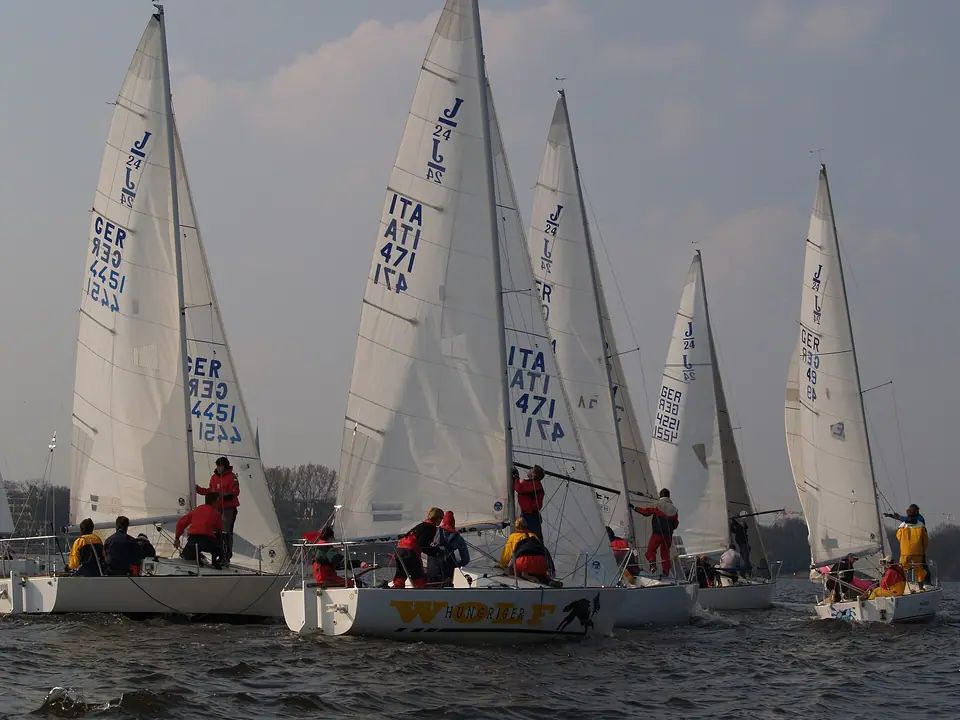
J24 class rules require at least three crew and cap combined weight at 400 kg (about 882 pounds) in swimwear. Most teams race with five, though four or six are legal if they make weight. Top crews in the past ran 800 to 900 pounds aboard, which is why the weigh-in has become a ritual at major events.
The class has held a world championship almost every year since 1979 (the 2020 and 2021 events were cancelled for COVID-19), and its recent rotation tells you how international it still is: Miami in 2019, Corpus Christi in 2022, Thessaloniki in 2023, Seattle in 2024, Plymouth in 2025 and Sandringham, Australia in 2026. Ken Read and Brazil's Mauricio Santa Cruz are among the sailors with multiple world titles.
The boat has also been the platform for the ISAF Nations Cup, the women's world match racing championship, the Rolex International Women's Keelboat Championship and US Sailing's masters championship for sailors over 55.
- Minimum 3 crew, maximum combined weight 400 kg
- Outboard required, minimum 3.5 hp
- World championship since 1979, cancelled only in 2020 and 2021
- International class status since 1990
The J24 sailboat interior, honest and bare
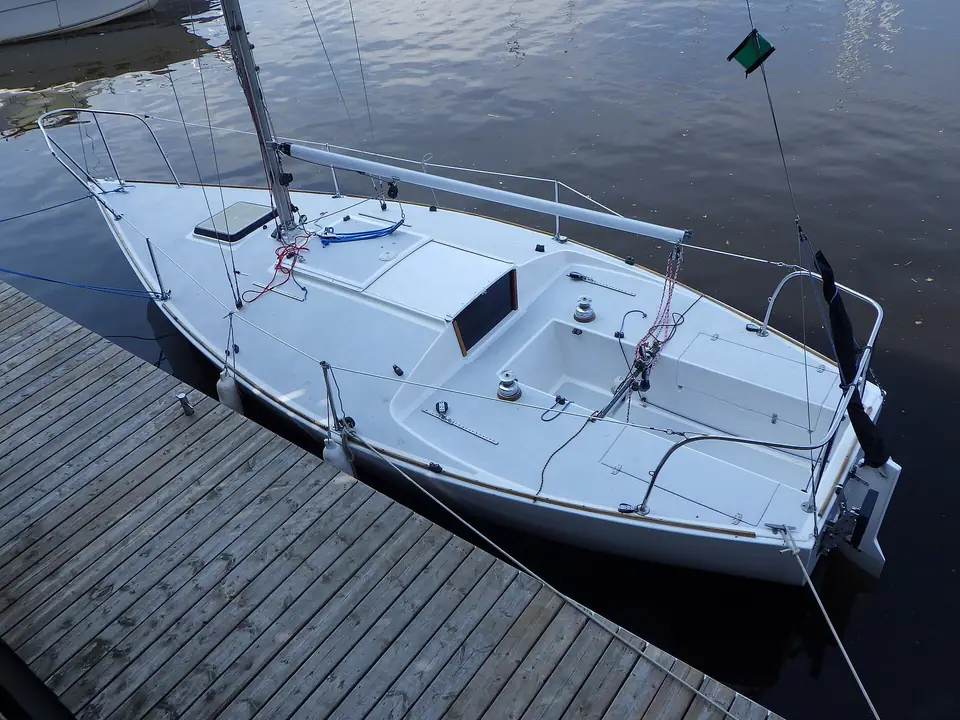
Below deck the J24 is simple and functional. A molded liner forms the cabin sole, there is a V-berth forward and two quarter berths aft, a hand-pump sink and an optional two-burner stove. The icebox is a portable cooler that doubles as the companionway step. Headroom is minimal and the finish is mostly bare white gelcoat.
That cabin earns its keep on regatta weekends as a place to store sails and change clothes, and plenty of owners have spent nights aboard at away events. Some later boats and European builds were finished more nicely, but nobody buys a J24 for the interior. Racers often strip out cushions and anything not required by the rules to save weight.
Buying by era, the early boats and the fixes
The first two years of production had real problems, and Practical Sailor documented them well. The hull-to-deck joint was sealed with silicone that failed and leaked; later boats were bedded in 3M 5200. The main bulkhead could delaminate under rig tension, the keel sump was filled with vermiculite that complicated the keel attachment, the mast cracked around the halyard sheave cutouts, and thin fiberglass hatches leaked and cracked.
In January 1980 the boat got Lexan forward hatches and a heavier companionway hatch, weldless rudder pintles followed in 1981, and the builder also moved to better plywood and screw-reinforced tabbing on the bulkhead, a reinforced port chainplate area and a double-ended backstay. Many early boats have since been upgraded, but you should confirm which fixes a specific hull has received. A 1978 boat that has been properly rebuilt can be a better buy than a neglected 1990s boat.
Hull numbers and builder plates also matter for resale. US boats built by TPI are the most common (Practical Sailor counted nearly 2,000 of the first 2,500 US boats), while Performance Sailcraft in San Francisco built West Coast boats before that company closed.
Campaign economics for a five-person team
The purchase price is the smallest part of a J24 program. A competitive sail inventory runs several thousand dollars, keel fairing by a professional adds hundreds to a couple of thousand, and Practical Sailor warns that trailering is not cheap. A double-axle trailer is recommended over a single axle, both for the boat's keel and for highway stability.
For a local fleet program with dry storage and a jib every season, budget about $3,000 to $5,000 a year. A national or world circuit with new sails, travel, charter or shipping, and entry fees can run past $12,000. Splitting costs five ways is what makes the J24 affordable for younger teams.
Where the J24 fleets are strongest
Annapolis has historically run one of the biggest fleets in the country, and Seattle's Fleet 26 described itself before the 2024 Worlds as the world's largest J24 group with about 30 active boats. Strong fleets also race in Texas, the Great Lakes, New England, Florida, Japan, Germany, Italy, Argentina and Brazil.
Before buying, check how many boats actually show up for local races near you. A J24 with a healthy fleet is a fantastic racing boat; a J24 without one is a cramped daysailer with a tippy feel and limited resale outside the racing world.
J/24 specifications
| Length overall | 24 ft7.32 m |
|---|---|
| Waterline length | 20 ft6.1 m |
| Beam | 8.9 ft2.71 m |
| Draft | 4 ft1.22 m |
| Displacement | 3,1 lbs1,406 kg |
| Ballast | 95 lbs431 kg |
| Sail area | 261 sq ft24.3 m² |
| Cabins | 1 |
| Berths | 4 (V-berth and two quarter berths) |
| Heads | None standard |
| Standard engines | Outboard on transom bracket, class minimum 3.5 hp |
| Hull type | Fiberglass monohull keelboat with transom-hung rudder |
| Keel | Fixed fin keel, bolted, about 950 lb |
| Rig | Fractional sloop with aluminum spars, backstay adjuster and symmetric spinnaker |
| Hull construction | Fiberglass with end-grain balsa core and vinylester outer skin |
| Builder | Tillotson Pearson (TPI) for J/Boats, plus licensed builders worldwide, United States |
| Naval architect | Rod Johnstone |
| Production | 1977 to present |
| Status | Discontinued |
Figures come from builder documentation and independent tests where available. Displacement is usually quoted light, so a loaded cruising boat will weigh more. Compare these specs with another model.
How much does a J/24 cost?
With more than 5,400 boats built, there is always a J24 for sale somewhere, and that keeps prices low. Project boats with soft decks, old sails and no trailer sit at the bottom. Boats with a current measurement certificate, a faired keel, a recent sail inventory and a double-axle trailer carry the premium, and late-production boats from licensed builders in Argentina or Italy can bring more than early US hulls.
Estimate your yearly cost
A planning estimate using common rules of thumb: insurance near 1.5 percent of value, maintenance near 3 percent, haul out and bottom paint by length. Your marina, region and use will move these numbers. Open the full cost calculator.
J/24 timeline
- 1976Rod Johnstone launches the garage-built prototype Ragtime
- 1977TPI begins production; 1,200 boats are sold in the first two years
- 1979First J24 World Championship held
- 1980Lexan hatches arrive in January 1980, followed by weldless rudder pintles in 1981
- 1990ISAF international class status granted
- 2024Worlds sailed on Puget Sound, hosted by Corinthian Yacht Club of Seattle
- 2026Worlds scheduled at Sandringham Yacht Club, Australia
Strengths and weaknesses
What owners like
- Largest keelboat class in the world with fleets in dozens of countries
- Old hulls remain competitive when properly prepared
- Very responsive and maneuverable, an excellent teaching platform
- Cheap to buy, and costs split across five crew
- Huge knowledge base of tuning guides and class support
What to weigh up
- Limited ultimate stability and documented capsizes
- Early boats leak and have bulkhead and keel attachment issues
- Five-person crew can be hard to fill every weekend
- Symmetric spinnaker and old-school rig feel dated next to sportboats
- Trailering and keel fairing add real costs
Used J/24 buyer checklist
Take this list to a viewing. Your ticks are saved in this browser so you can come back to it.
Always commission an independent marine survey and an engine survey before you buy. How a marine survey works.
Rivals to consider
J/22
Smaller, lighter and cheaper to campaign with three or four crew, but with smaller fleets in most regions.
Compare side by sideJ/70
The modern replacement for many J24 fleets, with a lifting keel, carbon rig and asymmetric spinnaker at a much higher price.
Compare side by sideMelges 24
A planing sportboat that is far faster downwind, with a lifting keel, but more expensive and more physical to sail.
Catalina 25
A cruiser with a real cabin and better accommodations, not a one-design race boat.
Compare side by sideOur verdict on the J/24
The J24 sailboat is still one of the best places to learn keelboat racing properly. It punishes sloppy trim, rewards teamwork, and costs very little to get into. Its weaknesses are age and stability: buy a boat whose bulkhead, keel and deck have been looked after, and keep it on protected water. If your local fleet is alive, there is no better value for money in one-design racing.
J/24 questions answered
How much is a J24 sailboat worth?
Most used J24s sell for roughly $2,500 to $30,000 in 2026. Race-ready boats with good sails and a double-axle trailer command the top of the range.
How many J24s were built?
More than 5,400, built by TPI in Rhode Island and licensed builders in about eight other countries.
How many people sail a J24?
Usually five, though four or six are legal as long as the combined crew weight stays under the 400 kg class limit.
What is the J24 interior like?
Basic. There is a V-berth, two quarter berths, a hand-pump sink and room for a cooler, with little headroom and a bare gelcoat finish.
Does a J24 have an engine?
No inboard. Every J24 uses an outboard on a transom bracket, and class rules require at least 3.5 horsepower.
Is the J24 safe in heavy weather?
It is stiff for its size but has a high center of gravity and limited ultimate stability. It is best suited to inshore racing rather than open ocean passages.
J/24 photos
More performance sailboats to explore
Beneteau First 24
Performance Sailboats, 24 ft
Used $45K to $90K
Beneteau First 25
Performance Sailboats, 25 ft
Used $5K to $15K
Beneteau First 235
Performance Sailboats, 23 ft
Used $5K to $14K
Ontario Yachts Sonar
Performance Sailboats, 23 ft
Used $8K to $35K