J/111 for Sale, Review and Buying Advice for the 36-Foot Speedster
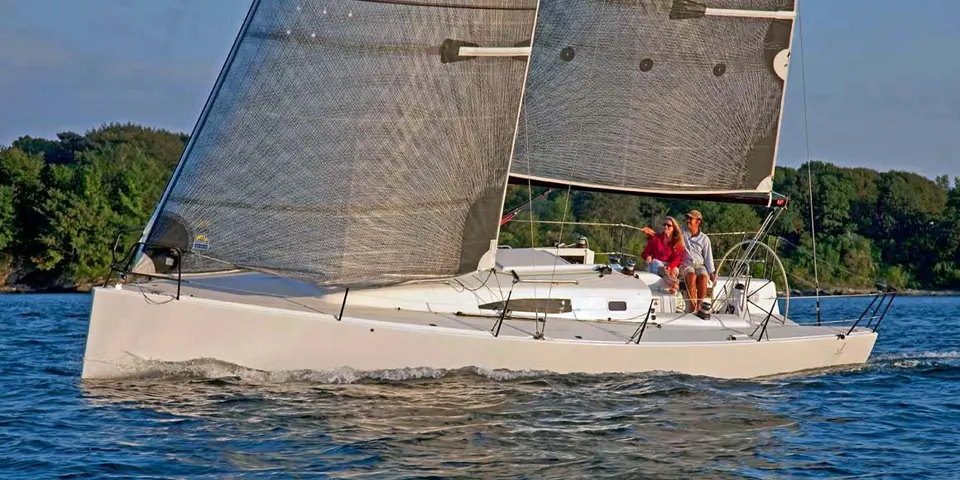
A 36-foot carbon-masted sprit boat that sails to windward at better than 7 knots and races as an international one-design on three continents.
- Length
- 36.5 ft11.1 m
- Beam
- 10.8 ft3.29 m
- Draft
- 7.2 ft2.19 m
- Cabins
- 1 plus removable V-berth
- Used price
- $150K to $275K
On this page
- Overview
- The J111 for sale market, small and specialized
- Alan Johnstone's numbers, read like a race boat
- How fast it actually goes
- The international one-design circuit
- Why a small crew can handle 36 feet of race boat
- Below deck, built for racing weekends
- Budgeting for a J111 program
- Specifications
- Price and value
- Strengths and weaknesses
- Used buyer checklist
- Rivals
- Our verdict
- FAQ
Alan Johnstone's 2010 design. 120 plus boats in 12 countries, 9,300 pounds, a 7.2-foot keel and a 1,399 sq ft gennaker. Used boats are scarce and typically priced from about $150,000 to $275,000.
- Experienced one-design racers
- Handicap racers wanting a winning boat
- Owners who also daysail with friends
- Teams stepping up from a J105
The J111 for sale market, small and specialized
Anyone hunting for a J111 for sale learns quickly that it is a small market. J/Boats counts more than 120 boats sailing in at least 12 countries, so at any time there are usually only a handful listed worldwide, and the best ones often sell inside the class before they reach a broker. That scarcity, combined with an active one-design circuit, has kept prices firm.
What buyers are paying for is a 36-footer that does something few boats this size can: win one-design championships with an amateur crew, then race offshore under handicap, then take six friends for an afternoon sail with the jib on a furler. My estimate for 2026 is roughly $150,000 to $275,000 for most used boats, with condition and sails driving most of the spread.
J/111 by the numbers
- Sail area to displacement
- 24.0Plenty of sail for the weight, the boat should feel lively in light air.
- Displacement to length
- 119Ultralight. Built for speed, keep payload to a minimum.
- Theoretical hull speed
- 7.7 knThe practical top speed of a displacement monohull under normal sailing, based on waterline length.
- Ballast ratio
- 38%A typical ballast ratio for a cruising monohull.
- Capsize screening
- 2.05Above 2.0, so this hull leans toward coastal stability over ultimate offshore resistance.
- Motion comfort ratio
- 17.9A quicker motion in waves, typical of light, beamy hulls.
- Length to beam ratio
- 3.38 : 1Moderate proportions.
Alan Johnstone's numbers, read like a race boat
Launched in August 2010, the J111 was drawn by Alan Johnstone, who had already led the J109 design a decade earlier. J/Boats lists it at 36 feet 6 inches overall with a long 32.7-foot waterline, 10 feet 10 inches of beam, and a displacement of 9,300 pounds. The lead bulb keel carries 3,515 pounds and draws about 7 feet 2 inches.
Run those through the usual ratios and you get a sail area to displacement ratio of about 24, a displacement to length ratio of about 119 (J/Boats' own figures) and a ballast ratio around 38 percent. That combination, light and long with a lot of righting moment, is why the boat can carry its 663 square feet of upwind sail in a breeze and then set a 1,399-square-foot gennaker downwind. The rudder is an internal spade rather than transom hung, and the reverse transom and carbon mast mark it as a generation newer than the J105 and J109.
- Upwind sail area about 663 sq ft, main and non-overlapping jib
- Gennaker about 1,399 sq ft on a retractable sprit
- Sail area to displacement about 24
- Displacement to length about 119
- Ballast ratio about 38 percent
How fast it actually goes
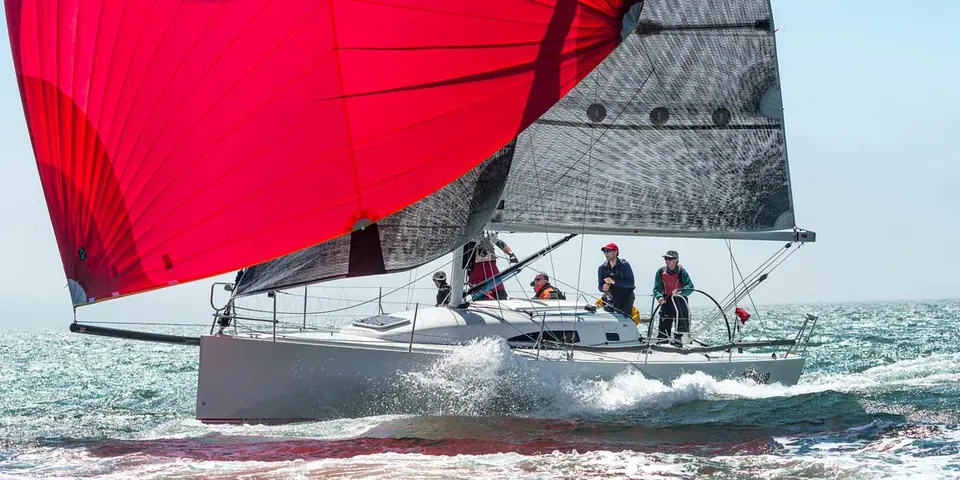
J/Boats says the J111 slices to windward at better than 7 knots and reaches double-digit speeds downwind, and owners and reviewers agree that it is balanced and easy to drive upwind with precise helm control. The 60-inch wheel gives the helmsman good leverage and sightlines, and the floor-mounted traveler and foot braces keep the trimmers working efficiently.
Its handicap record is long. Between 2010 and 2020 the class reports wins under PHRF, ORC, IRC, AMS, ORR and CSA in regional and international events. For a buyer, that versatility matters: even if the one-design fleet near you is thin, the boat will be competitive in whatever handicap system your club uses.
The international one-design circuit
World Sailing granted the J111 international class status in 2012, just two years after launch. The first North American championship was sailed out of Chicago Yacht Club in 2013, and the first Europeans in Le Havre, France the same year. World championships have since visited Cowes twice, Newport, San Francisco, Breskens in the Netherlands and Chicago.
The class remains active in 2026. The J111 North American championship was held at Youngstown Yacht Club on Lake Ontario with 14 teams over ten races and won by Bravo, and boats race in the UK, the Netherlands, Australia and across the Great Lakes and the US coasts.
Why a small crew can handle 36 feet of race boat
J/Boats argues that the asymmetric gennaker can be handled by two crew rather than the five or six a conventional spinnaker needs, and in practice the sprit setup does make sets and douses simpler. The jib lives on a furler and the mainsail runs on slides, so a short-handed crew can leave the dock quickly and put everything away without a foredeck team.
Full one-design racing still needs a proper crew to get the most out of the boat, but for daysailing, evening races and coastal passages the J111 is easier to run than its speed suggests. That is a large part of why owners keep their boats for many seasons.
Below deck, built for racing weekends
The interior is an open plan designed for overnighting rather than cruising. There is an L-shaped galley, a forward-facing navigation station, a wet locker, two full-length settee berths, two aft quarter berths and a private head forward, with a removable V-berth. Seating at the table works for six.
Systems are minimal: a 13-gallon fuel tank, a 26-gallon water tank with pressure water, and a Volvo Penta D1-20 saildrive diesel that J/Boats rates at 21 horsepower. Expect to add battery capacity if you plan to spend nights aboard.
Budgeting for a J111 program
A J111 is a big-boat program even when sailed by amateurs. Slip fees for a 36-footer, insurance, hauling, bottom preparation, saildrive service and a rotating set of laminated race sails put a club racing budget around $20,000 to $35,000 a year. A full one-design circuit with new sails each season, coaching and boat transport for championships can exceed $60,000.
Resale is the counterweight. Because the boat is still in production, supported by an international class and coveted in handicap racing, well-kept J111s have held their value better than most performance boats of the same age.
My advice on negotiating is simple. Price the sail inventory and the age of the standing rigging first, then the engine hours, then the electronics. A boat that needs a full new one-design inventory and a rig refresh can easily hide $40,000 to $60,000 of work behind an attractive asking price, which is often more than the gap to a fully sorted boat.
J/111 specifications
| Length overall | 36.5 ft11.1 m |
|---|---|
| Waterline length | 32.7 ft9.97 m |
| Beam | 10.8 ft3.29 m |
| Draft | 7.2 ft2.19 m |
| Displacement | 9,3 lbs4,216 kg |
| Ballast | 3,515 lbs1,594 kg |
| Sail area | 663 sq ft61.6 m² |
| Fuel capacity | 13 gal49 L |
| Fresh water | 26 gal98 L |
| Cabins | 1 plus removable V-berth |
| Berths | 6 to 8 (settees, quarter berths, V-berth) |
| Heads | 1 |
| Standard engines | Volvo Penta D1-20 diesel with saildrive and folding prop (J/Boats lists 21 hp) |
| Hull type | Fiberglass monohull with reverse transom and internal spade rudder |
| Keel | Fin keel with lead bulb, 7.2 ft draft |
| Rig | Fractional sloop, carbon mast, retractable sprit, asymmetric gennaker |
| Hull construction | Vacuum-infused fiberglass with balsa core |
| Builder | J/Boats (built in the United States), United States |
| Naval architect | Alan Johnstone |
| Production | 2010 to present |
| Status | In production |
Figures come from builder documentation and independent tests where available. Displacement is usually quoted light, so a loaded cruising boat will weigh more. Compare these specs with another model.
How much does a J/111 cost?
J111s rarely come up for sale and listings are spread across the US, the UK, the Netherlands and Australia, so prices here are broker estimates rather than a deep market average. Early 2010 to 2012 boats with original sails sit at the bottom, while later hulls with current one-design sails, upgraded electronics and a trailer or cradle reach the top. J/Boats prices new boats on request through its dealers.
Estimate your yearly cost
A planning estimate using common rules of thumb: insurance near 1.5 percent of value, maintenance near 3 percent, haul out and bottom paint by length. Your marina, region and use will move these numbers. Open the full cost calculator.
J/111 timeline
- 2010J111 introduced in August, designed by Alan Johnstone
- 2012World Sailing grants international class status
- 2013First North Americans at Chicago Yacht Club and first Europeans in Le Havre
- 2014First World Championship sailed in Cowes
- 2026North Americans at Youngstown Yacht Club, won by Bravo
Strengths and weaknesses
What owners like
- Fast upwind and downwind with a light, long hull
- International one-design class with World Sailing status
- Competitive under PHRF, ORC, IRC and ORR
- Sprit, furling jib and slides make it manageable short-handed
- Strong resale supported by continued production
What to weigh up
- Very few boats for sale at any time
- Over 7 feet of draft
- Small fuel and water capacity for cruising
- Racing budgets climb quickly with laminated sails
- Interior is basic for a 36-foot boat
Used J/111 buyer checklist
Take this list to a viewing. Your ticks are saved in this browser so you can come back to it.
Always commission an independent marine survey and an engine survey before you buy. How a marine survey works.
Rivals to consider
J/109
Heavier and slower but with a second cabin and more cruising comfort, at a lower used price.
Compare side by sideJ/105
Much bigger US one-design fleets and far cheaper, but older and less quick.
Compare side by sideX-Yachts X4.3
A more luxurious Danish performance cruiser with a better interior and a higher price.
Compare side by sideSwan 48
A much larger, more luxurious club racer and cruiser in a different budget bracket.
Compare side by sideOur verdict on the J/111
The J111 is one of the most complete performance boats of its era: quick in every direction, manageable for a small crew, and blessed with an international class and strong handicap results. Its scarcity is the main obstacle, so be ready to buy outside your region and to pay for a well-documented boat. If you want to race at a high level without stepping into a professional program, it is hard to find a better 36-footer.
J/111 questions answered
How much does a used J111 cost?
Most used J111s are priced roughly between $150,000 and $275,000 in 2026, depending on age, sails and equipment. Supply is thin, so asking prices vary widely.
How many J111s have been built?
J/Boats reports more than 120 boats sailing in at least 12 countries.
Who designed the J111?
Alan Johnstone designed it, and it was introduced in August 2010.
How fast is a J111?
J/Boats says it sails to windward at better than 7 knots and reaches double-digit speeds downwind.
Where is the J111 raced as a one-design?
In the US, the UK, the Netherlands and Australia, with world championships held in Cowes, Newport, San Francisco, Breskens and Chicago.
Can you sleep aboard a J111?
Yes. It has two settee berths, two quarter berths, a removable V-berth and a private head, which is fine for racing weekends.
J/111 photos
More performance sailboats to explore
Dehler 36 CWS
Performance Sailboats, 36 ft
Used $35K to $70K
Beneteau First 36
Performance Sailboats, 36 ft
Used $250K to $360K
Dehler 36
Performance Sailboats, 36 ft
Used $65K to $120K
Beneteau First 36.7
Performance Sailboats, 36 ft
Used $55K to $105K