Alerion Yachts Performance Sailboats
Alerion 28 Sailboat Review, Specs and Used Prices
Herreshoff's 1912 daysailer, reimagined in fiberglass by Carl Schumacher, and still the prettiest way to go sailing for an afternoon.
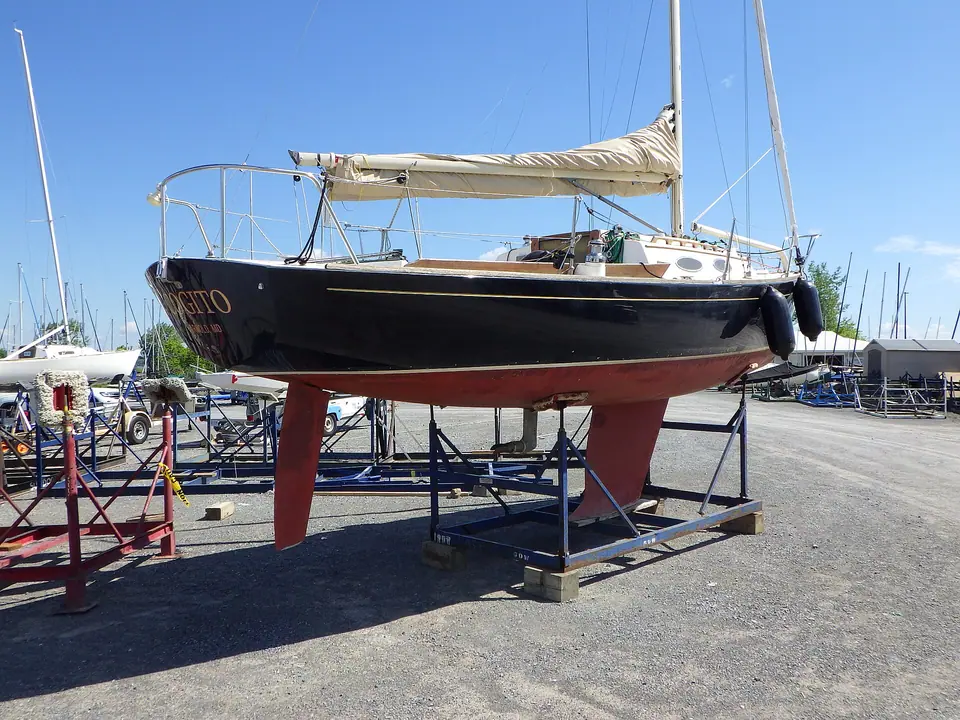
- Length
- 28.3 ft8.61 m
- Beam
- 8.2 ft2.49 m
- Draft
- 4.5 ft1.37 m
- Cabins
- 1
- Used price
- $38K to $95K
On this page
- Overview
- From Herreshoff's Alerion III to the Alerion Express 28
- Schumacher's numbers under the classic lines
- Designed so one person can sail it well
- Under sail, quick and very easy
- A small cabin for a nap, not a week
- Who built your Alerion 28
- Running costs and why Alerions sell quickly
- Specifications
- Price and value
- Strengths and weaknesses
- Used buyer checklist
- Rivals
- Our verdict
- FAQ
The Alerion Express 28 is a 28-foot fractional-rigged daysailer designed by Carl Schumacher and built since 1990, mostly by Tillotson Pearson in Rhode Island. About 470 built, simple to sail and very hard to beat for style.
- Daysailing and evening sails
- Single-handed sailors
- Couples downsizing from a cruiser
- Classic yacht lovers who do not want a wooden boat
From Herreshoff's Alerion III to the Alerion Express 28
The Alerion name goes back to 1912, when Nathanael Herreshoff designed Alerion III, a 26-foot daysailer for his own use on Narragansett Bay. It is widely regarded as one of the most beautiful small yachts ever built, and the original is preserved at Mystic Seaport. Generations of sailors looked at it and wished someone would build one they could own without maintaining a wooden boat.
That wish became the Alerion Express 28. In the 1980s Connecticut sailor Ralph Schacter commissioned Carl Schumacher, the California designer best known for fast, wholesome cruiser-racers, to draw a fiberglass interpretation: Herreshoff's sweeping sheer, long overhangs and low cabin, combined with a modern fin keel, spade rudder and fractional rig. Hull No. 1 was a prototype built at Lost River Marine in Stuart, Florida, in 1989, and production began in 1990. Sailing innovator Garry Hoyt joined the project in 1994 at the invitation of TPI's Everett Pearson, adding his jib boom and a fin-and-bulb keel, and the boat launched a brand.
When people search for Alerion sailboats or Alerion yachts, this is the boat most of them mean. It is the original, the most common and the template for everything that followed.
Alerion 28 by the numbers
- Sail area to displacement
- 21.0Plenty of sail for the weight, the boat should feel lively in light air.
- Displacement to length
- 165Light displacement for its length, quick but sensitive to added cruising weight.
- Theoretical hull speed
- 6.4 knThe practical top speed of a displacement monohull under normal sailing, based on waterline length.
- Ballast ratio
- 45%A high ballast ratio, so the boat stands up well to a breeze.
- Capsize screening
- 2.00Below 2.0, the traditional threshold for offshore suitability.
- Motion comfort ratio
- 16.9A quicker motion in waves, typical of light, beamy hulls.
- Length to beam ratio
- 3.45 : 1Moderate proportions.
Schumacher's numbers under the classic lines
The Alerion 28 measures 28 feet 3 inches overall on a 22 foot 10 inch waterline, with an 8 foot 2 inch beam and a 4 foot 6 inch draft. Displacement is about 4,400 pounds, with 2,000 pounds of ballast, a ballast ratio of about 45 percent. Sail area is roughly 353 square feet, split between a 206 square foot main and a 146 square foot jib.
Those numbers explain the boat's character. A sail area to displacement ratio around 21 gives it plenty of power for its weight, and the high ballast ratio keeps it on its feet. The long overhangs add sailing length as the boat heels, so it accelerates in gusts. The narrow beam, at just over 8 feet, keeps the boat slippery and also makes it trailerable.
- Ballast ratio about 45 percent
- Sail area to displacement ratio about 21
- Draft 4 ft 6 in, fine for most harbors
- Beam under the 8 ft 6 in US trailer limit
Designed so one person can sail it well
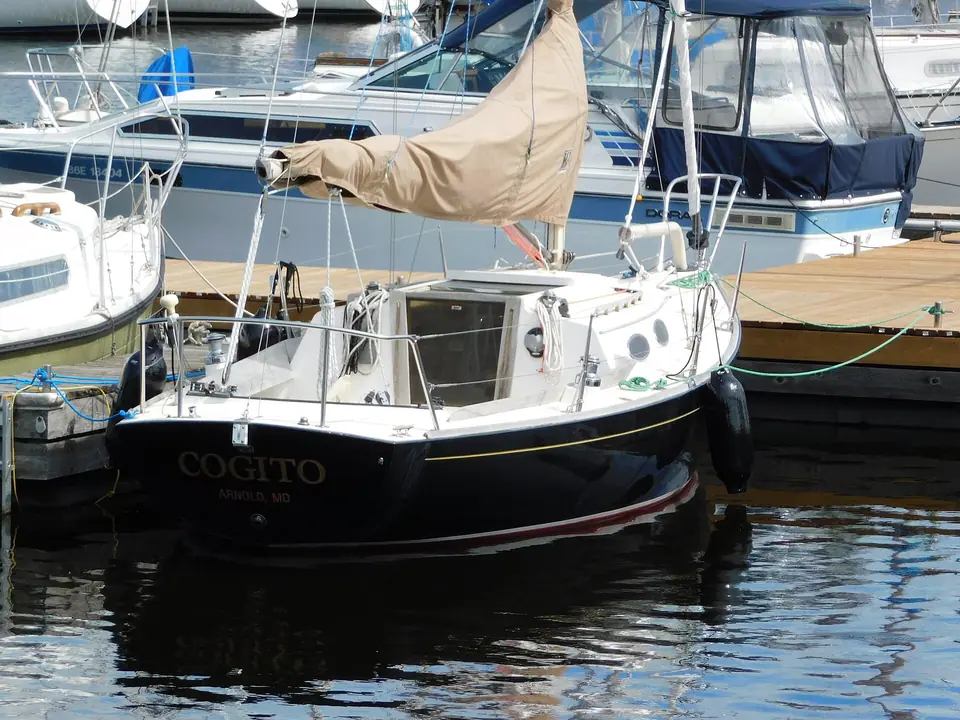
The Alerion 28's best trick is that one person can sail it properly. Many boats carry a self-tacking jib on a boom, so tacking means turning the tiller and nothing more. The mainsheet and jib sheet lead to the helmsman, and the fractional rig makes the main the primary engine, easy to depower by easing the traveler.
The cockpit is long, deep and comfortable, with room for four or five adults to sit back for an evening sail. Most boats are steered with a tiller, which gives the precise, connected feel that makes a daysailer fun. It is a boat that rewards good sailing, but is very forgiving of guests who just want to come along.
Under sail, quick and very easy
In a moderate breeze an Alerion 28 sails like a much bigger boat. It points well, tracks steadily and makes easy work of a chop. Owners consistently say it is faster than it looks, and in typical New England afternoon sea breezes it passes many cruisers several feet longer.
In lighter air the slim hull and modest wetted surface keep it moving. When the breeze builds, the ballast and narrow beam mean it heels early and then stiffens. A reef in the main is the usual move past 18 knots. This is a daysailer, not an offshore boat, but it handles a sloppy bay with confidence.
A small cabin for a nap, not a week
Below, the Alerion 28 has a V-berth forward, room for three to sleep, about 5 feet 8 inches of headroom, a small sink and a built-in cooler. Some boats carry a portable toilet, others a head with a holding tank. There is a small amount of storage and enough room to get out of a squall or to change clothes. Some owners use it for an occasional overnight, but nobody should buy one expecting a cruising interior.
That is the point. Instead of an interior, you get a long, comfortable cockpit and a boat that is beautiful from every angle. The cabin's real job is to protect sails, cushions and a lunch cooler.
Practical owners make small changes that pay off, such as a fitted cooler that slides under the companionway, a simple battery-powered cabin light and good cushion covers. Keeping weight out of the ends of the boat helps it sail to its numbers, so resist the temptation to load the V-berth with cruising gear.
Who built your Alerion 28
After the Florida prototype, Holby Marine in Bristol, Rhode Island built seven hulls, and Tillotson Pearson Industries in Rhode Island built most of the rest. Around 470 had been built by 2019. Later boats carry the Alerion Yachts name, and the brand has continued to offer the 28 in small numbers. Check current availability directly with Alerion Yachts if you are interested in a new build.
The Alerion range also grew around the 28. Schumacher drew the smaller Alerion Express 20 and the larger Alerion Express 38 in the same spirit, and later Alerion models carried the look to bigger sizes for couples who want more accommodation with the same lines.
Running costs and why Alerions sell quickly
An Alerion 28 is inexpensive to own. Expect about $4,500 to $10,000 per year for a mooring or slip, insurance, winter storage and routine maintenance. The varnished teak trim, rails and coaming are the main labor item. Many owners pay a yard to keep the brightwork up, and it is worth it, because varnish condition drives resale value.
Used Alerion 28s generally ask $38,000 to $95,000. The best boats sell quickly in New England, Long Island Sound and the Chesapeake, where the type is a fixture of yacht club moorings. Boats that are cosmetically tired but structurally sound can be excellent buys if you are willing to do the varnish.
When you shop, compare boats on the things that are expensive to fix rather than the asking price. A dry deck, a sound keel joint, sails less than about eight years old and a well-serviced diesel matter far more than whether a boat was built in 1995 or 2005. Ask whether a cradle, covers and a winter storage arrangement come with the boat, because finding a cradle for a long-overhang 28-footer can be surprisingly awkward.
Alerion 28 specifications
| Length overall | 28.3 ft8.61 m |
|---|---|
| Waterline length | 22.8 ft6.96 m |
| Beam | 8.2 ft2.49 m |
| Draft | 4.5 ft1.37 m |
| Displacement | 4,4 lbs1,996 kg |
| Ballast | 2, lbs907 kg |
| Sail area | 353 sq ft32.7 m² |
| Cabins | 1 |
| Berths | 3 |
| Heads | 1 (portable toilet or marine head with holding tank) |
| Standard engines | Yanmar 1GM10 diesel with shaft on early boats; later boats a saildrive (Volvo Penta MD2010 10 hp or Yanmar 2GM 14 hp) |
| Maximum power | 14 hp |
| Hull type | Light-displacement daysailer with long overhangs |
| Keel | Fin keel (standard fin or Scheel bulb; later fin and bulb), internally mounted spade rudder |
| Rig | Fractional sloop with optional self-tacking jib boom |
| Hull construction | Fiberglass, cored hull and deck |
| Builder | Lost River Marine (prototype), Holby Marine, then Tillotson Pearson (TPI) for most hulls, later Alerion Yachts, United States |
| Naval architect | Carl Schumacher |
| Other design credits | Inspired by Nathanael Herreshoff's Alerion III |
| Production | 1989 to present |
| Status | Limited production |
Figures come from builder documentation and independent tests where available. Displacement is usually quoted light, so a loaded cruising boat will weigh more. Compare these specs with another model.
How much does a Alerion 28 cost?
Alerion 28 prices depend on condition, brightwork and sails more than on year. Early 1990s boats with tired varnish and original sails ask around $40,000, while well-kept 2000s boats with new sails, a self-tacking jib and fresh brightwork reach $75,000 to $95,000. New England boats command a premium because that is where the type's following is strongest.
Estimate your yearly cost
A planning estimate using common rules of thumb: insurance near 1.5 percent of value, maintenance near 3 percent, haul out and bottom paint by length. Your marina, region and use will move these numbers. Open the full cost calculator.
Versions and options
- Prototype and Holby Marine boats
- Hull No. 1 was built at Lost River Marine in Stuart, Florida, in 1989, then Holby Marine in Bristol, Rhode Island built seven more.
- Alerion Express 28 (Tillotson Pearson)
- The main production run from Rhode Island and the majority of boats on the market. Minor cockpit and hardware changes came at about hull No. 150, along with more ballast.
- Hoyt jib boom boats (from 1994)
- Garry Hoyt's jib boom replaced the original self-tacking jib arrangement, and the keel became a fin and bulb. Boats built before 1994 likely have the original setup.
- Alerion 28 (Alerion Yachts)
- Later boats branded Alerion Yachts, built in small numbers.
Alerion 28 timeline
- 1912Nathanael Herreshoff designs Alerion for his own use
- 1989Hull No. 1, a prototype commissioned by Ralph Schacter and designed by Carl Schumacher, is built in Stuart, Florida
- 1990Production begins, first at Holby Marine and then at Tillotson Pearson in Rhode Island
- 1994Garry Hoyt joins the project, adding his jib boom and a fin-and-bulb keel
- 2019About 470 Alerion 28s have been built
- 2025Garry Hoyt dies in Newport aged 93
Strengths and weaknesses
What owners like
- Classic Herreshoff-inspired beauty
- Easy single-handed sailing, especially with a self-tacking jib
- Quick and well balanced in a breeze
- High ballast ratio and steady motion
- Large, comfortable cockpit
- Strong resale in New England
What to weigh up
- Minimal cabin and portable head only
- Small diesel struggles against wind and chop
- Brightwork requires constant upkeep
- Long overhangs make it pricey per foot at marinas
- Not designed for offshore passages
Used Alerion 28 buyer checklist
Take this list to a viewing. Your ticks are saved in this browser so you can come back to it.
Always commission an independent marine survey and an engine survey before you buy. How a marine survey works.
Rivals to consider
Morris M29
A Maine-built daysailer with similar style and even higher finish quality, at a significantly higher price.
J/9
A modern daysailer-cruiser from J Boats with a more contemporary look and similar ease of handling.
Beneteau First 27
Faster and more modern, with a real cabin, but none of the classic lines.
Compare side by sideCatalina 27
A much cheaper small cruiser with more interior and far less sailing elegance.
Compare side by sideOur verdict on the Alerion 28
The Alerion 28 is the rare boat that looks as good as it sails. Schumacher took Herreshoff's lines and made them practical, fast and easy for one person to handle, and three decades later there is still nothing quite like it at the price. Buy it for daysailing, accept that the cabin is for storage, and keep the brightwork up. Do that and an Alerion 28 will make every sail feel like an occasion, and it will be easy to sell when you are done.
Alerion 28 questions answered
How much is an Alerion 28 worth?
Used Alerion 28s generally ask between about $38,000 and $95,000, depending on condition, sails and brightwork.
Who designed the Alerion 28?
Carl Schumacher designed it in the late 1980s for Ralph Schacter, inspired by Nathanael Herreshoff's Alerion III of about 1912. The prototype was built in 1989 and production began in 1990.
Is the Alerion Express 28 the same as the Alerion 28?
Yes. Early boats were sold as the Alerion Express 28, and later boats carry the Alerion 28 name.
Can you single-hand an Alerion 28?
Yes. With the self-tacking jib and lines led to the helm, it is one of the easiest 28-footers to sail alone.
Is the Alerion 28 trailerable?
Its 8 foot 2 inch beam fits within the US trailer limit, though most owners keep the boat on a mooring and use a yard for storage.
How many Alerion 28s have been built?
About 470 had been built by 2019, most of them by Tillotson Pearson in Rhode Island.