Beneteau Performance Sailboats
Beneteau First 24 and First 24 SE, Review and Buying Guide
A Sam Manuard sportsboat hull with a swing keel, twin cassette rudders and a cabin for four, built in Slovenia and sold by Beneteau.
- Length
- 23.9 ft7.29 m
- Beam
- 8.2 ft2.5 m
- Draft
- 6.6 ft2 m
- Cabins
- Open plan saloon with forward V-berth
- Used price
- $45K to $90K
On this page
- Overview
- Mini Transat ideas in a boat for four
- First 24 SE or First 24, the choice that matters
- A keel that swings, rudders in cassettes and ten inches of draft
- What the test numbers show
- Below decks, deliberately simple
- Towing and rigging at the ramp
- The other First 24, from 1982
- New price, used values and yearly costs
- Specifications
- Price and value
- Strengths and weaknesses
- Used buyer checklist
- Rivals
- Our verdict
- FAQ
The Beneteau First 24 began as the Seascape 24 in 2017 and joined Beneteau's First range after the 2018 takeover. Today it comes as the carbon-rigged First 24 SE or the aluminum-rigged First 24, both trailerable and beachable.
- Sportsboat sailors who want to sleep aboard
- Trailer sailing and beach cruising
- Short-handed club racing
- Dinghy sailors moving to a keelboat
Beneteau First 24 by the numbers
- Sail area to displacement
- 28.9Racing level power, needs active reefing as the breeze builds.
- Displacement to length
- 120Light displacement for its length, quick but sensitive to added cruising weight.
- Theoretical hull speed
- 6.1 knThe practical top speed of a displacement monohull under normal sailing, based on waterline length.
- Ballast ratio
- 27%Relatively low ballast, form stability does more of the work.
- Capsize screening
- 2.44Above 2.0, so this hull leans toward coastal stability over ultimate offshore resistance.
- Motion comfort ratio
- 10.5A quicker motion in waves, typical of light, beamy hulls.
- Length to beam ratio
- 2.91 : 1A beamy hull with lots of volume for its length.
Mini Transat ideas in a boat for four
Most people typing beneteau 24 first into a search bar want the modern boat, the planing pocket cruiser that Beneteau now sells as the First 24. It did not start in Vendee. Seascape, a Slovenian builder founded by two Mini Transat sailors, Andraz Mihelin and Kristian Hajnsek, asked Samuel Manuard to scale its 18 and 27 concepts into an in-between boat. The result, the Seascape 24, won Best Small Cruiser in SAIL's 2017 Best Boats competition, and when Beneteau bought Seascape in 2018 the 24 became a First.
The brief was the same one Mihelin described to SAIL: 80 percent of the fun of sailing a Mini with 20 percent of the work. That means a plumb bow, hard chines and a broad stern for early planing, a deep swing keel with a lead bulb for stability, and an interior that sleeps four in a simple, almost Scandinavian way. It is a sportsboat that happens to have a cabin, not a cruiser pretending to be fast.
First 24 SE or First 24, the choice that matters
Sailboatdata records that the original carbon-rigged boat was sold simply as the First 24 from 2018 to 2020, and that a second version arrived for 2021. Today Beneteau lists both. The First 24 SE (Seascape Edition) keeps the racier recipe: carbon mast, boom and bowsprit, laminate sails and a lighter 1,000 kg (2,205 lb) displacement. The First 24 uses a Selden aluminum mast and boom with a classic backstay, Dacron North Sails and an aluminum sprit, and weighs 1,100 kg (2,425 lb).
Beneteau's July 2026 specification sheets put the difference in numbers. The SE carries a 24.0 m2 main and a 15.3 m2 jib (39.3 m2 upwind) with a 58 m2 gennaker on a 2.08 m carbon sprit. The First 24 carries a 17.4 m2 main and a 12.9 m2 jib (30.3 m2 upwind) with a 49.5 m2 gennaker on a 1.70 m aluminum sprit. Pick the SE if you want maximum pace and will race; pick the First 24 if you want a boat beginners can handle and a lower bill for sails and spars.
- First 24 SE: carbon spars, 1,000 kg, 39.3 m2 upwind, air draft 11.26 m
- First 24: aluminum spars and backstay, 1,100 kg, 30.3 m2 upwind, air draft 11.06 m
- Both: 7.29 m hull, 2.50 m beam, same swing keel options and CE category C8
A keel that swings, rudders in cassettes and ten inches of draft
Both versions share a swinging keel built as a GRP vinylester shell with a lead bulb insert, raised by a manually operated stainless keel winch. The standard keel weighs 300 kg (661 lb) and draws 2.00 m (6 ft 7 in) down and just 0.25 m (10 in) fully raised. An optional shallow keel of 430 kg (948 lb) draws 0.55 m to 1.15 m, but it sticks out of the hull when lifted, needs a different trailer and means the boat can no longer be beached. Beneteau says the two keels can be swapped later.
The twin rudders are foam-sandwich GRP blades in aluminum cassettes hung off the transom, and they lift clear like daggerboards. Combined with a thicker laminate in the bottom of the hull, that lets you drive the boat onto a beach. A swinging keel also protects the structure in a grounding, since it kicks up rather than transmitting the load straight into the hull.
What the test numbers show
Charles Doane sailed the Seascape 24 for SAIL in 12 to 15 knots of true wind and had it planing on a close reach at over 9 knots under working jib and main. Upwind at a tight 30 degree apparent wind angle it made about 6 knots, and on a broad reach without bothering to hoist the asymmetric it still held 8 knots or better. He called the helm lively but not twitchy and the boat fast but not ornery, which matches the experience of most owners.
SAIL's figures for that boat were a 1,962 lb displacement, 704 lb of ballast and a ballast ratio of 36 percent, with a sail area to displacement ratio of 46 and a displacement to length ratio of 63. Those are sportsboat numbers. The aluminum First 24 is heavier and carries less sail, so expect it to come onto the plane a little later, but it trades that for easier handling and lower loads.
Below decks, deliberately simple
The interior is one open space. Forward is a V-berth for two over a buoyancy volume, and either side of the keel box are long benches with sliding wooden extensions that turn them into full berths for two more. There is a dedicated spot for a chemical toilet at the back of the saloon, storage under the benches, a fold-down table that also mounts in the cockpit, and faux leather cushions on EVA foam flooring. Electrical, solar and instrument packs are options, so check what a used boat has.
Treat it as a camping boat for a weekend. SAIL described the original as relatively Spartan but well thought out, and that is still fair. If you need a galley and an enclosed head, look at the larger First 27 or an older 25-footer instead.
Towing and rigging at the ramp
At 8 ft 2 in of beam the First 24 is road legal in the US without permits. On its trailer it stands 3.4 m (11 ft 2 in) high with the mast or 2.25 m (7 ft 5 in) without, and the whole rig is 9.80 m long, so plan garage and storage space accordingly. A provisional mast crane lets owners step the mast without a hoist, and SAIL estimated that one person could rig and launch in roughly half an hour.
There is no inboard engine. The boat takes a removable bracket for a long-shaft outboard of up to 6 hp; SAIL's test boat used a 4 hp. A light four-stroke or an electric outboard keeps weight off the stern.
The other First 24, from 1982
The name is not new. From 1982 to 1985 Beneteau built a Jean-Marie Finot First 24 that sailboatdata credits with 677 hulls. It was a completely different boat: Beneteau's brochure gives an 8.00 m overall length, a 6.30 m waterline, a 2.50 m beam, about 1,500 kg displacement with 500 kg of ballast, a lifting keel drawing 0.80 m to 1.60 m and a 9.9 hp outboard. Beneteau pitched it as a trailerable family cruiser with five berths in three separate cabins.
If a listing shows a raked bow, wood trim inside and a 1980s build year, it is the Finot boat and should be priced as a classic pocket cruiser, typically a small fraction of the modern boat's value. Do not compare its specs with the Manuard design.
New price, used values and yearly costs
SAIL priced the Seascape 24 at $72,495 sailaway in 2018. Equipped new boats in 2026 typically land in the $80,000 to $110,000 range depending on version, sails and packs, with the SE at the upper end. Used Seascape 24s and First 24s ask roughly $45,000 to $90,000, and boats that come with a good trailer and a full North Sails inventory sell fastest.
Annual costs are low for a performance boat of this size if it lives on a trailer, around $2,500 to $7,000 for insurance, storage, sails and maintenance. Racing sails and carbon spar repairs are the costs that can spike.
Beneteau First 24 specifications
| Length overall | 23.9 ft7.29 m |
|---|---|
| Beam | 8.2 ft2.5 m |
| Draft | 6.6 ft2 m |
| Air draft | 36.3 ft11.06 m |
| Displacement | 2,425 lbs1,1 kg |
| Ballast | 661 lbs3 kg |
| Sail area | 326 sq ft30.3 m² |
| Cabins | Open plan saloon with forward V-berth |
| Berths | 4 (V-berth plus two extendable side berths) |
| Heads | Dedicated space for a portable chemical toilet |
| Maximum persons | 8 |
| Standard engines | None; removable bracket for a long-shaft outboard up to 6 hp |
| Maximum power | 6 hp |
| Hull type | Light planing monohull with hard chines, plumb bow and wide stern |
| Keel | Swing keel in GRP vinylester composite with lead bulb insert, 0.25 m to 2.00 m (10 in to 6 ft 7 in); optional shallow keel 0.55 m to 1.15 m |
| Rig | Fractional sloop with Selden aluminum mast and boom, backstay, retractable aluminum bowsprit (carbon spars and sprit on the First 24 SE) |
| Hull construction | Vacuum-infused vinylester GRP sandwich with Airex PVC foam core |
| CE design category | C |
| Builder | Seascape d.o.o. (Beneteau group), Slovenia, Slovenia |
| Naval architect | Samuel Manuard (Manuard YD) |
| Other design credits | Industrial design by SITO; concept and R&D by Seascape |
| Production | 2017 to present |
| Status | In production |
Figures come from builder documentation and independent tests where available. Displacement is usually quoted light, so a loaded cruising boat will weigh more. Compare these specs with another model.
How much does a Beneteau First 24 cost?
SAIL quoted the Seascape 24 at $72,495 sailaway in 2018, and the carbon-rigged First 24 SE still costs more than the aluminum First 24 today. Sail inventory, the electronics and autopilot packs, the shallow or deep keel and an included road trailer move prices more than model year. New prices are 2026 estimates for a typically equipped boat; Beneteau does not publish a US price list online.
Estimate your yearly cost
A planning estimate using common rules of thumb: insurance near 1.5 percent of value, maintenance near 3 percent, haul out and bottom paint by length. Your marina, region and use will move these numbers. Open the full cost calculator.
Versions and options
- Seascape 24 (2017 to 2018)
- Original Seascape-badged boat with carbon mast and boom, no backstay and epoxy-set laminate in early hulls.
- First 24 SE
- Carbon spars and sprit, laminate sails, 1,000 kg, 39.3 m2 upwind sail area. Sold as the First 24 from 2018 to 2020.
- First 24 (2021 on)
- Aluminum Selden rig with backstay, Dacron sails, 1,100 kg, 30.3 m2 upwind; easier and cheaper to own.
- Shallow keel option
- 430 kg keel drawing 0.55 m to 1.15 m; not beachable and needs a modified trailer.
Beneteau First 24 timeline
- 1982Beneteau launches an unrelated Finot-designed First 24 family cruiser, built until 1985.
- 2017The Manuard-designed Seascape 24 appears and wins SAIL's Best Small Cruiser award.
- 2018Beneteau buys Seascape and sells the boat as the First 24.
- 2021The aluminum-rigged First 24 arrives and the carbon boat becomes the First 24 SE.
- 2026Both versions remain in the First range under pricelist A2027.
Strengths and weaknesses
What owners like
- Planes readily in moderate breeze with a small crew
- Swing keel lifts to 10 inches of draft for beaching and ramps
- Twin cassette rudders give grip and lift clear
- Built-in buoyancy and swinging keel add safety
- Two versions to suit racers and beginners
What to weigh up
- Spartan interior with no galley or enclosed head
- Shallow keel option sacrifices beaching
- Not cheap for a 24-footer, especially the SE
- Outboard only, limited to 6 hp
Used Beneteau First 24 buyer checklist
Take this list to a viewing. Your ticks are saved in this browser so you can come back to it.
Always commission an independent marine survey and an engine survey before you buy. How a marine survey works.
Rivals to consider
J/70
The dominant US one-design sportsboat, with huge fleets and strong resale but almost no accommodation.
Compare side by sideJ/80
Larger and a little more comfortable, a proven one-design with a fixed keel that is harder to beach.
Compare side by sideBeneteau First 27
The bigger Manuard sibling with a galley and more space, heavier to tow.
Compare side by sideDelphia 24 One Design
A European lifting-keel 24-footer with a cabin, built for one-design racing and cheaper to buy.
Compare side by sideOur verdict on the Beneteau First 24
The First 24 is the closest thing to a family-friendly Mini Transat boat you can tow behind an SUV. It planes early, steers sweetly on twin rudders, swings its keel up to beach on a sandbar and still sleeps four for a weekend. Choose the SE if speed and racing are the point, or the aluminum First 24 if you want an easier, cheaper boat for learning and cruising. Just be honest about the interior: it is a well-organized tent, and buyers who want a galley and a head should move up a size.
Beneteau First 24 questions answered
Is the Beneteau First 24 the same as the Seascape 24?
Yes. The Manuard-designed Seascape 24 became the Beneteau First 24 after Beneteau bought Seascape in 2018, and the carbon version is now called the First 24 SE.
What is the difference between the First 24 and First 24 SE?
The SE has carbon spars and sprit, laminate sails, more sail area and weighs about 1,000 kg. The First 24 has an aluminum rig with a backstay, Dacron sails and weighs about 1,100 kg.
How fast is the Beneteau First 24?
SAIL saw over 9 knots planing on a close reach in 12 to 15 knots of wind and about 6 knots upwind on the Seascape 24.
Can you trailer a Beneteau First 24?
Yes. Its 8 ft 2 in beam is road legal, the keel and rudders lift, and it stands 3.4 m high on the trailer with the mast.
How much does a Beneteau 24 cost?
SAIL quoted $72,495 sailaway in 2018. In 2026 expect roughly $80,000 to $110,000 new and $45,000 to $90,000 used.
Was there an older Beneteau First 24?
Yes, a Finot-designed First 24 built from 1982 to 1985, a heavier family cruiser with a lifting keel and three small cabins.
Photos from the Beneteau range
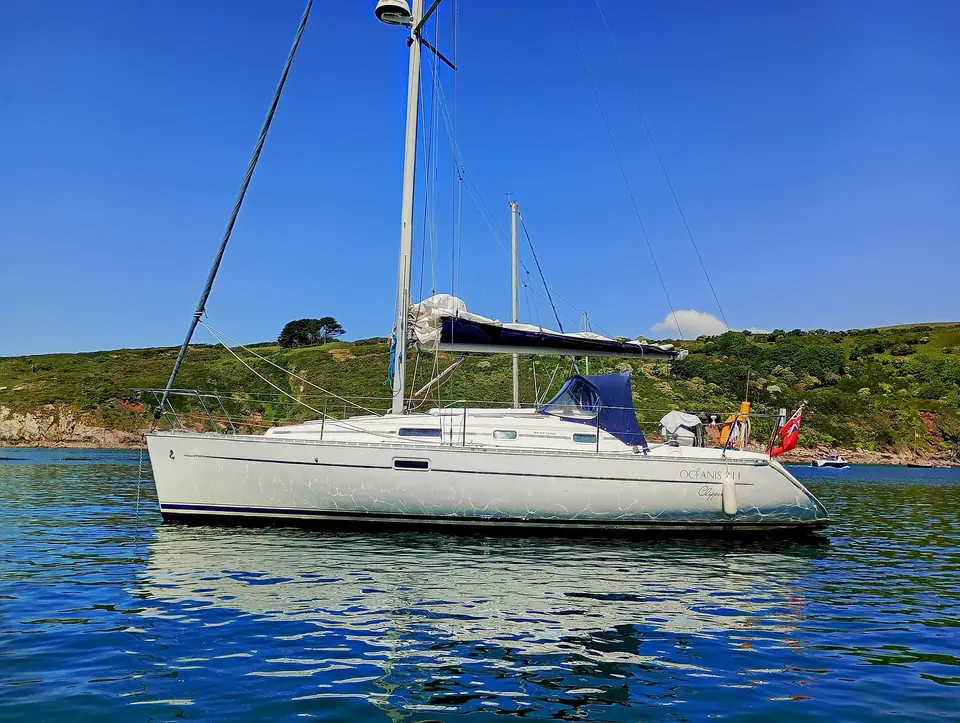
We have not found a freely licensed photo of the Beneteau First 24 yet, so these show other Beneteau boats, each captioned with the boat pictured.
More performance sailboats to explore
J/24
Performance Sailboats, 24 ft
Used $3K to $30K
Beneteau First 235
Performance Sailboats, 23 ft
Used $5K to $14K
Beneteau First 25
Performance Sailboats, 25 ft
Used $5K to $15K
Ontario Yachts Sonar
Performance Sailboats, 23 ft
Used $8K to $35K
Other Beneteau models
- Beneteau 49
- Beneteau 50
- Beneteau 57
- Beneteau 343
- Beneteau Antares 5.80
- Beneteau Antares 6
- Beneteau Antares 6.80
- Beneteau Antares 7
- Beneteau Antares 7.30
- Beneteau Antares 7.60
- Beneteau Antares 7.80
- Beneteau Antares 8
- Beneteau Antares 8.00
- Beneteau Antares 8.05
- Beneteau Antares 8.60
- Beneteau Antares 8.80
- Beneteau Antares 9
- Beneteau Antares 9.80
- Beneteau Antares 10.80
- Beneteau Antares 11
- Beneteau Antares 12
- Beneteau Antares 13.80
- Beneteau Antares 30
- Beneteau Antares 32
- Beneteau Antares 36
- Beneteau Antares 42
- Beneteau Antares 620 HB
- Beneteau Antares 650 HB
- Beneteau Antares 750 HB
- Beneteau Cyclades 39.3
- Beneteau Cyclades 43.3 and 43.4
- Beneteau Cyclades 50.5
- Beneteau First 18 SE
- Beneteau First 20
- Beneteau First 21.7
- Beneteau First 25
- Beneteau First 25.7
- Beneteau First 27
- Beneteau First 27.7
- Beneteau First 30
- Beneteau First 31.7
- Beneteau First 35
- Beneteau First 36
- Beneteau First 36.7
- Beneteau First 38
- Beneteau First 40
- Beneteau First 40.7
- Beneteau First 44
- Beneteau First 45
- Beneteau First 47.7
- Beneteau First 53
- Beneteau First 211
- Beneteau First 235
- Beneteau First 285
- Beneteau First 305
- Beneteau First 310
- Beneteau First 345
- Beneteau Flyer 6
- Beneteau Flyer 7
- Beneteau Flyer 8
- Beneteau Flyer 9
- Beneteau Flyer 10
- Beneteau Flyer 12
- Beneteau Flyer 500
- Beneteau Flyer 550
- Beneteau Flyer 650
- Beneteau Flyer 701
- Beneteau Flyer 750
- Beneteau Grand Trawler 62
- Beneteau Gran Turismo 32
- Beneteau Gran Turismo 36
- Beneteau Gran Turismo 40
- Beneteau Gran Turismo 41
- Beneteau Gran Turismo 44
- Beneteau Gran Turismo 45
- Beneteau Monte Carlo 6
- Beneteau Oceanis 30.1
- Beneteau Oceanis 31
- Beneteau Oceanis 34
- Beneteau Oceanis 34.1
- Beneteau Oceanis 35
- Beneteau Oceanis 35.1
- Beneteau Oceanis 36 CC
- Beneteau Oceanis 37
- Beneteau Oceanis 38
- Beneteau Oceanis 38.1
- Beneteau Oceanis 40
- Beneteau Oceanis 40 CC
- Beneteau Oceanis 41
- Beneteau Oceanis 41.1
- Beneteau Oceanis 42
- Beneteau Oceanis 42 CC
- Beneteau Oceanis 43
- Beneteau Oceanis 44 CC
- Beneteau Oceanis 45
- Beneteau Oceanis 46
- Beneteau Oceanis 46.1
- Beneteau Oceanis 48
- Beneteau Oceanis 50
- Beneteau Oceanis 51.1
- Beneteau Oceanis 54
- Beneteau Oceanis 55
- Beneteau Oceanis 58
- Beneteau Oceanis 311
- Beneteau Oceanis 320
- Beneteau Oceanis 321
- Beneteau Oceanis 323
- Beneteau Oceanis 331
- Beneteau Oceanis 350
- Beneteau Oceanis 351
- Beneteau Oceanis 370
- Beneteau Oceanis 390
- Beneteau Oceanis 400
- Beneteau Oceanis 411
- Beneteau Oceanis 423
- Beneteau Oceanis 430
- Beneteau Oceanis 440
- Beneteau Oceanis 461
- Beneteau Oceanis 473
- Beneteau Oceanis 500
- Beneteau Oceanis 510
- Beneteau Oceanis Clipper 361
- Beneteau Oceanis Clipper 373
- Beneteau Oceanis Clipper 381
- Beneteau Oceanis Clipper 393
- Beneteau Oceanis Yacht 54
- Beneteau Oceanis Yacht 60
- Beneteau Oceanis Yacht 62
- Beneteau Sense 43
- Beneteau Sense 46
- Beneteau Sense 50
- Beneteau Sense 55
- Beneteau Swift Trawler 30
- Beneteau Swift Trawler 34
- Beneteau Swift Trawler 35
- Beneteau Swift Trawler 41
- Beneteau Swift Trawler 44
- Beneteau Swift Trawler 48
- All Beneteau models