J/44 Sailboat, the Bermuda Race Boat That Became a One-Design
Rod Johnstone drew it after studying the 1988 Bermuda Race fleet, and 35 years later J/44 owners still share a pool of class-owned sails.
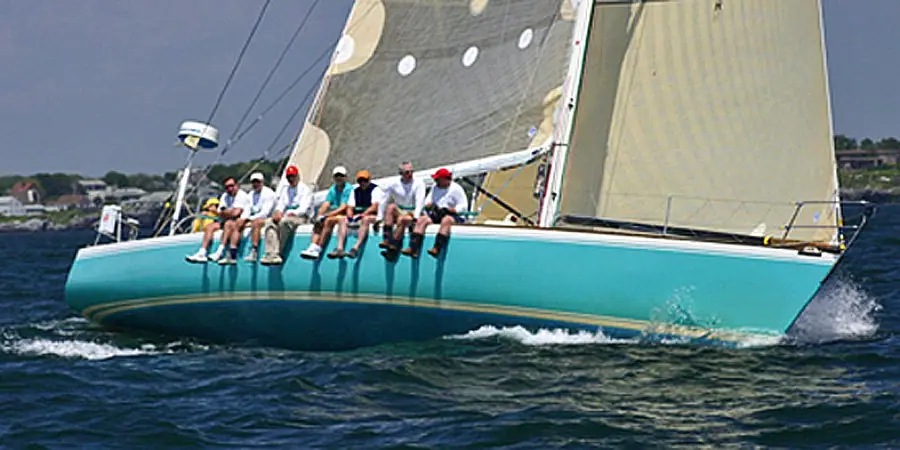
- Length
- 44.9 ft13.68 m
- Beam
- 13.7 ft4.18 m
- Draft
- 8 ft2.44 m
- Cabins
- 2 private cabins (owner's cabin forward, quarter cabin aft to starboard) plus saloon pilot berths
- Used price
- $100K to $200K
On this page
- Overview
- A J44 designed by reading the 1988 Bermuda Race results
- Long waterline, deep lead and a Hall rig
- Fastnet, Hobart and five Swans left behind
- The class that owns its own sails
- The J/Galley and a layout built for living aboard
- Yanmar power and 35-year-old systems
- Buying a used J/44 in 2026
- J/44 or a newer J/Boat?
- Specifications
- Price and value
- Strengths and weaknesses
- Used buyer checklist
- Rivals
- Our verdict
- FAQ
The J/44 is a 44 ft 11 in masthead racer-cruiser by Rod Johnstone, built by TPI for J/Boats from 1989 to 1993. About 67 were launched, each under ABS survey, and a class association still runs owner-steered one-design events.
- Owners who want Corinthian one-design racing offshore
- Newport Bermuda Race programs
- Couples cruising with occasional crew
- Sailors who value heavy-weather manners over planing speed
J/44 by the numbers
- Sail area to displacement
- 21.2Plenty of sail for the weight, the boat should feel lively in light air.
- Displacement to length
- 169Light displacement for its length, quick but sensitive to added cruising weight.
- Theoretical hull speed
- 8.3 knThe practical top speed of a displacement monohull under normal sailing, based on waterline length.
- Ballast ratio
- 41%A high ballast ratio, so the boat stands up well to a breeze.
- Capsize screening
- 1.96Below 2.0, the traditional threshold for offshore suitability.
- Motion comfort ratio
- 25.7Moderate motion comfort, typical of modern cruisers.
- Length to beam ratio
- 3.28 : 1Moderate proportions.
A J44 designed by reading the 1988 Bermuda Race results
Most production boats start with a marketing brief. The J/44 started with a spreadsheet. J/Boats says the design was inspired by an analysis of the 1988 Newport to Bermuda Race, which showed that dual-purpose racer-cruisers between 41 and 45 feet were the most popular offshore type and size. Rod Johnstone, who had founded the company with the J/24 in 1976, drew a 44 ft 11 in masthead sloop to fill that slot, and Tillotson-Pearson built it for J/Boats from 1989.
Production was short and the numbers small. J/Boats lists the J/44 as introduced in 1989, built to hull number 68, with a last model year of 1993; sailboatdata and J/Boats both put the total at 67 boats. Owners in 14 countries took delivery, and J/Boats calls it the most successful large offshore American yacht design ever, a claim based as much on how the fleet has stayed together as on race results.
Every J/44 was built under independent ABS survey to +A1 classification, and carries a bronze ABS plaque to prove it. That is rare in a production boat and it is one reason the type still has a reputation as an offshore boat rather than a club racer.
Long waterline, deep lead and a Hall rig
J/Boats explains the J/44's behavior in two points. First, a balanced hull with a long waterline relative to beam for directional stability in big waves, not compromised by rating tricks, long keels or skegs. Second, a low center of gravity and low moments of inertia, from a deep lead keel, hand-laid Baltek-cored hull and deck and a light, well engineered Hall Spars rig. The builder's own summary is that the boat sails well in the extremes: downwind in light air and upwind in a blow.
The numbers support that. On a 38 ft 8 in waterline the boat displaces 22,000 lb with 9,000 lb of lead, a ballast ratio of about 41 percent. J/Boats gives a sail area to displacement ratio of 21 and a displacement to length ratio of 169, figures that would still describe a quick performance cruiser today. Standard draft is a deep 8 ft, which matters if you cruise the Chesapeake or the Bahamas; sailboatdata lists a 6 ft shoal version and notes the standard rudder was modified in 1992.
Fastnet, Hobart and five Swans left behind
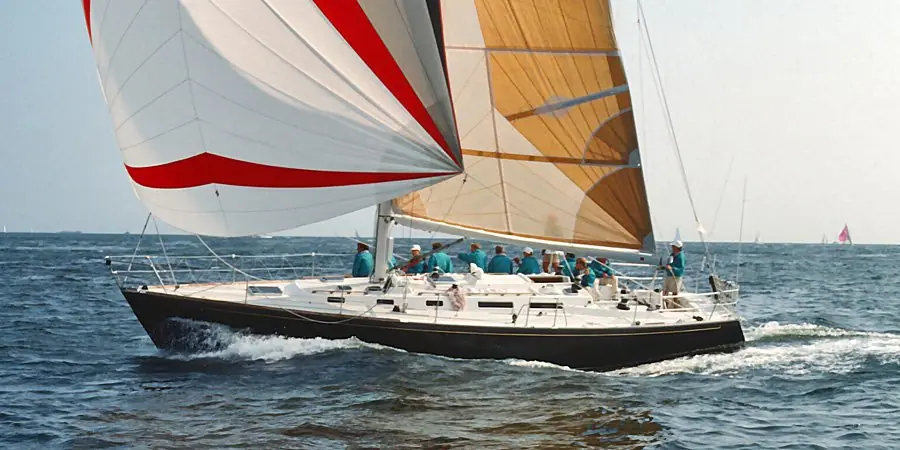
J/Boats credits the J/44 with an IMS overall win in the 1991 Fastnet Race and an IMS-1 class win in the 1992 Sydney-Hobart. The builder also likes to recall that five J/44s beat every Swan from 48 to 61 feet upwind in a rough 1990 race to Bermuda. Sailing World named it the 1990 Overall Boat of the Year, partly for an interior that revived the look of classic American cruising yachts.
The Bermuda connection never went away. J/Boats says the J/44 was the first class given its own start at the Newport Bermuda Race. Training programs have used the boats too: Sailing World reported U.S. Naval Academy and Kings Point crews racing J/44s in the Storm Trysail Intercollegiate Offshore Regatta, with Kings Point winning PHRF Large in its J/44 Comet.
The class that owns its own sails
The most unusual thing about the J/44 today is how it is raced. At class events, every boat uses one-design sails owned by the J/44 Class Association, rotated from boat to boat each day so no team gains an edge from a new inventory. J/Boats says this lets owners benefit from volume bidding with sailmakers and keeps a lid on replacement costs, while most owners also keep a PHRF wardrobe for other regattas.
Sailing World described the class at Block Island Race Week as a Corinthian group with crews spanning generations, owner-steered, with a seven-boat fleet and a dockside party that is part of the tradition. For a buyer, the class matters in two ways: it supports values, and it gives you a ready-made racing program with sail costs that are known in advance.
The J/Galley and a layout built for living aboard
Below, the J/44 follows a layout J/Boats says became a standard for offshore cruising design. The owner's cabin is forward with private access to the head, the main cabin has two pilot berths above settee berths with large drawers outboard, a large nav station sits opposite the galley, and aft there is a quarter cabin to starboard and a walk-through head to port. The galley's security at sea earned its own name, the J/Galley.
Styling is light and open rather than dark and traditional, and the builder argues that visibility and ventilation make long stays aboard possible without the confinement of most designs under 50 feet. Tanks are modest for an ocean cruiser, 40 gallons of fuel and 120 of water per sailboatdata, so serious cruisers add a watermaker or extra jerry capacity.
Yanmar power and 35-year-old systems
Power came from a Yanmar 4JH2-TE turbo diesel; J/Boats lists 62 hp and sailboatdata 64 hp. Many boats will have been repowered by now, and a documented repower is worth real money. The rest of the systems on a 1989 to 1993 boat are whatever the owners have made them: original wiring, tanks and plumbing should be assumed to need work unless invoices prove otherwise.
We found no published motoring speed or fuel burn for the J/44, so we have left those specs empty rather than guess. On a moderate displacement 44 footer with a diesel of this size, owners should expect economical cruising at modest revs, but check the actual engine and propeller on the boat you are viewing.
Buying a used J/44 in 2026
With roughly 67 boats worldwide, a J/44 for sale is an event rather than a market. The best boats often sell through class contacts before they are widely advertised, so joining the class association or contacting it early is the most effective way to find one. Expect to pay more for a boat that has kept up with the class, because class boats tend to have maintained rigs, safety gear and race-ready systems.
Our estimated U.S. range is roughly $100,000 to $200,000, but treat that as a starting point. A survey should concentrate on the deck core around hardware, the keel attachment on a deep 8 ft fin that has probably touched bottom at some point, the rudder, the age of standing rigging and the engine. Annual costs of $20,000 to $45,000 cover a 45 ft slip, haul-out, insurance, rig and engine service, and sails if you race outside the class pool.
J/44 or a newer J/Boat?
Buyers searching for a J/44 often also look at the J/124 and J/120. They are different boats. The J/120 is a 40 ft asymmetric-spinnaker racer-cruiser from the 1990s and 2000s, and the J/124 is a 41 ft boat from the mid 2000s; Denison recently listed a 2007 J/124 at $190,000 to $210,000. Both are lighter and more modern in sail plan, while the J/44 offers more interior, a deeper hull for heavy weather and the one-design class. If offshore comfort and a Bermuda Race start matter more than planing downwind, the J/44 still makes the stronger case.
J/44 specifications
| Length overall | 44.9 ft13.68 m |
|---|---|
| Waterline length | 38.7 ft11.8 m |
| Beam | 13.7 ft4.18 m |
| Draft | 8 ft2.44 m |
| Displacement | 22, lbs9,979 kg |
| Ballast | 9, lbs4,082 kg |
| Sail area | 1,039 sq ft96.5 m² |
| Fuel capacity | 4 gal151 L |
| Fresh water | 12 gal454 L |
| Cabins | 2 private cabins (owner's cabin forward, quarter cabin aft to starboard) plus saloon pilot berths |
| Berths | Forward double, aft quarter cabin, two saloon pilot berths and two settee berths |
| Heads | 2 (forward en suite access and aft walk-through head to port) |
| Standard engines | Yanmar 4JH2-TE turbo diesel, listed at 62 hp by J/Boats and 64 hp by sailboatdata |
| Maximum power | 64 hp |
| Hull type | Moderate displacement fin keel monohull with long waterline relative to beam |
| Keel | Deep lead fin, 8 ft standard; 6 ft shoal version listed by sailboatdata |
| Rig | Masthead sloop with Hall Spars aluminum mast and overlapping headsails |
| Hull construction | Hand-laid fiberglass with Baltek balsa-cored hull and deck, built under ABS survey |
| Builder | Tillotson-Pearson (TPI) for J/Boats, United States |
| Naval architect | Rod Johnstone |
| Production | 1989 to 1993 |
| Status | Discontinued |
Figures come from builder documentation and independent tests where available. Displacement is usually quoted light, so a loaded cruising boat will weigh more. Compare these specs with another model.
How much does a J/44 cost?
These are estimates: we could not find enough current U.S. J/44 asking prices to anchor the range firmly, because the fleet is small and boats change hands quietly within the class. Price is driven by sail inventory (class boats share class-owned one-design sails but most carry PHRF sails too), engine hours, rig age and how much deck core work has been done. Boats with a documented Bermuda Race history and recent standing rigging sell first.
Estimate your yearly cost
A planning estimate using common rules of thumb: insurance near 1.5 percent of value, maintenance near 3 percent, haul out and bottom paint by length. Your marina, region and use will move these numbers. Open the full cost calculator.
Versions and options
- Standard deep keel
- 8 ft draft and the configuration used by the one-design class.
- Shoal draft
- About 6 ft draft according to sailboatdata, for thinner cruising grounds.
- 1992 rudder change
- Sailboatdata notes the standard rudder was modified in 1992; confirm which rudder a given hull carries.
J/44 timeline
- 1988J/Boats analyzes the Newport Bermuda Race fleet and identifies the 41 to 45 ft racer-cruiser as the target
- 1989J/44 introduced, built by Tillotson-Pearson under ABS survey
- 1990Sailing World Overall Boat of the Year; five J/44s beat the Swans upwind to Bermuda
- 1991IMS overall win in the Fastnet Race, per J/Boats
- 1993Last model year, with about 67 boats launched
Strengths and weaknesses
What owners like
- Proven offshore hull with long waterline and deep lead keel
- Built under ABS survey to +A1
- Active one-design class with shared class sails
- Comfortable live-aboard layout with two heads and pilot berths
- Strong record in Bermuda, Fastnet and Hobart races
What to weigh up
- 8 ft standard draft rules out many anchorages
- Small fleet makes finding a boat slow
- Modest 40 gallon fuel tank for a cruising boat
- Original systems are now more than 30 years old
- Large masthead genoas are physical to tack short-handed
Used J/44 buyer checklist
Take this list to a viewing. Your ticks are saved in this browser so you can come back to it.
Always commission an independent marine survey and an engine survey before you buy. How a marine survey works.
Rivals to consider
J/120
Smaller and lighter asymmetric-spinnaker J with a large used fleet, less interior and less heavy-weather heft.
Compare side by sideJ/124
A 41 ft mid-2000s J/Boat that trades the J/44's cruising interior for a more modern sail plan.
Compare side by sideJ/40 (classic)
Rod Johnstone's earlier offshore cruiser, smaller and cheaper with a similar philosophy.
Compare side by sideSwan 48
Larger and far more expensive, the kind of boat the J/44 liked to beat upwind to Bermuda.
Compare side by sideOur verdict on the J/44
The J/44 is a boat that did exactly what its designer set out to do: win Bermuda Races while giving a family a proper offshore home. More than three decades later the class still races it one-design with shared sails, which says more about the boat than any award. Buy one for the hull, the class and the heavy-weather manners, budget for systems that are as old as the boat, and accept that 8 ft of draft will shape where you cruise.
J/44 questions answered
How many J/44s were built?
About 67, from 1989 to the 1993 model year, according to J/Boats and sailboatdata.
Who designed and built the J/44?
Rod Johnstone designed it and Tillotson-Pearson built it for J/Boats in the United States, under ABS survey.
What is the draft of a J/44?
The standard keel draws 8 ft. Sailboatdata lists a 6 ft shoal version.
Is the J/44 still raced one-design?
Yes. The J/44 Class Association runs owner-steered events using class-owned sails rotated between boats.
How much is a J/44 worth?
We estimate roughly $100,000 to $200,000 in the U.S. market, depending heavily on sails, engine and deck condition.
Is the J/124 the same as the J/44?
No. The J/124 is a different, 41 ft J/Boat from the mid 2000s; the J/44 is a 1989 to 1993 offshore racer-cruiser.
J/44 photos
More performance sailboats to explore
Elan 45
Performance Sailboats, 45 ft
Used $75K to $135K
Beneteau First 45
Performance Sailboats, 46 ft
Used $185K to $290K
X-Yachts X4.3
Performance Sailboats, 43 ft
Used $350K to $700K
Beneteau First 44
Performance Sailboats, 46 ft
Used $400K to $630K