Beneteau Performance Sailboats
Beneteau First 35 (2009 to 2016), Used Racer-Cruiser Guide
Farr's last mid-size First for Beneteau, a 35-footer with a big wheel, a T-keel and a forgiving helm that rewards a tweaker without punishing a family.
- Length
- 35.6 ft10.85 m
- Beam
- 11.9 ft3.64 m
- Draft
- 7.3 ft2.2 m
- Cabins
- 2 (V-berth forward behind double doors, double aft under the cockpit)
- Used price
- $95K to $165K
On this page
- Overview
- The First 35 most buyers mean, and the two older boats with the same number
- What Farr drew, and why it is gentler than the 34.7
- Test sail numbers from 14 knots of flat water
- One big wheel, a German mainsheet and three rigs
- Two private cabins and a saloon sized like the First 40's
- The Yanmar saildrive and the systems you will touch
- What a used First 35 costs to buy and keep
- Where the First 35 fits on a US racecourse
- Specifications
- Price and value
- Strengths and weaknesses
- Used buyer checklist
- Rivals
- Our verdict
- FAQ
The Beneteau First 35 is a Farr Yacht Design racer-cruiser built from 2009 to 2016 as the successor to the First 36.7. Two cabins, a 29 hp Yanmar saildrive, three rig choices and a 2016 Carbon Edition.
- PHRF and ORC club racers
- Couples who want a fast weekend cruiser
- Owners moving up from a 30 ft sportboat
- Buyers priced out of a J/109
The First 35 most buyers mean, and the two older boats with the same number
Type first 35 into a listing search and three different Beneteaus come back. The one this page covers, and the one most people are hunting for, is the Farr Yacht Design boat launched in 2009 and sold until 2016. Beneteau introduced it alongside the Juan Kouyoumdjian First 30 as part of a complete rebuild of the First range that had started with the First 50 and 45 in 2008 and the First 40 in 2009. SAIL called it the logical successor to the First 36.7, and Cruising World framed it as cut from the same cloth as the First 40.
The other two share only the name. The 1980 First 35 was a Jean Berret design derived from an IOR three-quarter-ton racer, a masthead boat of about 35 ft 2 in with a 10,485 lb displacement; sailboatdata counts 455 built and notes it was sold in the US as the Beneteau R/C 35. The First 35s5 of 1988 to 1994 is the Berret and Philippe Starck boat with the mahogany interior and carbon tiller that shocked the 1987 Paris show. Neither has the Farr boat's twin-spreader fractional rig, open transom or saildrive, so a quick look at the stern and the rig settles which one is in front of you.
Beneteau First 35 by the numbers
- Sail area to displacement
- 20.3Plenty of sail for the weight, the boat should feel lively in light air.
- Displacement to length
- 189Light displacement for its length, quick but sensitive to added cruising weight.
- Theoretical hull speed
- 7.4 knThe practical top speed of a displacement monohull under normal sailing, based on waterline length.
- Ballast ratio
- 30%A typical ballast ratio for a cruising monohull.
- Capsize screening
- 2.08Above 2.0, so this hull leans toward coastal stability over ultimate offshore resistance.
- Motion comfort ratio
- 21.5A quicker motion in waves, typical of light, beamy hulls.
- Length to beam ratio
- 2.98 : 1A beamy hull with lots of volume for its length.
What Farr drew, and why it is gentler than the 34.7
The hull measures 35 ft 7 in overall on a 35 ft hull length, with a 30 ft 7 in waterline and an 11 ft 11 in beam. Beneteau's own equipment list gives a light displacement of 5,500 kg (12,125 lb) with the deep keel and 6,060 kg (13,360 lb) with the heavier shoal fin, which explains why some websites print the larger number. Cruising World worked out a sail area to displacement ratio of 20.3 on the 670 sq ft of 100 percent sail area, with a ballast ratio around 0.37 on the deep keel.
Those numbers describe a quick boat that is not extreme, and every tester said the same thing on the water. SAIL's reviewer, who had sailed the First 34.7, noted that the older boat demanded constant attention from driver and trimmers while the 35 felt forgiving from the moment he took the wheel. It was drawn to IRC for windward-leeward work and longer races, but Farr kept the helm light and the rudder deep enough that a cruising couple does not need a full crew on the rail to keep it on its feet.
Test sail numbers from 14 knots of flat water
Cruising World's Bill Springer sailed a boat with the optional carbon mast, North 3DL sails and the deep bulb keel in about 14 knots and flat water. Upwind under the 108 percent blade jib it tacked through roughly 75 degrees and held 6.5 to 7 knots, and he described it tracking like a train with silky feedback through the big wheel. With the symmetric spinnaker up on a broad reach the log jumped into the 8 knot range and the helm stayed just as responsive.
SAIL tested in 10 knots or less and still saw 7 knots and more, pointing to within about 30 degrees of the apparent wind and carrying the kite from dead downwind up to about 75 degrees off the wind without drama. The one caution in both reports concerns low speed. The high aspect rudder and skinny T-keel foil need flow, so in light air and chop you sail for speed first and height second, exactly as you would on a modern one-design.
One big wheel, a German mainsheet and three rigs
The cockpit is laid out for a full crew but works for two. A single large wheel dominates the aft end, with a full-width traveler just ahead of it and a German-style mainsheet led to winches the helmsman can reach. Primary winches sit on the coamings and the halyard and sheet winches on the cabin top, with jib tracks running alongside the house so the side decks stay clear. SAIL's tester found the outhaul, cunningham, vang and backstay all fell easily to hand, calling it a real tweaker's boat, though a singlehander has to leave the wheel to trim the jib.
Beneteau offered three rigs: a standard aluminum mast with wire, a performance aluminum version with rod rigging, and a carbon racing spar. The 2015 and 2016 Carbon Edition bundled the carbon mast, rod rigging, fiber backstay, rigid vang, lead keel, a retractable carbon bowsprit for asymmetric spinnakers and a composite wheel that tilts out of the way on tacks. Earlier boats were often delivered with symmetric spinnaker gear; adding a sprit and a furling A-sail is one of the most useful upgrades for shorthanded owners.
- Removable aft beam across the open transom
- Liferaft locker in the cockpit sole, 120 by 110 cm
- Detachable bow roller; a windlass was optional
- No cockpit table as standard, a clue to the racing bias
Two private cabins and a saloon sized like the First 40's
Nauta Design styled the interior in light Alpi teak or oak with a white cerused oak sole. The saloon, SAIL noted, is the same length as the First 40's but a little narrower, with straight settees that are long enough for sea berths and a hinged folding table that drops out of the way on race day. Under that table sits the water heater, and both swing aside to expose the keel bolts, a clever use of space that also makes inspection easy.
Double doors open the forecabin to the saloon, which helps both light and access on either tack. Beneteau's list gives the forward berth as about 6 ft 7 in long and the aft double as roughly 6 ft 6 in, but the aft cabin loses height under the cockpit and the molded wheel well intrudes into it. The single head with shower sits aft by the companionway. There is a proper chart table to starboard and an L-shaped galley opposite; reviewers liked the galley's bracing but wanted more counter space, and long-term stowage is thin. Headroom runs about 6 ft 1 in to 6 ft 2 in.
The Yanmar saildrive and the systems you will touch
This was among the first Firsts to move to a saildrive. The 29 hp Yanmar drives a two-blade Flexofold folding propeller, and Cruising World reported the hull motoring at about 7 knots with noticeable but not intrusive noise. SAIL found it spun in its own length and backed under control. Everything except the oil filter is easy to reach.
Tankage is modest at 20 gallons of diesel and 53 gallons of water, with a 20 gallon holding tank, so this is a weekend and coastal boat unless you add capacity. The electrical side is simple 12 volt with a 125 amp alternator on later boats. Expect to replace the saildrive diaphragm on Yanmar's schedule, typically every seven years, and to check the folding prop's gears and zinc each haul.
What a used First 35 costs to buy and keep
In 2010 Cruising World listed the boat at $225,000 sailaway. Today most US asking prices fall between roughly $95,000 and $165,000, and condition, rig and sails explain more of that gap than model year. A tired early boat with the shoal keel and original cruising canvas is a very different purchase from a Carbon Edition with a recent racing wardrobe, even though the hull is identical.
Annual ownership for a 35 ft fin keeler in the US, excluding depreciation and racing sails, typically runs about $9,000 to $18,000 depending on slip location, insurance and how much you race. Racers should budget separately for sails; a laminate main and jib for this rig quickly become a five-figure line item.
Where the First 35 fits on a US racecourse
The First 35 never built a US one-design fleet the way the 36.7 did, so in North America it is mainly a PHRF and ORC boat. That can be a plus: you are not bound by class sail limits, and the boat's IRC heritage means it was designed to be raced with a cruising interior in place. Against the J/109 it gives up some refinement on deck but offers a lighter helm and a lower price per foot on the used market.
For cruising, the two-cabin layout suits a couple or a small family better than the three-cabin layouts of its predecessor. If you plan on overnight races with six crew, accept that the saloon settees become the sea berths and that the single head is the bottleneck.
Beneteau First 35 specifications
| Length overall | 35.6 ft10.85 m |
|---|---|
| Waterline length | 30.6 ft9.33 m |
| Beam | 11.9 ft3.64 m |
| Draft | 7.3 ft2.2 m |
| Air draft | 56.6 ft17.25 m |
| Displacement | 12,125 lbs5,5 kg |
| Ballast | 3,682 lbs1,67 kg |
| Sail area | 67 sq ft62.3 m² |
| Fuel capacity | 2 gal75 L |
| Fresh water | 53 gal2 L |
| Cabins | 2 (V-berth forward behind double doors, double aft under the cockpit) |
| Berths | 4 in cabins plus 2 saloon settee berths |
| Heads | 1 (aft by the companionway, with shower) |
| Maximum persons | 8 |
| Standard engines | Yanmar 29 hp diesel (3YM30) with saildrive and two-blade folding propeller |
| Maximum power | 29 hp |
| Cruise speed | 7 knots |
| Hull type | Light IRC-oriented fin keel monohull with fine entry and powerful aft sections |
| Keel | Cast iron fin with bulb (T-keel) at 7 ft 3 in standard; shoal keel at 5 ft 11 in; lead keel at 7 ft 7 in on the 2016 Carbon Edition |
| Rig | Fractional sloop, keel-stepped double-spreader mast; standard aluminum, performance aluminum with rod rigging, or carbon |
| Hull construction | Solid fiberglass hull with a bonded structural counter-molding; injection-molded balsa-cored deck |
| CE design category | A (8 persons) |
| Builder | Beneteau, France |
| Naval architect | Farr Yacht Design (Farr design #622) |
| Other design credits | Interior by Nauta Design |
| Production | 2009 to 2016 |
| Status | Discontinued |
Figures come from builder documentation and independent tests where available. Displacement is usually quoted light, so a loaded cruising boat will weigh more. Compare these specs with another model.
How much does a Beneteau First 35 cost?
Cruising World quoted a sailaway price of $225,000 in 2010. The used spread depends more on rig and keel than on year: a carbon mast, rod rigging and a recent laminate inventory push a boat to the top, while a shoal keel cruiser with original Dacron sits near the bottom. The few 2015 to 2016 Carbon Editions, with lead keel and tilting wheel as standard, command the highest asking prices.
Estimate your yearly cost
A planning estimate using common rules of thumb: insurance near 1.5 percent of value, maintenance near 3 percent, haul out and bottom paint by length. Your marina, region and use will move these numbers. Open the full cost calculator.
Versions and options
- Standard
- Aluminum keel-stepped mast with wire rigging, cast iron T-keel at 7 ft 3 in or shoal fin at 5 ft 11 in.
- Performance rig
- Aluminum spar with rod rigging and upgraded deck gear for owners who race.
- Carbon racing rig
- Carbon mast option on standard boats; the tested Cruising World boat carried it with North 3DL sails.
- Carbon Edition (2015 to 2016)
- Carbon mast, rod rigging, fiber backstay, lead keel at 7 ft 7 in, retractable carbon bowsprit, tilting composite wheel and a Raymarine regatta electronics pack as standard.
Beneteau First 35 timeline
- 1980The original Jean Berret First 35 appears, based on an IOR three-quarter-ton racer
- 2009Farr-designed First 35 launches with the First 30 as Beneteau finishes renewing the First range
- 2010SAIL and Cruising World publish tests; sailaway price quoted at $225,000
- 2015Carbon Edition introduced with carbon mast, lead keel and tilting wheel
- 2016Final equipment list issued; Beneteau closes its 2006 to 2016 First generation
Strengths and weaknesses
What owners like
- Forgiving, light helm that is far less demanding than the First 34.7
- Upwind tacking angles near 75 degrees with good sails
- Keel bolts easy to inspect under the saloon table
- Saloon length matches the bigger First 40
- Saildrive installation is quiet and maneuvers well
- Carbon Edition offers a ready-made racing spec
What to weigh up
- Single head and only two cabins
- Large wheel blocks the path forward in the cockpit
- Small fuel and water tanks for cruising
- Galley short on counter space and long-term stowage thin
- Aft berth headroom compromised by the wheel well
Used Beneteau First 35 buyer checklist
Take this list to a viewing. Your ticks are saved in this browser so you can come back to it.
Always commission an independent marine survey and an engine survey before you buy. How a marine survey works.
Rivals to consider
J/109
The US benchmark at this size, with an active one-design class and a higher used price.
Compare side by sideBeneteau First 36.7
The predecessor, cheaper and backed by US one-design fleets, but with a busier helm and three cramped cabins.
Compare side by sideBavaria Match 35
German racer-cruiser with a lighter interior and smaller US presence.
Compare side by sideX-Yachts X-35
Danish one-design with a stiffer build and a stiffer price.
Our verdict on the Beneteau First 35
The Beneteau First 35 is the friendliest of Farr's late Firsts: quick enough to win club races, docile enough that a couple can take it away for a week, and simple enough to maintain with its saildrive and two-cabin interior. It is not the boat for a family that needs three cabins or big tanks, and its US racing scene is handicap rather than one-design. Choose by rig and keel, budget for sails if you race, and verify the keel structure under that clever folding table. A well kept example costs far less than a comparable J/109 and gives most of the same pleasure.
Beneteau First 35 questions answered
Who designed the Beneteau First 35?
Farr Yacht Design drew the 2009 First 35 as design number 622, and Nauta Design styled the interior. The 1980 First 35 and the First 35s5 were Jean Berret designs.
What years was the Farr First 35 built?
It launched in 2009 and stayed in the range until 2016, ending with the Carbon Edition introduced for 2015.
What engine does the First 35 have?
A 29 hp Yanmar diesel on a saildrive with a two-blade folding propeller. Cruising World saw about 7 knots under power.
How deep is the First 35 keel?
The standard T-keel draws 7 ft 3 in and the shoal version 5 ft 11 in. The Carbon Edition's lead keel draws 7 ft 7 in.
How much is a used Beneteau First 35?
Most US asking prices sit between about $95,000 and $165,000 in 2026. Rig, keel and sails move the price more than model year.
Is the First 35 a good shorthanded boat?
Yes, with care. The helm is light and the mainsheet is within reach of the wheel, but the jib winches are forward, so an autopilot and an asymmetric on a sprit make life easier.
Photos from the Beneteau range
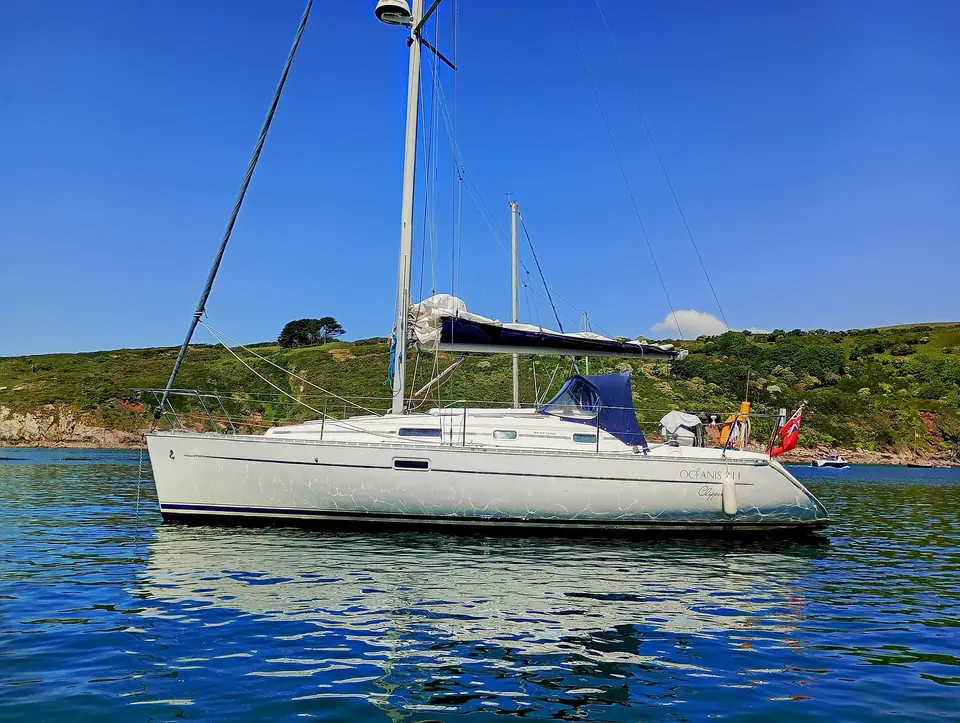
We have not found a freely licensed photo of the Beneteau First 35 yet, so these show other Beneteau boats, each captioned with the boat pictured.
More performance sailboats to explore
Beneteau First 36.7
Performance Sailboats, 36 ft
Used $55K to $105K
J/109
Performance Sailboats, 35 ft
Used $90K to $175K
Dehler 36
Performance Sailboats, 36 ft
Used $65K to $120K
Beneteau First 36
Performance Sailboats, 36 ft
Used $250K to $360K
Other Beneteau models
- Beneteau 49
- Beneteau 50
- Beneteau 57
- Beneteau 343
- Beneteau Antares 5.80
- Beneteau Antares 6
- Beneteau Antares 6.80
- Beneteau Antares 7
- Beneteau Antares 7.30
- Beneteau Antares 7.60
- Beneteau Antares 7.80
- Beneteau Antares 8
- Beneteau Antares 8.00
- Beneteau Antares 8.05
- Beneteau Antares 8.60
- Beneteau Antares 8.80
- Beneteau Antares 9
- Beneteau Antares 9.80
- Beneteau Antares 10.80
- Beneteau Antares 11
- Beneteau Antares 12
- Beneteau Antares 13.80
- Beneteau Antares 30
- Beneteau Antares 32
- Beneteau Antares 36
- Beneteau Antares 42
- Beneteau Antares 620 HB
- Beneteau Antares 650 HB
- Beneteau Antares 750 HB
- Beneteau Cyclades 39.3
- Beneteau Cyclades 43.3 and 43.4
- Beneteau Cyclades 50.5
- Beneteau First 18 SE
- Beneteau First 20
- Beneteau First 21.7
- Beneteau First 24
- Beneteau First 25
- Beneteau First 25.7
- Beneteau First 27
- Beneteau First 27.7
- Beneteau First 30
- Beneteau First 31.7
- Beneteau First 36
- Beneteau First 36.7
- Beneteau First 38
- Beneteau First 40
- Beneteau First 40.7
- Beneteau First 44
- Beneteau First 45
- Beneteau First 47.7
- Beneteau First 53
- Beneteau First 211
- Beneteau First 235
- Beneteau First 285
- Beneteau First 305
- Beneteau First 310
- Beneteau First 345
- Beneteau Flyer 6
- Beneteau Flyer 7
- Beneteau Flyer 8
- Beneteau Flyer 9
- Beneteau Flyer 10
- Beneteau Flyer 12
- Beneteau Flyer 500
- Beneteau Flyer 550
- Beneteau Flyer 650
- Beneteau Flyer 701
- Beneteau Flyer 750
- Beneteau Grand Trawler 62
- Beneteau Gran Turismo 32
- Beneteau Gran Turismo 36
- Beneteau Gran Turismo 40
- Beneteau Gran Turismo 41
- Beneteau Gran Turismo 44
- Beneteau Gran Turismo 45
- Beneteau Monte Carlo 6
- Beneteau Oceanis 30.1
- Beneteau Oceanis 31
- Beneteau Oceanis 34
- Beneteau Oceanis 34.1
- Beneteau Oceanis 35
- Beneteau Oceanis 35.1
- Beneteau Oceanis 36 CC
- Beneteau Oceanis 37
- Beneteau Oceanis 38
- Beneteau Oceanis 38.1
- Beneteau Oceanis 40
- Beneteau Oceanis 40 CC
- Beneteau Oceanis 41
- Beneteau Oceanis 41.1
- Beneteau Oceanis 42
- Beneteau Oceanis 42 CC
- Beneteau Oceanis 43
- Beneteau Oceanis 44 CC
- Beneteau Oceanis 45
- Beneteau Oceanis 46
- Beneteau Oceanis 46.1
- Beneteau Oceanis 48
- Beneteau Oceanis 50
- Beneteau Oceanis 51.1
- Beneteau Oceanis 54
- Beneteau Oceanis 55
- Beneteau Oceanis 58
- Beneteau Oceanis 311
- Beneteau Oceanis 320
- Beneteau Oceanis 321
- Beneteau Oceanis 323
- Beneteau Oceanis 331
- Beneteau Oceanis 350
- Beneteau Oceanis 351
- Beneteau Oceanis 370
- Beneteau Oceanis 390
- Beneteau Oceanis 400
- Beneteau Oceanis 411
- Beneteau Oceanis 423
- Beneteau Oceanis 430
- Beneteau Oceanis 440
- Beneteau Oceanis 461
- Beneteau Oceanis 473
- Beneteau Oceanis 500
- Beneteau Oceanis 510
- Beneteau Oceanis Clipper 361
- Beneteau Oceanis Clipper 373
- Beneteau Oceanis Clipper 381
- Beneteau Oceanis Clipper 393
- Beneteau Oceanis Yacht 54
- Beneteau Oceanis Yacht 60
- Beneteau Oceanis Yacht 62
- Beneteau Sense 43
- Beneteau Sense 46
- Beneteau Sense 50
- Beneteau Sense 55
- Beneteau Swift Trawler 30
- Beneteau Swift Trawler 34
- Beneteau Swift Trawler 35
- Beneteau Swift Trawler 41
- Beneteau Swift Trawler 44
- Beneteau Swift Trawler 48
- All Beneteau models