Beneteau 350 Oceanis, the Original Oceanis on Today's Market
Philippe Briand's 1986 to 1993 cruiser that launched the Oceanis name, built in France and South Carolina and now one of the cheapest 34-footers around.
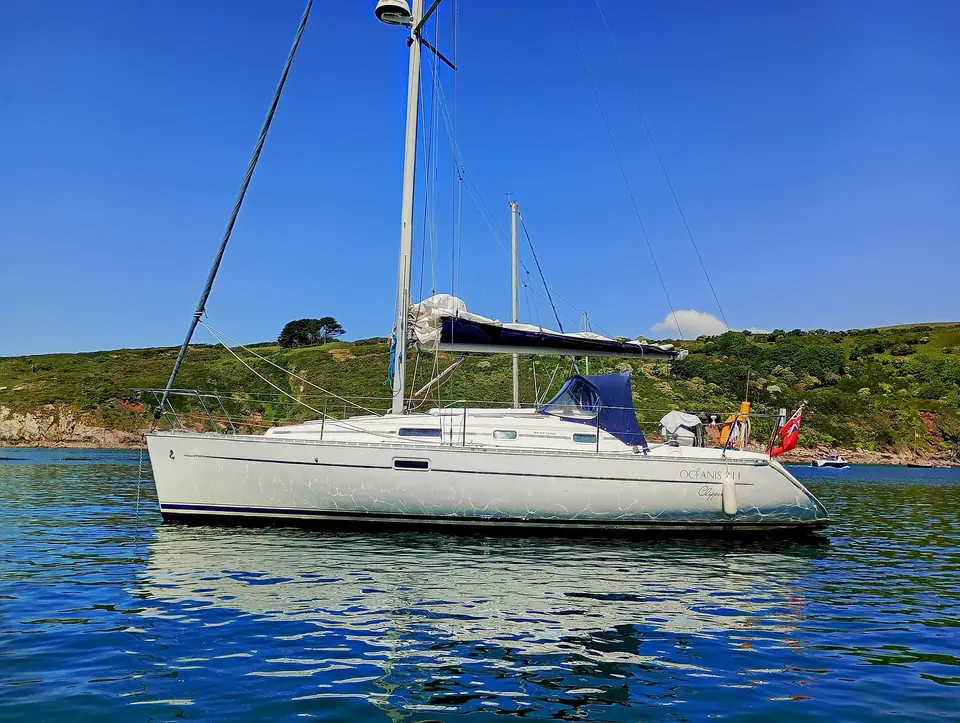
- Length
- 33.8 ft10.3 m
- Beam
- 11.3 ft3.43 m
- Draft
- 5.1 ft1.56 m
- Cabins
- 2 or 3 (owner's aft cabin or two aft doubles)
- Used price
- $22K to $48K
On this page
- Overview
- The Beneteau 350 Oceanis that started a line
- Long waterline, shallow forefoot, wide stern
- Fin or wing keel, depending on who you ask
- Owner's aft cabin or two doubles
- Smoked skylight and a boardable transom
- The circuit board panel and other owner complaints
- Volvo 2003 power and 21 gallons of diesel
- A sub-$50,000 cruiser, with conditions
- Specifications
- Price and value
- Strengths and weaknesses
- Used buyer checklist
- Rivals
- Our verdict
- FAQ
The Beneteau Oceanis 350 is a 33 ft 10 in Philippe Briand cruiser built from 1986 to 1993 in France and the US. It launched the Oceanis line with the 430 and is now a budget cruiser with known electrical quirks.
- Budget cruisers and first big boats
- Coastal cruising couples
- Owners willing to rewire and refit
- Shoal-water sailors with the wing keel
Beneteau Oceanis 350 by the numbers
- Sail area to displacement
- 20.1Plenty of sail for the weight, the boat should feel lively in light air.
- Displacement to length
- 176Light displacement for its length, quick but sensitive to added cruising weight.
- Theoretical hull speed
- 7.3 knThe practical top speed of a displacement monohull under normal sailing, based on waterline length.
- Ballast ratio
- 37%A typical ballast ratio for a cruising monohull.
- Capsize screening
- 2.05Above 2.0, so this hull leans toward coastal stability over ultimate offshore resistance.
- Motion comfort ratio
- 20.9A quicker motion in waves, typical of light, beamy hulls.
- Length to beam ratio
- 3.00 : 1Moderate proportions.
The Beneteau 350 Oceanis that started a line
The beneteau 350 oceanis is where the Oceanis name begins. Sailboatdata notes that along with the 430 it was the very first boat of the range, and Yachting Monthly calls it the forerunner of the Oceanis marque, designed by Philippe Briand in 1985 and setting new parameters for mainstream cruising design and pricing. Practical Sailor dates production from 1986 to 1993 and reports that about 144 were built at Beneteau's plant in Marion, South Carolina, with more in France. In the US it was first introduced as the Oceanis 35.
The concept was sharply focused on the charter market, Yachting Monthly says, but family owners noticed it too. Practical Sailor saw it as a good example of Beneteau's influence on sailboat styling: smoked wraparound windows, a scooped transom with molded steps and curvy interior shapes that American builders were slow to adopt. Today it is one of the cheapest ways into a 34 ft cruiser with standing headroom and two private cabins.
Long waterline, shallow forefoot, wide stern
Beneteau's brochure gives 10.30 m overall, a 10.10 m hull, a 9.13 m (29 ft 11 in) waterline and a 3.43 m (11 ft 3 in) beam. Displacement is about 4,800 kg (10,582 lb) with roughly 1,800 kg of ballast, and the sail plan pairs a 21 m2 main with a 35.4 m2 furling genoa. Practical Sailor calculated a displacement to length ratio of 178 and a sail area to displacement ratio of 16.2, generous but not excessive, while noting that the 350 name oversells a boat that is 33 ft 10 in long.
The hull is fairly light with little below the waterline, including bilge. Yachting Monthly says the very shallow forefoot makes handling poor in a seaway, while the boat is quick and responsive in light to medium winds. Owners quoted by Practical Sailor split on pounding, but agreed on the rest: not enough sail for winds under 6 knots, a need to reef the main in 20 knots or on a beam reach to keep the boat balanced, and genuine pace once the wind passes 13 knots, with one owner seeing 8 to 9 knots in 20 to 25. The wide stern tends to wander in a big following sea.
Fin or wing keel, depending on who you ask
Two keels exist, about 1.56 m (5 ft 1 in) for the fin and about 1.25 m (4 ft 1 in) for the wing keel, but the sources disagree on which was standard. Practical Sailor says the 4 ft 2 in wing keel was standard and the 5 ft 2 in fin optional; Yachting Monthly says a low-aspect fin was standard and the wing an option. That probably reflects US and European spec lists, so ask the seller and check the boat out of the water.
Both are external cast iron, with keel bolts screwed into steel inserts cast into the keel, and on the wing version the winglets are bolted on. One owner told Practical Sailor the wings can foul a second anchor rode, so he used chain or a weight on the second line. The rudder is a balanced spade behind what designer Bob Perry calls a skeglet, and the prop shaft exits through a short supporting skeg.
Owner's aft cabin or two doubles
Beneteau's drawings show two layouts: an owner's version with one aft cabin and a large head, and a two aft cabin version. Practical Sailor says the twin aft cabin charter boat was built only in France, yet also describes the three-cabin plan as the one found on most 350s, so expect to see both. Yachting Monthly warns that the head is rather cramped in the twin version and that stowage, never generous, gets worse. One owner put it plainly: by cramming three cabins in, the boat is for small people. The forecabin is little more than a sleeping platform.
The galley opposite the head has a two-burner stove with oven, double round sinks that owners like because they hold bottles and pots securely, Frigoboat 12 volt refrigeration and an icebox that holds ice for four days in the tropics. The navigation seat faces aft so the navigator can talk to the helm. Light ash veneer makes the cabins airy but dents easily and darkens with moisture. Ventilation is the near-unanimous complaint: one deck vent in the head and a forward hatch too small to pass a sailbag.
Smoked skylight and a boardable transom
The low coachroof with its smoked skylight and the wide, boardable transom were striking in 1986, and Practical Sailor credits the 350 with popularizing the scoop that became standard on cruisers. The aft cabin raises the cockpit slightly, and one owner found the backrests comfortably angled but short. The same owner praised the cockpit drains and the propane locker, which also takes outboard fuel and spare diesel. The bridgedeck sits level with the cockpit seats, a good safety feature at the cost of a steep ladder.
The rig is a masthead sloop with double spreaders swept back enough to do without fore and aft lowers, plus a baby stay. Narrow sheeting angles help it point. Beneteau's November 1990 list specifies Lewmar 43 genoa winches, a Goiot windlass, teak-covered cockpit benches and an 800 mm wheel.
The circuit board panel and other owner complaints
Several owners told Practical Sailor about the electrical system. The panel used electronic circuit breakers mounted on a printed circuit board, with heavy wires soldered to a terminal strip; movement gradually fractured the small leads and one owner rebuilt the board. Another reported wire that was undersized and untinned, with voltage drops bad enough that cycling the freshwater pump switched the stereo on and off. Any 350 you buy should either have been rewired or be priced for it.
Other reports include leaks and adhesive outgassing at the wraparound skylight, a flimsy anchor locker lid, a bow roller too short for an articulated plow, and French hardware that is good but hard to source: one 1988 owner struggled to find parts for his Goiot furler, Optimus stove and Plastimo bilge pump. The hull to deck joint is a shoebox riveted on 6 inch centers and through-bolted only at the stanchion bases, where one owner had his only leaks.
Volvo 2003 power and 21 gallons of diesel
Practical Sailor lists a 28 hp Volvo Penta 2003 that is easily serviced and cruises the boat at 7 knots at 2,000 to 2,200 rpm, with 21 gallons of fuel, while warning that Volvo parts are expensive. Beneteau's brochure gives 80 liters of fuel and about 300 liters of water; Practical Sailor says 82 gallons. A French 1987 example on the market still runs a Volvo 2003, but many US boats will have been repowered by now. Ask for the date and the installer, and check the engine mounts and shaft alignment either way.
A sub-$50,000 cruiser, with conditions
Practical Sailor added the Oceanis 350 to its list of affordable cruising sailboats under $50,000, alongside the Bristol 35.5C, Niagara 35 and Tartan 37, praising its modern underbody and upwind ability while preferring lead to its iron keel. It found late 1980s boats around $45,000. A realistic 2026 range is about $22,000 to $48,000, and annual running costs about $6,500 to $13,000. Yachting Monthly's advice still stands: check the history of any 350 and get a thorough survey.
Beneteau Oceanis 350 specifications
| Length overall | 33.8 ft10.3 m |
|---|---|
| Waterline length | 30 ft9.13 m |
| Beam | 11.3 ft3.43 m |
| Draft | 5.1 ft1.56 m |
| Displacement | 10,582 lbs4,8 kg |
| Ballast | 3,968 lbs1,8 kg |
| Sail area | 607 sq ft56.4 m² |
| Fuel capacity | 21 gal8 L |
| Fresh water | 79 gal3 L |
| Cabins | 2 or 3 (owner's aft cabin or two aft doubles) |
| Berths | 6 including saloon singles |
| Heads | 1, aft to starboard |
| Standard engines | Volvo Penta 2003 diesel, 28 hp |
| Maximum power | 28 hp |
| Hull type | Moderate-displacement fin keel monohull with balanced spade rudder behind a small skeg |
| Keel | External cast iron; fin about 1.56 m (5 ft 1 in) or wing keel about 1.25 m (4 ft 1 in) |
| Rig | Masthead sloop, double spreaders swept aft, baby stay, roller-furling genoa |
| Hull construction | Solid fiberglass hull with bonded liner and molded floors, balsa-cored deck |
| CE design category | Pre-CE |
| Builder | Beneteau, France and Marion, South Carolina, France and USA |
| Naval architect | Philippe Briand |
| Production | 1986 to 1993 |
| Status | Discontinued |
Figures come from builder documentation and independent tests where available. Displacement is usually quoted light, so a loaded cruising boat will weigh more. Compare these specs with another model.
How much does a Beneteau Oceanis 350 cost?
Practical Sailor found a number of late 1980s Oceanis 350s selling for around $45,000 and called that evidence the model holds its value. In France a 1987 boat with a Volvo Penta 2003 was cut from 27,000 to 23,500 euros. Rewired electrics, a repower and a dry deck are what separate the top of the range from the bottom.
Estimate your yearly cost
A planning estimate using common rules of thumb: insurance near 1.5 percent of value, maintenance near 3 percent, haul out and bottom paint by length. Your marina, region and use will move these numbers. Open the full cost calculator.
Versions and options
- Owner's version
- One aft cabin, larger head and more stowage.
- Two aft cabin version
- Three cabins in all; smaller head and starboard cockpit locker.
- Wing keel
- About 1.25 m (4 ft 1 in) draft with bolted winglets.
- Oceanis 35 (US)
- Name used when the boat was first introduced in the US.
Beneteau Oceanis 350 timeline
- 1985Philippe Briand designs the boat
- 1986Launched with the Oceanis 430 as the first Oceanis models
- 1990November equipment list describes owner's and twin aft cabin versions
- 1993Production ends; the Jean Berret Oceanis 351 follows
Strengths and weaknesses
What owners like
- Very low purchase price for a 34 footer
- Quick in 13 knots and up
- Aft-facing nav seat and good galley sinks
- Choice of fin or shoal wing keel
- Built in the US as well as France
What to weigh up
- Problematic original electrical panel and wiring
- Poor ventilation below
- Undercanvassed in very light air
- Iron keel and older French hardware
Used Beneteau Oceanis 350 buyer checklist
Take this list to a viewing. Your ticks are saved in this browser so you can come back to it.
Always commission an independent marine survey and an engine survey before you buy. How a marine survey works.
Rivals to consider
Catalina 34
American contemporary from 1985, heavier, with a large and active owner association.
Compare side by sideJeanneau Sun Odyssey 34
French rival from the early 1990s in the same size.
Bavaria 340
German mid-1980s cruiser with fin or wing keel and charter layouts.
Compare side by sidePearson 37-2
Practical Sailor's companion pick in the same under-$50,000 budget class.
Our verdict on the Beneteau Oceanis 350
The beneteau 350 oceanis matters more than its spec sheet. It set the template for the European cruiser most of us now sail, and it still delivers a quick, easy boat in a moderate breeze with two private cabins for very little money. The flip side is a set of well documented weaknesses: a fragile original electrical panel, thin ventilation, French hardware that is hard to source and a hull that dislikes a head sea. Buy one that has been rewired and repowered, or price the work in, and it is a sound budget cruiser.
Beneteau Oceanis 350 questions answered
What years was the Beneteau Oceanis 350 built?
From 1986 to 1993, according to Practical Sailor; it was designed by Philippe Briand in 1985.
Was the Oceanis 350 built in the US?
Yes. Practical Sailor says about 144 were built at Marion, South Carolina, with more built in France.
What is a 1987 or 1988 Beneteau Oceanis 350 worth?
Roughly $22,000 to $42,000 in 2026, depending on electrics, engine and deck condition.
What engine does the Beneteau 350 have?
A 28 hp Volvo Penta 2003 diesel was original, though many have been repowered.
Is the Oceanis 350 the same as the Oceanis 351?
No. The 351 is a beamier Jean Berret design from the mid-1990s.
Photos from the Beneteau range
We have not found a freely licensed photo of the Beneteau Oceanis 350 yet, so these show other Beneteau boats, each captioned with the boat pictured.
More cruising sailboats to explore
Beneteau Oceanis 34
Cruising Sailboats, 34 ft
Used $70K to $115K
Beneteau Oceanis 331
Cruising Sailboats, 34 ft
Used $42K to $72K
Hunter 33
Cruising Sailboats, 34 ft
Used $45K to $140K
Beneteau Oceanis 35
Cruising Sailboats, 34 ft
Used $95K to $145K
Other Beneteau models
- Beneteau 49
- Beneteau 50
- Beneteau 57
- Beneteau 343
- Beneteau Antares 5.80
- Beneteau Antares 6
- Beneteau Antares 6.80
- Beneteau Antares 7
- Beneteau Antares 7.30
- Beneteau Antares 7.60
- Beneteau Antares 7.80
- Beneteau Antares 8
- Beneteau Antares 8.00
- Beneteau Antares 8.05
- Beneteau Antares 8.60
- Beneteau Antares 8.80
- Beneteau Antares 9
- Beneteau Antares 9.80
- Beneteau Antares 10.80
- Beneteau Antares 11
- Beneteau Antares 12
- Beneteau Antares 13.80
- Beneteau Antares 30
- Beneteau Antares 32
- Beneteau Antares 36
- Beneteau Antares 42
- Beneteau Antares 620 HB
- Beneteau Antares 650 HB
- Beneteau Antares 750 HB
- Beneteau Cyclades 39.3
- Beneteau Cyclades 43.3 and 43.4
- Beneteau Cyclades 50.5
- Beneteau First 18 SE
- Beneteau First 20
- Beneteau First 21.7
- Beneteau First 24
- Beneteau First 25
- Beneteau First 25.7
- Beneteau First 27
- Beneteau First 27.7
- Beneteau First 30
- Beneteau First 31.7
- Beneteau First 35
- Beneteau First 36
- Beneteau First 36.7
- Beneteau First 38
- Beneteau First 40
- Beneteau First 40.7
- Beneteau First 44
- Beneteau First 45
- Beneteau First 47.7
- Beneteau First 53
- Beneteau First 211
- Beneteau First 235
- Beneteau First 285
- Beneteau First 305
- Beneteau First 310
- Beneteau First 345
- Beneteau Flyer 6
- Beneteau Flyer 7
- Beneteau Flyer 8
- Beneteau Flyer 9
- Beneteau Flyer 10
- Beneteau Flyer 12
- Beneteau Flyer 500
- Beneteau Flyer 550
- Beneteau Flyer 650
- Beneteau Flyer 701
- Beneteau Flyer 750
- Beneteau Grand Trawler 62
- Beneteau Gran Turismo 32
- Beneteau Gran Turismo 36
- Beneteau Gran Turismo 40
- Beneteau Gran Turismo 41
- Beneteau Gran Turismo 44
- Beneteau Gran Turismo 45
- Beneteau Monte Carlo 6
- Beneteau Oceanis 30.1
- Beneteau Oceanis 31
- Beneteau Oceanis 34
- Beneteau Oceanis 34.1
- Beneteau Oceanis 35
- Beneteau Oceanis 35.1
- Beneteau Oceanis 36 CC
- Beneteau Oceanis 37
- Beneteau Oceanis 38
- Beneteau Oceanis 38.1
- Beneteau Oceanis 40
- Beneteau Oceanis 40 CC
- Beneteau Oceanis 41
- Beneteau Oceanis 41.1
- Beneteau Oceanis 42
- Beneteau Oceanis 42 CC
- Beneteau Oceanis 43
- Beneteau Oceanis 44 CC
- Beneteau Oceanis 45
- Beneteau Oceanis 46
- Beneteau Oceanis 46.1
- Beneteau Oceanis 48
- Beneteau Oceanis 50
- Beneteau Oceanis 51.1
- Beneteau Oceanis 54
- Beneteau Oceanis 55
- Beneteau Oceanis 58
- Beneteau Oceanis 311
- Beneteau Oceanis 320
- Beneteau Oceanis 321
- Beneteau Oceanis 323
- Beneteau Oceanis 331
- Beneteau Oceanis 351
- Beneteau Oceanis 370
- Beneteau Oceanis 390
- Beneteau Oceanis 400
- Beneteau Oceanis 411
- Beneteau Oceanis 423
- Beneteau Oceanis 430
- Beneteau Oceanis 440
- Beneteau Oceanis 461
- Beneteau Oceanis 473
- Beneteau Oceanis 500
- Beneteau Oceanis 510
- Beneteau Oceanis Clipper 361
- Beneteau Oceanis Clipper 373
- Beneteau Oceanis Clipper 381
- Beneteau Oceanis Clipper 393
- Beneteau Oceanis Yacht 54
- Beneteau Oceanis Yacht 60
- Beneteau Oceanis Yacht 62
- Beneteau Sense 43
- Beneteau Sense 46
- Beneteau Sense 50
- Beneteau Sense 55
- Beneteau Swift Trawler 30
- Beneteau Swift Trawler 34
- Beneteau Swift Trawler 35
- Beneteau Swift Trawler 41
- Beneteau Swift Trawler 44
- Beneteau Swift Trawler 48
- All Beneteau models