Beneteau Performance Sailboats
Beneteau First 31.7 Review, Specs and Used Buying Notes
A light, fractionally rigged Finot 31-footer that kept the small First alive from 1998 to 2010, with two private cabins tucked inside a club racer.
- Length
- 31.5 ft9.61 m
- Beam
- 10.6 ft3.23 m
- Draft
- 6.2 ft1.9 m
- Cabins
- 2 (forward cabin and one aft cabin)
- Used price
- $30K to $78K
On this page
- Overview
- The First 31.7 and the Finot school of small fast boats
- What the Beneteau 31.7 numbers really promise
- A fractional rig that suits a small crew
- Two private cabins inside a club racer
- A small diesel and simple systems
- Buying a used Beneteau 31.7 for sale today
- First 310, Oceanis 311 and First 30, the family around the 31.7
- What a First 31.7 costs to keep each year
- Specifications
- Price and value
- Strengths and weaknesses
- Used buyer checklist
- Rivals
- Our verdict
- FAQ
The First 31.7 is a Groupe Finot designed 31 ft 6 in cruiser-racer built by Beneteau from 1998 until the Juan K First 30 replaced it in 2010. It weighs about 8,300 lb and has two cabins and an enclosed head.
- PHRF club racing with a crew of three to five
- Weekend cruising for two couples
- Sailors moving up from a sportboat
- Budget-minded buyers who want a real performance boat
The First 31.7 and the Finot school of small fast boats
Search for first 31.7 and you land on one of the quieter success stories in Beneteau's performance range. The boat came from Groupe Finot, the office of Jean-Marie Finot, which had already drawn the First 310 of 1990 and the Figaro Solo singlehanded one-design. Sailboatdata groups the Figaro Solo, the First 310, the First 31.7, the Oceanis 300 and the Oceanis Clipper 311 as boats with shared origins, so the 31.7 is best understood as the cruiser-racer branch of a family that also produced a cruising sloop and a solo ocean racer.
Production started in 1998, during the years when Beneteau gave its First models a ".7" suffix (21.7, 25.7, 27.7, 31.7, 36.7, 40.7 and 44.7). Archived Beneteau range pages show the 31.7 still listed in August 2007, in September 2008 and in February 2010. By August 2010 its slot had been taken by the Juan Kouyoumdjian First 30, which puts the end of the run at 2010. Beneteau's own description of the time pitched it as a boat that combined pleasure on the helm and sensitivity in tuning with simplicity and safety of use, and then went cruising once the racing season was over.
Beneteau First 31.7 by the numbers
- Sail area to displacement
- 17.5Balanced power for coastal and offshore cruising.
- Displacement to length
- 153Light displacement for its length, quick but sensitive to added cruising weight.
- Theoretical hull speed
- 7.2 knThe practical top speed of a displacement monohull under normal sailing, based on waterline length.
- Ballast ratio
- 27%Relatively low ballast, form stability does more of the work.
- Capsize screening
- 2.10Above 2.0, so this hull leans toward coastal stability over ultimate offshore resistance.
- Motion comfort ratio
- 18.6A quicker motion in waves, typical of light, beamy hulls.
- Length to beam ratio
- 2.97 : 1A beamy hull with lots of volume for its length.
What the Beneteau 31.7 numbers really promise
On paper the 31.7 is a light boat with a moderate rig. Sailboatdata lists 8,267 lb of displacement on a 28 ft 10 in waterline, which gives a displacement to length ratio of about 153, firmly in light territory. Reported sail area is 447 sq ft, and the sail area to displacement ratio of about 17.6 is lower than many buyers expect from a First. The point is that a boat this light does not need a huge rig to be quick, and the moderate sail plan keeps loads manageable for a crew of three or four.
Ballast is 2,260 lb of cast iron in a bulbed fin, roughly 27 percent of displacement. That is a low ratio, and it tells you the boat relies on hull form and crew weight on the rail for stability. Expect it to heel early in a building breeze and to reward a crew that reefs or flattens the main before the boat is overpowered. Theoretical hull speed is 7.2 knots, but a light fractional boat like this can exceed it off the wind once a spinnaker is up.
The comfort ratio of about 18.6 and a capsize screening value of 2.1 put the 31.7 in the coastal and inshore racer category. It is a boat for club racing, overnight distance races in settled weather and summer cruising, not a platform for open ocean passages.
A fractional rig that suits a small crew
The 31.7 carries a fractional sloop rig with an I of 38.9 ft and a J of 11.3 ft, so the foretriangle is small and the mainsail does most of the work (the main triangle is about 227 sq ft against roughly 220 sq ft for a 100 percent foretriangle). For a cruising couple that is good news. Headsails are small, sheet loads are light and the mainsail can be depowered with backstay, vang and traveler instead of an early headsail change.
For racing, the same layout means the boat is sensitive to mainsail trim. If you plan to race, a good main and a light-air jib are the first places to spend. When you look at a used boat, ask what the sail inventory is and how old each sail is, because a tired main costs more speed on this design than a tired genoa does on a masthead cruiser.
Two private cabins inside a club racer
Beneteau marketed the 31.7 with two private cabins and a separate head compartment, which was the point of the boat. You get a forward cabin, an aft cabin and a saloon with settees that serve as extra berths for a delivery or a regatta weekend. For two couples on a short cruise, or a family with young children, that is enough. For anyone used to the volume of a modern Oceanis, it will feel compact.
Tankage is where the racing priorities show. Sailboatdata lists only about 8 gallons (30 liters) of diesel and 42 gallons (159 liters) of water. Eight gallons is fine for motoring in and out of harbor and the occasional calm, but it is not a cruising range, so owners who plan longer trips usually carry jerry cans. Check what a seller has added: a cockpit table, a dodger, a refrigerator conversion and LED lighting all make the boat more pleasant but also add weight to a light hull.
A small diesel and simple systems
Sailboatdata records the original engine as a Yanmar diesel of about 21 hp. That is a reasonable match for an 8,300 lb hull, enough to push into a short chop and handle docking, but not a lot of reserve against a strong headwind and current. On any boat now well over 15 years old, the engine is where survey money goes first: ask for hours, service records, the age of the exhaust elbow and the condition of the drive and its seals.
Electrical systems on these boats were basic from the factory. A typical example today will have a mix of original wiring and later additions for chartplotters, autopilots and AIS. Look for neat runs, proper fusing and a battery bank sized for what has been fitted. Small, simple systems are part of the 31.7's appeal, and a boat where they have stayed simple is often the better buy.
Buying a used Beneteau 31.7 for sale today
Every Beneteau 31.7 for sale in the US is now 16 to 28 years old, and clean, well documented examples are not common, so a good one can take some searching. Our 2026 estimate for asking prices runs from about $30,000 for an early boat that needs sails and engine work to about $78,000 for a late, well equipped example. Many of the best boats have spent their lives racing, which can mean either meticulous care or hard use, and the survey is the only way to tell which.
The iron keel deserves attention. Cast iron fins need their coating maintained, and rust weeping at the keel to hull joint or blistered fairing on the fin is common on neglected boats. It is a fixable job, but price it in. Also look hard at the rudder, because a spade rudder on a light, quick boat that has been raced hard will show wear in its bearings first.
If you are comparing boats, prioritize structure (deck core, keel and rudder), then sails, then engine. Electronics and cosmetic upgrades are the easiest things to add later and the hardest to recover at resale.
First 310, Oceanis 311 and First 30, the family around the 31.7
The First 310 (1990 to 1995, 496 built) is the closest relative and the boat most often confused with the 31.7 in listings. It is shorter at 31 ft, lighter at about 7,050 lb and carries a little more sail, so it is the livelier of the two, while the 31.7 is a slightly larger, more grown-up boat with a bulbed keel. The Oceanis 311 and Oceanis 300 come from the same Finot lineage but are cruising boats with shallower keels and more interior volume.
When the 31.7 left the range in 2010, the First 30 by Juan Kouyoumdjian took over the small First slot with a wider, more modern hull. If you want a 30 to 32 ft Beneteau that is clearly a racer-cruiser and not a cruiser, the 31.7 sits in the middle of that timeline and is usually cheaper than a First 30 of similar condition.
What a First 31.7 costs to keep each year
Running costs are modest by sailboat standards. A realistic yearly budget in the US is about $5,000 to $14,000, covering slip or mooring, haul-out and bottom paint, insurance, engine service and a reserve for rigging and sails. The low end assumes a mooring and a do-it-yourself owner. The high end assumes a marina slip in an expensive area and an active racing program, where sails become the largest single expense.
Plan on standing rigging replacement every 10 to 15 years if the records do not show it has been done, and budget for a new mainsail every few seasons if you race seriously. A light boat is cheap to haul and paint, which offsets some of the sail spending.
Beneteau First 31.7 specifications
| Length overall | 31.5 ft9.61 m |
|---|---|
| Waterline length | 28.9 ft8.8 m |
| Beam | 10.6 ft3.23 m |
| Draft | 6.2 ft1.9 m |
| Displacement | 8,267 lbs3,75 kg |
| Ballast | 2,26 lbs1,025 kg |
| Sail area | 447 sq ft41.5 m² |
| Fuel capacity | 8 gal3 L |
| Fresh water | 42 gal159 L |
| Cabins | 2 (forward cabin and one aft cabin) |
| Berths | 4 in the two cabins plus saloon settees |
| Heads | 1, in a separate compartment |
| Standard engines | Yanmar diesel of about 21 hp (original equipment per sailboatdata) |
| Hull type | Light fiberglass monohull with fin keel and spade rudder |
| Keel | Cast iron fin with bulb, 6 ft 3 in (1.90 m) draft, about 2,260 lb of ballast |
| Rig | Fractional sloop, I 38.9 ft, J 11.3 ft, P 35.4 ft, E 12.8 ft |
| Hull construction | Fiberglass (GRP) hull and deck with cast iron ballast |
| Builder | Beneteau, France |
| Naval architect | Groupe Finot (Jean-Marie Finot) |
| Production | 1998 to 2010 |
| Status | Discontinued |
Figures come from builder documentation and independent tests where available. Displacement is usually quoted light, so a loaded cruising boat will weigh more. Compare these specs with another model.
How much does a Beneteau First 31.7 cost?
Production ended in 2010, so every First 31.7 for sale is a used boat, and the spread is wide because the run lasted twelve years. Racing history matters more than age here: a boat with tired sails, a soft deck around the hardware or a neglected iron keel sells near the bottom of the range, while a late, well kept example with a recent sail inventory and new electronics sits at the top. Expect US asking prices to be negotiable by 10 to 15 percent on boats that have been listed for a season.
Estimate your yearly cost
A planning estimate using common rules of thumb: insurance near 1.5 percent of value, maintenance near 3 percent, haul out and bottom paint by length. Your marina, region and use will move these numbers. Open the full cost calculator.
Versions and options
- First 31.7 (1998 to 2010)
- The only production version. Fractional sloop, cast iron bulbed fin of about 6 ft 3 in draft, two cabins and an enclosed head.
- First 310 (1990 to 1995)
- Earlier Finot design sharing family origins, 31 ft, about 7,050 lb, deep or shoal keel and a tall-rig 310R version. Not the same boat as the 31.7.
Beneteau First 31.7 timeline
- 1990First 310 by Groupe Finot launches the line of small Finot Firsts
- 1998First 31.7 first built, joining the .7 family of Firsts
- 2007Still listed in Beneteau's First range alongside the 21.7, 25.7, 27.7, 34.7, 36.7, 40.7, 44.7 and First 50
- 2010Juan K designed First 30 replaces the 31.7 in the range
Strengths and weaknesses
What owners like
- Light, easily driven hull that rewards good trim
- Fractional rig with small headsails, easy for a short-handed crew
- Two private cabins and an enclosed head in a 31 ft racer
- Low running costs and cheap to haul and maintain
- Usually less expensive than a later First 30 in similar condition
What to weigh up
- Low ballast ratio means early heeling and reefing
- Very small fuel tank of about 8 gallons
- Clean, well documented US examples are not common
- Iron keel needs ongoing coating maintenance
- Coastal boat, not suited to offshore passages
Used Beneteau First 31.7 buyer checklist
Take this list to a viewing. Your ticks are saved in this browser so you can come back to it.
Always commission an independent marine survey and an engine survey before you buy. How a marine survey works.
Rivals to consider
J/105
Slightly longer US sprit boat with big one-design fleets, but a simpler interior and higher used prices.
Compare side by sideJeanneau Sun Fast 32
Jeanneau's performance 32-footer of the same era, a natural cross-shop on the French used market.
X-Yachts X-332
Danish 33-footer with a reputation for finish and pace, usually priced above the Beneteau.
J/92
Lighter asymmetric-spinnaker 30-footer from J/Boats, more race-focused below.
Our verdict on the Beneteau First 31.7
The First 31.7 is a sensible way into real performance sailing without paying J/Boats money. It is light, quick in the right hands and simple to own, and its two cabins and enclosed head make weekends aboard genuinely possible. The catches are a tiny fuel tank, a low ballast ratio that asks for early reefing and an iron keel that needs care. Buy the boat with the best structure and mainsail rather than the newest electronics, and it will give years of good club racing and summer cruising.
Beneteau First 31.7 questions answered
Who designed the Beneteau First 31.7?
The First 31.7 was designed by Groupe Finot, the office of Jean-Marie Finot, which also drew the First 310 and the Figaro Solo.
When was the First 31.7 built?
Beneteau built it from 1998 until 2010, when the Juan Kouyoumdjian designed First 30 took its place in the range.
How much is a used Beneteau 31.7?
In 2026 we estimate US asking prices from about $30,000 for an early boat needing work to about $78,000 for a late, well equipped example. Sails, keel condition and engine hours drive most of the difference.
How many cabins does the First 31.7 have?
Two private cabins, one forward and one aft, plus a separate head compartment and saloon settees for extra crew.
Is the First 31.7 the same boat as the First 310?
No. They come from the same Finot family, but the First 310 (1990 to 1995) is a shorter, lighter boat. The 31.7 is slightly larger and has a bulbed keel.
Can a First 31.7 go offshore?
It is best treated as a coastal boat. Its light displacement, low ballast ratio and small tankage suit club racing and summer cruising rather than ocean passages.
Photos from the Beneteau range
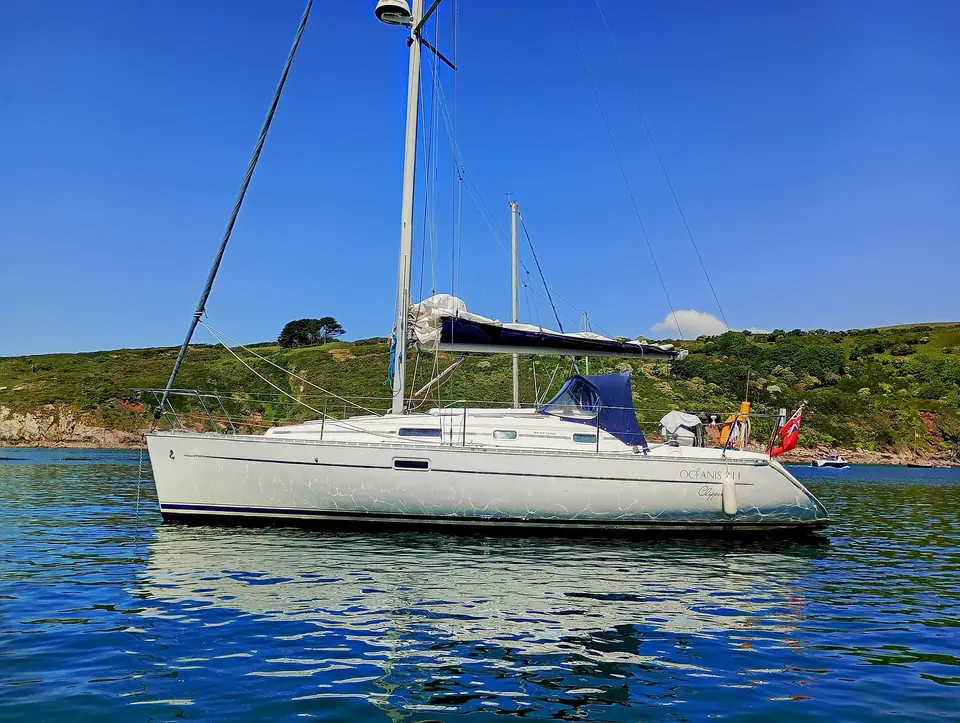
We have not found a freely licensed photo of the Beneteau First 31.7 yet, so these show other Beneteau boats, each captioned with the boat pictured.
More performance sailboats to explore
Beneteau First 310
Performance Sailboats, 31 ft
Used $18K to $42K
Beneteau First 30
Performance Sailboats, 31 ft
Used $150K to $195K
Beneteau First 305
Performance Sailboats, 31 ft
Used $14K to $36K
J/99
Performance Sailboats, 33 ft
Used $180K to $275K
Other Beneteau models
- Beneteau 49
- Beneteau 50
- Beneteau 57
- Beneteau 343
- Beneteau Antares 5.80
- Beneteau Antares 6
- Beneteau Antares 6.80
- Beneteau Antares 7
- Beneteau Antares 7.30
- Beneteau Antares 7.60
- Beneteau Antares 7.80
- Beneteau Antares 8
- Beneteau Antares 8.00
- Beneteau Antares 8.05
- Beneteau Antares 8.60
- Beneteau Antares 8.80
- Beneteau Antares 9
- Beneteau Antares 9.80
- Beneteau Antares 10.80
- Beneteau Antares 11
- Beneteau Antares 12
- Beneteau Antares 13.80
- Beneteau Antares 30
- Beneteau Antares 32
- Beneteau Antares 36
- Beneteau Antares 42
- Beneteau Antares 620 HB
- Beneteau Antares 650 HB
- Beneteau Antares 750 HB
- Beneteau Cyclades 39.3
- Beneteau Cyclades 43.3 and 43.4
- Beneteau Cyclades 50.5
- Beneteau First 18 SE
- Beneteau First 20
- Beneteau First 21.7
- Beneteau First 24
- Beneteau First 25
- Beneteau First 25.7
- Beneteau First 27
- Beneteau First 27.7
- Beneteau First 30
- Beneteau First 35
- Beneteau First 36
- Beneteau First 36.7
- Beneteau First 38
- Beneteau First 40
- Beneteau First 40.7
- Beneteau First 44
- Beneteau First 45
- Beneteau First 47.7
- Beneteau First 53
- Beneteau First 211
- Beneteau First 235
- Beneteau First 285
- Beneteau First 305
- Beneteau First 310
- Beneteau First 345
- Beneteau Flyer 6
- Beneteau Flyer 7
- Beneteau Flyer 8
- Beneteau Flyer 9
- Beneteau Flyer 10
- Beneteau Flyer 12
- Beneteau Flyer 500
- Beneteau Flyer 550
- Beneteau Flyer 650
- Beneteau Flyer 701
- Beneteau Flyer 750
- Beneteau Grand Trawler 62
- Beneteau Gran Turismo 32
- Beneteau Gran Turismo 36
- Beneteau Gran Turismo 40
- Beneteau Gran Turismo 41
- Beneteau Gran Turismo 44
- Beneteau Gran Turismo 45
- Beneteau Monte Carlo 6
- Beneteau Oceanis 30.1
- Beneteau Oceanis 31
- Beneteau Oceanis 34
- Beneteau Oceanis 34.1
- Beneteau Oceanis 35
- Beneteau Oceanis 35.1
- Beneteau Oceanis 36 CC
- Beneteau Oceanis 37
- Beneteau Oceanis 38
- Beneteau Oceanis 38.1
- Beneteau Oceanis 40
- Beneteau Oceanis 40 CC
- Beneteau Oceanis 41
- Beneteau Oceanis 41.1
- Beneteau Oceanis 42
- Beneteau Oceanis 42 CC
- Beneteau Oceanis 43
- Beneteau Oceanis 44 CC
- Beneteau Oceanis 45
- Beneteau Oceanis 46
- Beneteau Oceanis 46.1
- Beneteau Oceanis 48
- Beneteau Oceanis 50
- Beneteau Oceanis 51.1
- Beneteau Oceanis 54
- Beneteau Oceanis 55
- Beneteau Oceanis 58
- Beneteau Oceanis 311
- Beneteau Oceanis 320
- Beneteau Oceanis 321
- Beneteau Oceanis 323
- Beneteau Oceanis 331
- Beneteau Oceanis 350
- Beneteau Oceanis 351
- Beneteau Oceanis 370
- Beneteau Oceanis 390
- Beneteau Oceanis 400
- Beneteau Oceanis 411
- Beneteau Oceanis 423
- Beneteau Oceanis 430
- Beneteau Oceanis 440
- Beneteau Oceanis 461
- Beneteau Oceanis 473
- Beneteau Oceanis 500
- Beneteau Oceanis 510
- Beneteau Oceanis Clipper 361
- Beneteau Oceanis Clipper 373
- Beneteau Oceanis Clipper 381
- Beneteau Oceanis Clipper 393
- Beneteau Oceanis Yacht 54
- Beneteau Oceanis Yacht 60
- Beneteau Oceanis Yacht 62
- Beneteau Sense 43
- Beneteau Sense 46
- Beneteau Sense 50
- Beneteau Sense 55
- Beneteau Swift Trawler 30
- Beneteau Swift Trawler 34
- Beneteau Swift Trawler 35
- Beneteau Swift Trawler 41
- Beneteau Swift Trawler 44
- Beneteau Swift Trawler 48
- All Beneteau models