Beneteau Performance Sailboats
Beneteau 211 Buyer's Guide, the First 211 Lifting Keeler
The late-1990s Finot trailer sailer that taught a generation of European families to cruise, now one of the cheapest routes into a proper lifting keeler.
- Length
- 21 ft6.4 m
- Beam
- 8.1 ft2.48 m
- Draft
- 5.9 ft1.8 m
- Cabins
- Open plan with a curtained forward sleeping platform
- Used price
- $9K to $20K
On this page
- Overview
- The boat for a family moving up from dinghies
- What the 211 changed, and what it kept
- Colorful, simple and built around the keel box
- Lively, quick, and a little twitchy upwind
- A class boat in Britain and Ireland
- Trailering, launching and outboard choice
- What a 211 is worth, and running it cheaply
- Specifications
- Price and value
- Strengths and weaknesses
- Used buyer checklist
- Rivals
- Our verdict
- FAQ
The Beneteau First 211 is a 21-foot Groupe Finot lifting-keel cruiser built from 1998 until the First 21.7 replaced it in 2004. It weighs about 1,100 kg, sleeps four and dries out on its keel and twin rudders.
- Young families moving up from dinghies
- Budget trailer sailing
- Learning to race keelboats
- Beach and drying-harbor cruising
Beneteau First 211 by the numbers
- Sail area to displacement
- 24.0Racing level power, needs active reefing as the breeze builds.
- Displacement to length
- 142Light displacement for its length, quick but sensitive to added cruising weight.
- Theoretical hull speed
- 5.9 knThe practical top speed of a displacement monohull under normal sailing, based on waterline length.
- Ballast ratio
- 32%A typical ballast ratio for a cruising monohull.
- Capsize screening
- 2.42Above 2.0, so this hull leans toward coastal stability over ultimate offshore resistance.
- Motion comfort ratio
- 11.4A quicker motion in waves, typical of light, beamy hulls.
- Length to beam ratio
- 2.58 : 1A beamy hull with lots of volume for its length.
The boat for a family moving up from dinghies
Picture a couple with two young kids, a Laser in the garage and a summer budget that does not stretch to a 30-footer. That was exactly the buyer Groupe Finot and Beneteau had in mind when they updated the First 210 in 1998 and called it the First 211. Yachting Monthly summed it up as a boat aimed at the young family moving up from a dinghy: bright inside, simple to sail, quick enough to keep a dinghy sailor interested, and small enough to tow home at the end of the season.
Anyone searching for a Beneteau 211 today is usually weighing it against its siblings. The 211 kept the 210's hull and rig substantially unchanged and improved the accommodation so four people could sleep aboard. In 2004 it was restyled again as the First 21.7. Because the three versions share so much, a 211 is often the value choice: the same sailing qualities at the lowest price in the family.
What the 211 changed, and what it kept
The 210 had launched in 1992 and won Sailing World's 1993 Daysailer and Weekender Boat of the Year. Wikipedia records it at 2,225 lb with 772 lb of ballast and a lifting keel drawing 5 ft 10 in down and 2 ft 4 in up, plus twin rudders angled outward at 15 degrees. The 211 kept that concept, with Beneteau's brochure listing a 6.40 m overall length, 6.25 m hull, 6.00 m waterline and 2.48 m beam.
Beneteau's brochure quotes the 211 at about 1,100 kg (2,425 lb) light, with a profiled cast iron lifting keel of 350 kg (772 lb), two lifting rudders and buoyancy foam positioned to make the boat unsinkable. Sailboatdata lists a higher 2,745 lb, the figure Beneteau later published for the 21.7, so treat online numbers with care. The brochure CE rating was B for four people and C for six, and the working sail area 25.2 m2 (271 sq ft), with a 37.6 m2 spinnaker.
- First 210 (1992 to 1997): original Finot design, first Boat of the Year success
- First 211 (1998 to 2004): same hull and rig, improved four-berth interior
- First 21.7 (2004 on): restyled deck hardware, joinery and coachroof beam
Colorful, simple and built around the keel box
The interior is laid out around the lifting keel case, which runs up the middle of the cabin. Yachting Monthly described it as colourful, bright and simple: you crawl past the casing to a forward sleeping platform that is curtained off from the saloon, and either side of the case are a single-burner cooker and a washing-up bowl. There is sitting headroom, a useful amount of stowage under the berths and a pair of saloon berths for the kids.
Beneteau's brochure explains the trick that frees up space: the structural beam that supports the mast is integrated into the coachroof, so there is no compression post in the saloon, and an articulated companionway hatch opens to give standing room at the galley. A First Yacht Club pack added a kitchenette with crockery, a fresh water system, extra stowage, cherry-tone wood finishes, upholstery and a full anchoring kit. Ask whether a boat had it, because adding those parts piecemeal costs more than the pack did.
Lively, quick, and a little twitchy upwind
Every review of the First 21 family says the same thing about performance: lively and fast. The keel is narrow and deep, which Yachting Monthly found gave good but twitchy windward performance, so the 211 rewards a light hand on the tiller and an early reef. The twin rudders make sense here, keeping one blade biting as the boat heels in a gust, and they let the 211 sit upright on a drying mooring or a beach on its keel and rudders.
Sailboatdata calculates a sail area to displacement ratio of about 22 using Beneteau's reported sail area, and a hull speed near 5.9 knots. Bob Perry wrote of the 210 that it shows design innovation aimed at sparkling performance, unusual among trailer sailers. Do not expect a 211 to plane like a modern Manuard sportsboat, but on a reach in 15 knots it will run away from most 22-foot cruisers of its era.
A class boat in Britain and Ireland
Sailboatdata notes that class racing for the 211 exists in France, Britain, Ireland and elsewhere, and that is a big part of why European prices hold up. Club fleets give you tuning partners, a used sail market and a reason to keep the boat in good order. In the US you will be racing under PHRF; the 210 carried an average handicap of 195 according to Wikipedia, which gives a sense of where the family sits against J/24s and Catalina 22s.
If racing is the plan, prioritize a boat with a hard keel surface, tight keel pads and a recent mainsail. The swing mechanism and loose pads cost more speed than most people realize, because a fin that wobbles in its case stalls early upwind.
Trailering, launching and outboard choice
Beneteau's own pitch was that the 211 can be towed behind your car to any seaside holiday destination, and at 8 ft 2 in wide it fits US road rules without permits. With the keel up the boat draws about 2 ft 4 in, so it launches from ordinary ramps, and the rudders lift so they are not the first thing to touch the concrete. Use a braked trailer; the rig, outboard and cruising kit push the towed weight well past the boat's dry figure.
Power is an outboard on a transom bracket. A 4 to 6 hp long-shaft is the usual choice; anything heavier sits awkwardly on the stern of a boat this light. Check that the bracket and transom backing plate are sound, because years of outboard vibration can loosen the fastenings.
What a 211 is worth, and running it cheaply
Expect roughly $9,000 to $20,000 for a First 211 in the US in 2026, with the trailer and sails swinging the number more than the model year. A late boat with a galvanized trailer and an asymmetric kit sits at the top; an early hull with tired sails and a sticky keel belongs at the bottom. Kept on its trailer in a yard, the 211 costs roughly $1,500 to $4,000 a year in insurance, storage, haulouts and outboard maintenance.
The value case is simple: you get the same hull, rig and keel concept as a 21.7 for less money, and you give up a slightly nicer interior. For a family that will mostly daysail and camp aboard, that is a fair trade.
Beneteau First 211 specifications
| Length overall | 21 ft6.4 m |
|---|---|
| Waterline length | 19.7 ft6 m |
| Beam | 8.1 ft2.48 m |
| Draft | 5.9 ft1.8 m |
| Displacement | 2,425 lbs1,1 kg |
| Ballast | 772 lbs35 kg |
| Sail area | 271 sq ft25.2 m² |
| Fresh water | 9 gal35 L |
| Cabins | Open plan with a curtained forward sleeping platform |
| Berths | 4 |
| Heads | No enclosed head; space for a portable toilet |
| Standard engines | Outboard motor on a transom bracket |
| Hull type | Light displacement monohull with buoyancy foam |
| Keel | Profiled cast iron lifting (pivoting) keel of 350 kg, 0.70 m to 1.80 m (2 ft 4 in to 5 ft 11 in), twin lifting rudders |
| Rig | Fractional sloop with furling headsail, 25.2 m2 working sail area and a 37.6 m2 spinnaker |
| Hull construction | GRP hull and deck with moulded structural liner and buoyancy foam, cast iron lifting keel |
| CE design category | B (4 people) and C (6 people) |
| Builder | Chantiers Beneteau, France |
| Naval architect | Groupe Finot |
| Production | 1998 to 2004 |
| Status | Discontinued |
Figures come from builder documentation and independent tests where available. Displacement is usually quoted light, so a loaded cruising boat will weigh more. Compare these specs with another model.
How much does a Beneteau First 211 cost?
A First 211 is usually a few thousand dollars cheaper than a 21.7 of similar condition because it is older and has the plainer interior. The trailer can be worth a quarter of the package, and boats with a newer main, an asymmetric kit and a serviced keel bring the most. Most hulls are in Europe; these are 2026 US estimates, not prices copied from current listings.
Estimate your yearly cost
A planning estimate using common rules of thumb: insurance near 1.5 percent of value, maintenance near 3 percent, haul out and bottom paint by length. Your marina, region and use will move these numbers. Open the full cost calculator.
Beneteau First 211 timeline
- 1992The Finot-designed First 210 introduces the 21-foot lifting-keel hull.
- 1993The 210 wins Sailing World's Daysailer and Weekender Boat of the Year.
- 1998Beneteau updates the boat as the First 211 with improved four-berth accommodation.
- 2004The 211 is restyled into the First 21.7.
Strengths and weaknesses
What owners like
- Cheapest way into the Finot First 21 family
- 350 kg cast iron lifting keel gives real windward ability
- Twin lifting rudders and a beachable hull
- Buoyancy foam for an unsinkable rating
- Active class racing in Europe supports values and parts
What to weigh up
- Windward helm can feel twitchy in a breeze
- Plainer interior than the later 21.7
- No enclosed head and only sitting headroom
- Rare in North America, so most buyers face an import
Used Beneteau First 211 buyer checklist
Take this list to a viewing. Your ticks are saved in this browser so you can come back to it.
Always commission an independent marine survey and an engine survey before you buy. How a marine survey works.
Rivals to consider
Beneteau First 21.7
The direct successor on the same hull with a roomier, better finished interior and a higher price.
Compare side by sideJ/22
A fixed-keel American one-design with strong fleets, sharper upwind but harder to trailer and launch.
Compare side by sideCatalina 22
Heavier, roomier and far more common in the US, with a swing keel and a gentler but slower motion.
Compare side by sidePrecision 21
An American-built small cruiser with a shoal keel and centerboard, simpler and less sporty under sail.
Our verdict on the Beneteau First 211
The First 211 is the bargain-bin entry to one of Beneteau's best small designs. It shares the 210 and 21.7's hull, rig and lifting-keel concept, it is light enough to tow and fast enough to keep a dinghy sailor grinning, and it dries out upright when the tide leaves. What you give up against the 21.7 is mostly polish below. Buy on the condition of the keel mechanism, rudders and trailer rather than the year, and a 211 will teach a family to sail and still be worth most of its purchase price when they move on.
Beneteau First 211 questions answered
What is a Beneteau 211?
It is the Beneteau First 211, a 21-foot Groupe Finot lifting-keel trailer sailer built from 1998 to 2004 between the First 210 and the First 21.7.
How heavy is the Beneteau First 211?
Beneteau's brochure lists about 1,100 kg (2,425 lb) light displacement with a 350 kg (772 lb) cast iron keel. Some online databases quote 2,745 lb, which is the later 21.7 figure.
Can a Beneteau 211 dry out?
Yes. Yachting Monthly notes it can be dried out on the keel and twin rudders, which suits tidal harbors and beaches.
How many people does a First 211 sleep?
Four, on the curtained forward platform and the two saloon berths.
How much is a Beneteau 211 for sale?
In the US expect roughly $9,000 to $20,000 in 2026, depending mainly on the trailer, sails and keel condition.
Is the Beneteau 211 the same as the 21.7?
Same hull and keel concept, but the 21.7 of 2004 added an integrated coachroof beam, new joinery and updated hardware.
Photos from the Beneteau range
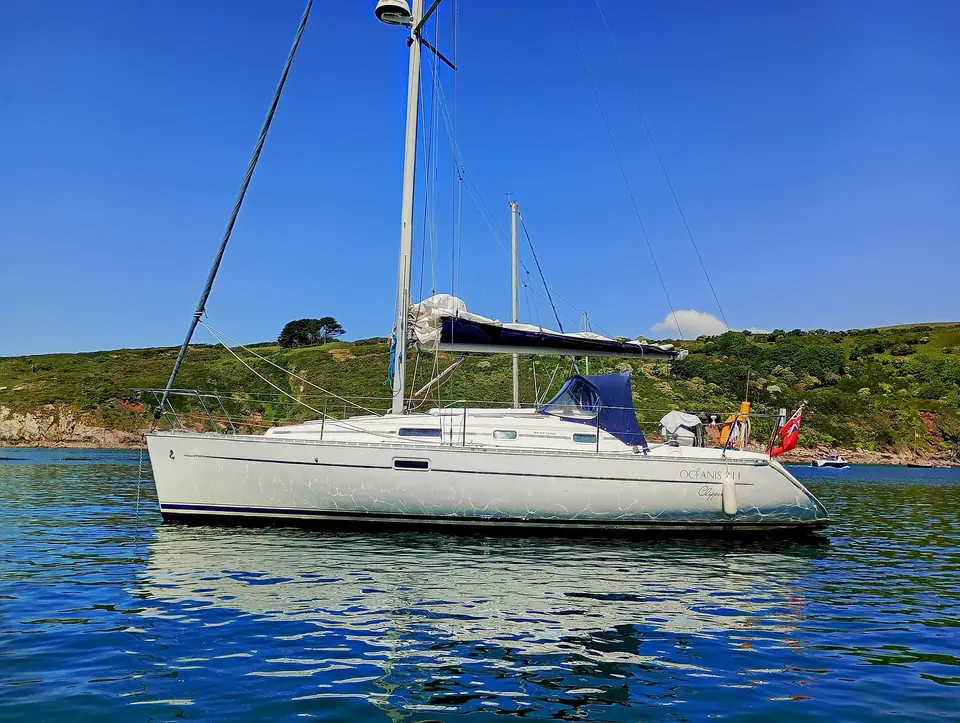
We have not found a freely licensed photo of the Beneteau First 211 yet, so these show other Beneteau boats, each captioned with the boat pictured.
More performance sailboats to explore
Beneteau First 20
Performance Sailboats, 21 ft
Used $19K to $37K
Beneteau First 21.7
Performance Sailboats, 21 ft
Used $12K to $26K
J/22
Performance Sailboats, 23 ft
Used $3K to $22K
Pearson Ensign
Performance Sailboats, 23 ft
Used $2K to $35K
Other Beneteau models
- Beneteau 49
- Beneteau 50
- Beneteau 57
- Beneteau 343
- Beneteau Antares 5.80
- Beneteau Antares 6
- Beneteau Antares 6.80
- Beneteau Antares 7
- Beneteau Antares 7.30
- Beneteau Antares 7.60
- Beneteau Antares 7.80
- Beneteau Antares 8
- Beneteau Antares 8.00
- Beneteau Antares 8.05
- Beneteau Antares 8.60
- Beneteau Antares 8.80
- Beneteau Antares 9
- Beneteau Antares 9.80
- Beneteau Antares 10.80
- Beneteau Antares 11
- Beneteau Antares 12
- Beneteau Antares 13.80
- Beneteau Antares 30
- Beneteau Antares 32
- Beneteau Antares 36
- Beneteau Antares 42
- Beneteau Antares 620 HB
- Beneteau Antares 650 HB
- Beneteau Antares 750 HB
- Beneteau Cyclades 39.3
- Beneteau Cyclades 43.3 and 43.4
- Beneteau Cyclades 50.5
- Beneteau First 18 SE
- Beneteau First 20
- Beneteau First 21.7
- Beneteau First 24
- Beneteau First 25
- Beneteau First 25.7
- Beneteau First 27
- Beneteau First 27.7
- Beneteau First 30
- Beneteau First 31.7
- Beneteau First 35
- Beneteau First 36
- Beneteau First 36.7
- Beneteau First 38
- Beneteau First 40
- Beneteau First 40.7
- Beneteau First 44
- Beneteau First 45
- Beneteau First 47.7
- Beneteau First 53
- Beneteau First 235
- Beneteau First 285
- Beneteau First 305
- Beneteau First 310
- Beneteau First 345
- Beneteau Flyer 6
- Beneteau Flyer 7
- Beneteau Flyer 8
- Beneteau Flyer 9
- Beneteau Flyer 10
- Beneteau Flyer 12
- Beneteau Flyer 500
- Beneteau Flyer 550
- Beneteau Flyer 650
- Beneteau Flyer 701
- Beneteau Flyer 750
- Beneteau Grand Trawler 62
- Beneteau Gran Turismo 32
- Beneteau Gran Turismo 36
- Beneteau Gran Turismo 40
- Beneteau Gran Turismo 41
- Beneteau Gran Turismo 44
- Beneteau Gran Turismo 45
- Beneteau Monte Carlo 6
- Beneteau Oceanis 30.1
- Beneteau Oceanis 31
- Beneteau Oceanis 34
- Beneteau Oceanis 34.1
- Beneteau Oceanis 35
- Beneteau Oceanis 35.1
- Beneteau Oceanis 36 CC
- Beneteau Oceanis 37
- Beneteau Oceanis 38
- Beneteau Oceanis 38.1
- Beneteau Oceanis 40
- Beneteau Oceanis 40 CC
- Beneteau Oceanis 41
- Beneteau Oceanis 41.1
- Beneteau Oceanis 42
- Beneteau Oceanis 42 CC
- Beneteau Oceanis 43
- Beneteau Oceanis 44 CC
- Beneteau Oceanis 45
- Beneteau Oceanis 46
- Beneteau Oceanis 46.1
- Beneteau Oceanis 48
- Beneteau Oceanis 50
- Beneteau Oceanis 51.1
- Beneteau Oceanis 54
- Beneteau Oceanis 55
- Beneteau Oceanis 58
- Beneteau Oceanis 311
- Beneteau Oceanis 320
- Beneteau Oceanis 321
- Beneteau Oceanis 323
- Beneteau Oceanis 331
- Beneteau Oceanis 350
- Beneteau Oceanis 351
- Beneteau Oceanis 370
- Beneteau Oceanis 390
- Beneteau Oceanis 400
- Beneteau Oceanis 411
- Beneteau Oceanis 423
- Beneteau Oceanis 430
- Beneteau Oceanis 440
- Beneteau Oceanis 461
- Beneteau Oceanis 473
- Beneteau Oceanis 500
- Beneteau Oceanis 510
- Beneteau Oceanis Clipper 361
- Beneteau Oceanis Clipper 373
- Beneteau Oceanis Clipper 381
- Beneteau Oceanis Clipper 393
- Beneteau Oceanis Yacht 54
- Beneteau Oceanis Yacht 60
- Beneteau Oceanis Yacht 62
- Beneteau Sense 43
- Beneteau Sense 46
- Beneteau Sense 50
- Beneteau Sense 55
- Beneteau Swift Trawler 30
- Beneteau Swift Trawler 34
- Beneteau Swift Trawler 35
- Beneteau Swift Trawler 41
- Beneteau Swift Trawler 44
- Beneteau Swift Trawler 48
- All Beneteau models