J/100 Review, Specs and Used J100 Buying Guide
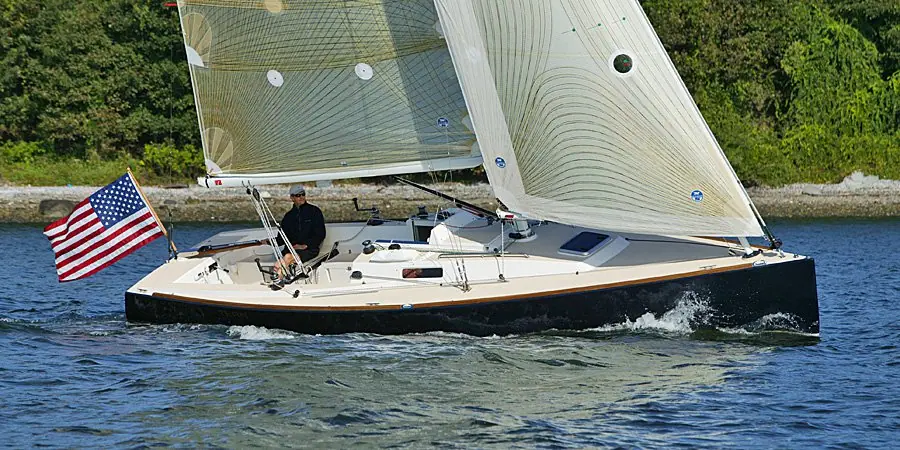
A 33 foot tiller-steered daysailer that recaptures dinghy feel for sailors who no longer want to round up a crew.
- Length
- 32.8 ft10 m
- Beam
- 9.3 ft2.82 m
- Draft
- 5.8 ft1.75 m
- Cabins
- Open cabin with optional V-berth forward
- Used price
- $65K to $115K
On this page
- Overview
- A J100 designed for the founder's own sailing in Maine
- Narrow, light and quick to accelerate
- A deck built so one person can do everything
- Below decks: a weekender, not a cruiser
- The odd one out among 2004's luxury daysailers
- One-design racing and the no-custom-options rule
- Owning a used J/100 in 2026
- Specifications
- Price and value
- Strengths and weaknesses
- Used buyer checklist
- Rivals
- Our verdict
- FAQ
The J/100 is a 32 ft 10 in daysailer and club racer designed by Rod Johnstone and launched in 2004. Sailing World named it 2005 Overall Boat of the Year. Built by Pearson Composites in Rhode Island, it is now a classic J model.
- Experienced sailors who want a short-handed daysailer
- Couples doing evening races and weekend hops
- Club one-design racing
- Sailors downsizing from larger racer-cruisers
J/100 by the numbers
- Sail area to displacement
- 22.0Plenty of sail for the weight, the boat should feel lively in light air.
- Displacement to length
- 119Ultralight. Built for speed, keep payload to a minimum.
- Theoretical hull speed
- 7.2 knThe practical top speed of a displacement monohull under normal sailing, based on waterline length.
- Ballast ratio
- 38%A typical ballast ratio for a cruising monohull.
- Capsize screening
- 1.98Below 2.0, the traditional threshold for offshore suitability.
- Motion comfort ratio
- 17.2A quicker motion in waves, typical of light, beamy hulls.
- Length to beam ratio
- 3.55 : 1Moderate proportions.
A J100 designed for the founder's own sailing in Maine
The J/100 began as a personal wish list. Jim Johnstone, J/Boats sales manager at launch, told Cruising World it was the brainchild of his uncle Bob Johnstone, who wanted a boat he could sail in Maine in his 60s without hunting for crew. J/Boats' own brochure pitched it as the Sunfish, Hobie or J/24 of a sailor's youth reincarnated, with the stability of a keel and the comfort of a dodger and a real head.
Rod Johnstone drew it as a 32 ft 10 in hull with a long 29 ft waterline and just 9 ft 3 in of beam. Hull No. 1 was launched in July 2004, and by the end of that year hull 23 was nearly finished at the Pearson Composites plant in Warren, Rhode Island, with orders through hull 74. Sailing World named the J/100 its Overall Boat of the Year for 2005. J/Boats now lists it among its classic models alongside the J/92 and J/124.
Narrow, light and quick to accelerate
On J/Boats' specification the J/100 displaces 6,500 lb with 2,450 lb of lead and antimony in a bulb keel drawing 5 ft 9 in, or 4 ft 6 in with the shoal option. Sail area is 478 sq ft (100 percent foretriangle) on a fractional sloop rig with a tapered carbon mast. The numbers that matter are the ratios: a displacement to length ratio of 119 and a sail area to displacement ratio of 22, firmly in performance territory.
Sailing World's Chuck Allen described a boat that feels like a large, stable dinghy. It heels slightly when you step aboard, is sensitive to crew weight, accelerates faster than almost anything he had sailed, turns inside a boat length during a 360 and holds speed through lulls. He tried hard to wipe it out under the asymmetric and could not, thanks to a deep rudder. The one caution was jibing: because the boat is so light, turn too quickly and the clew may not make it through in time. 48 North found it narrow enough to cut through Puget Sound slop and, like a meter boat, to roll down a little and lock into its groove.
A deck built so one person can do everything
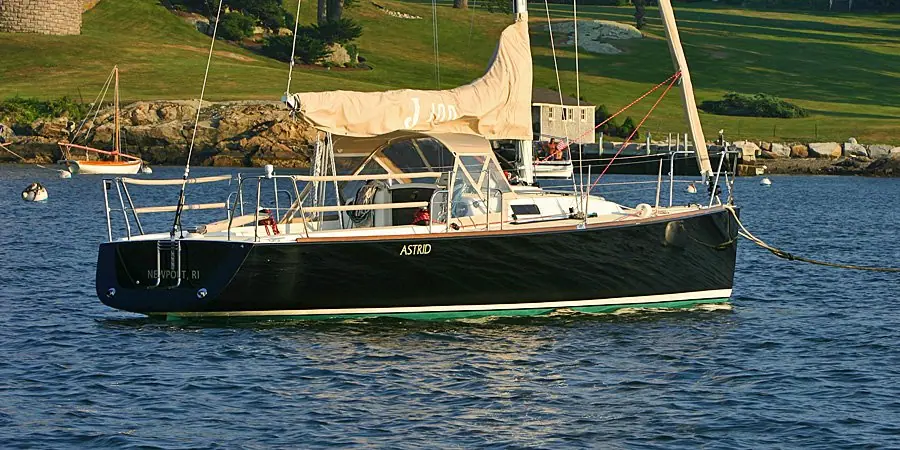
Everything leads aft. The optional Hoyt self-tacking jib boom lets the headsail tack itself and acts as a whisker pole downwind; for one-design racing it comes off and a hanked jib goes on the set-back headstay. The main has double 4:1 and 24:1 rough and fine tune systems, the traveler sits recessed in the cockpit seat, and the hydraulic backstay control is tucked under the tiller so the helmsman can pump it without losing leverage.
The cockpit is huge for the size, with 9 ft 6 in seats and backrests close to 14 inches high, yet short crew can still brace on the leeward seat. A swim platform is molded into the closed transom with a telescoping ladder. Lifelines are not required by class rules, but more than half of the early boats had them and every hull has backing for stanchions. Sailing World's only deck complaint was that the handrails end too far forward for comfort when you do need to go up to clear a spinnaker.
Below decks: a weekender, not a cruiser
The cabin is deliberately simple: two settee berths, an optional V-berth forward behind a door, a marine head with sink and 14 gallon holding tank, teak-trimmed shelves and a cooler instead of a galley. A 5 gallon freshwater system with a foot pump was optional. Power is a single 95 amp-hour battery, and J/Boats' table lists a 2 cylinder Yanmar saildrive of 14 to 15 hp with a folding prop, fed from a 10 gallon tank. J/Boats says it hums along at 6.5 knots.
Testers were honest about the limits. Sailing World noted weak soundproofing on the engine box of its test boat, basic lighting and a lack of ventilation that could make the boat musty. Engine access for filter changes and access to keel bolts and bilge were praised. It is fine for a weekend of harbor hopping, as the brochure promised, but not for a week aboard.
The odd one out among 2004's luxury daysailers
The J/100 arrived in the same season as a wave of upscale daysailers, including the Morris 36, Hinckley DS42 and Friendship 40. SAIL's tester called the J/100 the only performance boat in that group and arguably its only true daysailer. Cruising World made a similar point: the others started from traditional designs updated with modern underbodies, while J/Boats started with a thoroughly modern hull and added simple, high-quality gear.
That difference still shapes the used market. The J/100 costs a fraction of those luxury boats, has no varnish to speak of and rewards good sailing technique. Buyers who want brightwork and a yacht club look should consider the traditional daysailers; buyers who want to go fast with minimal fuss usually end up here.
One-design racing and the no-custom-options rule
J/Boats set the J/100 up for one-design racing from the start. Jim Johnstone explained that the company would not allow custom options but extended the standard list, so boats stayed alike and no oddball would suffer at resale. Gentleman's rules keep crews sitting legs-in, which keeps the racing friendly for older crews, and the same boat works as a short-handed PHRF entry at the club level.
For buyers, that discipline is valuable. A used J/100 is a known quantity, sails and parts are standardized, and fleet knowledge on tuning and maintenance is easy to find.
Owning a used J/100 in 2026
Running costs are modest for a 33 footer: roughly $6,000 to $14,000 a year in the US for a mooring or slip, insurance, haul-out, bottom work, saildrive service and sail replacement over time. Racing owners will spend more on sails.
Construction is SCRIMP resin infusion with Baltek balsa core in hull and deck, and J/Boats offered a 10 year transferable blister warranty when new. On a used boat, focus on the saildrive seal and lower unit, the carbon mast and rod rigging, the hydraulic backstay, keel sump and bulb fairing, and any soft deck around hardware. A J100 for sale with the Hoyt boom, a dodger and fresh sails is worth paying extra for if you sail short-handed.
J/100 specifications
| Length overall | 32.8 ft10 m |
|---|---|
| Waterline length | 29 ft8.84 m |
| Beam | 9.3 ft2.82 m |
| Draft | 5.8 ft1.75 m |
| Displacement | 6,5 lbs2,948 kg |
| Ballast | 2,45 lbs1,111 kg |
| Sail area | 478 sq ft44.4 m² |
| Fuel capacity | 1 gal38 L |
| Cabins | Open cabin with optional V-berth forward |
| Berths | 2 settee berths, 4 with optional V-berth |
| Heads | 1 marine head in the forward area |
| Standard engines | Yanmar 2 cylinder diesel saildrive (J/Boats lists 14 to 15 hp) with folding prop |
| Cruise speed | 6.5 knots |
| Hull type | Narrow, plumb-bowed light displacement monohull |
| Keel | Lead and antimony fin with bulb, 5 ft 9 in standard or 4 ft 6 in shoal option |
| Rig | Fractional sloop with tapered carbon mast, aluminum boom, rod rigging and hydraulic backstay; optional Hoyt self-tacking jib boom |
| Hull construction | SCRIMP resin-infused fiberglass with Baltek end-grain balsa core, lead bulb keel |
| Builder | Pearson Composites for J/Boats, USA |
| Naval architect | Rodney S. Johnstone |
| Other design credits | Concept by Bob Johnstone |
| Production | 2004 to present |
| Status | Discontinued |
Figures come from builder documentation and independent tests where available. Displacement is usually quoted light, so a loaded cruising boat will weigh more. Compare these specs with another model.
How much does a J/100 cost?
Sailing World quoted the J/100 at $135,000 ready to race when it named the boat 2005 Overall Boat of the Year. J/Boats deliberately banned custom options and widened the standard list so oddball boats would not hurt resale, which keeps the fleet consistent and prices relatively tight. In 2026, boats with the Hoyt jib boom, newer sails, a dodger and a well-maintained saildrive sit at the top, while boats with tired sails or saildrive seal neglect sit at the bottom.
Estimate your yearly cost
A planning estimate using common rules of thumb: insurance near 1.5 percent of value, maintenance near 3 percent, haul out and bottom paint by length. Your marina, region and use will move these numbers. Open the full cost calculator.
Versions and options
- Standard keel
- 5 ft 9 in draft, the choice for racing and windward performance.
- Shoal keel
- 4 ft 6 in draft for thin-water harbors and cruising grounds.
- Hoyt jib boom package
- Removable self-tacking jib boom with a loose-footed furling jib for short-handed sailing.
- Carbon bowsprit package
- Retractable carbon sprit with launching tube for an asymmetric spinnaker, offered as an option on later spec sheets.
J/100 timeline
- 2004Hull No. 1 launched in July; orders reach hull 74 by year end
- 2004Sailing World tests the boat and quotes $135,000 ready to race
- 2005Named Sailing World Overall Boat of the Year
- 2026Listed by J/Boats among its classic daysailer models
Strengths and weaknesses
What owners like
- Exceptional acceleration and light, precise tiller feel
- Truly single-handable with the Hoyt jib boom
- Huge, comfortable cockpit
- One-design consistency supports resale
- Low running costs
- Carbon mast and quality Harken and Spinlock gear
What to weigh up
- Minimal accommodations and no galley
- Poor ventilation below
- Sensitive to crew weight and tender initially
- Short handrails make going forward awkward
Used J/100 buyer checklist
Take this list to a viewing. Your ticks are saved in this browser so you can come back to it.
Always commission an independent marine survey and an engine survey before you buy. How a marine survey works.
Rivals to consider
J/105
A larger, more popular one-design with a real interior and an established class, but needs more crew.
Compare side by sideJ/88
A newer, sportier J with a sprit and more racing focus, less of a relaxed daysailer.
Compare side by sideAlerion 28
A smaller, classically styled daysailer for sailors who value looks and simplicity over speed.
Compare side by sideMorris M36
A luxury daysailer from the same 2004 generation, more traditional and far more expensive.
Our verdict on the J/100
The J/100 does exactly what Bob Johnstone wanted: it gives an experienced sailor the speed and feel of a dinghy in a 33 foot keelboat that one or two people can handle. Accommodations are spartan and it will never be a cruiser, but as an evening racer and weekend daysailer it is one of the best boats J/Boats has built. Pay for a boat with good sails, the jib boom and a cared-for saildrive, and you will have something that holds its value and makes every short sail worthwhile.
J/100 questions answered
How much does a J/100 cost?
Used J/100s generally sell for about $65,000 to $115,000 in the US in 2026. Sailing World quoted $135,000 ready to race when the boat was new in 2004.
Is the J/100 still in production?
No. J/Boats lists the J/100 among its classic daysailer models, and boats are only available used.
Can you sleep on a J100 sailboat?
Yes, for a night or a weekend. There are two settee berths, an optional V-berth and a marine head, but no galley.
What engine does the J/100 have?
A 2 cylinder Yanmar diesel saildrive of about 14 to 15 hp with a folding prop and a 10 gallon fuel tank.
Can the J/100 be singlehanded?
Yes. All controls lead to the cockpit, the optional Hoyt self-tacking jib boom tacks the headsail, and the hydraulic backstay sits under the tiller.
J/100 photos
More performance sailboats to explore
J/99
Performance Sailboats, 33 ft
Used $180K to $275K
Dehler 30 One Design
Performance Sailboats, 34 ft
Used $95K to $190K
Beneteau First 31.7
Performance Sailboats, 32 ft
Used $30K to $78K
Dehler 35
Performance Sailboats, 34 ft
Used $70K to $125K