Pearson Yachts Performance Sailboats
Pearson Ensign, the Ensign Sailboat Buyer's Guide
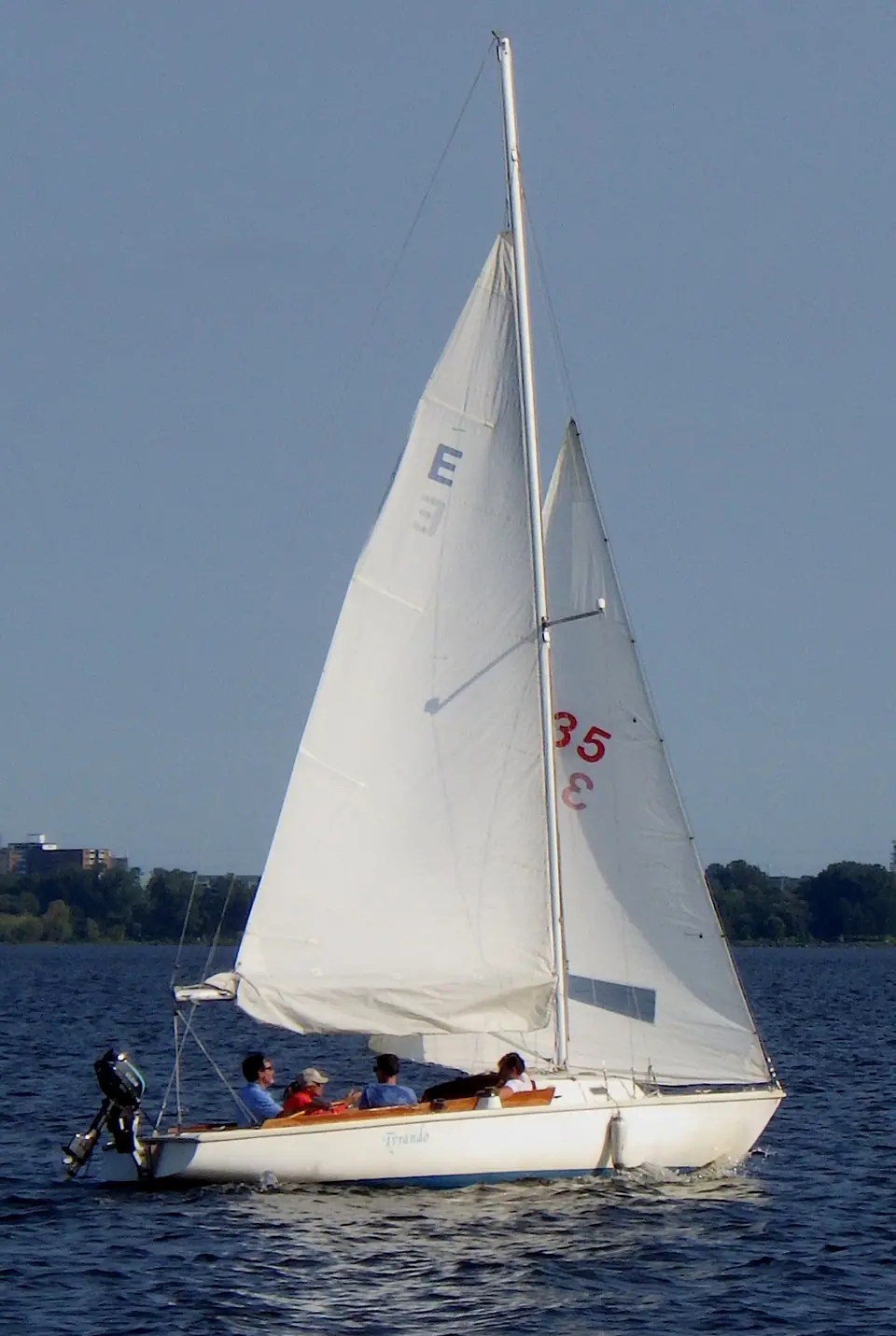
Carl Alberg's deep-cockpit full-keel daysailer, the first boat inducted into the American Sailboat Hall of Fame, still racing in its seventh decade.
- Length
- 22.5 ft6.86 m
- Beam
- 7 ft2.13 m
- Draft
- 3 ft0.91 m
- Cabins
- Cuddy cabin
- Used price
- $2K to $35K
On this page
- Overview
- From the Electra to the Ensign: a dealer's idea that stuck
- Why sailors love the eight foot cockpit
- A full keel that forgives and still races close
- One-design racing in its seventh decade
- Hall of Fame, revival and the next builder
- Ensign sailboat for sale: what the money buys
- What to check on an old Pearson Ensign
- Specifications
- Price and value
- Strengths and weaknesses
- Used buyer checklist
- Rivals
- Our verdict
- FAQ
The Ensign is a 22 ft 6 in full-keel daysailer and one-design racer drawn by Carl Alberg and built by Pearson Yachts from 1962 to 1983, with about 1,775 completed. Ensign Spars later revived production, and an active class still races it.
- Keelboat one-design racing on a budget
- Family daysailing on lakes and bays
- Yacht club training programs
- Older sailors wanting a stable, comfortable daysailer
Pearson Ensign by the numbers
- Sail area to displacement
- 18.1Balanced power for coastal and offshore cruising.
- Displacement to length
- 285Moderate displacement, a classic cruising balance between load carrying and speed.
- Theoretical hull speed
- 5.5 knThe practical top speed of a displacement monohull under normal sailing, based on waterline length.
- Ballast ratio
- 40%A high ballast ratio, so the boat stands up well to a breeze.
- Capsize screening
- 1.94Below 2.0, the traditional threshold for offshore suitability.
- Motion comfort ratio
- 18.8A quicker motion in waves, typical of light, beamy hulls.
- Length to beam ratio
- 3.21 : 1Moderate proportions.
From the Electra to the Ensign: a dealer's idea that stuck
In 1959 Pearson Yachts commissioned Carl Alberg, the Swedish-born designer trained at Chalmers who emigrated to the US in 1925, to draw a 22 foot cruiser for Midget Ocean Racing Club events. The result was the Electra, with a masthead rig, a small self-bailing cockpit and a cabin with galley, head and bunks. About 350 were built over six years. Pearson's dealers told the factory that many buyers wanted the opposite balance, a big cockpit and a small cabin, and Pearson asked Alberg to turn the Electra hull into a one-design daysailer.
Alberg moved the mast six inches forward, enlarged the mainsail and reduced the foretriangle. First called the Electra Day Sailor, the Ensign sailboat was an instant success: 219 were sold in 1962, the first fleet formed at Larchmont, New York, and 213 more followed in 1963 along with nine new fleets from Houston to Falmouth, Maine. Pearson built about 1,775 Ensigns before stopping in 1983 (sailboatdata counts 1,776 and lists the last Pearson boats as 1982).
Why sailors love the eight foot cockpit
The Ensign's defining feature is a deep, eight foot cockpit with a teak sole and mahogany benches on many boats. SAIL's Adam Cort put it well: you sit in an Ensign, not on it. The class says six to eight adults fit comfortably, which makes it a superb family daysailer and a safe training boat, with no risk of being swept off the side deck or clouted by the boom on every tack.
Forward, the cuddy cabin has two berths, mostly used for stowing sails and getting out of the rain, though the class notes it can shelter two in a storm and some owners camp aboard. Headroom is under four feet. There is no galley or head as standard; this is a daysailer, not a pocket cruiser.
A full keel that forgives and still races close
The Ensign is 22 ft 6 in long on a 16 ft 9 in waterline, with a 7 ft beam, 3,000 pounds of displacement and 1,200 pounds of ballast in a full keel drawing only 3 feet. Sail area is about 235 square feet on a fractional rig. Those are Folkboat-like proportions, as Practical Sailor has described Alberg's daysailers: not fast by modern standards, but sensible boats that stand up to a breeze. Hull speed is roughly 5.5 knots.
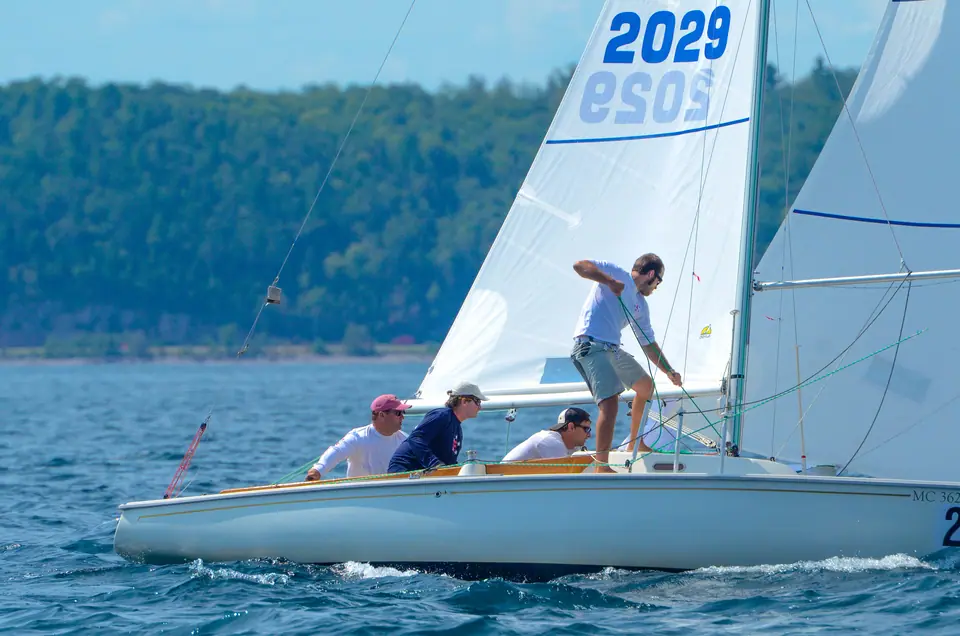
The class association says the sail plan reaches hull speed in eight to ten knots of wind, that the full keel delivers performance when sailed flat and forgiveness when allowed to heel, and that the helm has a nice feel on all points of sail. SAIL found it ghosts well in light air and has a surprisingly powerful hull upwind in a breeze. The three foot draft makes it ideal for bays, lakes and anchoring close to shore.
One-design racing in its seventh decade
The Ensign has long been the largest full-keel one-design class in the US. SAIL counted more than 50 active fleets in 2011, when Canandaigua Yacht Club in New York hosted the 50th National Championship, and fleets are still being chartered: the class added Fleet 85 on Dataw Island, South Carolina, in April 2025 and reactivated Fleet 68 in Sturgeon Bay, Wisconsin.
Racing is close, strategic and tactical, and old boats remain competitive. The class notes that the 2025 national champion was built in 1967 and the previous year's champion in 1966. Boats are best raced with four crew and carry no lifelines, so dinghy techniques such as hiking and roll tacking work. The Ensign Class Association rigidly maintains the one-design rules, and for singlehanded daysailing a main and blade with optional cabin-top winches, or a roller furler, keeps things simple.
Hall of Fame, revival and the next builder
On January 25, 2002, the Ensign became the first boat inducted into the American Sailboat Hall of Fame. Production had stopped for 18 years after Pearson, until Ensign Spars of Dunedin, Florida, acquired the molds in 2001 and began building boats again. By 2014 Ensign Spars was based in Marquette, Michigan, under owner Chad Lewis, and the class raffled a brand-new 23 foot Ensign Classic that year to promote the fleet.
Today Ensign Spars operates as the class's parts supplier, selling rigging, fiberglass and wood parts, rub rails, covers and motor mounts, including small electric outboards. The class website's buyer page currently carries the note that a new Ensign by Thoroughbred Boat Company is coming soon, so watch for news of renewed production. In total the class says more than 1,800 Ensigns have been built since 1962.
Ensign sailboat for sale: what the money buys
Ensign boats are among the cheapest ways into keelboat one-design racing. Prices on the class classifieds in 2026 run from $750 for a project to $35,000 for a top boat, with most sound Pearson hulls between about $4,500 and $11,500 and well-prepared race boats or later-built hulls near $18,000 to $26,000. Location matters: boats near active fleets in the Northeast, Great Lakes, Texas, Florida and Colorado sell readily.
Annual costs are low, roughly $1,500 to $6,000 for a mooring or dry sailing, insurance, bottom paint and small parts, plus sails if you race. Most owners use a small outboard for getting to and from the mooring, increasingly an electric one.
What to check on an old Pearson Ensign
Most Ensigns are now 45 to 60 years old, so condition varies enormously. The class library includes guidance on draining water from the keel for winter storage, a reminder that water can collect in the keel area of these boats and cause damage if it freezes. Mahogany benches, wood trim and rudder parts may need refinishing or replacement, rub rails wear out, and decks and cockpit soles on boats this old deserve a careful moisture check. Ask the class or a local fleet captain to help assess a boat; Ensign sailors are generous with advice and know the history of many hulls by number.
Pearson Ensign specifications
| Length overall | 22.5 ft6.86 m |
|---|---|
| Waterline length | 16.8 ft5.11 m |
| Beam | 7 ft2.13 m |
| Draft | 3 ft0.91 m |
| Displacement | 3, lbs1,361 kg |
| Ballast | 1,2 lbs544 kg |
| Sail area | 235 sq ft21.8 m² |
| Cabins | Cuddy cabin |
| Berths | 2 in the cuddy |
| Heads | None fitted as standard |
| Standard engines | None; small outboard on a bracket is common |
| Hull type | Full-keel displacement monohull with attached rudder |
| Keel | Full keel, 3 ft draft, 1,200 lb ballast |
| Rig | Fractional sloop with spinnaker; class inventory of working jib, blade, #2 and #1 genoas |
| Hull construction | Fiberglass with encapsulated full keel ballast, wood trim |
| Builder | Pearson Yachts (1962 to 1983); later Ensign Spars, United States |
| Naval architect | Carl Alberg |
| Production | 1962 to present |
| Status | Discontinued |
Figures come from builder documentation and independent tests where available. Displacement is usually quoted light, so a loaded cruising boat will weigh more. Compare these specs with another model.
How much does a Pearson Ensign cost?
The Ensign Class Association's own classifieds in 2026 show the real market: project boats from $750 to about $3,000, sound older Pearson hulls with usable sails from $4,500 to $11,500, and well-sorted race boats or late-built hulls from about $18,000 to $35,000. Hull age matters less than you might expect because old boats still win, so sails, rig, keel condition, trailer and class legality drive price. A competitive boat in an active fleet area sells far faster than an equally good one far from any fleet.
Estimate your yearly cost
A planning estimate using common rules of thumb: insurance near 1.5 percent of value, maintenance near 3 percent, haul out and bottom paint by length. Your marina, region and use will move these numbers. Open the full cost calculator.
Versions and options
- Pearson Ensign (1962 to 1983)
- About 1,775 built by Pearson; the bulk of the fleet.
- Ensign Spars Ensign (from 2001)
- Production revived from the original molds, first in Dunedin, Florida, later in Marquette, Michigan.
- Ensign Classic
- Name used for new boats from Ensign Spars around 2014.
- Pearson Electra
- The 1959 masthead-rigged cruiser on the same hull, with a larger cabin and smaller cockpit; about 350 built.
Pearson Ensign timeline
- 1959Carl Alberg designs the Electra for Pearson
- 1962Ensign introduced as the Electra Day Sailor; 219 sold and Fleet 1 formed at Larchmont
- 1983Pearson production ends after about 1,775 boats
- 2001Ensign Spars acquires the molds and restarts production
- 2002Ensign becomes the first boat inducted into the American Sailboat Hall of Fame
- 201150th National Championship at Canandaigua Yacht Club
- 2025National championship won by a 1967-built boat; new fleets chartered
Strengths and weaknesses
What owners like
- Huge, deep, secure cockpit for six to eight
- Forgiving full keel with only 3 ft draft
- Active one-design class with more than 50 fleets
- Old boats remain competitive, protecting value
- Very low cost of ownership
- Classic Alberg looks
What to weigh up
- Slow by modern standards
- Cuddy cabin is for shelter, not cruising
- Many boats need wood, deck or keel-area work
- No lifelines, so not ideal for small children without care
- New boats have been scarce since the Pearson era
Used Pearson Ensign buyer checklist
Take this list to a viewing. Your ticks are saved in this browser so you can come back to it.
Always commission an independent marine survey and an engine survey before you buy. How a marine survey works.
Rivals to consider
Cape Dory Typhoon
Alberg's smaller 19 ft full-keel daysailer, cheaper and similarly charming but without the racing class.
Rhodes 19
Another classic one-design daysailer with a strong Northeast following.
Sonar
A faster, more modern 23 ft one-design with a large open cockpit and adaptive sailing programs.
Compare side by sideJ/22
A lighter, livelier fin-keel one-design for sailors who want speed over comfort.
Compare side by sideOur verdict on the Pearson Ensign
The Ensign is one of the great American daysailers: a deep, safe cockpit, a forgiving full keel, three foot draft and Carl Alberg's timeless lines, backed by a class where a 1967 boat can still win the nationals. It is not fast and its cuddy is no cruising cabin, but for family sailing and close, tactical keelboat racing on a small budget it is hard to beat. Buy a dry, well-maintained hull near an active fleet, check the keel area and deck carefully, and an Ensign will hold its value and give years of pleasure.
Pearson Ensign questions answered
Who designed the Ensign sailboat?
Carl Alberg, who adapted it from his Electra design for Pearson Yachts in 1962.
How many Pearson Ensigns were built?
Pearson built about 1,775 between 1962 and 1983, and the class says more than 1,800 Ensigns have been built in total.
How much does an Ensign sailboat cost?
On the class classifieds in 2026 prices range from under $1,000 for projects to about $35,000, with most sound boats between $4,500 and $26,000.
Is the Ensign still raced?
Yes. The Ensign Class Association runs national and regional regattas, and the 2025 national champion was a 1967-built boat.
Can you sleep on an Ensign?
The cuddy has two berths and can shelter two in bad weather, but the boat is a daysailer with no standard galley or head.
Is the Ensign still being built?
Pearson stopped in 1983, Ensign Spars revived production from 2001, and the class has announced a new Ensign from Thoroughbred Boat Company as coming soon.