J/80 Review, the 26-Foot Sprit Boat That Still Packs Start Lines
The 1993 sportboat that brought the asymmetric spinnaker and retractable sprit to a 26-foot one-design, now strongest in France and Spain.
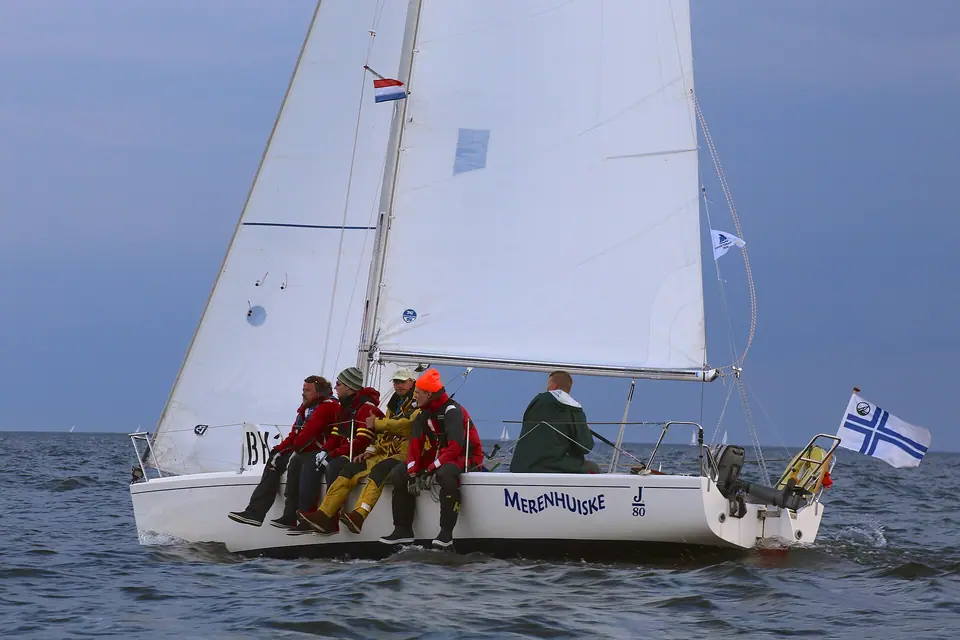
- Length
- 26.3 ft8 m
- Beam
- 8.3 ft2.51 m
- Draft
- 4.9 ft1.49 m
- Cabins
- 1
- Used price
- $12K to $48K
On this page
- Overview
- The J80 in context, a sprit boat before sprits were normal
- The first J built with SCRIMP infusion
- Crew rules and where the big fleets race
- On the water, more wind needed but more boat in return
- The 2009 keel stub warning and what it means for buyers today
- Below deck and the weekend question
- Running costs and the value case against a J70
- Specifications
- Price and value
- Strengths and weaknesses
- Used buyer checklist
- Rivals
- Our verdict
- FAQ
A 26-foot 3-inch, 2,900-pound fixed-keel sportboat by Rod Johnstone. Over 1,700 built since 1993 by TPI and J/Composites, raced in large European fleets and sold used in the US for about $12,000 to $48,000.
- Racers in windy venues
- Sailing schools and clubs
- Budget-minded sportboat buyers
- European one-design racing
J/80 by the numbers
- Sail area to displacement
- 26.6Racing level power, needs active reefing as the breeze builds.
- Displacement to length
- 122Light displacement for its length, quick but sensitive to added cruising weight.
- Theoretical hull speed
- 6.3 knThe practical top speed of a displacement monohull under normal sailing, based on waterline length.
- Ballast ratio
- 48%A high ballast ratio, so the boat stands up well to a breeze.
- Capsize screening
- 2.31Above 2.0, so this hull leans toward coastal stability over ultimate offshore resistance.
- Motion comfort ratio
- 11.6A quicker motion in waves, typical of light, beamy hulls.
- Length to beam ratio
- 3.18 : 1Moderate proportions.
The J80 in context, a sprit boat before sprits were normal
J/Boats announced the J80 in late 1992 and TPI built hull number one in the spring of 1993. At the time, a fixed-keel 26-footer with a retractable sprit and a big asymmetric spinnaker was a radical idea for a mainstream one-design. The J/105 had just introduced the sprit on a bigger boat; the J80 put it on a boat that four people could race and tow behind a car.
Rod Johnstone gave it a long, light hull: 26 feet 3 inches overall, 22 feet on the waterline, 8 feet 3 inches of beam and 2,900 pounds, nearly half of it in the 1,400-pound lead keel. J/Boats quotes a 48 percent ballast ratio and 338 square feet of main and jib, and the big asymmetric flown from the sprit is what makes the J80 light up downwind and plane in a breeze.
The first J built with SCRIMP infusion
The J80 holds a quiet place in boatbuilding history. It was the first J/Boats model built with SCRIMP, the Seemann Composites resin infusion process developed in conjunction with the US Defense Department, which TPI had already used on the Sundeer cruising boats, the Corsair 31 trimaran and the Hoyt Solar Sailor. Infusion gave a lighter, more consistent laminate than open molding, and Hinckley, Sabre and others soon licensed the same technology.
European builders did not have access to SCRIMP in the 1990s, so European J80s were built conventionally by hand lay-up, the same method used for the J22 and J24. Both versions use a balsa and E-glass sandwich with vinylester in the outer skin for blister resistance, and later European boats use Plexus adhesive for the hull to deck joint and the fore and aft bulkheads. J/Boats says builders offered a five-year structural and ten-year blister warranty.
Crew rules and where the big fleets race
The J80 class allows three crew of any weight, or four or more people up to a combined 715 pounds. That flexibility is one reason the boat works for couples with two friends, youth teams and corporate crews alike.
The center of gravity of the class has moved to Europe. The 2024 World Championship in La Rochelle drew 70 boats from seven nations, 45 of them French and 16 Spanish, and was won by Spain's Javier Padron Torrent. The 2025 Worlds in Nieuwpoort, Belgium, brought more than 270 sailors, with Padron's team leading again after nine races. In the United States the fleets are smaller and regional, so check local turnout before you buy purely to race one-design.
- Crew of 3 at any weight, or 4 plus up to 715 lb combined
- World Sailing recognized class
- Fleet strongholds in France, Spain, Belgium and the Netherlands
- PHRF around 127 in Long Island Sound handicap racing, per Practical Sailor
On the water, more wind needed but more boat in return
Practical Sailor tested the J80 against the Melges 24 and was clear about the trade-off. The Melges is lighter at about 1,700 pounds, rates faster in the 90s under PHRF and planes at around 10 knots of wind. The J80 needs more breeze to come alive, but in 15 knots of wind J80 speeds reach into the teens and Practical Sailor had seen them crack 20 knots on gusty San Francisco days, and it is a more forgiving boat for less experienced crews and rougher water.
The 12-foot cockpit fits a four-person race crew comfortably, and because the keel is fixed and heavier, the J80 feels steady upwind in chop where lighter sportboats get thrown around. It is also a respectable daysailer, which is why sailing schools such as J/World have run fleets of them for years.
The 2009 keel stub warning and what it means for buyers today
In 2009 J/Boats published a detailed best-practices bulletin after two J80s more than 15 years old suffered apparent keel stub failures within a year. It is the most useful document any J80 buyer can read. The keel is bolted with five 3/4-inch 316 stainless bolts to a molded fiberglass sump supported by six closely spaced solid fiberglass floors, and the bulletin makes clear that groundings, hard trailering and aggressive keel fairing are the main threats to that structure.
The practical advice is specific. Load the trailer so 80 to 90 percent of the weight sits on the keel, with the pads only snug against the hull. Avoid strapping the boat down hard onto the keel. Never grind fiberglass off the sump while fairing, because the class limits the shape and the glass is structural. Torque keel nuts correctly, about 125 foot-pounds for clean 3/4-inch 316 bolts, and periodically back them off one at a time to look for crevice corrosion.
For a buyer, the takeaway is not that the J80 is fragile. It is that a 30-year-old raced and trailered keelboat needs a surveyor who knows composite keel structures, and a seller who can show what has been inspected and repaired.
Below deck and the weekend question
The cabin is basic but usable. Practical Sailor measured about 4 feet of headroom, a teak and holly sole, single berths over 6 feet long but only 19 inches wide, and a forepeak about 5 feet 6 inches wide at the main bulkhead. It is enough for a night at an away regatta, not a cruising boat.
Auxiliary power is a small outboard of around 3 horsepower on a transom bracket, carrying only about two gallons of fuel. Plan motoring to the race course, not passages.
Running costs and the value case against a J70
Ownership is simple. Most boats live on trailers or moorings, the outboard costs little, and annual spending for a club racer runs about $3,500 to $6,000 including insurance, storage, sails on rotation and maintenance. A traveling program with new sails every season and national events climbs to $10,000 to $14,000.
The value case is strong. When it launched in 1993, Practical Sailor reported a base price of $33,200 plus about $4,500 for sails. Today a good used J80 costs less than half of a comparable used J70 and gives you a bigger boat, a real cabin and a fixed keel that suits windy, open water. What you give up is the J70's huge North American fleets and its ramp-launch convenience.
J/80 specifications
| Length overall | 26.3 ft8 m |
|---|---|
| Waterline length | 22 ft6.71 m |
| Beam | 8.3 ft2.51 m |
| Draft | 4.9 ft1.49 m |
| Displacement | 2,9 lbs1,315 kg |
| Ballast | 1,4 lbs635 kg |
| Sail area | 338 sq ft31.4 m² |
| Cabins | 1 |
| Berths | 4 (V-berth and two settee berths) |
| Heads | None standard |
| Standard engines | Small outboard on transom bracket, about 3 hp typical |
| Hull type | Fiberglass monohull sportboat with transom-hung rudder |
| Keel | Fixed swept fin with 1,400 lb lead keel on a molded sump |
| Rig | Fractional sloop, aluminum mast, retractable sprit, masthead asymmetric spinnaker |
| Hull construction | Balsa and E-glass sandwich, SCRIMP resin infusion on US boats, hand-laid in Europe |
| Builder | Tillotson Pearson (TPI) in the US, J/Composites in France, plus European and Asian licensees, United States |
| Naval architect | Rod Johnstone |
| Production | 1993 to present |
| Status | Limited production |
Figures come from builder documentation and independent tests where available. Displacement is usually quoted light, so a loaded cruising boat will weigh more. Compare these specs with another model.
How much does a J/80 cost?
US listings in 2025 and 2026 have clustered between about $25,000 and $46,000 for sound boats with trailers and usable sails, with project boats below that. Hull condition around the keel matters more than year, because a boat with a documented keel floor or sump repair needs paperwork from a reputable yard to sell well. European-built boats from J/Composites are rare in the US but common in France and Spain.
Estimate your yearly cost
A planning estimate using common rules of thumb: insurance near 1.5 percent of value, maintenance near 3 percent, haul out and bottom paint by length. Your marina, region and use will move these numbers. Open the full cost calculator.
J/80 timeline
- 1992J/Boats announces the J80 design by Rod Johnstone
- 1993Hull number one launched in April, the first J built with SCRIMP infusion at TPI
- 2009J/Boats issues a keel and structure best-practices bulletin after two keel stub failures on older boats
- 2024Worlds in La Rochelle draw 70 boats; Spain's Javier Padron Torrent wins
- 2025Worlds sailed in Nieuwpoort, Belgium, with more than 270 sailors
Strengths and weaknesses
What owners like
- Planes downwind under its big asymmetric spinnaker
- Fixed keel is steady in chop and windy venues
- Usable overnight cabin for its size
- Flexible crew weight rules
- Used prices well below a J70
- Excellent documentation from J/Boats on inspection and maintenance
What to weigh up
- Needs more wind than lighter sportboats to come alive
- US fleets are smaller and more regional than in Europe
- Fixed keel needs a hoist to launch
- Keel sump and floors require careful inspection on older boats
- Narrow berths and minimal headroom
Used J/80 buyer checklist
Take this list to a viewing. Your ticks are saved in this browser so you can come back to it.
Always commission an independent marine survey and an engine survey before you buy. How a marine survey works.
Rivals to consider
J/70
Smaller, lighter and ramp-launchable with much bigger US fleets, but roughly twice the used price.
Compare side by sideJ/24
The older, cheaper one-design with symmetric spinnaker and five crew, slower downwind but with bigger fleets worldwide.
Compare side by sideMelges 24
Lighter and faster with a lifting keel, more physical to sail and more expensive.
J/88
A step up to 29 feet with an inboard and a proper weekend interior, at three to four times the price.
Compare side by sideOur verdict on the J/80
The J80 is one of the smartest used sportboat buys in America, provided the keel structure checks out. It is faster and more stable in a breeze than its size suggests, it gives you a usable cabin, and it costs a fraction of a J70. If you want huge domestic start lines, the J70 is the better bet. If you want an affordable, robust asymmetric boat for club racing, PHRF or a regatta trip to Europe, the J80 still makes a strong case.
J/80 questions answered
How much does a used J80 cost?
Most US J80s sell for about $12,000 to $48,000, with sound boats with trailers and usable sails commonly listed between $25,000 and $46,000.
How many J80s have been built?
J/Boats counts over 1,700 J80 owners, with boats built by TPI in the United States, J/Composites in France and other licensees in Europe and Asia.
How many crew race a J80?
Three crew of any weight, or four or more people with a combined weight up to 715 pounds.
Is the J80 still built?
Production continued in France through J/Composites well after US production slowed, and new boats are built in small numbers for European fleets.
What should I check on a used J80?
Focus on the keel sump, keel floors, keel bolts and rudder fittings, following J/Boats' 2009 best-practices bulletin.
How fast is a J80?
Practical Sailor reported speeds in the teens in 15 knots of wind and had seen J80s crack 20 knots on gusty San Francisco days.
J/80 photos
More performance sailboats to explore
Beneteau First 27
Performance Sailboats, 26 ft
Used $55K to $130K
Beneteau First 25.7
Performance Sailboats, 26 ft
Used $15K to $55K

Colgate 26
Performance Sailboats, 26 ft
Used $12K to $40K

Delphia 24 One Design
Performance Sailboats, 25 ft
Used $14K to $32K