Beneteau Performance Sailboats
Beneteau First 40 Buyer's Guide, the Hobart-Winning Family Racer
Built to beat the 40.7 by 15 seconds a mile and still carry a family, the Farr First 40 took first and second overall in the 2009 Sydney Hobart.
- Length
- 41.3 ft12.58 m
- Beam
- 12.8 ft3.89 m
- Draft
- 8 ft2.45 m
- Cabins
- 3 (forward double, two aft doubles)
- Used price
- $135K to $235K
On this page
- Overview
- A Beneteau 40 First with one job, beat the 40.7
- Beamier, lower and a foot longer than the 40.7
- What the testers found under sail
- Lockers that stay on the dock on race night
- Nauta interior, three cabins and a single head
- From the 2008 launch to the 2015 Carbon Edition
- Owning one in the US
- Other boats that answer to First 40
- Specifications
- Price and value
- Strengths and weaknesses
- Used buyer checklist
- Rivals
- Our verdict
- FAQ
The Beneteau First 40 is a 41 ft 3 in Farr racer-cruiser launched in 2007 and 2008 to replace the First 40.7. Two True and Wicked finished first and second overall in the 2009 Sydney Hobart. Three cabins, one head, deep or shoal keels.
- IRC and ORC racers who also cruise
- Offshore race crews on a production budget
- Owners upgrading from a First 40.7 or 36.7
- Families who sail fast on weekends
Beneteau First 40 by the numbers
- Sail area to displacement
- 20.2Plenty of sail for the weight, the boat should feel lively in light air.
- Displacement to length
- 181Light displacement for its length, quick but sensitive to added cruising weight.
- Theoretical hull speed
- 7.9 knThe practical top speed of a displacement monohull under normal sailing, based on waterline length.
- Ballast ratio
- 37%A typical ballast ratio for a cruising monohull.
- Capsize screening
- 1.97Below 2.0, the traditional threshold for offshore suitability.
- Motion comfort ratio
- 24.6A quicker motion in waves, typical of light, beamy hulls.
- Length to beam ratio
- 3.24 : 1Moderate proportions.
A Beneteau 40 First with one job, beat the 40.7
When buyers type beneteau 40 first into a search bar they almost always mean this boat: the Farr Yacht Design First 40 that Beneteau introduced in Europe around 2007 and 2008 and that Cruising World put through its 2010 Boat of the Year trials. The brief, as Cruising World's Alvah Simon described it, was to keep or improve the performance of the hugely successful First 40.7 while adding everything a family cruiser needs, from cockpit lounging space to systems for longer coastal trips. Beneteau predicted up to 15 seconds a mile of improvement over its predecessor.
The early numbers were encouraging. SAIL reported that about 100 boats sold within a year of the European launch, and its test boat was sailing in Marseille not long after the model appeared. Then came the result that made the boat's name: in the 2009 Rolex Sydney Hobart, Andrew Saies' First 40 Two True won the Tattersall's Cup for first overall on handicap, with the sistership Wicked second.
Beamier, lower and a foot longer than the 40.7
SAIL described the hull as beamier, lower and sleeker than the 40.7's, a foot longer and with 25 percent more righting moment thanks to build changes that lowered the center of gravity and cut hull weight. Powerful stern sections are paired with a shallow aft overhang that keeps the static waterline short and lengthens it as the boat heels, which also lets the wheel sit far enough forward to leave room behind it for the driver and tactician.
Keel choice matters more than on most cruisers. SAIL tested the T-bulb, which it said weighs about 760 lb less than the shoal fin, has much less wetted surface and is noticeably faster. Cruising World's figures give 15,895 lb displacement with the deep keel and 16,614 lb with the shoal, a deep ballast ratio of 0.42, a displacement to length ratio of 166 and a sail area to displacement ratio of 21.5. Beneteau's 2013 CR inventory lists a 7,900 kg light displacement under the EC method and four keel options from cast iron to full lead.
- Deep cast iron keel, 2.45 m, standard on the 2013 CR inventory (2,925 kg)
- Deep iron and lead keel, 2.45 m (3,000 kg), optional
- Deep all-lead keel, 2.45 m (2,925 kg), optional and preferred by racers
- Shoal cast iron keel, 1.95 m (3,340 kg), optional
What the testers found under sail
In 5 to 8 knots off Marseille, SAIL found the helm extremely light and well balanced upwind and warned that the T-keel boat needs flow over the foils before it will point, so slow mark roundings reward precise steering. In 10 to 13 knots it locked into a groove; in 15 to 22 knots with three crew it was a joy to steer upwind, and a few inches of mainsheet were all it took to keep it on its feet while making 6.7 knots or more with no weight on the rail. Twist control through vang and mainsheet mattered more than backstay.
Cruising World's judges tested it off Annapolis and admitted that their notepads hit the deck once it powered up. Simon found it accelerated quickly, tacked nimbly and handled well on all points of sail in strong breeze, with an enormous, perfectly balanced wheel. With its narrow fin and deep spade rudder it turned in its own length under power and backed with precision on the 40 hp Yanmar.
Lockers that stay on the dock on race night
Farr carried over and refined the 40.7's convertible cockpit. The cockpit seat and stowage lockers lift out for racing, leaving an open working area for a full crew, and the helm seat that spans the open transom also stays ashore on race night to give room around the backstay adjuster. Bolted back in, the lockers are long enough to lie on and big enough for cruising gear. A double-ended mainsheet works off a wide traveler forward of the wheel, and SAIL praised the cast A-frame pedestal and a liferaft-sized locker under the helm with good access to the steering quadrant.
The cruising compromises are real. Cruising World noted a removable bow roller and no windlass on its test boat, lifelines at the 24 inch minimum and no boarding gates, and an 8 ft draft that rules out many anchorages. The deck is teak covered with wide, uncluttered side decks.
Nauta interior, three cabins and a single head
Below, the layout echoes the 40.7 with the head forward so the bow cabin is effectively en suite. Beneteau quotes 2.00 by 1.50 m berths in the two symmetrical aft cabins and 1.90 by 1.40 m in the forward cabin, and the saloon settees are long enough, at 1.95 m, to serve as sea berths. SAIL measured 6 ft of headroom aft and a V-berth 6 ft 8 in long. The light oak or Alpi veneer gives an airy feel.
The L-shaped galley to port is small but has a two-burner stove and an icebox, and the nav station is properly sized. The centerline table is a drawback for racers sorting sails, and SAIL wanted more handholds when the boat is heeled. One head for eight people is the price of the racing layout.
From the 2008 launch to the 2015 Carbon Edition
The boat changed in specification more than in shape. Early US boats came with a triple-spreader aluminum rig and an optional turbo package that added a carbon mast and rod rigging, according to Cruising World. By 2013 Beneteau listed a First 40 CR (cruiser-racer) inventory with a tapered aluminum mast, Dyform rigging, a hydraulic backstay and a cast iron deep keel as standard. For the 2015 model year Beneteau added a Carbon Edition of the First 30, 35 and 40, delivered race-ready with a carbon mast, lead keel, black composite wheel and Raymarine racing electronics, plus a retractable carbon bowsprit for asymmetric spinnakers.
That spread means two boats of the same year can be very different. Read the inventory line by line.
Owning one in the US
Annual costs for a 41 ft racer-cruiser typically run $11,000 to $26,000 excluding depreciation once slip, insurance, haul-out and maintenance are counted; owners who campaign the boat will spend more on sails and crew logistics. The Yanmar saildrive is simple to service, and the 34 gallon tank is ample for a boat that motors little.
The First 40 is mainly a European and Australian boat, so the US brokerage pool is smaller than for the 40.7. That helps sellers of race-proven boats and means buyers sometimes look at imports.
Other boats that answer to First 40
The name has history. Beneteau's 1983 IOR One Tonner was also marketed as the First 40 Evolution; only a dozen were built in carbon and Kevlar, and one of them, Phoenix, won individual honors at the 1985 Admiral's Cup. The Jean Berret First 405 of 1986 is a masthead cruiser-racer, and the First 40.7 of 1997 to 2008 is the boat this one replaced. A plain Beneteau 40 without the First prefix usually refers to a cruising model from the Oceanis side of the catalog. Check the hull identification number, keel and rig before comparing prices.
Beneteau First 40 specifications
| Length overall | 41.3 ft12.58 m |
|---|---|
| Waterline length | 35 ft10.67 m |
| Beam | 12.8 ft3.89 m |
| Draft | 8 ft2.45 m |
| Air draft | 63.3 ft19.3 m |
| Displacement | 17,412 lbs7,9 kg |
| Ballast | 6,447 lbs2,924 kg |
| Sail area | 848 sq ft78.8 m² |
| Fuel capacity | 34 gal13 L |
| Fresh water | 53 gal2 L |
| Cabins | 3 (forward double, two aft doubles) |
| Berths | 6 in cabins plus 2 saloon berths |
| Heads | 1, between saloon and forward cabin |
| Maximum persons | 12 |
| Standard engines | Yanmar 3JH4E 40 hp diesel with saildrive and two-blade folding prop |
| Maximum power | 40 hp |
| Hull type | Fin keel monohull with wide, flat aft sections and spade rudder |
| Keel | Deep T-bulb 2.45 m (8 ft) in lead, iron or iron and lead depending on version; shoal cast iron 1.95 m (about 6 ft 4 in) |
| Rig | Fractional sloop, triple swept spreaders, aluminum mast standard on CR spec, carbon mast with rod rigging on race-oriented and Carbon Edition boats |
| Hull construction | Injection-molded fiberglass hull with structural inner molding; balsa-cored injected deck |
| CE design category | A12 / B12 / C12 |
| Builder | Beneteau, France |
| Naval architect | Farr Yacht Design |
| Other design credits | Interior by Nauta Design |
| Production | 2007 to present |
| Status | Discontinued |
Figures come from builder documentation and independent tests where available. Displacement is usually quoted light, so a loaded cruising boat will weigh more. Compare these specs with another model.
How much does a Beneteau First 40 cost?
Cruising World listed a sailaway price of $300,000 for the 2010 boat it tested. Current European asking prices run from about 109,000 pounds for a 2009 boat to 225,000 to 235,000 euros for well-equipped 2011 examples, and US boats fall in a similar band. Keel type, a carbon rig, North or 3Di sail inventories and documented race history explain most of the spread.
Estimate your yearly cost
A planning estimate using common rules of thumb: insurance near 1.5 percent of value, maintenance near 3 percent, haul out and bottom paint by length. Your marina, region and use will move these numbers. Open the full cost calculator.
Versions and options
- First 40 (2008 to 2012 specification)
- Aluminum triple-spreader rig, deep T-bulb or shoal keel, optional carbon mast and rod rigging turbo package.
- First 40 CR
- Cruiser-racer inventory listed in 2013 with aluminum mast, Dyform rigging, hydraulic backstay and cast iron deep keel as standard.
- First 40 Carbon Edition
- 2015 model year race-ready version with carbon mast, lead keel, composite wheel, Raymarine racing pack and grey hull decoration.
Beneteau First 40 timeline
- 2007First hulls built as the Farr successor to the First 40.7
- 2009Two True and Wicked take first and second overall in the Sydney Hobart
- 2010Tested by Cruising World in its Boat of the Year program at a $300,000 sailaway price
- 2013First 40 CR inventory published with four keel options
- 2015Carbon Edition added to the First 30, 35 and 40
Strengths and weaknesses
What owners like
- Proven offshore race winner with a Sydney Hobart overall victory
- Light, balanced helm across a wide wind range
- Convertible cockpit works for both racing and cruising
- Three double cabins and long saloon sea berths
- CE Category A hull
- Choice of keel and rig to suit the program
What to weigh up
- One head for up to eight people
- 8 ft deep keel limits cruising grounds
- No windlass or gates on base boats
- Smaller US used market than the 40.7
- Spec varies widely between boats
Used Beneteau First 40 buyer checklist
Take this list to a viewing. Your ticks are saved in this browser so you can come back to it.
Always commission an independent marine survey and an engine survey before you buy. How a marine survey works.
Rivals to consider
Beneteau First 40.7
The predecessor, cheaper and with a one-design fleet, but slower and narrower.
Compare side by sideJ/122
Asymmetric sprit racer-cruiser of the same era with a strong US dealer base.
X-Yachts X-41
Danish one-design-capable rival, stiffer build and higher price.
Dufour 40 Performance
French alternative with more cruising volume and a lower price.
Compare side by sideBeneteau First 45
Bigger Farr sister of the same generation for owners who want more offshore range.
Compare side by sideOur verdict on the Beneteau First 40
The First 40 is what happens when a good designer is told to improve a classic without forgetting the family. It is faster and more powerful than the 40.7, it has a Hobart overall win to prove it, and it still sleeps six in proper doubles. It is not a liveaboard: one head, an 8 ft keel and a minimal anchoring setup see to that. Buy the keel and rig that match your program, survey the structure as carefully as you would on any raced Beneteau, and you get a serious offshore racer that will also take the family across to the islands.
Beneteau First 40 questions answered
Is the Beneteau First 40 the same as the First 40.7?
No. The First 40 is a newer Farr design from 2007 and 2008, a foot longer, beamier and more powerful than the 1997 to 2008 First 40.7.
Did a First 40 win the Sydney Hobart?
Yes. Two True won the 2009 Tattersall's Cup for first overall on handicap, with the First 40 Wicked second.
What does a used Beneteau First 40 cost?
Most asking prices fall between about $135,000 and $235,000, depending on year, keel, rig and sails.
How deep is the First 40's keel?
The deep T-bulb draws 2.45 m (8 ft); the shoal cast iron keel draws about 1.95 m (6 ft 4 in).
How many cabins does the First 40 have?
Three double cabins and one head, with saloon settees long enough to use as sea berths.
Photos from the Beneteau range
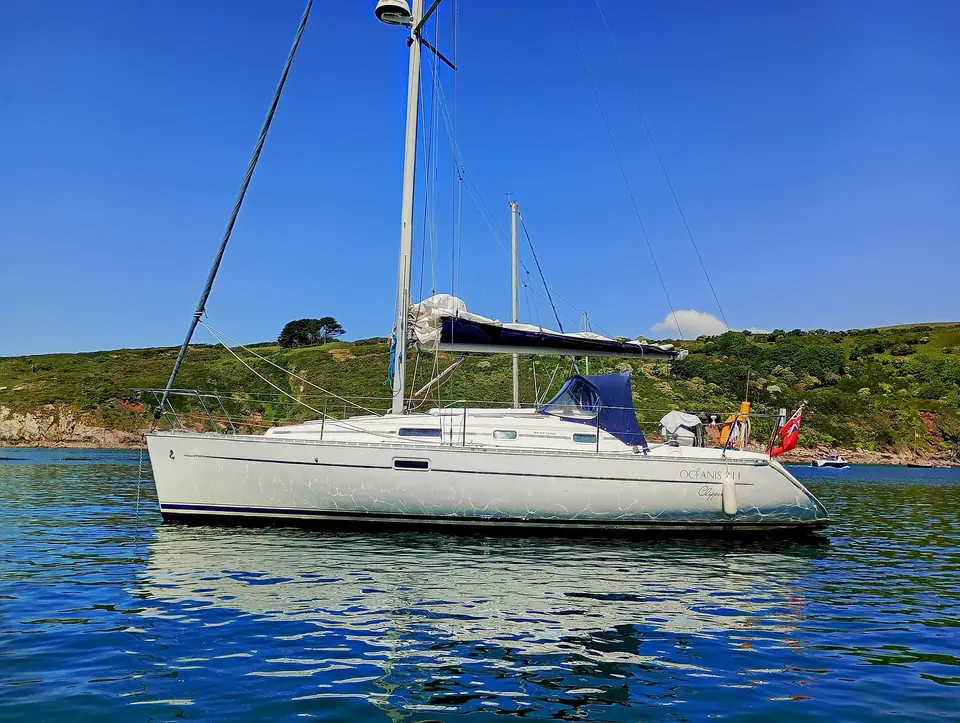
We have not found a freely licensed photo of the Beneteau First 40 yet, so these show other Beneteau boats, each captioned with the boat pictured.
More performance sailboats to explore
J/40
Performance Sailboats, 41 ft
Used $45K to $620K
J/124
Performance Sailboats, 41 ft
Used $130K to $220K
Dufour 40 Performance
Performance Sailboats, 40 ft
Used $85K to $145K
Dehler 42
Performance Sailboats, 42 ft
Used $230K to $360K
Other Beneteau models
- Beneteau 49
- Beneteau 50
- Beneteau 57
- Beneteau 343
- Beneteau Antares 5.80
- Beneteau Antares 6
- Beneteau Antares 6.80
- Beneteau Antares 7
- Beneteau Antares 7.30
- Beneteau Antares 7.60
- Beneteau Antares 7.80
- Beneteau Antares 8
- Beneteau Antares 8.00
- Beneteau Antares 8.05
- Beneteau Antares 8.60
- Beneteau Antares 8.80
- Beneteau Antares 9
- Beneteau Antares 9.80
- Beneteau Antares 10.80
- Beneteau Antares 11
- Beneteau Antares 12
- Beneteau Antares 13.80
- Beneteau Antares 30
- Beneteau Antares 32
- Beneteau Antares 36
- Beneteau Antares 42
- Beneteau Antares 620 HB
- Beneteau Antares 650 HB
- Beneteau Antares 750 HB
- Beneteau Cyclades 39.3
- Beneteau Cyclades 43.3 and 43.4
- Beneteau Cyclades 50.5
- Beneteau First 18 SE
- Beneteau First 20
- Beneteau First 21.7
- Beneteau First 24
- Beneteau First 25
- Beneteau First 25.7
- Beneteau First 27
- Beneteau First 27.7
- Beneteau First 30
- Beneteau First 31.7
- Beneteau First 35
- Beneteau First 36
- Beneteau First 36.7
- Beneteau First 38
- Beneteau First 40.7
- Beneteau First 44
- Beneteau First 45
- Beneteau First 47.7
- Beneteau First 53
- Beneteau First 211
- Beneteau First 235
- Beneteau First 285
- Beneteau First 305
- Beneteau First 310
- Beneteau First 345
- Beneteau Flyer 6
- Beneteau Flyer 7
- Beneteau Flyer 8
- Beneteau Flyer 9
- Beneteau Flyer 10
- Beneteau Flyer 12
- Beneteau Flyer 500
- Beneteau Flyer 550
- Beneteau Flyer 650
- Beneteau Flyer 701
- Beneteau Flyer 750
- Beneteau Grand Trawler 62
- Beneteau Gran Turismo 32
- Beneteau Gran Turismo 36
- Beneteau Gran Turismo 40
- Beneteau Gran Turismo 41
- Beneteau Gran Turismo 44
- Beneteau Gran Turismo 45
- Beneteau Monte Carlo 6
- Beneteau Oceanis 30.1
- Beneteau Oceanis 31
- Beneteau Oceanis 34
- Beneteau Oceanis 34.1
- Beneteau Oceanis 35
- Beneteau Oceanis 35.1
- Beneteau Oceanis 36 CC
- Beneteau Oceanis 37
- Beneteau Oceanis 38
- Beneteau Oceanis 38.1
- Beneteau Oceanis 40
- Beneteau Oceanis 40 CC
- Beneteau Oceanis 41
- Beneteau Oceanis 41.1
- Beneteau Oceanis 42
- Beneteau Oceanis 42 CC
- Beneteau Oceanis 43
- Beneteau Oceanis 44 CC
- Beneteau Oceanis 45
- Beneteau Oceanis 46
- Beneteau Oceanis 46.1
- Beneteau Oceanis 48
- Beneteau Oceanis 50
- Beneteau Oceanis 51.1
- Beneteau Oceanis 54
- Beneteau Oceanis 55
- Beneteau Oceanis 58
- Beneteau Oceanis 311
- Beneteau Oceanis 320
- Beneteau Oceanis 321
- Beneteau Oceanis 323
- Beneteau Oceanis 331
- Beneteau Oceanis 350
- Beneteau Oceanis 351
- Beneteau Oceanis 370
- Beneteau Oceanis 390
- Beneteau Oceanis 400
- Beneteau Oceanis 411
- Beneteau Oceanis 423
- Beneteau Oceanis 430
- Beneteau Oceanis 440
- Beneteau Oceanis 461
- Beneteau Oceanis 473
- Beneteau Oceanis 500
- Beneteau Oceanis 510
- Beneteau Oceanis Clipper 361
- Beneteau Oceanis Clipper 373
- Beneteau Oceanis Clipper 381
- Beneteau Oceanis Clipper 393
- Beneteau Oceanis Yacht 54
- Beneteau Oceanis Yacht 60
- Beneteau Oceanis Yacht 62
- Beneteau Sense 43
- Beneteau Sense 46
- Beneteau Sense 50
- Beneteau Sense 55
- Beneteau Swift Trawler 30
- Beneteau Swift Trawler 34
- Beneteau Swift Trawler 35
- Beneteau Swift Trawler 41
- Beneteau Swift Trawler 44
- Beneteau Swift Trawler 48
- All Beneteau models