Beneteau Oceanis 51.1 Buyer's Guide, With Notes on the Classic Oceanis 510
Beneteau's chined 52-footer that sold about 500 hulls, and how it differs from the 1990s Oceanis 510 that shares its name.
- Length
- 52.3 ft15.95 m
- Beam
- 15.8 ft4.8 m
- Draft
- 7.6 ft2.31 m
- Cabins
- 3 to 5
- Used price
- $280K to $770K
On this page
- Overview
- Oceanis 510 or Oceanis 51.1, two very different boats
- A flagship that sold out before it was shown
- Easy, Comfort or First Line, choosing the right version
- Under sail and power, the published numbers
- The helm stations and a few design quirks
- Living aboard, from three cabins to five
- Saildrive or shaft drive
- Running costs and the resale picture after the Oceanis 52
- Specifications
- Price and value
- Strengths and weaknesses
- Used buyer checklist
- Rivals
- Our verdict
- FAQ
The Oceanis 51.1 is a Berret-Racoupeau designed 52-foot cruiser built from 2017 to 2025 in Easy, Comfort and First Line versions. The unrelated Oceanis 510 was a heavier 50-footer built from 1992 to 1997.
- Couples who host family and friends
- Owners moving up from a 45-footer
- Charter fleet buyers
- Coastal cruisers who motor often
Beneteau Oceanis 51.1 by the numbers
- Sail area to displacement
- 16.5Balanced power for coastal and offshore cruising.
- Displacement to length
- 126Light displacement for its length, quick but sensitive to added cruising weight.
- Theoretical hull speed
- 9.3 knThe practical top speed of a displacement monohull under normal sailing, based on waterline length.
- Ballast ratio
- 24%Relatively low ballast, form stability does more of the work.
- Capsize screening
- 2.01Above 2.0, so this hull leans toward coastal stability over ultimate offshore resistance.
- Motion comfort ratio
- 24.6A quicker motion in waves, typical of light, beamy hulls.
- Length to beam ratio
- 3.32 : 1Moderate proportions.
Oceanis 510 or Oceanis 51.1, two very different boats
Search for a Beneteau Oceanis 510 and you will find two boats a generation apart. The original Oceanis 510, sometimes listed as the Oceanis 51, was built from 1992 to 1997. It was also drawn by Berret-Racoupeau, measured about 50 feet overall and displaced roughly 37,000 pounds with 13,228 pounds of ballast. About 100 were built in three and four cabin layouts, and it was pitched as a family clipper able to make the occasional ocean passage.
The Oceanis 51.1 that this guide focuses on arrived at the Cannes Yachting Festival in September 2017. It is longer at 52 ft 4 in, beamier, and more than 6,000 pounds lighter, with a ballast ratio of about 24 percent against the 510's 36 percent. The two boats share a designer and a name, but almost nothing else: the 510 is a heavy, deep-cockpit cruiser of the old school, the 51.1 is a wide-sterned, twin-rudder, chined modern cruiser.
A 1993 Oceanis 510 in good order typically asks $80,000 to $150,000 in the US. For that money you get a solid hull, a big interior and an engine and rig that are probably on their second or third set of most components. The 51.1 is a $300,000 to $770,000 boat. They are not competing for the same buyer, so decide which era you want before you start comparing listings.
A flagship that sold out before it was shown
Beneteau had already sold its entire first year of 51.1 production before the boat appeared at a single show, according to Germany's Yacht magazine. It replaced the Oceanis 48 and stayed in the lineup for eight years, with about 500 hulls built before the Oceanis 52 took over at Cannes in September 2025. That production run makes it one of the most common 50-foot monohulls in charter fleets and on the brokerage market.
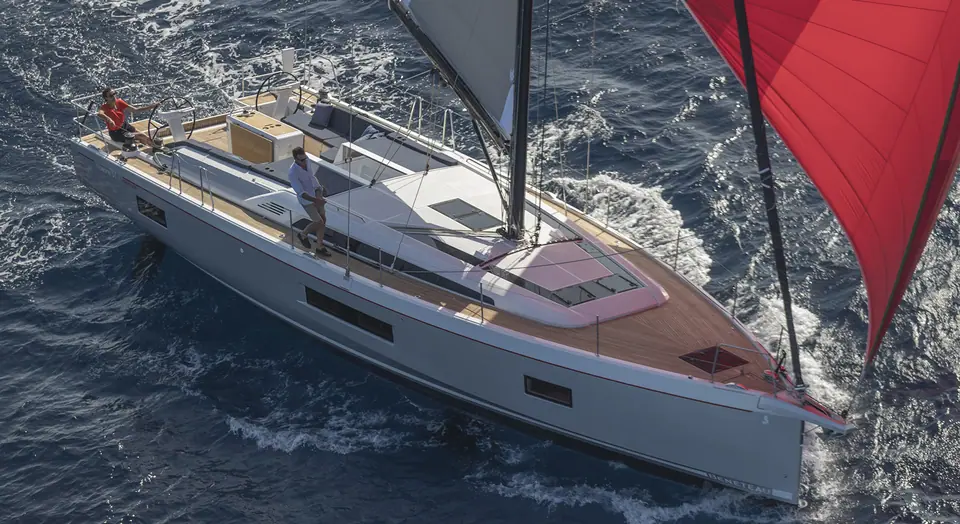
The design team was Berret-Racoupeau for the hull and Nauta for the interior. The hull's signature is a hard chine running from bow to stern, which the designers linked to the 88-foot racing yacht Rambler. Below the chine the forward sections stay fine for a clean entry and low wetted surface, while above it the volume flares out to make room for a forward cabin that Yacht magazine compared to those normally found on 60-footers.
Easy, Comfort or First Line, choosing the right version
Beneteau sold the 51.1 in three flavors built on the same hull. The Easy version used a self-tacking jib, in-mast furling and a minimum of winches, aimed at couples and charter fleets. Comfort added a cockpit arch, more equipment and cruising features. First Line was the performance version, with about 35 percent more sail area, a taller carbon or aluminum spar and a 9 ft 2 in bulb keel.
For most US buyers the Comfort spec with the standard 7 ft 7 in keel is the right choice. First Line boats are genuinely quick but draw too much for much of the East Coast, and their laminate sails are expensive to replace. Easy spec boats can be upgraded with a genoa, code zero and asymmetric spinnaker, all of which were factory options.
- Shoal keel about 6 ft 1 in for the Bahamas, Chesapeake and Florida Keys
- Standard air draft 70 ft 1 in; First Line adds about five feet
- Two mainsheet choices: arch-mounted or German-style double-ended to both helms
- Dock and Go rotating saildrive package was available for joystick docking
Under sail and power, the published numbers
Cruising World sailed a 51.1 in 10 to 11 knots of wind with waves and recorded 7.4 knots close hauled under main and the 90 percent self-tacking jib, and 7.4 knots reaching with a code zero. The tester tacked repeatedly without touching a sheet, which sums up the boat's appeal for a couple. In the Pacific Northwest, 48 North logged nearly 6 knots upwind at 45 degrees true in lighter air and noted that the boat tracked in perfect balance with the wheel left alone for a full minute.
Under power the 51.1 is unusually fast for a sailboat when fitted with the larger engine. SAIL's test boat, fitted with an upgraded engine it described as 100 hp, reached 10.1 knots at 3,400 rpm and cruised at 9.7 knots at 2,500 rpm, while Cruising World recorded 7.9 knots at 2,100 rpm and 8.6 knots at 2,800 rpm. 48 North, testing a boat with the 110 hp engine on Lake Union, saw just over 9 knots flat out and reckoned on an 8 to 8.5 knot cruise, enough to turn a 10 hour Seattle to Anacortes run into roughly 7.5 hours.
With the standard 53 gallon tank, that speed comes at a cost in range. SAIL notes that an optional extra tank doubles fuel capacity, and any 51.1 being bought for extended cruising should have it, along with a watermaker to stretch the standard 116 gallons of water.
The helm stations and a few design quirks
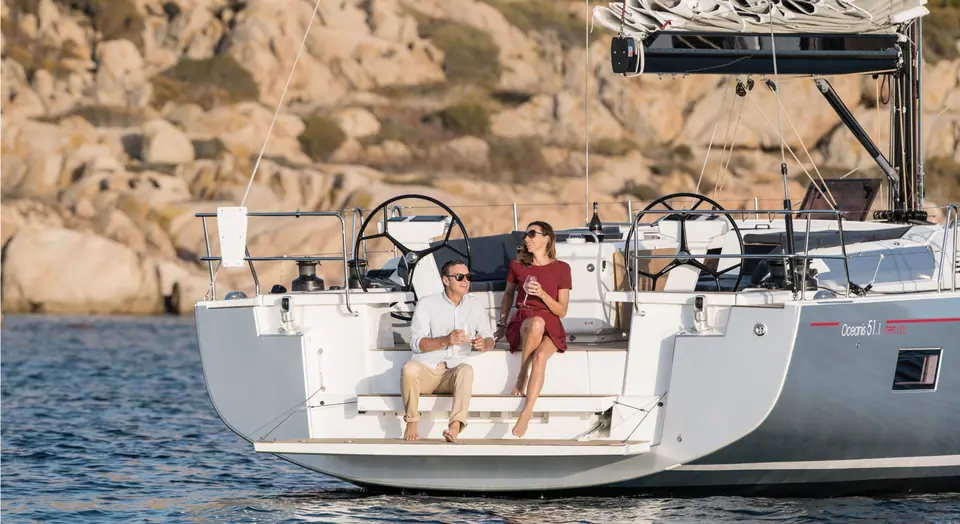
The twin rudders give a light, quick helm, and dual electric self-tailing winches at each wheel let one person handle the boat. Raised lifelines, wide side decks and a companionway that SAIL compared to a staircase make moving around safe. The cockpit table is huge and the hideaway davits and swing-out galley grill are well-liked features.
SAIL listed some real annoyances. The helm consoles are small and accept only about nine-inch displays, the engine controls sit near the helmsman's ankles, the bow thruster joystick is easy to bump during docking, and on the test boat the water and waste deck fills were only about four inches apart. Cruising World found the full bimini blocked the view of the mainsail, a common complaint on big production cruisers. Most owners solve the deck fill issue with clear labeling and a different fill cap color.
Living aboard, from three cabins to five
The three cabin owner's version puts the master suite forward, with an island queen berth, walk-around space, nightstands, a sofa and separate head and shower compartments. Two aft cabins share the stern, and an owner's area combines a navigation desk with a reclining athwartships seat. The saloon has generous U-shaped dinette seating, and the C-shaped galley sits forward to port with good fridge and freezer space.
Charter versions split the boat into four or five cabins with three or four heads. These are common on the used market, especially from Mediterranean and Caribbean fleets, and they cost much less. The layout is fine for a large family, but the smaller aft cabins and extra heads mean more maintenance and less stowage.
Saildrive or shaft drive
The standard engine is an 80 hp Yanmar on a saildrive. The upgrade is a 110 hp Yanmar on a conventional shaft, and for US buyers it is the version to find. Shaft drive avoids the seven-year saildrive diaphragm replacement, is easier to service in remote places, and the extra power transforms motoring into a headsea. The trade-off is a little more drag under sail and a slightly higher purchase price.
Running costs and the resale picture after the Oceanis 52
Plan on $32,000 to $65,000 a year for a 52-foot berth, insurance, haul out, engine and generator service, and wear items. A 52-foot slip on the US East or West Coast is the single largest cost, and many marinas charge by the overall length including the bowsprit and davits.
The arrival of the Oceanis 52, with a European gross price of about €571,690, has made late model 51.1s look like good value. Expect privately owned 2022 to 2024 boats to hold their prices well. Ex-charter boats will remain the bargain end of the market, and they are perfectly usable if you budget for new sails, cushions and electronics.
Beneteau Oceanis 51.1 specifications
| Length overall | 52.3 ft15.95 m |
|---|---|
| Waterline length | 47.7 ft14.53 m |
| Beam | 15.8 ft4.8 m |
| Draft | 7.6 ft2.31 m |
| Air draft | 70.1 ft21.37 m |
| Displacement | 30,702 lbs13,926 kg |
| Ballast | 7,485 lbs3,395 kg |
| Sail area | 1,011 sq ft93.9 m² |
| Fuel capacity | 53 gal201 L |
| Fresh water | 116 gal439 L |
| Cabins | 3 to 5 |
| Heads | 2 to 4 |
| Standard engines | Yanmar 80 hp diesel, saildrive |
| Optional engines | Yanmar 110 hp diesel, shaft drive |
| Maximum power | 110 hp |
| Cruise speed | 7.9 knots |
| Top speed | 10.1 knots |
| Hull type | Monohull with full-length hard chine and twin rudders |
| Keel | Iron fin 7 ft 7 in (standard), shoal fin about 6 ft 1 in, or 9 ft 2 in bulb keel with the First Line package |
| Rig | Fractional sloop, in-mast furling main and self-tacking jib standard; taller carbon or aluminum mast with First Line |
| Hull construction | Vacuum-infused fiberglass with balsa core, vinylester outer layer |
| CE design category | A |
| Builder | Beneteau (Groupe Beneteau), France |
| Naval architect | Berret-Racoupeau Yacht Design |
| Other design credits | Nauta Design (interior and styling) |
| Production | 2017 to 2025 |
| Status | Discontinued |
Figures come from builder documentation and independent tests where available. Displacement is usually quoted light, so a loaded cruising boat will weigh more. Compare these specs with another model.
Performance data
| Condition | Speed (kn) | Source |
|---|---|---|
| Close hauled, 10 to 11 kn true, main and self-tacking jib | 7.4 | Cruising World |
| Reaching with code zero, 10 to 11 kn true | 7.4 | Cruising World |
| Motoring 2,100 rpm, 110 hp shaft drive | 7.9 | Cruising World |
| Motoring 2,800 rpm | 8.6 | Cruising World |
| Motoring 2,500 rpm, upgraded engine | 9.7 | SAIL |
| Wide open throttle 3,400 rpm | 10.1 | SAIL |
Published sea trial figures. Light air on the Chesapeake limited SAIL's sailing results to about 5 knots in 6.4 knots apparent.
How much does a Beneteau Oceanis 51.1 cost?
SAIL listed a $412,600 base price in 2018, and by the time Cruising World tested a later boat the base had climbed to about $600,000 with the test boat at $630,000. Used values split sharply between five cabin ex-charter boats, which can dip below $300,000 in Europe, and privately ordered three cabin boats with the 110 hp shaft drive, generator and air conditioning, which ask $550,000 to $770,000 in the US. The original Oceanis 510 from the 1990s is a separate market at roughly $80,000 to $150,000.
Estimate your yearly cost
A planning estimate using common rules of thumb: insurance near 1.5 percent of value, maintenance near 3 percent, haul out and bottom paint by length. Your marina, region and use will move these numbers. Open the full cost calculator.
Versions and options
- Easy
- Self-tacking jib, in-mast furling and minimal winches. Popular with charter fleets.
- Comfort
- Cruising spec with a cockpit arch, more deck gear and comfort options. The best fit for most private owners.
- First Line
- About 35 percent more sail area, taller spar and a 9 ft 2 in bulb keel for owners who want performance.
- Oceanis 510 (1992 to 1997)
- Different, earlier Berret-Racoupeau design of about 50 feet and 37,000 pounds, built in roughly 100 units.
Beneteau Oceanis 51.1 timeline
- 1992The original Oceanis 510 enters production, running until 1997
- 2017Oceanis 51.1 premieres at Cannes, with the first year of production already sold
- 2018US base price listed at $412,600
- 2025Production ends after about 500 hulls as the Oceanis 52 debuts at Cannes
Strengths and weaknesses
What owners like
- Huge forward owner's cabin for a 52-footer
- Fast under power with the 110 hp shaft drive option
- Light, balanced twin rudder helm
- Easy short-handed handling with the self-tacking jib
- Large supply of used boats and a wide price range
What to weigh up
- Small standard tanks, especially fuel
- Cramped helm consoles and low engine controls
- Bimini blocks the view of the mainsail
- First Line draft is too deep for many US waters
- Ex-charter boats can be tired
Used Beneteau Oceanis 51.1 buyer checklist
Take this list to a viewing. Your ticks are saved in this browser so you can come back to it.
Always commission an independent marine survey and an engine survey before you buy. How a marine survey works.
Rivals to consider
Jeanneau Sun Odyssey 490
Sister brand boat with a walk-around deck and a sportier feel, slightly smaller inside.
Hanse 510
More modern interior and self-tacking jib as standard, but less common on the US used market.
Beneteau Oceanis Yacht 60
The step up in Beneteau's own range, with far more finish and a tender garage.
Compare side by sideOur verdict on the Beneteau Oceanis 51.1
The Oceanis 51.1 is the boat to buy if you want a 50-footer that two people can sail and a crowd can live on. It sails better than its volume suggests, motors faster than most rivals with the 110 hp shaft drive, and the forward cabin is excellent. Look for a privately owned Comfort spec boat with the standard keel and extra tankage. Buyers drawn to the 1990s Oceanis 510 should treat it as a separate, older and heavier boat, and judge it on the condition of its systems rather than its design.
Beneteau Oceanis 51.1 questions answered
Is the Oceanis 510 the same boat as the Oceanis 51.1?
No. The Oceanis 510 was built from 1992 to 1997 and weighs about 37,000 pounds. The Oceanis 51.1 was built from 2017 to 2025 and is a completely different, lighter design.
How much does a 1993 Beneteau Oceanis 510 cost?
Most 1992 to 1994 Oceanis 510s ask between about $80,000 and $150,000 in the US, depending on condition and refits.
How much is a used Beneteau Oceanis 51.1?
Expect roughly $280,000 for an older ex-charter boat up to about $770,000 for a well-equipped late model owner's version.
What replaced the Oceanis 51.1?
The Oceanis 52, designed by Biscontini Yacht Design, replaced it at the Cannes Yachting Festival in September 2025.
How fast is the Oceanis 51.1?
Testers recorded 7.4 knots close hauled in 10 to 11 knots of wind, and up to 10.1 knots under power with the larger engine.
How many Oceanis 51.1 were built?
About 500 hulls were built during its roughly eight year production run, according to SAIL.
Beneteau Oceanis 51.1 photos
More cruising sailboats to explore
Jeanneau 54
Cruising Sailboats, 53 ft
Used $230K to $560K
Beneteau Cyclades 50.5
Cruising Sailboats, 51 ft
Used $100K to $175K
Dufour 530
Cruising Sailboats, 54 ft
Used $470K to $760K
Beneteau 50
Cruising Sailboats, 51 ft
Used $110K to $250K
Other Beneteau models
- Beneteau 49
- Beneteau 50
- Beneteau 57
- Beneteau 343
- Beneteau Antares 5.80
- Beneteau Antares 6
- Beneteau Antares 6.80
- Beneteau Antares 7
- Beneteau Antares 7.30
- Beneteau Antares 7.60
- Beneteau Antares 7.80
- Beneteau Antares 8
- Beneteau Antares 8.00
- Beneteau Antares 8.05
- Beneteau Antares 8.60
- Beneteau Antares 8.80
- Beneteau Antares 9
- Beneteau Antares 9.80
- Beneteau Antares 10.80
- Beneteau Antares 11
- Beneteau Antares 12
- Beneteau Antares 13.80
- Beneteau Antares 30
- Beneteau Antares 32
- Beneteau Antares 36
- Beneteau Antares 42
- Beneteau Antares 620 HB
- Beneteau Antares 650 HB
- Beneteau Antares 750 HB
- Beneteau Cyclades 39.3
- Beneteau Cyclades 43.3 and 43.4
- Beneteau Cyclades 50.5
- Beneteau First 18 SE
- Beneteau First 20
- Beneteau First 21.7
- Beneteau First 24
- Beneteau First 25
- Beneteau First 25.7
- Beneteau First 27
- Beneteau First 27.7
- Beneteau First 30
- Beneteau First 31.7
- Beneteau First 35
- Beneteau First 36
- Beneteau First 36.7
- Beneteau First 38
- Beneteau First 40
- Beneteau First 40.7
- Beneteau First 44
- Beneteau First 45
- Beneteau First 47.7
- Beneteau First 53
- Beneteau First 211
- Beneteau First 235
- Beneteau First 285
- Beneteau First 305
- Beneteau First 310
- Beneteau First 345
- Beneteau Flyer 6
- Beneteau Flyer 7
- Beneteau Flyer 8
- Beneteau Flyer 9
- Beneteau Flyer 10
- Beneteau Flyer 12
- Beneteau Flyer 500
- Beneteau Flyer 550
- Beneteau Flyer 650
- Beneteau Flyer 701
- Beneteau Flyer 750
- Beneteau Grand Trawler 62
- Beneteau Gran Turismo 32
- Beneteau Gran Turismo 36
- Beneteau Gran Turismo 40
- Beneteau Gran Turismo 41
- Beneteau Gran Turismo 44
- Beneteau Gran Turismo 45
- Beneteau Monte Carlo 6
- Beneteau Oceanis 30.1
- Beneteau Oceanis 31
- Beneteau Oceanis 34
- Beneteau Oceanis 34.1
- Beneteau Oceanis 35
- Beneteau Oceanis 35.1
- Beneteau Oceanis 36 CC
- Beneteau Oceanis 37
- Beneteau Oceanis 38
- Beneteau Oceanis 38.1
- Beneteau Oceanis 40
- Beneteau Oceanis 40 CC
- Beneteau Oceanis 41
- Beneteau Oceanis 41.1
- Beneteau Oceanis 42
- Beneteau Oceanis 42 CC
- Beneteau Oceanis 43
- Beneteau Oceanis 44 CC
- Beneteau Oceanis 45
- Beneteau Oceanis 46
- Beneteau Oceanis 46.1
- Beneteau Oceanis 48
- Beneteau Oceanis 50
- Beneteau Oceanis 54
- Beneteau Oceanis 55
- Beneteau Oceanis 58
- Beneteau Oceanis 311
- Beneteau Oceanis 320
- Beneteau Oceanis 321
- Beneteau Oceanis 323
- Beneteau Oceanis 331
- Beneteau Oceanis 350
- Beneteau Oceanis 351
- Beneteau Oceanis 370
- Beneteau Oceanis 390
- Beneteau Oceanis 400
- Beneteau Oceanis 411
- Beneteau Oceanis 423
- Beneteau Oceanis 430
- Beneteau Oceanis 440
- Beneteau Oceanis 461
- Beneteau Oceanis 473
- Beneteau Oceanis 500
- Beneteau Oceanis 510
- Beneteau Oceanis Clipper 361
- Beneteau Oceanis Clipper 373
- Beneteau Oceanis Clipper 381
- Beneteau Oceanis Clipper 393
- Beneteau Oceanis Yacht 54
- Beneteau Oceanis Yacht 60
- Beneteau Oceanis Yacht 62
- Beneteau Sense 43
- Beneteau Sense 46
- Beneteau Sense 50
- Beneteau Sense 55
- Beneteau Swift Trawler 30
- Beneteau Swift Trawler 34
- Beneteau Swift Trawler 35
- Beneteau Swift Trawler 41
- Beneteau Swift Trawler 44
- Beneteau Swift Trawler 48
- All Beneteau models