Bavaria Yachts Cruising Sailboats
Bavaria 820, a 1980s Pocket Cruiser From Bavaria's Early Years
One of the small fin-keel cruisers that turned a young Giebelstadt yard into a builder, now a 40-year-old boat bought on condition alone.
- Length
- 27 ft8.23 m
- Beam
- 9 ft2.74 m
- Draft
- 5 ft1.52 m
- Cabins
- Not verified; interiors vary from boat to boat
- Used price
- $7K to $18K
On this page
- Overview
- Bavaria before the assembly line
- What the recorded specifications tell you
- Axel Mohnhaupt and the early Bavaria character
- Expect the interior to vary from boat to boat
- The engine question on a 40-year-old 27-footer
- Where early Bavarias show their age
- Should a US sailor look for one?
- Specifications
- Price and value
- Strengths and weaknesses
- Used buyer checklist
- Rivals
- Our verdict
- FAQ
The Bavaria 820 is a 27 ft fractional sloop designed by Axel Mohnhaupt and built by Bavaria Yachtbau from 1982 to 1985, with about 130 completed. Nearly all survivors are in Europe and sell as budget starter cruisers.
- First-time owners in Europe
- Lake and inland water sailing
- Budget weekend cruising for two
- DIY refit projects
Bavaria 820 by the numbers
- Sail area to displacement
- 14.4A cruising rig sized for comfort, so expect to motor in very light air.
- Displacement to length
- 231Moderate displacement, a classic cruising balance between load carrying and speed.
- Theoretical hull speed
- 6.3 knThe practical top speed of a displacement monohull under normal sailing, based on waterline length.
- Capsize screening
- 2.04Above 2.0, so this hull leans toward coastal stability over ultimate offshore resistance.
- Motion comfort ratio
- 19.4A quicker motion in waves, typical of light, beamy hulls.
- Length to beam ratio
- 3.00 : 1Moderate proportions.
Bavaria before the assembly line
Today Bavaria is associated with charter fleets and factory-scale production, but in 1982, when the Bavaria 820 appeared, the company was four years old. Winfried Herrmann, who ran a window manufacturing business, and Josef Meltl, a yacht charter broker, had founded Bavaria Yachtbau in Giebelstadt in 1978, hundreds of miles from the sea. Its first boats, the Bavaria 707 and 808, were drawn by Kurt Schroter. From 1981 the yard turned to Axel Mohnhaupt, who designed a run of small and mid-size cruisers: the 770, the 890 flagship, the 606, the 820 and, from 1985, the 960 and 1060.
The model names roughly track hull length in decimeters, so the 820 is an 8.2 meter boat, about 27 feet. Sailboatdata records it as built from 1982 to 1985, with around 130 completed. That is a small number by later Bavaria standards, when the yard turned out thousands of boats a year, and it explains why the 820 is rarely seen outside German-speaking Europe.
What the recorded specifications tell you
Published data on the 820 is thin and clearly rounded: 27 ft overall, 22 ft on the waterline, 9 ft of beam, 5 ft of draft and a displacement of about 5,500 lb, with 280 sq ft of reported sail area on a fractional sloop rig. Ballast weight and tank sizes are not recorded in any source we could find, so treat any listing that quotes them precisely with mild suspicion unless the seller has the original brochure.
Run those figures through the usual formulas and they describe a moderate-displacement coastal cruiser. The displacement to length ratio works out to roughly 230, the sail area to displacement ratio to about 14 and the theoretical hull speed to roughly 6.3 knots. That sail area figure probably reflects a small working headsail; an 820 with only the standard sails will want a larger genoa or a light-air sail to move in under 8 knots of wind.
Axel Mohnhaupt and the early Bavaria character
We could not find a contemporary magazine test of the 820 itself, but YACHT's long used-boat review of its bigger sister, the Mohnhaupt-designed 890, gives a good sense of the family. The magazine described Mohnhaupt as a designer with America's Cup experience and a background in fluid mechanics, and found the 890 surprisingly light on the helm, sensitive upwind and almost nervous on the rudder, tacking through about 80 degrees in light air.
The same test noted that young Bavaria modeled itself on Nautor's Swan when it came to solidity, with a fully laminated hull to deck joint and a heavy ballast ratio on the 890. Whether every detail carried over to the smaller 820 is not documented, so a surveyor should confirm the hull to deck join and keel attachment on the boat in front of you rather than assume it.
Expect the interior to vary from boat to boat
Bavaria in the early 1980s was not yet a factory of fixed options. On the 890, YACHT found two quite different interiors: an early version with the toilet compartment between saloon and forepeak and the galley by the companionway, and a later one that moved the furniture forward and put a small toilet room aft. Engines also varied, from a Volvo saildrive in the brochure to a Faryman on a shaft fitted at the factory.
That pattern is worth keeping in mind with an 820. No layout drawing for the boat is widely published, and four decades of owners have rebuilt, removed and added furniture. Measure berths before you commit; the 890's berths were only 1.90 m (6 ft 3 in) long, generous for 1982 German sailors but tight for many buyers today. Headroom on a 27-footer of this vintage is also likely to fall short of six feet.
The engine question on a 40-year-old 27-footer
Sailboatdata lists the original auxiliary as a 10 hp Volvo Penta diesel. Any original engine still in service is near the end of its life, and most 820s on the market have either been repowered or need to be. Budget roughly $8,000 to $14,000 for a new small diesel installed, more if the boat has a saildrive and you replace the leg.
If the boat has a saildrive, check the age of the rubber diaphragm and look for milky oil in the leg, a sign of failing seals. A shaft installation gives more freedom when choosing a replacement engine, because you are not tied to a specific saildrive adapter. Either way, a recent repower with receipts is the single most valuable thing an 820 can have.
Where early Bavarias show their age
YACHT's 890 test is again the best guide to the problems of boats from this period, and most of them are age-related rather than design faults. Plexiglas cabin windows go brittle and leak, and replacing them properly is harder than it looks. Glued vinyl or velour headliners come loose and are tedious to replace. Original teak in the cockpit rarely survives three decades. The 890's cast aluminum stemhead fitting proved brittle and irreplaceable after a collision, and its upper rudder bearing had worn enough to cause vibration.
Add the usual checks for any 1980s fiberglass boat: moisture in a cored deck around stanchions and fittings, the condition of chainplates and standing rigging, keel bolts and the keel to hull joint, osmosis blisters if the boat has spent decades in fresh water then moved to salt, and the age of the electrical system.
Should a US sailor look for one?
For most American buyers the honest answer is no, unless one turns up nearby. A Catalina 27, Hunter 27 or Contessa 26 offers similar size, a far bigger owner community and readily available parts, and is easy to find in any US region. The 820's appeal is that it is a solid, simply rigged small cruiser at a very low price in Europe, a good boat for a sailor based on a German or Austrian lake or the Dutch waterways.
If you do buy one, the economics are those of any old 27-footer. Expect annual costs of about $4,000 to $9,000 in the US covering a slip or mooring, haul-out, bottom paint, insurance and routine engine work, before any refit projects. Keep the purchase price low enough that a repower or new sails do not push the total above what a comparable Catalina would have cost.
Bavaria 820 specifications
| Length overall | 27 ft8.23 m |
|---|---|
| Waterline length | 22 ft6.71 m |
| Beam | 9 ft2.74 m |
| Draft | 5 ft1.52 m |
| Displacement | 5,5 lbs2,495 kg |
| Sail area | 28 sq ft26 m² |
| Cabins | Not verified; interiors vary from boat to boat |
| Heads | Not verified |
| Standard engines | Volvo Penta diesel of about 10 hp (recorded by sailboatdata as an MC5C) |
| Hull type | Fin keel monohull with spade rudder |
| Keel | Fixed fin keel, about 5 ft draft |
| Rig | Fractional sloop |
| Hull construction | Fiberglass (GRP) |
| Builder | Bavaria Yachtbau, Giebelstadt, Germany |
| Naval architect | Axel Mohnhaupt |
| Production | 1982 to 1985 |
| Status | Discontinued |
Figures come from builder documentation and independent tests where available. Displacement is usually quoted light, so a loaded cruising boat will weigh more. Compare these specs with another model.
How much does a Bavaria 820 cost?
There is no real US market for the Bavaria 820; almost every survivor sits in Germany, Austria, the Netherlands or on Central European lakes, where asking prices for 1980s 27-footers typically run from the high single thousands to the high teens in euros. Condition swamps age: a boat with a recent repower, new windows and decent sails can be worth twice a tired one. Shipping one to the US usually costs more than the boat, so buy where it lies or not at all.
Estimate your yearly cost
A planning estimate using common rules of thumb: insurance near 1.5 percent of value, maintenance near 3 percent, haul out and bottom paint by length. Your marina, region and use will move these numbers. Open the full cost calculator.
Versions and options
- Bavaria 820
- The only recorded version: a fin keel, spade rudder fractional sloop built 1982 to 1985.
- Sister models
- Bavaria 770 (25 ft) and 890 (29 ft, 1981 to 1985 per sailboatdata) were Mohnhaupt designs of the same era; the 960 and 1060 followed in 1985.
Bavaria 820 timeline
- 1978Winfried Herrmann and Josef Meltl found Bavaria Yachtbau in Giebelstadt; first boats are the Schroter-designed 707 and 808
- 1981Axel Mohnhaupt designs begin; his 890 flagship premieres at boot Dusseldorf and the 770 follows
- 1982Bavaria 820 enters production
- 1985820 production ends after about 130 boats; the Mohnhaupt 960 and 1060 arrive
Strengths and weaknesses
What owners like
- Very low purchase price in Europe
- Simple fractional sloop rig that is easy to handle
- Designed by an experienced performance designer
- Small size keeps running costs modest
- Part of a well-documented early Bavaria family
What to weigh up
- Almost none in the US, and import costs exceed the boat's value
- Sparse published data and no known magazine test
- Original engines are at the end of their lives
- Interior space and headroom are modest by modern standards
- Small owner community for parts and advice
Used Bavaria 820 buyer checklist
Take this list to a viewing. Your ticks are saved in this browser so you can come back to it.
Always commission an independent marine survey and an engine survey before you buy. How a marine survey works.
Rivals to consider
Catalina 27
The obvious US alternative, with thousands built and parts everywhere.
Compare side by sideBavaria 890
The bigger Mohnhaupt sister from the same years, with more space and a strong used-boat reputation in Germany.
Our verdict on the Bavaria 820
The Bavaria 820 is a footnote in Bavaria's history and a sensible little boat for the right European owner: a Mohnhaupt-designed 27-footer from the years when the yard was still proving it could build solid yachts. Data is sparse, no magazine tested it and every surviving example has been shaped by four decades of owners, so the specific boat matters far more than the model. In Europe, a well-kept 820 with a recent engine is a cheap way into cruising. In the US, it is a curiosity, and a local Catalina or Hunter will almost always be the smarter buy.
Bavaria 820 questions answered
How long is the Bavaria 820?
About 27 ft (8.23 m) overall, with a 22 ft waterline and a 9 ft beam according to sailboatdata.
When was the Bavaria 820 built?
From 1982 to 1985, with about 130 boats completed in Giebelstadt.
Who designed the Bavaria 820?
Axel Mohnhaupt, who designed most of Bavaria's sailboats in the early 1980s, including the 770, 890, 960 and 1060.
What is a Bavaria 820 worth?
Typically the equivalent of about $7,000 to $18,000 in Europe, depending mostly on engine and general condition.
Is the Bavaria 820 a good first boat?
It can be in Europe, if the engine, windows and rigging have been renewed. In the US, a Catalina 27 or similar is easier to own and maintain.
Photos from the Bavaria Yachts range
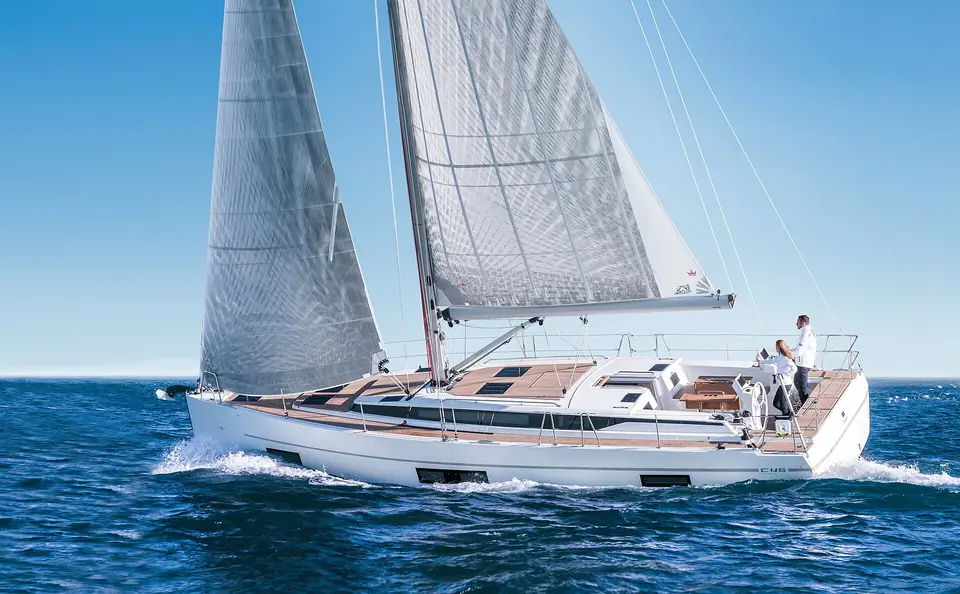
We have not found a freely licensed photo of the Bavaria 820 yet, so these show other Bavaria Yachts boats, each captioned with the boat pictured.
More cruising sailboats to explore
Catalina 27
Cruising Sailboats, 27 ft
Used $3K to $20K
Hunter 27
Cruising Sailboats, 27 ft
Used $5K to $50K
MacGregor 26X
Cruising Sailboats, 26 ft
Used $9K to $25K
Catalina 28
Cruising Sailboats, 29 ft
Used $18K to $62K
Other Bavaria Yachts models
- Bavaria 30 Cruiser
- Bavaria 31 Cruiser
- Bavaria 33 Sport
- Bavaria 35 Cruiser
- Bavaria 35 Match
- Bavaria 38 Cruiser
- Bavaria 39 Cruiser
- Bavaria 42 Cruiser
- Bavaria 43 Cruiser
- Bavaria 44
- Bavaria 47 Ocean
- Bavaria 49
- Bavaria 50 Cruiser
- Bavaria 340
- Bavaria C38
- Bavaria C42
- Bavaria C50
- Bavaria C57
- Bavaria Cruiser 32
- Bavaria Cruiser 33
- Bavaria Cruiser 34
- Bavaria Cruiser 36
- Bavaria Cruiser 37
- Bavaria Cruiser 40
- Bavaria Cruiser 41
- Bavaria Cruiser 45
- Bavaria Cruiser 46
- Bavaria Cruiser 51
- Bavaria Cruiser 55
- Bavaria Cruiser 56
- Bavaria Ocean 38
- Bavaria R40
- Bavaria R55
- Bavaria S29
- Bavaria S33
- Bavaria S36
- Bavaria S40
- Bavaria Sport 32
- Bavaria Sport 34
- Bavaria Sport 35 HT
- Bavaria Sport 39
- Bavaria Sport 43
- Bavaria SR41
- Bavaria Vision 42
- Bavaria Vision 44
- Bavaria Vision 46
- All Bavaria Yachts models