Beneteau 381 Oceanis, the 1996 Clipper 381 as a Used Cruiser
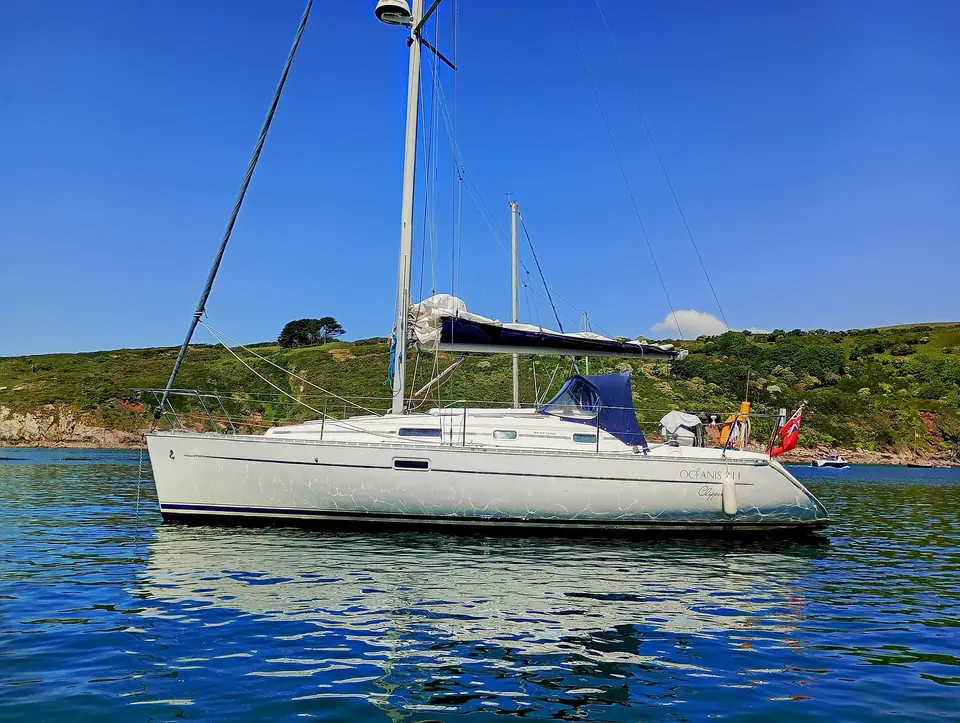
Berret-Racoupeau's 38 footer of the late 1990s, a roomy two cabin cruiser with big water tanks that the 393 later replaced.
- Length
- 38.6 ft11.76 m
- Beam
- 12.9 ft3.94 m
- Draft
- 5.3 ft1.62 m
- Cabins
- 2 (US specification)
- Used price
- $52K to $85K
On this page
- Overview
- Oceanis 381, Clipper 381, Beneteau 381, and not the 38.1
- Berret-Racoupeau's mid-nineties hull in numbers
- Deck and rig as Beneteau USA specified them
- Two cabins, one aft head and a basin in the forecabin
- A carbon rudder stock and other construction notes
- Westerbeke 42, 39 gallons and a 200 amp house bank
- Who the 381 suits today
- Values in 2026 and the case against overpaying
- Specifications
- Price and value
- Strengths and weaknesses
- Used buyer checklist
- Rivals
- Our verdict
- FAQ
The Beneteau Oceanis 381, sold as the Oceanis Clipper 381 in Europe and the Beneteau 381 in the US, is a 38 ft 7 in Berret-Racoupeau cruiser introduced in 1996. It is unrelated to the 2017 Oceanis 38.1.
- Cruising couples on a budget
- Coastal and Bahamas cruising
- Buyers who value water capacity and simplicity
Oceanis 381, Clipper 381, Beneteau 381, and not the 38.1
This is the boat behind searches for a Beneteau 381 Oceanis. Beneteau introduced the Oceanis 381 in 1996 as a Berret-Racoupeau design; its heritage archive now files it under the Oceanis Clipper range of 1995 to 2008, Europe's name for the better-equipped cruising versions. In the US, Beneteau USA's equipment list called it the Oceanis 381 and its website later listed it as the Beneteau 381.
The trap is the Oceanis 38.1, a completely different Finot-Conq boat built from 2017 with twin rudders and a chined hull. A listing that says 381 and shows a single wheel, a rounded 1990s coachroof and cherry joinery is the 1996 boat; a listing that says 38.1 and shows twin wheels and a bowsprit is not.
Sailboatdata also records a charter version, the Moorings 382, based on the 381 and first built in 1996.
Beneteau Oceanis Clipper 381 by the numbers
- Sail area to displacement
- 17.9Balanced power for coastal and offshore cruising.
- Displacement to length
- 189Light displacement for its length, quick but sensitive to added cruising weight.
- Theoretical hull speed
- 7.7 knThe practical top speed of a displacement monohull under normal sailing, based on waterline length.
- Ballast ratio
- 32%A typical ballast ratio for a cruising monohull.
- Capsize screening
- 2.10Above 2.0, so this hull leans toward coastal stability over ultimate offshore resistance.
- Motion comfort ratio
- 22.2A quicker motion in waves, typical of light, beamy hulls.
- Length to beam ratio
- 2.99 : 1A beamy hull with lots of volume for its length.
Berret-Racoupeau's mid-nineties hull in numbers
Beneteau USA listed the 381 at 38 ft 7 in overall, 32 ft 10 in on the waterline, 12 ft 11 in in beam and 5 ft 4 in in draft, with a displacement of 14,991 lb. The French data sheet gives a 11.50 m hull length and 6,800 kg. Sailboatdata adds 4,740 lb of ballast, a healthy ratio of about 32 percent.
The waterline is short for the overall length by modern standards, a product of the overhangs of the era. Wayne Burdick of Beneteau USA made that point himself when the 393 replaced the 381: the newer boat gained more than two feet of waterline, to 35 ft 1 in, and a higher sail area to displacement ratio. Practical Sailor quoted the 381's ratio at 14.45 against about 16 for the 393.
The upshot is a boat that is stiff and steady rather than quick, happiest reaching in a moderate breeze. Theoretical hull speed is about 7.7 knots.
Deck and rig as Beneteau USA specified them
The US boats came with a deck-stepped aluminum mast with in-mast furling, two sets of aft-swept spreaders, discontinuous 1x19 stainless rigging and twin backstays, plus a 140 percent roller-furling genoa. Reported sail area was 681 sq ft and the mast stood 50 ft above the water. A classic mast with a fully battened main and lazy jacks was on the options list, as was gennaker gear.
Hardware was Lewmar: two 48 self-tailing primaries on the coamings and a 40 on the coachroof for the mainsheet and halyards. One quirk is that the genoa and main halyards were jammed off and stowed at the mast, while reefing and furling lines ran aft to six clutches. The cockpit has a pedestal with a 42 in wheel and a table with fold-down leaves, stern rail seats, a starboard cockpit locker and a swim platform with a hinged transom door.
Two cabins, one aft head and a basin in the forecabin
The US equipment list describes a two cabin layout finished in cherry-stained wood with a cherry-battened headliner. Forward is a double berth about 6 ft 7 in long but only about 4 ft 1 in wide, with a hanging locker, a bench seat and its own wash basin. The saloon has a table that converts to a berth, cabinets along the hull and about 6 ft 6 in of headroom, with a navigation station and a galley with a two burner stove and oven, a top-loading freezer and a front-loading refrigerator.
Aft is a single cabin with a double berth that tapers from about 5 ft 11 in to 4 ft 11 in, and a molded one-piece head with a hand shower and a 15 gallon holding tank. Charter versions such as the Moorings 382 may differ, so check any ex-fleet boat against what is actually on board.
Ventilation is generous for the era, with two Lewmar hatches in the saloon, a forward hatch, opening portlights in every space and a Dorade vent over the saloon.
A carbon rudder stock and other construction notes
Construction follows the Beneteau recipe of the 1990s: a laminated fiberglass hull with an internal fiberglass grid reinforced with unidirectional rovings, and a balsa-cored deck. The water tanks are fiberglass, built into the hull grid, and the engine stringers are part of the grid too.
The surprise on the equipment list is the steering: a carbon fiber rudder, rudder shaft and quadrant, with an emergency tiller. A carbon stock does not rust, but after nearly 30 years the rudder bearings and the bond between stock and blade deserve a close look on survey. The keel is described as a wedge fin in cast iron, so check for rust weeping at the keel joint and around the bolts.
Westerbeke 42, 39 gallons and a 200 amp house bank
American boats were powered by a 42 hp Westerbeke diesel driving a fixed three-blade 15 by 13 propeller on a stainless shaft. The companionway steps lift on a pneumatic spring for engine access. Sailboatdata lists the engine as a 44 hp Westerbeke, and European boats may carry a different make, so identify the engine on any boat you view.
Fuel is 39 to 40 gallons in an aluminum tank, and water a generous 127 gallons in two tanks, enough for a week or more of careful cruising. The electrical system was a 100 amp hour engine battery, a 200 amp hour house battery, a 50 amp alternator and a 20 amp charger. Most boats will have been upgraded; any that have not need a bigger house bank and a modern charger before serious cruising.
Westerbeke parts remain available in the US, but an engine of this age with high hours is a candidate for repowering, which is often the biggest single cost in bringing a 381 up to date.
Who the 381 suits today
The 381 is a couple's boat. With one aft cabin, a separate forward double and big water tanks, it suits two people cruising the East Coast, the Gulf or the Bahamas, with occasional guests in the forecabin. The 5 ft 4 in draft is practical in the Chesapeake and Florida, and a 50 ft mast clears the 65 ft bridges of the Intracoastal Waterway easily.
It is not a performance boat and it is not an offshore boat in the bluewater sense. Practical Sailor's comment on the Oceanis line of the 1990s applies: lively in maneuvering and capable of good passage times, but acceleration, sail-carrying power and windward ability were not their strengths.
Values in 2026 and the case against overpaying
We expect a Beneteau 381 for sale in the US to ask roughly $52,000 to $85,000 in 2026. The spread depends on the condition of the in-mast furling gear, the age of the standing rigging and sails, the engine and how far the electrical system has been modernized. European listings we reviewed were at 59,000 to 65,000 euros for 1996 and 1998 boats.
Budget $8,500 to $16,000 a year to keep one in the US. Because so much of the value sits in the rig and engine, a surveyor's report and a rigger's inspection are worth more than any price guide; pay for a well-sorted boat rather than a cheap project.
Beneteau Oceanis Clipper 381 specifications
| Length overall | 38.6 ft11.76 m |
|---|---|
| Waterline length | 32.8 ft10.01 m |
| Beam | 12.9 ft3.94 m |
| Draft | 5.3 ft1.62 m |
| Air draft | 50 ft15.24 m |
| Displacement | 14,991 lbs6,8 kg |
| Ballast | 4,74 lbs2,15 kg |
| Sail area | 681 sq ft63.3 m² |
| Fuel capacity | 39 gal148 L |
| Fresh water | 127 gal481 L |
| Cabins | 2 (US specification) |
| Berths | 4 in cabins, plus saloon |
| Heads | 1 aft, with wash basin in the forward cabin |
| Standard engines | Westerbeke 42 hp diesel on a shaft (US boats) |
| Hull type | Fin keel monohull with spade rudder |
| Keel | Cast iron wedge fin with bulb, 5 ft 4 in draft |
| Rig | Masthead sloop, deck-stepped in-mast furling mast, double aft-swept spreaders, twin backstays, 140 percent genoa |
| Hull construction | Solid fiberglass hull with internal fiberglass grid; balsa-cored deck |
| CE design category | A |
| Builder | Beneteau, France |
| Naval architect | Berret-Racoupeau Yacht Design |
| Production | 1996 to present |
| Status | Discontinued |
Figures come from builder documentation and independent tests where available. Displacement is usually quoted light, so a loaded cruising boat will weigh more. Compare these specs with another model.
How much does a Beneteau Oceanis Clipper 381 cost?
Boats that have had their rigging, furling mast gear and engine renewed are worth far more than the year suggests. Former Moorings 382 charter boats sit at the bottom. European 381s we found were listed at 59,000 to 65,000 euros, and a UK Clipper 381 at 47,500 pounds, which brackets our US estimates.
Estimate your yearly cost
A planning estimate using common rules of thumb: insurance near 1.5 percent of value, maintenance near 3 percent, haul out and bottom paint by length. Your marina, region and use will move these numbers. Open the full cost calculator.
Versions and options
- Oceanis 381 / Beneteau 381 (US)
- Two cabins, Westerbeke 42 hp, 39 to 40 gal fuel and 127 gal water.
- Oceanis Clipper 381 (Europe)
- European designation; the French sheet listed 8 berths and CE category A.
- Moorings 382
- Charter version based on the 381, first built in 1996.
Beneteau Oceanis Clipper 381 timeline
- 1996Oceanis 381 introduced; the Moorings 382 charter version follows
- 2001Beneteau USA names the 381 as a Berret-Racoupeau success when announcing the 393
- 2002The Beneteau 393 replaces the 381 in the US range
- 2017The unrelated Finot-Conq Oceanis 38.1 is launched, adding name confusion
Strengths and weaknesses
What owners like
- Big 127 gallon water capacity
- Good ballast ratio for an Oceanis
- Practical 5 ft 4 in draft
- Carbon rudder stock does not corrode
- Comfortable two cabin layout for a couple
- Low purchase price for a 38 footer
What to weigh up
- Short waterline for the length limits speed
- Narrow forward berth
- Halyards stowed at the mast
- Original in-mast furling gear is now old
- Single head
Used Beneteau Oceanis Clipper 381 buyer checklist
Take this list to a viewing. Your ticks are saved in this browser so you can come back to it.
Always commission an independent marine survey and an engine survey before you buy. How a marine survey works.
Rivals to consider
Jeanneau Sun Odyssey 37
French contemporary that usually sails a little more briskly.
Catalina 380
American-built rival with a roomy interior and strong owner support.
Hunter 376
US alternative from the same years, often cheaper on the brokerage market.
Beneteau 393
The successor, with a longer waterline, more volume and a higher price.
Compare side by sideOur verdict on the Beneteau Oceanis Clipper 381
The Beneteau 381 is a sensible, roomy and inexpensive 38 footer for a cruising couple. It carries a lot of water, draws only 5 ft 4 in, has a respectable ballast ratio and a rudder stock that cannot rust. It is not quick, its forward berth is narrow and its furling rig and machinery are now old enough that their condition decides the boat's worth. Buy one that has been re-rigged and repowered, or price those jobs in, and it will do years of comfortable coastal cruising for the price of a much smaller new boat.
Beneteau Oceanis Clipper 381 questions answered
Is the Beneteau 381 the same as the Oceanis 38.1?
No. The 381 is a 1996 Berret-Racoupeau design; the 38.1 is a 2017 Finot-Conq boat with twin rudders.
What engine does the Beneteau 381 have?
US boats were specified with a 42 hp Westerbeke diesel on a shaft; sailboatdata lists it as a 44 hp Westerbeke.
What is the draft of the Beneteau Oceanis 381?
5 ft 4 in, according to Beneteau USA.
How much water and fuel does the Oceanis 381 carry?
About 127 gallons of water and 39 to 40 gallons of fuel.
How much is a Beneteau 381 for sale?
About $52,000 to $85,000 in the US in 2026, depending mostly on rig, engine and electrical upgrades.
Photos from the Beneteau range
We have not found a freely licensed photo of the Beneteau Oceanis Clipper 381 yet, so these show other Beneteau boats, each captioned with the boat pictured.
More cruising sailboats to explore
Bavaria 38 Cruiser
Cruising Sailboats, 38 ft
Used $70K to $110K
Dufour 385 Grand Large
Cruising Sailboats, 38 ft
Used $70K to $110K
Beneteau Oceanis 38.1
Cruising Sailboats, 39 ft
Used $140K to $235K
Beneteau Oceanis 390
Cruising Sailboats, 38 ft
Used $38K to $65K
Other Beneteau models
- Beneteau 49
- Beneteau 50
- Beneteau 57
- Beneteau 343
- Beneteau Antares 5.80
- Beneteau Antares 6
- Beneteau Antares 6.80
- Beneteau Antares 7
- Beneteau Antares 7.30
- Beneteau Antares 7.60
- Beneteau Antares 7.80
- Beneteau Antares 8
- Beneteau Antares 8.00
- Beneteau Antares 8.05
- Beneteau Antares 8.60
- Beneteau Antares 8.80
- Beneteau Antares 9
- Beneteau Antares 9.80
- Beneteau Antares 10.80
- Beneteau Antares 11
- Beneteau Antares 12
- Beneteau Antares 13.80
- Beneteau Antares 30
- Beneteau Antares 32
- Beneteau Antares 36
- Beneteau Antares 42
- Beneteau Antares 620 HB
- Beneteau Antares 650 HB
- Beneteau Antares 750 HB
- Beneteau Cyclades 39.3
- Beneteau Cyclades 43.3 and 43.4
- Beneteau Cyclades 50.5
- Beneteau First 18 SE
- Beneteau First 20
- Beneteau First 21.7
- Beneteau First 24
- Beneteau First 25
- Beneteau First 25.7
- Beneteau First 27
- Beneteau First 27.7
- Beneteau First 30
- Beneteau First 31.7
- Beneteau First 35
- Beneteau First 36
- Beneteau First 36.7
- Beneteau First 38
- Beneteau First 40
- Beneteau First 40.7
- Beneteau First 44
- Beneteau First 45
- Beneteau First 47.7
- Beneteau First 53
- Beneteau First 211
- Beneteau First 235
- Beneteau First 285
- Beneteau First 305
- Beneteau First 310
- Beneteau First 345
- Beneteau Flyer 6
- Beneteau Flyer 7
- Beneteau Flyer 8
- Beneteau Flyer 9
- Beneteau Flyer 10
- Beneteau Flyer 12
- Beneteau Flyer 500
- Beneteau Flyer 550
- Beneteau Flyer 650
- Beneteau Flyer 701
- Beneteau Flyer 750
- Beneteau Grand Trawler 62
- Beneteau Gran Turismo 32
- Beneteau Gran Turismo 36
- Beneteau Gran Turismo 40
- Beneteau Gran Turismo 41
- Beneteau Gran Turismo 44
- Beneteau Gran Turismo 45
- Beneteau Monte Carlo 6
- Beneteau Oceanis 30.1
- Beneteau Oceanis 31
- Beneteau Oceanis 34
- Beneteau Oceanis 34.1
- Beneteau Oceanis 35
- Beneteau Oceanis 35.1
- Beneteau Oceanis 36 CC
- Beneteau Oceanis 37
- Beneteau Oceanis 38
- Beneteau Oceanis 38.1
- Beneteau Oceanis 40
- Beneteau Oceanis 40 CC
- Beneteau Oceanis 41
- Beneteau Oceanis 41.1
- Beneteau Oceanis 42
- Beneteau Oceanis 42 CC
- Beneteau Oceanis 43
- Beneteau Oceanis 44 CC
- Beneteau Oceanis 45
- Beneteau Oceanis 46
- Beneteau Oceanis 46.1
- Beneteau Oceanis 48
- Beneteau Oceanis 50
- Beneteau Oceanis 51.1
- Beneteau Oceanis 54
- Beneteau Oceanis 55
- Beneteau Oceanis 58
- Beneteau Oceanis 311
- Beneteau Oceanis 320
- Beneteau Oceanis 321
- Beneteau Oceanis 323
- Beneteau Oceanis 331
- Beneteau Oceanis 350
- Beneteau Oceanis 351
- Beneteau Oceanis 370
- Beneteau Oceanis 390
- Beneteau Oceanis 400
- Beneteau Oceanis 411
- Beneteau Oceanis 423
- Beneteau Oceanis 430
- Beneteau Oceanis 440
- Beneteau Oceanis 461
- Beneteau Oceanis 473
- Beneteau Oceanis 500
- Beneteau Oceanis 510
- Beneteau Oceanis Clipper 361
- Beneteau Oceanis Clipper 373
- Beneteau Oceanis Clipper 393
- Beneteau Oceanis Yacht 54
- Beneteau Oceanis Yacht 60
- Beneteau Oceanis Yacht 62
- Beneteau Sense 43
- Beneteau Sense 46
- Beneteau Sense 50
- Beneteau Sense 55
- Beneteau Swift Trawler 30
- Beneteau Swift Trawler 34
- Beneteau Swift Trawler 35
- Beneteau Swift Trawler 41
- Beneteau Swift Trawler 44
- Beneteau Swift Trawler 48
- All Beneteau models