Oceanis 323 (Beneteau 323) Review and Buying Guide
A 2000s Groupe Finot 32 that set the volume standard for its size, quick in light air, tender in a breeze, built in France and South Carolina.
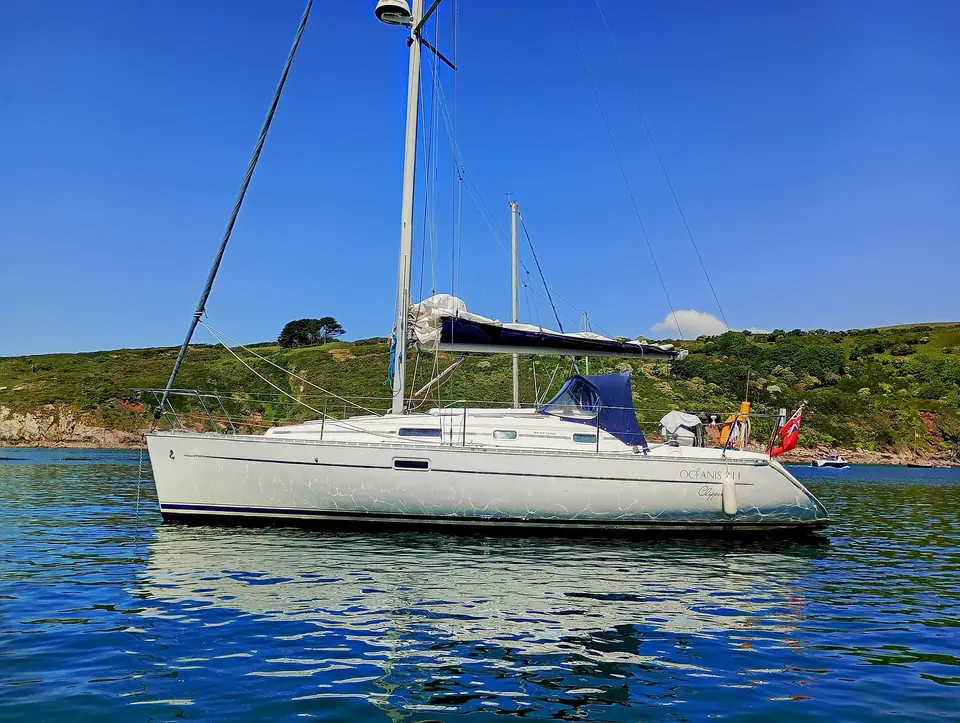
- Length
- 32.8 ft10 m
- Beam
- 10.7 ft3.26 m
- Draft
- 5.9 ft1.8 m
- Cabins
- 2 (forward double, aft double)
- Used price
- $45K to $75K
On this page
- Overview
- Oceanis 323, Clipper 323 or Beneteau 323: one Finot hull
- Freeboard, beam carried aft and a stepped coachroof
- Deep, shoal or lifting, and the ballast behind each
- Practical Sailor's Chesapeake sail, knot by knot
- A wheel that swings and a seat that tilts
- Room for four, lockers for fewer
- Yanmar 21, 65 liters and two 70 Ah batteries
- From $76,700 new to today's Beneteau 323 for sale listings
- Specifications
- Price and value
- Strengths and weaknesses
- Used buyer checklist
- Rivals
- Our verdict
- FAQ
The Oceanis 323, also sold as the Oceanis Clipper 323 and the US-built Beneteau 323, is a 32 ft 10 in Groupe Finot cruiser from 2003 to 2008 with deep, shoal or lifting keels and a big aft cabin.
- Couples and small families cruising coastal waters
- Light-air venues such as the Chesapeake
- Single-handers who value an easy cockpit
- Buyers stepping up from a 27 to 30 footer
Beneteau Oceanis 323 by the numbers
- Sail area to displacement
- 19.7Balanced power for coastal and offshore cruising.
- Displacement to length
- 168Light displacement for its length, quick but sensitive to added cruising weight.
- Theoretical hull speed
- 7.2 knThe practical top speed of a displacement monohull under normal sailing, based on waterline length.
- Ballast ratio
- 23%Relatively low ballast, form stability does more of the work.
- Capsize screening
- 2.03Above 2.0, so this hull leans toward coastal stability over ultimate offshore resistance.
- Motion comfort ratio
- 20.3A quicker motion in waves, typical of light, beamy hulls.
- Length to beam ratio
- 3.07 : 1Moderate proportions.
Oceanis 323, Clipper 323 or Beneteau 323: one Finot hull
The oceanis 323 is one design wearing several names. In Europe it was the Oceanis 323 and the better-equipped Oceanis Clipper 323; in the US it was the Beneteau 323, built at Beneteau's plant in Marion, South Carolina; and a charter version went to The Moorings as the Moorings 32.2. Groupe Finot drew it, and it was named Boat of the Year at the 2004 Oslo Boat Show.
Wikipedia dates production in France from 2003 to 2007, but Beneteau's own Clipper 323 equipment list is dated March 2008 and European listings include 2008-built boats, so the 323 was still being built into 2008 before the Oceanis 31 took its place. In the US it replaced the lighter, narrower Beneteau 311, which Practical Sailor described as only moderately successful there.
Freeboard, beam carried aft and a stepped coachroof
Rupert Holmes, writing for boats.com, said the 323 set new standards for 32 ft cruisers when it was launched: higher freeboard, a wide beam carried well aft and a stepped coachroof produced far more volume than earlier boats of this size. Practical Sailor noticed the same thing from another angle. Heeled under sail she looks low and racy; upright at the dock, the true height of the topsides and cabintop shows, along with the cruising brief behind them.
Beneteau's figures are 10.00 m overall, 9.72 m on deck, an 8.89 m (29 ft 2 in) waterline and a 3.26 m (10 ft 8 in) beam. Light displacement is 4,230 kg (9,325 lb). The mast sits a little farther forward than on similar boats, over the leading edge of the keel, which frees space below for a proper aft cabin and a full-size head.
Deep, shoal or lifting, and the ballast behind each
Three keels were listed. The standard European deep keel draws 1.80 m (5 ft 11 in) with 988 kg of cast iron ballast, the shoal keel draws 1.45 m (4 ft 9 in) with 1,095 kg, and a lifting keel runs from 0.80 m to 2.00 m. Practical Sailor's US test boat had the shoal keel, sensible for the Chesapeake, and the reviewers advised buyers in windier or deeper waters to take the deeper fin for stiffness and pointing.
Naval architect Jack Hornor, writing for BoatUS, put the numbers in context: a sail area to displacement ratio of 19.6 and a displacement to length ratio of 168 make the 323 an excellent light-air boat, but ballast is only about 26 percent of displacement, so it is no surprise she is reported to be a bit tender. His advice was to sail her flat, like the big dinghy she resembles.
Practical Sailor's Chesapeake sail, knot by knot
Practical Sailor's test started in about 5 knots of wind, where the 323 made 4 to 4.5 knots over the ground. In 10 knots true it close-reached at 5.8 to 6.2 knots, well-mannered and dry, but slightly overpowered in gusts under full main and the 116 percent genoa. The testers guessed that a reef or a working jib would be the right combination by 15 knots.
She tacked easily through 90 degrees and accelerated to 5.5 knots as fast as the crew could trim. The wheel was large enough to steer from the windward side with a foot on the leeward seat, responsive and with a slight weather helm. The boom is low enough to flake the main by hand without lazy jacks, a small thing that matters at the end of a day.
A wheel that swings and a seat that tilts
Two cockpit details set the 323 apart. A patented helm seat bracket lets the seat tilt completely out of the way for boarding over the transom, which Practical Sailor called the best method of securing a seat it had seen. The wheel pivots on its column: pull a stainless pin and it swings forward to a second locked position, opening the gap to the starboard seat. US-built boats also got a split backstay to clear the boarding path.
The cockpit is 6 ft 4 in long between binnacle and companionway and seats six on teak slats, but storage is thin: one starboard locker, a single winch handle pocket and no cubbies. The mainsheet attaches mid-boom with the traveler on the coachroof, lines run aft through Spinlock clutches, and the European list specifies Harken 32.2 self-tailing primaries while Practical Sailor's US boat had Lewmar 30s. In the US a genoa furler was optional, and most buyers chose a Profurl; an in-mast furling main was also offered and cuts sail area by about 15 percent.
Room for four, lockers for fewer
The saloon is 9 ft 8 in long on the centerline with just over 6 ft 3 in of headroom, settees port and starboard that seat six around a drop-leaf table, an L-shaped galley to port at the foot of the companionway and a chart table opposite. The forward double is 6 ft 10 in long but only 5 ft wide at the head; the aft cabin's double measures 6 ft 10 in by 6 ft 3 in and gets light from a transom port and two opening ports. Beneteau's own sheet gives the aft berth as 2.05 by 1.90 m.
The head is the surprise: 6 ft 2 in of headroom and 4 ft 9 in fore and aft, large enough to shower seated and with a tall locker for wet gear. Practical Sailor's main complaint was storage. Many lockers are shallow or narrow, so a crew of four on a week-long cruise will live partly out of duffel bags. The galley offers a 60 liter top-opening icebox with 12 volt refrigeration, a two-burner stove and oven, and a counter about 3 ft 11 in wide.
Yanmar 21, 65 liters and two 70 Ah batteries
Beneteau's 2008 equipment list specifies a 21 hp Yanmar diesel on a shaft with a fixed three-blade propeller, a 65 liter (17 gallon) rotomolded fuel tank, a 160 liter (42 gallon) water tank, a 22 liter calorifier and an 88 liter holding tank. Electrics are basic: one 70 amp hour service battery, one 70 amp hour engine battery and a 10 amp charger. Sailboatdata lists 18 hp for some European boats and 22 hp for the US version, so check the engine plate rather than the brochure.
Construction follows Beneteau's practice of the period: a solid fiberglass hull with vinylester in the outer skin against osmosis, a bonded grid of stringers and floors, bulkheads bonded with polyurethane adhesive and a hull to deck joint fastened with stainless screws, adhesive and a through-bolted toerail. Chainplates tie to stainless rods bedded in the laminate.
From $76,700 new to today's Beneteau 323 for sale listings
Practical Sailor gave a base price of $76,700 at launch and concluded that the 323 holds its value, citing asks of $49,900 to $73,000 for 2005 and 2006 boats. In 2026 a realistic US range is about $45,000 to $75,000, with deep keel boats and those with furling gear and recent sails at the top. One owner who bought new in early 2008 reported a few build quality issues and some cost-cut accessories that needed replacing, then years of dependable use. Running costs are about $7,000 to $13,500 a year in most US markets.
Beneteau Oceanis 323 specifications
| Length overall | 32.8 ft10 m |
|---|---|
| Waterline length | 29.2 ft8.89 m |
| Beam | 10.7 ft3.26 m |
| Draft | 5.9 ft1.8 m |
| Air draft | 48.6 ft14.82 m |
| Displacement | 9,325 lbs4,23 kg |
| Ballast | 2,178 lbs988 kg |
| Sail area | 546 sq ft50.7 m² |
| Fuel capacity | 17 gal65 L |
| Fresh water | 42 gal16 L |
| Cabins | 2 (forward double, aft double) |
| Berths | 4 in cabins plus saloon settees |
| Heads | 1, large, with shower |
| Maximum persons | 6 |
| Standard engines | Yanmar diesel of about 21 hp (3YM20 family), shaft drive |
| Hull type | Beamy fin keel monohull with nearly plumb stem, reverse transom and spade rudder |
| Keel | Cast iron deep fin 1.80 m (5 ft 11 in) standard in Europe; shoal 1.45 m (4 ft 9 in); lifting keel 0.80 to 2.00 m |
| Rig | Deck-stepped 9/10 sloop, single spreaders swept 25 degrees, discontinuous rod rigging |
| Hull construction | Solid fiberglass hull with bonded structural grid; cored deck |
| CE design category | B (6 persons), C (8 persons) |
| Builder | Beneteau, France; Beneteau USA, Marion, South Carolina, France and USA |
| Naval architect | Groupe Finot (Jean-Marie Finot and Pascal Conq) |
| Production | 2003 to 2008 |
| Status | Discontinued |
Figures come from builder documentation and independent tests where available. Displacement is usually quoted light, so a loaded cruising boat will weigh more. Compare these specs with another model.
Performance data
| Condition | Speed (kn) | Source |
|---|---|---|
| About 5 kn of wind, full sail | 4 to 4.5 SOG | Practical Sailor, Chesapeake |
| 10 kn true, close reach, full main and 116% genoa | 5.8 to 6.2 SOG | Practical Sailor, Chesapeake |
| Out of a tack through 90 degrees | 5.5 | Practical Sailor, Chesapeake |
Shoal keel test boat drawing 4 ft 9 in; speeds over the ground with little current.
How much does a Beneteau Oceanis 323 cost?
Practical Sailor put the base price at $76,700 when the 323 was introduced, and its later look at listings found asks from $49,900 for a 2005 boat to $73,000 for a 2006. In Europe 2005 to 2008 Clipper 323s ask about 49,900 to 59,900 euros. Deep keel, furling gear, newer sails and the original Yanmar with low hours lift a boat toward the top of the band.
Estimate your yearly cost
A planning estimate using common rules of thumb: insurance near 1.5 percent of value, maintenance near 3 percent, haul out and bottom paint by length. Your marina, region and use will move these numbers. Open the full cost calculator.
Versions and options
- Oceanis 323
- European base version.
- Oceanis Clipper 323
- Better-equipped European version; same hull and rig.
- Beneteau 323
- US version built in Marion, South Carolina, often with the shoal keel and a split backstay.
- Moorings 32.2
- Charter version of the same design.
Beneteau Oceanis 323 timeline
- 2003Production begins in France
- 2004Named Boat of the Year at the Oslo Boat Show
- 2006September Clipper 323 brochure lists deep, shoal and lifting keels
- 2008Final equipment list issued in March; the Oceanis 31 follows
Strengths and weaknesses
What owners like
- Quick and lively in light air
- Large aft cabin and an unusually big head
- Pivoting wheel and tilting helm seat
- Choice of deep, shoal or lifting keel
- Holds its value well
What to weigh up
- Tender in a breeze, reefs early
- Limited cockpit and interior stowage
- Small fuel and water tanks
- Basic electrical system as built
Used Beneteau Oceanis 323 buyer checklist
Take this list to a viewing. Your ticks are saved in this browser so you can come back to it.
Always commission an independent marine survey and an engine survey before you buy. How a marine survey works.
Rivals to consider
Catalina 320
Heavier, more conventional American 32 with a big interior and long production run.
Compare side by sideHunter 33
Hunter's 2004 design with mainsheet arch and large cockpit, aimed at the same buyer.
Compare side by sideJeanneau Sun Odyssey 32
Group sibling of the same years on a 9.6 m hull, later updated as the 32i.
Bavaria 31 Cruiser
German alternative from 2007 with a similar two-cabin layout.
Compare side by sideOur verdict on the Beneteau Oceanis 323
The oceanis 323 earned its reputation honestly. Groupe Finot gave a 32-footer the aft cabin, head and saloon of a bigger boat without killing its sailing, and in light to moderate air it is genuinely quick and fun. The price is a tender boat that wants a reef early, thin storage and tanks sized for weekends. Choose the deep keel unless your water is thin, look for furling gear and decent sails, and a well kept 323 is one of the better used 32-footers of its decade.
Beneteau Oceanis 323 questions answered
Is the Beneteau 323 the same boat as the Oceanis Clipper 323?
Yes. Oceanis 323, Oceanis Clipper 323 and Beneteau 323 are the same Groupe Finot design; the Clipper had more standard equipment and the Beneteau 323 was built in South Carolina.
What years was the Oceanis 323 built?
From 2003 into 2008, when Beneteau's last equipment list was issued and the Oceanis 31 replaced it.
What is the draft of a Beneteau 323?
1.80 m (5 ft 11 in) with the deep keel, 1.45 m (4 ft 9 in) with the shoal keel, or 0.80 m to 2.00 m with the lifting keel.
Is the Beneteau 323 tender?
Somewhat. Ballast is about 26 percent of displacement, so it is fast in light air but needs reefing in about 15 knots.
How much does a Beneteau 323 for sale cost?
Roughly $45,000 to $75,000 in the US in 2026, depending on keel, sails and condition.
Photos from the Beneteau range
We have not found a freely licensed photo of the Beneteau Oceanis 323 yet, so these show other Beneteau boats, each captioned with the boat pictured.
More cruising sailboats to explore
Bavaria Cruiser 32
Cruising Sailboats, 33 ft
Used $52K to $84K
Bavaria Cruiser 33
Cruising Sailboats, 33 ft
Used $68K to $105K
Bavaria Cruiser 34
Cruising Sailboats, 33 ft
Used $95K to $175K
Beneteau Oceanis 321
Cruising Sailboats, 33 ft
Used $30K to $55K
Other Beneteau models
- Beneteau 49
- Beneteau 50
- Beneteau 57
- Beneteau 343
- Beneteau Antares 5.80
- Beneteau Antares 6
- Beneteau Antares 6.80
- Beneteau Antares 7
- Beneteau Antares 7.30
- Beneteau Antares 7.60
- Beneteau Antares 7.80
- Beneteau Antares 8
- Beneteau Antares 8.00
- Beneteau Antares 8.05
- Beneteau Antares 8.60
- Beneteau Antares 8.80
- Beneteau Antares 9
- Beneteau Antares 9.80
- Beneteau Antares 10.80
- Beneteau Antares 11
- Beneteau Antares 12
- Beneteau Antares 13.80
- Beneteau Antares 30
- Beneteau Antares 32
- Beneteau Antares 36
- Beneteau Antares 42
- Beneteau Antares 620 HB
- Beneteau Antares 650 HB
- Beneteau Antares 750 HB
- Beneteau Cyclades 39.3
- Beneteau Cyclades 43.3 and 43.4
- Beneteau Cyclades 50.5
- Beneteau First 18 SE
- Beneteau First 20
- Beneteau First 21.7
- Beneteau First 24
- Beneteau First 25
- Beneteau First 25.7
- Beneteau First 27
- Beneteau First 27.7
- Beneteau First 30
- Beneteau First 31.7
- Beneteau First 35
- Beneteau First 36
- Beneteau First 36.7
- Beneteau First 38
- Beneteau First 40
- Beneteau First 40.7
- Beneteau First 44
- Beneteau First 45
- Beneteau First 47.7
- Beneteau First 53
- Beneteau First 211
- Beneteau First 235
- Beneteau First 285
- Beneteau First 305
- Beneteau First 310
- Beneteau First 345
- Beneteau Flyer 6
- Beneteau Flyer 7
- Beneteau Flyer 8
- Beneteau Flyer 9
- Beneteau Flyer 10
- Beneteau Flyer 12
- Beneteau Flyer 500
- Beneteau Flyer 550
- Beneteau Flyer 650
- Beneteau Flyer 701
- Beneteau Flyer 750
- Beneteau Grand Trawler 62
- Beneteau Gran Turismo 32
- Beneteau Gran Turismo 36
- Beneteau Gran Turismo 40
- Beneteau Gran Turismo 41
- Beneteau Gran Turismo 44
- Beneteau Gran Turismo 45
- Beneteau Monte Carlo 6
- Beneteau Oceanis 30.1
- Beneteau Oceanis 31
- Beneteau Oceanis 34
- Beneteau Oceanis 34.1
- Beneteau Oceanis 35
- Beneteau Oceanis 35.1
- Beneteau Oceanis 36 CC
- Beneteau Oceanis 37
- Beneteau Oceanis 38
- Beneteau Oceanis 38.1
- Beneteau Oceanis 40
- Beneteau Oceanis 40 CC
- Beneteau Oceanis 41
- Beneteau Oceanis 41.1
- Beneteau Oceanis 42
- Beneteau Oceanis 42 CC
- Beneteau Oceanis 43
- Beneteau Oceanis 44 CC
- Beneteau Oceanis 45
- Beneteau Oceanis 46
- Beneteau Oceanis 46.1
- Beneteau Oceanis 48
- Beneteau Oceanis 50
- Beneteau Oceanis 51.1
- Beneteau Oceanis 54
- Beneteau Oceanis 55
- Beneteau Oceanis 58
- Beneteau Oceanis 311
- Beneteau Oceanis 320
- Beneteau Oceanis 321
- Beneteau Oceanis 331
- Beneteau Oceanis 350
- Beneteau Oceanis 351
- Beneteau Oceanis 370
- Beneteau Oceanis 390
- Beneteau Oceanis 400
- Beneteau Oceanis 411
- Beneteau Oceanis 423
- Beneteau Oceanis 430
- Beneteau Oceanis 440
- Beneteau Oceanis 461
- Beneteau Oceanis 473
- Beneteau Oceanis 500
- Beneteau Oceanis 510
- Beneteau Oceanis Clipper 361
- Beneteau Oceanis Clipper 373
- Beneteau Oceanis Clipper 381
- Beneteau Oceanis Clipper 393
- Beneteau Oceanis Yacht 54
- Beneteau Oceanis Yacht 60
- Beneteau Oceanis Yacht 62
- Beneteau Sense 43
- Beneteau Sense 46
- Beneteau Sense 50
- Beneteau Sense 55
- Beneteau Swift Trawler 30
- Beneteau Swift Trawler 34
- Beneteau Swift Trawler 35
- Beneteau Swift Trawler 41
- Beneteau Swift Trawler 44
- Beneteau Swift Trawler 48
- All Beneteau models