Catalina Yachts Cruising Sailboats
Catalina 42 Buyer's Guide, Mark I and Mark II Compared
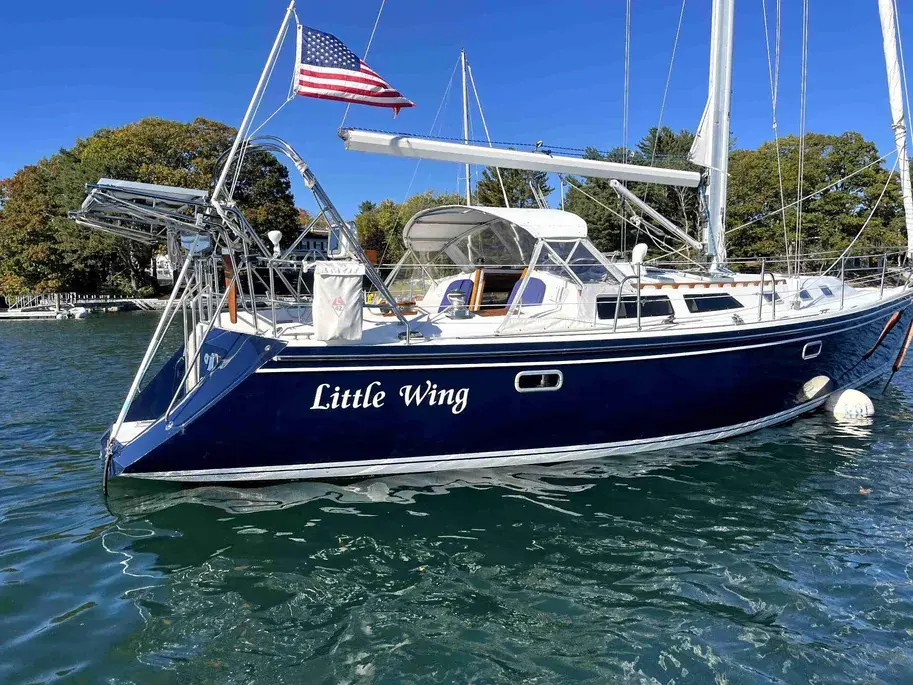
The three-cabin 42 footer that made Catalina sailboats a fixture in charter fleets and marinas, with more than 1,000 built over two decades.
- Length
- 41.9 ft12.76 m
- Beam
- 13.8 ft4.22 m
- Draft
- 6.7 ft2.03 m
- Cabins
- 2 or 3 (Mk II also offered with an island berth forward and, late in production, a 4-cabin plan)
- Used price
- $65K to $195K
On this page
- Overview
- A 40 footer that grew two feet and a third cabin
- Mark I versus Mark II: what actually changed
- Two cabins, three cabins, and the late four-cabin plan
- How the 42 sails, by the polars and by its owners
- Construction: solid hull, cored deck and Catalina's pan
- Yanmar power, tankage and access
- Parts, owners and life after Catalina
- Catalina 42 for sale: where the value sits
- Specifications
- Price and value
- Strengths and weaknesses
- Used buyer checklist
- Rivals
- Our verdict
- FAQ
The Catalina 42 is a 41 ft 10 in masthead sloop built by Catalina Yachts from 1989 to about 2011 in Mark I and Mark II form, with two, three and later four cabin layouts. More than 1,000 were built.
- Couples cruising the coast or the Bahamas
- Families who need three private cabins
- First-time big-boat buyers wanting a known quantity
- Liveaboards on a moderate budget
Catalina 42 by the numbers
- Sail area to displacement
- 17.0Balanced power for coastal and offshore cruising.
- Displacement to length
- 196Light displacement for its length, quick but sensitive to added cruising weight.
- Theoretical hull speed
- 8.0 knThe practical top speed of a displacement monohull under normal sailing, based on waterline length.
- Ballast ratio
- 40%A high ballast ratio, so the boat stands up well to a breeze.
- Capsize screening
- 2.02Above 2.0, so this hull leans toward coastal stability over ultimate offshore resistance.
- Motion comfort ratio
- 25.4Moderate motion comfort, typical of modern cruisers.
- Length to beam ratio
- 3.03 : 1Moderate proportions.
Mark I versus Mark II: what actually changed
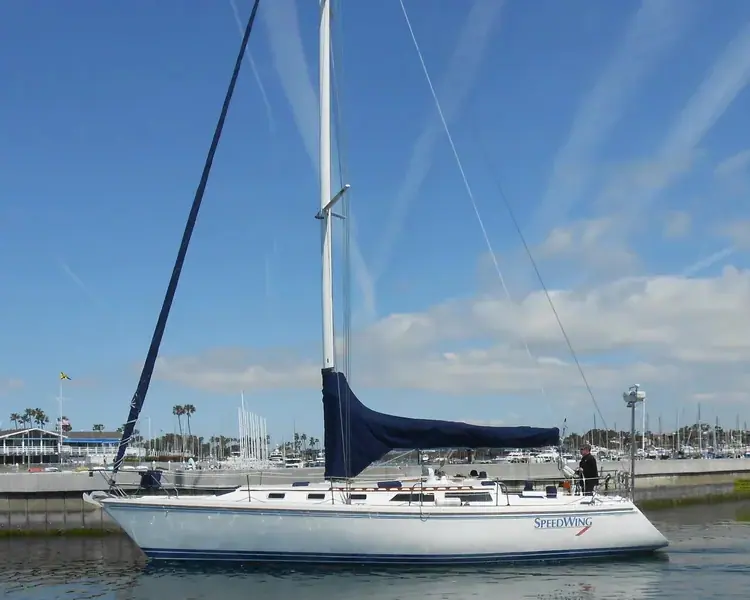
Douglas was blunt that the hull, deck hardware, engine and standing rigging are virtually identical between the two generations. The differences that matter to a buyer are the stern, the cockpit and the rudder. The Mark II has a fuller, more buoyant stern section and a modified reverse transom with a larger boarding platform. One owner who moved from Mark I hull 240 to Mark II hull 498 told Practical Sailor that the newer boat felt heavier on the helm at first and rode higher, more like a center cockpit boat, but did not hobbyhorse.
The rudder is the most important single change. Early shoal-draft boats paired a short rudder with the winged keel, and the Mark II introduced a deeper, high-aspect, semi-elliptical blade. Owners who retrofitted the deeper rudder to Mark Is reported better handling and less load on the wheel, and Douglas pointed out that the pressure many owners blamed on weather helm was really load on the rudder and small skeg. On any Mark I, ask which rudder is fitted.
Marketing literature once claimed the Mark II was 2,500 pounds heavier than the Mark I. Douglas called that a mistake: the Mark I was never as light as advertised. Treat both as roughly 20,500 pound boats on a 36 ft waterline.
Two cabins, three cabins, and the late four-cabin plan
Every Catalina 42 puts the owner forward. In the original plan a Pullman-style double sits on the starboard side of the forward cabin, about 72 inches long on the centerline, with the owner's head right in the bow, which has six feet of headroom. Catalina's own range listings from the mid-2000s show the Mark II offered in two-cabin and three-cabin versions with either the Pullman or a centerline island berth forward, plus a four-cabin version.
The two-cabin boat has one aft stateroom in the starboard quarter, a compact second head, the galley in the port quarter and a full nav station with a swing-out seat. Its real advantage is the cavernous space aft of the galley, which owners fill with a heater, inverter, refrigeration and tools, and which gives good access to the steering. In the three-cabin boat, mirror-image aft cabins each have a seven foot double and six feet of headroom, the galley moves amidships opposite the dinette, and both the pantry and the navigator's desk shrink noticeably.
In every version the dinette seats six to eight and converts to a large double, and the galley carries a three-burner stove with oven, twin sinks and solid-surface counters on later boats. Practical Sailor's owners praised the volume but complained about limited stowage, heavy settee boards and, on older boats, drawers and doors that flew open underway. Later boats got positive latches and roller slides.
How the 42 sails, by the polars and by its owners
Douglas's polar predictions for a fin-keel boat with a 155 percent genoa show about 4.5 knots in 6 knots of true wind at 47 degrees, 6 knots in 10 knots of breeze at 45 degrees, and a best downwind speed around 9 knots at 120 to 135 degrees in 16 to 20 knots. Below 5 knots of wind it is sluggish. Hull speed on the 36 ft waterline is roughly 8 knots.
Owners describe a stiff boat that settles at 10 to 15 degrees of heel and rarely puts the rail in the water. Most tuck in a reef above 18 knots to balance the helm. A San Francisco singlehander reported carrying a 150 percent genoa to 22 knots in the Singlehanded Farallones race, and a Lake Pontchartrain owner raced his boat to class wins on a PHRF of 96, against about 105 for a typical stock 42. The tall, high-aspect rig with 797 square feet of working sail is simple: Douglas warned that it was not designed to be tuned underway and that cranking on an adjustable backstay could overload the spreaders.
Sail handling is cruiser-friendly. Halyards run aft through Garhauer blocks to stoppers and winches on the bridge deck, the mainsheet traveler sits forward of the companionway, and genoa sheets lead to toerail blocks for good offwind angles plus a short cabin-top track for small headsails.
Construction: solid hull, cored deck and Catalina's pan
The hull is solid fiberglass, about 1 3/8 to 1 1/2 inches thick at the keel and roughly half an inch at the sheer. Since 1995 Catalina used vinylester resin behind the gelcoat to resist blistering, though Practical Sailor still found some owners with blister repairs, most handled under the prorated warranty. The deck is cored with end-grain balsa and plywood under hardware. Stiffness comes from a molded fiberglass pan bonded to the hull that also carries the sole and berth bases.
The hull to deck joint is an external flange bonded and through-bolted on 8 inch centers and covered by an aluminum rubrail, and only one Practical Sailor respondent reported a leak there. Engine mounts are lagged into a hardwood-filled glass pan rather than through-bolted, which Douglas defended and Practical Sailor questioned. A Seattle surveyor told the magazine he rated the 42's construction better than some other Catalinas and many production rivals.
Yanmar power, tankage and access
Sailboatdata lists the Mark I with a Yanmar 4JHBE of 44 hp and the Mark II with a 4JH2E of 50 hp. Access is excellent for a production boat, from the companionway, the starboard cabin and removable galley panels, so all four sides of the engine can be reached. Fuel capacity of about 39 gallons is the weak point for distance cruising, and several owners added tankage under the sole. Water capacity is listed at 138 gallons for the Mark II, generous for a 42.
For offshore use, owners commonly add an inner forestay for a storm or staysail, which Douglas accepted with the note that running backstays may then be needed. Wiring is color coded, and newer boats have tinned connections.
Parts, owners and life after Catalina
Catalina Yachts paused production in October 2025 after a short-lived change of ownership, and its tooling and remaining assets were auctioned on June 9, 2026. Owners lose factory parts and drawings, but the active owner association and mainstream hardware from Lewmar, Garhauer, Schaefer, Edson and Yanmar keep the 42 easy to maintain.
Catalina 42 for sale: where the value sits
Most 42 ft Catalina for sale listings in the US fall between about $65,000 for a tired early Mark I and $195,000 for a late, well-equipped Mark II. The sweet spot for value is a late-1990s or early-2000s Mark II that has already had its rigging, sails and electronics renewed. Former charter boats are common because the three-cabin layout suited bareboat fleets; they are not automatically bad buys, but check hour meters, upholstery and the steering gear closely.
Plan on roughly $11,000 to $26,000 a year for a 42 ft slip, insurance, haul-out, bottom paint, engine service and a reserve for sails and rigging, depending heavily on region.
Catalina 42 specifications
| Length overall | 41.9 ft12.76 m |
|---|---|
| Waterline length | 36 ft10.97 m |
| Beam | 13.8 ft4.22 m |
| Draft | 6.7 ft2.03 m |
| Displacement | 20,5 lbs9,299 kg |
| Ballast | 8,3 lbs3,765 kg |
| Sail area | 797 sq ft74 m² |
| Fuel capacity | 39 gal148 L |
| Fresh water | 138 gal522 L |
| Cabins | 2 or 3 (Mk II also offered with an island berth forward and, late in production, a 4-cabin plan) |
| Berths | 6 to 8 including the convertible dinette |
| Heads | 2 |
| Standard engines | Yanmar 4JHBE 44 hp diesel (Mk I); Yanmar 4JH2E 50 hp diesel (Mk II) |
| Hull type | Moderate displacement fin keel monohull with spade rudder and small skeg |
| Keel | Lead fin of about 6 ft (Mk I) or up to 6 ft 8 in (Mk II), or a winged shoal keel near 4 ft 10 in; 8,300 lb ballast in each |
| Rig | Masthead sloop, Isomat double-spreader mast with spreaders swept 17 degrees, halyards led aft |
| Hull construction | Solid fiberglass hull, balsa and plywood cored deck, lead keel |
| Builder | Catalina Yachts, United States |
| Naval architect | Gerry Douglas (Catalina), developed from a Nelson/Marek racing hull |
| Other design credits | Frank Butler (company founder and product direction) |
| Production | 1989 to 2011 |
| Status | Discontinued |
Figures come from builder documentation and independent tests where available. Displacement is usually quoted light, so a loaded cruising boat will weigh more. Compare these specs with another model.
How much does a Catalina 42 cost?
The 42 spans 22 model years, so price follows age and generation more than anything else. Practical Sailor's market scan once showed early Mark Is around $70,000 and mid-1990s boats above $100,000; in Europe in 2026 a 1996 Mark II is asking about 99,500 euros and a 2008 Mark II about 198,000 euros. Two-cabin boats with the big pantry and workroom are preferred by couples, three-cabin boats by families and former charter operators. Deep rudder retrofits, updated electronics and newer sails add real value, and the 2026 closure of Catalina has not dented demand for a model this common.
Estimate your yearly cost
A planning estimate using common rules of thumb: insurance near 1.5 percent of value, maintenance near 3 percent, haul out and bottom paint by length. Your marina, region and use will move these numbers. Open the full cost calculator.
Versions and options
- Mark I (1989 to 1995)
- Hulls 1 to 477, conventional reverse transom, Yanmar 44 hp, early boats with a shorter rudder.
- Mark II (1995 to about 2011)
- Fuller stern, larger boarding platform, reworked cockpit with table and observation seats, deeper rudder, Yanmar 50 hp.
- Two-cabin
- Single aft cabin plus a large workroom and pantry, the cruising couple's choice.
- Three-cabin
- Twin aft cabins, galley amidships, smaller nav station, popular with families and charter fleets.
- Island berth and four-cabin Mark II
- Later Mark IIs were listed with a centerline berth forward instead of the Pullman, and a four-cabin plan.
Catalina 42 timeline
- 1989Catalina 42 introduced, one of the first US production 42 footers with three staterooms
- 1995Mark II replaces the Mark I after hull 477, with new stern, cockpit and deeper rudder
- 2011Practical Sailor dates the end of Mark II production
- 2026Catalina's remaining assets are auctioned on June 9, ending factory support
Strengths and weaknesses
What owners like
- Huge used market makes buying, surveying and reselling easy
- Stiff, well-mannered sailing with a usable 36 ft waterline
- Choice of two, three and later four cabin layouts
- Excellent engine access for a production boat
- Generous 138 gallon water capacity on the Mark II
- Simple rig with halyards led aft
What to weigh up
- Fuel capacity of about 39 gallons is small for distance cruising
- Stowage is limited, especially in three-cabin boats
- Early Mark I shoal boats have a short rudder that loads the helm
- Engine mounts lagged rather than through-bolted
- No factory support since Catalina's collapse
Used Catalina 42 buyer checklist
Take this list to a viewing. Your ticks are saved in this browser so you can come back to it.
Always commission an independent marine survey and an engine survey before you buy. How a marine survey works.
Rivals to consider
Catalina 400
Catalina's own slightly smaller cruiser sold alongside the late Mark II, with a more modern interior.
Beneteau Oceanis 411
French rival of the late 1990s with a lighter feel and a large charter presence, usually priced similarly.
Compare side by sideHunter 410
American competitor with an arch and B&R rig, roomy below but a different sailing feel.
Bavaria C42
The modern alternative for buyers whose budget stretches to a much newer, beamier boat.
Compare side by sideOur verdict on the Catalina 42
The Catalina 42 is the default answer for American sailors who want a dependable, roomy 42 footer without paying for prestige. It sails better than its reputation suggests, it is simply built and easy to work on, and more than 1,000 sisterships mean there is always a comparable sale and an owner who has fixed your problem before. Buy a late Mark II with the deep rudder and a two-cabin plan if you cruise as a couple, add fuel capacity if you plan to go far, and survey the deck core and keel joint carefully. Few boats deliver as much usable space per dollar.
Catalina 42 questions answered
What is the difference between the Catalina 42 Mk I and Mk II?
The Mark II (from 1995) has a fuller stern with a bigger boarding platform, a redesigned cockpit and a deeper rudder. Hull, rig and machinery are virtually the same.
How much is a Catalina 42 worth?
In 2026 most US boats trade between about $65,000 and $195,000, depending on year, generation, layout and equipment.
How many Catalina 42s were built?
More than 1,000, including 477 Mark Is, roughly evenly split between two- and three-cabin layouts.
Is the Catalina 42 a good offshore boat?
It is a stiff, solid coastal cruiser that owners have taken on longer passages, but 39 gallons of fuel and a rig not designed for underway tuning mean offshore use calls for upgrades such as extra tankage and an inner forestay.
What engine does the Catalina 42 have?
Sailboatdata lists a Yanmar 4JHBE of 44 hp in the Mark I and a Yanmar 4JH2E of 50 hp in the Mark II.
Are Catalina sailboats still being built?
No. Catalina paused production in October 2025 and its tooling and assets were auctioned in June 2026, so every Catalina 42 for sale is a used boat.
Catalina 42 photos
More cruising sailboats to explore
Bavaria Vision 42
Cruising Sailboats, 42 ft
Used $150K to $215K
Beneteau Oceanis 411
Cruising Sailboats, 42 ft
Used $75K to $130K
Dufour 412 Grand Large
Cruising Sailboats, 42 ft
Used $165K to $245K
Beneteau Oceanis 42
Cruising Sailboats, 42 ft
Used $340K to $430K