MacGregor 26X Review and MacGregor 26 Buyer's Guide
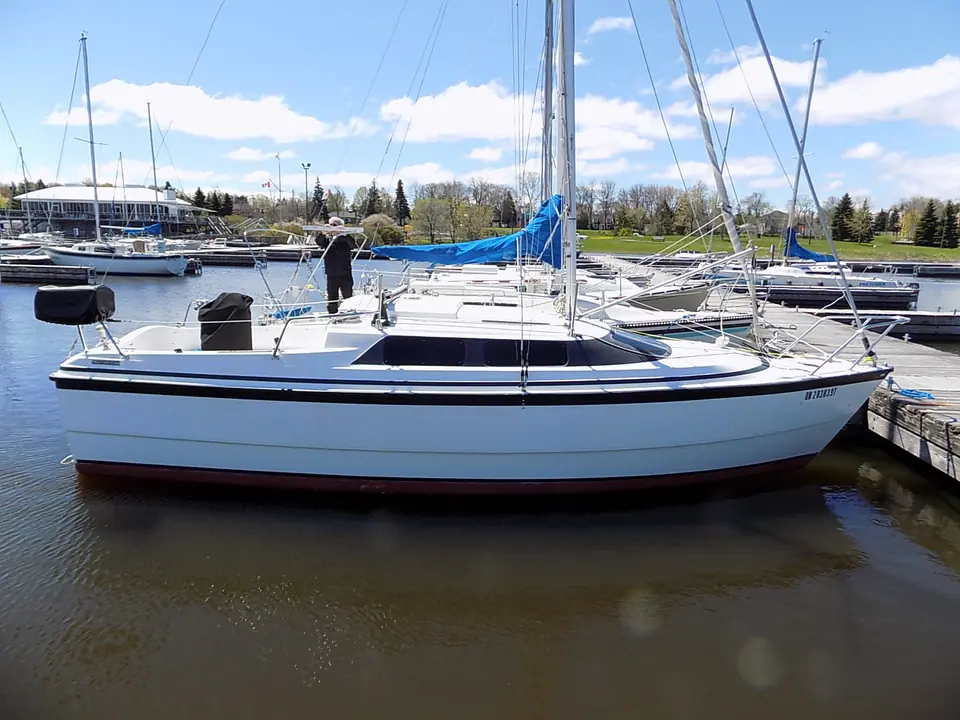
Half sailboat, half runabout, the water-ballasted MacGregor 26X sails at 6 knots, motors past 20 and splits sailors like no other boat.
- Length
- 25.8 ft7.87 m
- Beam
- 7.8 ft2.38 m
- Draft
- 5.5 ft1.68 m
- Cabins
- 1 plus aft double
- Used price
- $9K to $25K
On this page
- Overview
- The MacGregor 26 family: 26D, 26S, 26X and 26M
- Roger MacGregor's powersailer gamble
- Water ballast and the one rule you never break
- Under power: 6 knots on a 9.9, 20-plus on a 50
- Under sail: honest about its limits
- MacGregor 26X interior: standing headroom in a trailer boat
- How it is built, and what fails
- 26X or 26M: which one to buy
- MacGregor 26 for sale: prices and ownership costs
- Specifications
- Price and value
- Strengths and weaknesses
- Used buyer checklist
- Rivals
- Our verdict
- FAQ
The MacGregor 26X (1995 to 2003) is a 26-foot trailerable powersailer with about 1,400 lb of water ballast, a centerboard and up to a 50 hp outboard. It sits between the 26S and the later 26M.
- Families who want sail and power in one boat
- Lake and river cruising
- Trailer cruising to distant waters
- Budget buyers who value space over sailing performance
The MacGregor 26 family: 26D, 26S, 26X and 26M
Type MacGregor 26 into a search bar and you will find four generations of the same idea, a light, water-ballasted, trailerable 26-footer that a family can tow behind an SUV and launch at any ramp. Roger MacGregor's California company built the family from 1986 to 2013. Knowing which version you are looking at is the first step, because they sail and motor very differently.
The 26D and 26S are conventional sailboats with small outboards. Listings labeled 26C usually refer to these earlier Classic models. The 26X changed the formula with a powerboat stern and a big outboard, and the 26M refined that idea for its final decade. This guide focuses on the 26X, with the others explained where they differ.
- MacGregor 26D (1986 to 1989): daggerboard, water ballast, small outboard
- MacGregor 26S (1990 to 1995): swing centerboard, water ballast, small outboard
- MacGregor 26X (1995 to 2003): centerboard, water ballast, outboards up to 50 hp
- MacGregor 26M (2003 to 2013): daggerboard, water plus fixed ballast, outboards around 50 hp
MacGregor 26X by the numbers
- Sail area to displacement
- 18.6Balanced power for coastal and offshore cruising.
- Displacement to length
- 138Light displacement for its length, quick but sensitive to added cruising weight.
- Theoretical hull speed
- 6.4 knThe practical top speed of a displacement monohull under normal sailing, based on waterline length.
- Ballast ratio
- 37%A typical ballast ratio for a cruising monohull.
- Capsize screening
- 2.01Above 2.0, so this hull leans toward coastal stability over ultimate offshore resistance.
- Motion comfort ratio
- 15.7A quicker motion in waves, typical of light, beamy hulls.
- Length to beam ratio
- 3.30 : 1Moderate proportions.
Roger MacGregor's powersailer gamble
The 26X was a deliberate cross between the MacGregor 26 sailboat and the MacGregor 19 Powersailer. Practical Sailor described it as an attempt to reach several markets with one hull, a boat that could sail at around 7 knots and motor at 20 knots or more. To do that, MacGregor widened and flattened the stern so the hull could plane under power, kept the weight down at about 2,350 pounds dry, and relied on water ballast rather than lead for stability under sail.
It sold extremely well. Good Old Boat estimates about 5,000 26X boats were built between 1995 and 2003, an enormous number for a 26-footer, and Practical Sailor found that two-year-old boats were reselling for 85 to 90 percent of their new price. Practical Sailor's review listed a base 26X with sails and trailer at $14,995 from the factory, or roughly $17,000 equipped, plus $5,000 to $7,000 for an outboard and electronics. No conventional 26-foot sailboat came close to that price.
Water ballast and the one rule you never break
The ballast tank runs along the bottom of the hull from about 3 feet forward of the transom to the V-berth and is about 4 feet wide. Open a valve at the dock and seawater fills it, adding about 1,400 pounds and bringing displacement to about 3,750 pounds. Drain it at the ramp and the boat is light enough to tow with a midsize SUV. The centerboard itself is a hollow, largely unweighted foil, so it adds lateral resistance for sailing to windward but little righting moment; the water does that job.
Here is the rule: the boat must never be sailed with the ballast tank empty. Without the water it has very little stability, and a gust that a ballasted 26X shrugs off can capsize an empty one. MacGregor's own demonstration showed a fully ballasted boat self-righting with 120 pounds of pull on the jib halyard. Many owners motor at high speed with the tank drained, because full ballast drops top speed to under 10 knots, but that must be done in calm water with sails furled.
Practical Sailor also found the tank slow to fill and much too slow to drain, so plan time for it at the ramp. Valve leaks that let water into the cabin are a known issue on aging boats.
Under power: 6 knots on a 9.9, 20-plus on a 50
Outboard choice defines how you use a 26X. Practical Sailor measured 6 to 7 knots with a 9.9 hp motor, 12 to 14 knots with a 25 hp and more than 20 knots with a 50 hp, and the tester made 360-degree turns at 18 knots without drama. Owners and Good Old Boat report around 20 knots lightly loaded with a 50, falling below 10 knots when the ballast is full.
The trade-off of a heavy 50 hp outboard is weight in the stern, which hurts sailing trim and can make the boat squat. Steering uses push-pull cables with limited feel, and the factory stern ladder sat close to the propeller, a hazard Practical Sailor flagged. Many owners move the ladder outboard of the rudder.
Under sail: honest about its limits
As a sailboat the 26X is modest. MacGregor pitched it as a 7-knot sailer, a Puget Sound owner told Practical Sailor he sees 8 knots on a broad reach with the genoa, and Good Old Boat cites a surfing run of 12.9 knots downwind. Upwind it is average at best, tacking through 95 to 105 degrees. Practical Sailor cited a PHRF handicap of 240 to 250.
In a breeze the weather helm builds quickly, and if the main is not eased or reefed the boat can run out of rudder, stall and round up. Most owners reef in 15 to 18 knots. The hull pounds in a short chop and rolls in larger waves. Roger MacGregor himself said the boat was designed for inland waters and limited coastal sailing, and was too small to be a long-distance passagemaker. Take that at face value.
MacGregor 26X interior: standing headroom in a trailer boat
The 26X interior is its other big selling point. MacGregor advertised standing headroom; Practical Sailor measured about 5 feet 10 inches at the foot of the companionway and less amidships, still remarkable for a boat that tows legally. A V-berth forward, a dinette that converts to a berth, a small galley, an enclosed head and a large aft double under the cockpit give a family of four a usable weekend layout.
Finish is basic. Practical Sailor found rough surfaces and fiberglass shards in stowage areas, and there is very little bilge under the sole, so water can accumulate unseen. MacGregor later drilled small holes so water would show on the cabin sole. There are no real side decks, so going forward means crossing the cabin top, and families with small children often add bow netting.
How it is built, and what fails
Construction is simpler than its reputation suggests. Practical Sailor reported hand-laid fiberglass throughout, with up to 15 layers and 3/4 inch thickness at the centerboard trunk and bow, and Good Old Boat describes a shoebox hull to deck joint sealed with adhesive and through-bolted with stainless bolts on 4-inch centers. Foam flotation blocks under the coaming, bow and anchor locker kept a swamped test boat afloat.
Owners commonly report weak early rudder brackets (many have been replaced with stronger aftermarket or factory versions), rudder blades and linkages damaged by groundings, ballast valve leaks, and stress cracking around the transom and engine pad on boats that have run big outboards hard for years.
26X or 26M: which one to buy
The 26M replaced the 26X in 2003 and remained in production until about 2013. It switched from a centerboard to a daggerboard, and added some fixed ballast to the water tank, while keeping the big-outboard formula; Practical Sailor saw up to 19 knots with a 50 hp. Many reviewers felt it tightened up the 26X's handling quirks. A 26M costs more, typically $15,000 to the high $30,000s in 2026.
A well-sorted 26X with upgraded rudders, a newer outboard and a good trailer gives you most of what a 26M offers for less money. If you mostly sail and only occasionally motor fast, a 26S or 26D is cheaper still and arguably a better sailboat.
MacGregor 26 for sale: prices and ownership costs
In 2026 most MacGregor 26X boats ask between $9,000 and $25,000 including trailer, with the outboard's age and size the biggest variable. Good examples with four-stroke 50s cluster in the mid-teens to low twenties. Older 26D and 26S boats are cheaper, often under $10,000.
Running costs are low if the boat lives on its trailer: insurance, registration, outboard service and trailer upkeep total about $1,500 to $3,000 a year. Keeping it in a slip pushes the figure toward $5,000. The large MacGregor owner community online keeps parts and upgrade knowledge easy to find even though the company stopped building sailboats.
MacGregor 26X specifications
| Length overall | 25.8 ft7.87 m |
|---|---|
| Waterline length | 23 ft7.01 m |
| Beam | 7.8 ft2.38 m |
| Draft | 5.5 ft1.68 m |
| Displacement | 3,75 lbs1,701 kg |
| Ballast | 1,4 lbs635 kg |
| Sail area | 281 sq ft26.1 m² |
| Fuel capacity | 18 gal68 L |
| Fresh water | 1 gal38 L |
| Cabins | 1 plus aft double |
| Berths | Up to 6 |
| Heads | 1 small enclosed head |
| Standard engines | Outboard on transom, commonly 40 to 50 hp |
| Optional engines | Smaller 9.9 to 25 hp outboards on sail-focused boats |
| Maximum power | 50 hp |
| Top speed | 20 knots |
| Hull type | Water-ballasted planing-capable monohull with a broad flat stern |
| Keel | Unweighted centerboard plus about 1,400 lb internal water ballast tank, 9 in draft with board up, 5 ft 6 in board down |
| Rig | Fractional sloop with single-handed mast raising system |
| Hull construction | Hand-laid fiberglass, foam flotation, bolted and bedded hull to deck joint |
| Builder | MacGregor Yacht Corporation, United States |
| Naval architect | Roger MacGregor |
| Production | 1995 to 2003 |
| Status | Discontinued |
Figures come from builder documentation and independent tests where available. Displacement is usually quoted light, so a loaded cruising boat will weigh more. Compare these specs with another model.
How much does a MacGregor 26X cost?
Outboard condition dominates 26X pricing because a late four-stroke 50 hp can be worth a third of the package. Trailer condition, rudder and steering upgrades and the state of the ballast valve and centerboard come next. The later 26M sells for several thousand dollars more than a comparable 26X, and older 26D and 26S models sell for less.
Estimate your yearly cost
A planning estimate using common rules of thumb: insurance near 1.5 percent of value, maintenance near 3 percent, haul out and bottom paint by length. Your marina, region and use will move these numbers. Open the full cost calculator.
MacGregor 26X timeline
- 1986MacGregor 26D introduced with water ballast and daggerboard
- 1990MacGregor 26S replaces the 26D with a swing centerboard
- 1995MacGregor 26X launches as a powersailer for outboards up to 50 hp
- 200326M replaces the 26X with a daggerboard and added fixed ballast
- 2013MacGregor 26 production ends
Strengths and weaknesses
What owners like
- Tows behind a midsize SUV with the ballast drained
- Motors at 20 knots or more with a 50 hp outboard
- Near standing headroom at the companionway in a trailerable boat
- Very low purchase and running costs
- Huge owner community and plentiful boats
- Launches and retrieves at almost any ramp
What to weigh up
- Must never be sailed with the ballast tank empty
- Modest upwind performance and heavy weather helm
- Pounds in chop and rolls in waves
- Basic interior finish and minimal bilge
- Not suitable for open-water passages
Used MacGregor 26X buyer checklist
Take this list to a viewing. Your ticks are saved in this browser so you can come back to it.
Always commission an independent marine survey and an engine survey before you buy. How a marine survey works.
Rivals to consider
Catalina 25
A better sailboat with a heavier, more stable motion, but far harder to tow and limited to small outboard speeds.
Compare side by sideCatalina 22
Simpler and cheaper, a stronger one-design sailboat, but with no real headroom and no fast motoring.
Compare side by sideCatalina 250
Water ballast and wing keel versions offer a more sailing-focused trailerable alternative.
Hunter 26
Water-ballasted rival from the same era with a more conventional sailing focus.
Our verdict on the MacGregor 26X
The MacGregor 26X is not a great sailboat and it is not a great powerboat, but it is a very good answer to a specific question: how do you get a family onto the water, under sail or power, with a boat you can tow and store at home? Respect the water ballast rule, choose a boat with sorted rudders and a healthy outboard, and keep to lakes, rivers and sheltered coastal waters. Sailors who care about pointing angles should buy something else. Families who care about getting there, swimming, and sleeping aboard will find few better values.
MacGregor 26X questions answered
What is the difference between the MacGregor 26X and 26M?
The 26X uses a centerboard and water ballast and takes up to a 50 hp outboard. The 26M, built from 2003, uses a daggerboard, adds fixed ballast and keeps the big-outboard formula.
How fast is a MacGregor 26X under power?
About 20 knots or more with a 50 hp outboard and the ballast drained, 12 to 14 knots with a 25 hp, and 6 to 7 knots with a 9.9 hp.
Is the MacGregor 26X safe?
It is safe for sheltered and coastal waters when sailed with the water ballast tank full. Sailing with an empty tank greatly reduces stability and is the main risk.
How much is a used MacGregor 26X worth?
Most sell between about $9,000 and $25,000 with trailer, depending largely on the outboard and overall condition.
What is a MacGregor 26D?
The 26D was the original 1986 water-ballasted MacGregor 26 with a daggerboard and small outboard, built until 1989 and followed by the 26S.
How much headroom does a MacGregor 26X have?
MacGregor advertised standing headroom, and Practical Sailor measured about 5 feet 10 inches at the foot of the companionway, with less amidships. That is unusually generous for a trailerable boat.