Beneteau Oceanis 370, a 1990 Briand Cruiser for the Budget Buyer
The 36 footer that closed Beneteau's first Oceanis generation, simple, light on gadgets and now one of the cheapest ways into a French cruiser.
- Length
- 35.7 ft10.87 m
- Beam
- 12.4 ft3.79 m
- Draft
- 5.1 ft1.55 m
- Used price
- $28K to $50K
On this page
- Overview
- Where the Oceanis 370 sits in the first Oceanis family
- Beneteau 370 is not the 373, the 37 or the 37.1
- Philippe Briand's numbers, line by line
- A masthead rig with a short base
- Fin or wing, two keels for two kinds of water
- The first-generation Oceanis and heavy weather
- Buying a 1990 Oceanis 370 today
- Beneteau 370 prices in 2026
- Specifications
- Price and value
- Strengths and weaknesses
- Used buyer checklist
- Rivals
- Our verdict
- FAQ
The Beneteau Oceanis 370 is a 35 ft 8 in masthead sloop designed by Philippe Briand and first built in 1990, the last addition to the original 1986 to 1991 Oceanis family. It came with a fin or a shallow wing keel.
- Budget coastal cruising
- Thin-water cruising with the wing keel
- Owners who enjoy refitting an older boat
Where the Oceanis 370 sits in the first Oceanis family
The Beneteau Oceanis 370 belongs to the very first generation of the Oceanis line. That range began in 1986 with the Oceanis 350 and 430, both drawn by Philippe Briand, and Beneteau's own heritage archive now groups six boats under the 1986 to 1991 Oceanis banner: the 320, 350, 370, 390, 430 and 500. Sailboatdata dates the 370 to 1990, which makes it one of the last models added before Beneteau moved on to the second generation of Oceanis boats in 1991.
Beneteau marketed it as the sailing boat of the 90s and pitched it on comfort at anchor rather than speed, describing a boat where, sails rolled and anchor down, comfort is the only master on board. Like its sisters it was designed by Philippe Briand, better known to racers for his offshore and maxi designs, working here in a deliberately easy, cruising register.
Beneteau USA still kept a page for the 370 in its earlier models archive in 1999, so the boat was sold in the American market, but it was never common. Most of the fleet is in Europe, and US buyers searching for a Beneteau 370 often turn up a different boat.
Beneteau Oceanis 370 by the numbers
- Sail area to displacement
- 16.0Balanced power for coastal and offshore cruising.
- Displacement to length
- 181Light displacement for its length, quick but sensitive to added cruising weight.
- Theoretical hull speed
- 7.5 knThe practical top speed of a displacement monohull under normal sailing, based on waterline length.
- Ballast ratio
- 32%A typical ballast ratio for a cruising monohull.
- Capsize screening
- 2.12Above 2.0, so this hull leans toward coastal stability over ultimate offshore resistance.
- Motion comfort ratio
- 21.0A quicker motion in waves, typical of light, beamy hulls.
- Length to beam ratio
- 2.87 : 1A beamy hull with lots of volume for its length.
Beneteau 370 is not the 373, the 37 or the 37.1
Model numbers in the Oceanis line overlap enough to cause expensive mistakes. The Oceanis 370 is the 1990 Briand boat described here. The Beneteau 373, or Oceanis Clipper 373, is a Berret-Racoupeau design from 2004. The Oceanis 37, sold in the US as the Beneteau 37, is a 2006 Finot-Conq design. The Oceanis 37.1 is a 2023 Marc Lombard boat with twin rudders. All four are listed online as Beneteau 37-something.
The easiest way to confirm a true 370 is the hull identification number and the boat's age: an Oceanis 370 dates from around 1990, carries a masthead rig and a single wheel, and has the softer, rounded coachroof styling of the first Oceanis generation.
- Oceanis 370: Philippe Briand, about 1990, 35 ft 8 in
- Beneteau 373: Berret-Racoupeau, 2004 onward
- Oceanis 37 / Beneteau 37: Finot-Conq, 2006 onward
- Oceanis 37.1: Marc Lombard, 2023 onward
Philippe Briand's numbers, line by line
Sailboatdata gives the 370 an overall length of 35 ft 8 in, a waterline of 31 ft 7 in, a beam of 12 ft 5 in and a displacement of 12,787 lb with 4,078 lb of ballast. That ballast ratio, just under 32 percent, is respectable for a production cruiser, and a displacement to length ratio of about 181 puts the boat in the light to moderate band.
Reported sail area is a modest 548 sq ft, giving a sail area to displacement ratio of about 16. That points to a boat that needs a decent breeze to get going and will appreciate a good genoa in light air. Ted Brewer's comfort ratio of about 21 and a capsize screening value of about 2.1 mark it as a coastal cruiser, which is exactly how Beneteau sold it. Theoretical hull speed is about 7.5 knots.
Those figures are sailboatdata's. We could not find an original Beneteau specification sheet for tankage, engine power or accommodation, so treat any listing that quotes them as something to verify on the boat.
A masthead rig with a short base
The rig is a masthead sloop, and its measurements are a little unusual. The foretriangle base, J, is only about 11 ft, so the 100 percent foretriangle works out to about 243 sq ft while the mainsail triangle is about 288 sq ft. In other words the main is the larger of the two working sails, and the boat depends on an overlapping genoa to reach its reported area.
That has two practical consequences. First, the genoa's condition matters a great deal: a baggy, stretched headsail on a boat like this kills pointing and adds heel. Second, a well-cut main pays dividends, so check what the owner has. Original furling gear of this age should be inspected closely or budgeted for replacement.
Fin or wing, two keels for two kinds of water
Two keels were listed. The standard fin draws 5 ft 1 in, and a wing keel version draws only 4 ft 2 in, according to sailboatdata. The wing keel makes the 370 a genuine thin-water cruiser for the Chesapeake, the Florida Keys and the Bahamas, at some cost in windward ability.
Both keels are external fins bolted to the hull. On a boat that is now more than 35 years old, the keel bolts, the keel-to-hull joint and the internal structure around them are the first items a surveyor should look at, especially on a wing keel boat that has spent its life touching bottom.
The first-generation Oceanis and heavy weather
It is worth knowing the reputation of the family. Writing about the later Oceanis 393, PBO noted that the earliest Oceanis models were lightly ballasted, had relatively shallow draft and lacked low center of gravity bulb keels, and that sailing performance and ultimate stability took a back seat to accommodation. It cited the 1997 Bay of Biscay knockdown of a 1989 Oceanis 390, after which the UK's Marine Accident Investigation Branch called that model safe and comfortable for pleasure sailing and charter but not designed for crossing oceans in bad weather.
That finding was about the 390, not the 370, and the 370's ballast ratio is better than many cruisers of its day. The sensible reading is the same for both boats: this is a coastal and island-hopping cruiser. Choose your weather, reef early and leave ocean crossings to boats designed for them.
Buying a 1990 Oceanis 370 today
At this age, the hull number and the survey matter far more than the brochure. The engine was a Volvo diesel according to sailboatdata, but after three and a half decades many boats will have been repowered, and a recent engine with receipts is the single biggest value item on the boat. Standing rigging, chainplates, deck hardware bedding and the electrical system are the next priorities.
Interiors of this era used light wood veneers and generous opening hatches. Look for water staining on bulkheads and veneer delamination near ports and hatches, which tells you how well the deck has been kept sealed. Soft deck areas around stanchions and the mast step deserve a moisture meter.
Expect to spend about $6,500 to $12,000 a year to keep a 370 in the US, plus a refit reserve if the boat has not been updated. A clean, sorted boat is worth paying more for, because a cheap one can easily absorb its own purchase price in rigging, sails and machinery.
Beneteau 370 prices in 2026
We found no current Oceanis 370 listings to quote, which itself tells you how rare the boat is. Using its bigger sister the Oceanis 390 as a guide, we estimate that a Beneteau Oceanis 370 in the US should ask about $28,000 to $50,000 in 2026, with tired boats below that range and freshly refitted examples possibly above it.
If you are open to similar money, compare the 370 with an Oceanis 350 from the same family or with second-generation boats such as the Oceanis 351. Pick the best maintained boat rather than the model number.
Beneteau Oceanis 370 specifications
| Length overall | 35.7 ft10.87 m |
|---|---|
| Waterline length | 31.6 ft9.63 m |
| Beam | 12.4 ft3.79 m |
| Draft | 5.1 ft1.55 m |
| Displacement | 12,787 lbs5,8 kg |
| Ballast | 4,078 lbs1,85 kg |
| Sail area | 548 sq ft50.9 m² |
| Standard engines | Volvo diesel (horsepower not published in the sources we found) |
| Hull type | Fin keel monohull with spade rudder |
| Keel | Fin keel, 5 ft 1 in draft, or wing keel, 4 ft 2 in draft |
| Rig | Masthead sloop |
| Hull construction | Fiberglass |
| Builder | Beneteau, France |
| Naval architect | Philippe Briand |
| Production | 1990 to present |
| Status | Discontinued |
Figures come from builder documentation and independent tests where available. Displacement is usually quoted light, so a loaded cruising boat will weigh more. Compare these specs with another model.
How much does a Beneteau Oceanis 370 cost?
Oceanis 370s rarely come up for sale, so we anchor values to the larger Oceanis 390 of the same family, which was listed in Europe at roughly 40,000 to 69,000 euros in 2026. A 370 is a smaller boat, and on this side of the Atlantic condition, engine age and rigging decide the price far more than the year.
Estimate your yearly cost
A planning estimate using common rules of thumb: insurance near 1.5 percent of value, maintenance near 3 percent, haul out and bottom paint by length. Your marina, region and use will move these numbers. Open the full cost calculator.
Versions and options
- Fin keel
- Standard fin drawing 5 ft 1 in.
- Wing keel
- Shoal version drawing 4 ft 2 in, suited to thin-water cruising.
Beneteau Oceanis 370 timeline
- 1986The Oceanis line launches with the Briand-designed 350 and 430
- 1990Oceanis 370 first built, according to sailboatdata
- 1991End of the first Oceanis generation in Beneteau's heritage listing; second-generation models follow
- 1999Beneteau USA still lists the 370 among its earlier models online
Strengths and weaknesses
What owners like
- Very low purchase price for a French cruiser
- Respectable ballast ratio for its era
- Shallow wing keel option for thin water
- Philippe Briand design pedigree
- Simple masthead rig and systems that are easy to understand
What to weigh up
- Rare in the US, so comparables are hard to find
- Original specifications for tanks and engine are poorly documented
- Modest sail area for light air
- Old age means rigging, engine and wiring may all need work
- First-generation Oceanis are coastal boats, not heavy-weather boats
Used Beneteau Oceanis 370 buyer checklist
Take this list to a viewing. Your ticks are saved in this browser so you can come back to it.
Always commission an independent marine survey and an engine survey before you buy. How a marine survey works.
Rivals to consider
Catalina 36
Long-running American cruiser that is easy to find and support in the US.
Compare side by sideHunter 35.5 Legend
US-built contemporary with a roomy interior and a similar price.
Beneteau Oceanis 350
Smaller first-generation sister by the same designer, built in larger numbers.
Compare side by sideOur verdict on the Beneteau Oceanis 370
The Oceanis 370 is a boat to buy on condition, not on reputation. Philippe Briand gave it sensible proportions, a decent ballast ratio and a wing keel option that suits thin water, and today it costs less than many 30 footers. But it is a rare, poorly documented first-generation Oceanis that is now more than 35 years old, built for coastal sailing rather than heavy weather. Find one with a newer engine, recent rigging and a dry deck, and it is an inexpensive way to go coastal cruising. Find one that needs all three, and you are better off with a better-kept sister.
Beneteau Oceanis 370 questions answered
Who designed the Beneteau Oceanis 370?
Philippe Briand, who drew the first generation of Oceanis models from 1986 onward.
When was the Oceanis 370 built?
Sailboatdata dates the first boats to 1990, and Beneteau groups it with its 1986 to 1991 Oceanis range.
What is the draft of the Beneteau 370?
5 ft 1 in with the standard fin keel or 4 ft 2 in with the wing keel.
Is the Beneteau 370 the same as the Beneteau 373?
No. The 373 is a 2004 Berret-Racoupeau design; the Oceanis 370 is a 1990 Briand design.
How much is a Beneteau Oceanis 370 worth?
We estimate about $28,000 to $50,000 in the US in 2026, depending mainly on engine, rigging and deck condition.
Photos from the Beneteau range
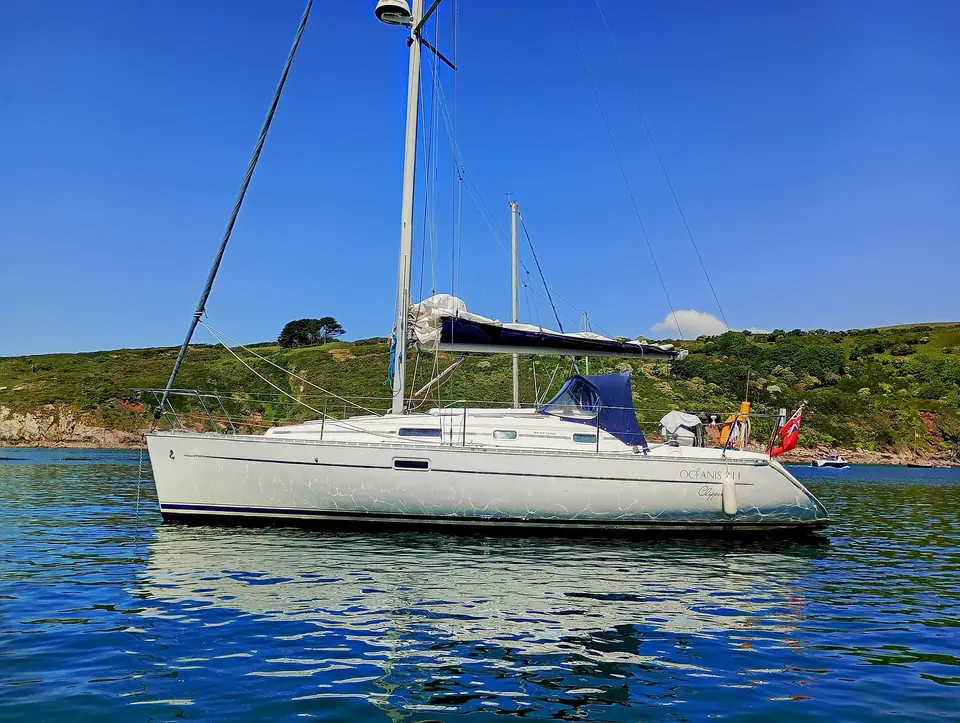
We have not found a freely licensed photo of the Beneteau Oceanis 370 yet, so these show other Beneteau boats, each captioned with the boat pictured.
More cruising sailboats to explore
Beneteau 343
Cruising Sailboats, 36 ft
Used $55K to $90K
Catalina 355
Cruising Sailboats, 35 ft
Used $145K to $290K
Beneteau Oceanis 34.1
Cruising Sailboats, 35 ft
Used $195K to $300K
Bavaria 35 Cruiser
Cruising Sailboats, 35 ft
Used $55K to $85K
Other Beneteau models
- Beneteau 49
- Beneteau 50
- Beneteau 57
- Beneteau 343
- Beneteau Antares 5.80
- Beneteau Antares 6
- Beneteau Antares 6.80
- Beneteau Antares 7
- Beneteau Antares 7.30
- Beneteau Antares 7.60
- Beneteau Antares 7.80
- Beneteau Antares 8
- Beneteau Antares 8.00
- Beneteau Antares 8.05
- Beneteau Antares 8.60
- Beneteau Antares 8.80
- Beneteau Antares 9
- Beneteau Antares 9.80
- Beneteau Antares 10.80
- Beneteau Antares 11
- Beneteau Antares 12
- Beneteau Antares 13.80
- Beneteau Antares 30
- Beneteau Antares 32
- Beneteau Antares 36
- Beneteau Antares 42
- Beneteau Antares 620 HB
- Beneteau Antares 650 HB
- Beneteau Antares 750 HB
- Beneteau Cyclades 39.3
- Beneteau Cyclades 43.3 and 43.4
- Beneteau Cyclades 50.5
- Beneteau First 18 SE
- Beneteau First 20
- Beneteau First 21.7
- Beneteau First 24
- Beneteau First 25
- Beneteau First 25.7
- Beneteau First 27
- Beneteau First 27.7
- Beneteau First 30
- Beneteau First 31.7
- Beneteau First 35
- Beneteau First 36
- Beneteau First 36.7
- Beneteau First 38
- Beneteau First 40
- Beneteau First 40.7
- Beneteau First 44
- Beneteau First 45
- Beneteau First 47.7
- Beneteau First 53
- Beneteau First 211
- Beneteau First 235
- Beneteau First 285
- Beneteau First 305
- Beneteau First 310
- Beneteau First 345
- Beneteau Flyer 6
- Beneteau Flyer 7
- Beneteau Flyer 8
- Beneteau Flyer 9
- Beneteau Flyer 10
- Beneteau Flyer 12
- Beneteau Flyer 500
- Beneteau Flyer 550
- Beneteau Flyer 650
- Beneteau Flyer 701
- Beneteau Flyer 750
- Beneteau Grand Trawler 62
- Beneteau Gran Turismo 32
- Beneteau Gran Turismo 36
- Beneteau Gran Turismo 40
- Beneteau Gran Turismo 41
- Beneteau Gran Turismo 44
- Beneteau Gran Turismo 45
- Beneteau Monte Carlo 6
- Beneteau Oceanis 30.1
- Beneteau Oceanis 31
- Beneteau Oceanis 34
- Beneteau Oceanis 34.1
- Beneteau Oceanis 35
- Beneteau Oceanis 35.1
- Beneteau Oceanis 36 CC
- Beneteau Oceanis 37
- Beneteau Oceanis 38
- Beneteau Oceanis 38.1
- Beneteau Oceanis 40
- Beneteau Oceanis 40 CC
- Beneteau Oceanis 41
- Beneteau Oceanis 41.1
- Beneteau Oceanis 42
- Beneteau Oceanis 42 CC
- Beneteau Oceanis 43
- Beneteau Oceanis 44 CC
- Beneteau Oceanis 45
- Beneteau Oceanis 46
- Beneteau Oceanis 46.1
- Beneteau Oceanis 48
- Beneteau Oceanis 50
- Beneteau Oceanis 51.1
- Beneteau Oceanis 54
- Beneteau Oceanis 55
- Beneteau Oceanis 58
- Beneteau Oceanis 311
- Beneteau Oceanis 320
- Beneteau Oceanis 321
- Beneteau Oceanis 323
- Beneteau Oceanis 331
- Beneteau Oceanis 350
- Beneteau Oceanis 351
- Beneteau Oceanis 390
- Beneteau Oceanis 400
- Beneteau Oceanis 411
- Beneteau Oceanis 423
- Beneteau Oceanis 430
- Beneteau Oceanis 440
- Beneteau Oceanis 461
- Beneteau Oceanis 473
- Beneteau Oceanis 500
- Beneteau Oceanis 510
- Beneteau Oceanis Clipper 361
- Beneteau Oceanis Clipper 373
- Beneteau Oceanis Clipper 381
- Beneteau Oceanis Clipper 393
- Beneteau Oceanis Yacht 54
- Beneteau Oceanis Yacht 60
- Beneteau Oceanis Yacht 62
- Beneteau Sense 43
- Beneteau Sense 46
- Beneteau Sense 50
- Beneteau Sense 55
- Beneteau Swift Trawler 30
- Beneteau Swift Trawler 34
- Beneteau Swift Trawler 35
- Beneteau Swift Trawler 41
- Beneteau Swift Trawler 44
- Beneteau Swift Trawler 48
- All Beneteau models