Beneteau Performance Sailboats
First 36.7, Beneteau's Farr One-Design for Racing and Cruising
A Farr-designed 36 footer built in South Carolina, raced as a strict one-design across North America and still cruised by families.
- Length
- 35.8 ft10.9 m
- Beam
- 11.3 ft3.45 m
- Draft
- 7.2 ft2.2 m
- Cabins
- 3 (V-berth forward, two aft cabins)
- Used price
- $55K to $105K
On this page
- Overview
- The First 36.7 is still racing a quarter century on
- Farr's brief: the 40.7 idea in a smaller hull
- Built in South Carolina, with a few early fixes
- Cruise mode and race mode in one cockpit
- What two test crews measured
- The class rules you inherit
- Three cabins and a very small head
- A 29 hp saildrive and modest tankage
- What a Beneteau 36.7 for sale costs to buy and keep
- Specifications
- Price and value
- Strengths and weaknesses
- Used buyer checklist
- Rivals
- Our verdict
- FAQ
The Beneteau First 36.7 is a Farr Yacht Design racer-cruiser introduced in 2001 and built largely at Beneteau's Marion, South Carolina plant. About 800 were built, and an active one-design class still races them in the US.
- One-design racers
- Families who race and cruise
- PHRF and ORC club sailors
The First 36.7 is still racing a quarter century on
Plenty of production boats were sold as one-designs; few still have a functioning class 25 years later. The First 36.7 does. Its North American class association published a recap of the 2026 North American Championship on Lake Ontario, after championships in San Diego in 2025 and Chicago in 2023, and fleets have raced in the Chicago and Bayview Mackinac races and at Helly Hansen NOOD regattas from San Diego to Chicago. That racing life is the single biggest reason a first 36.7 holds its value better than most 20-year-old 36 footers.
Sailing World named it the Best Value of its 2002 Boat of the Year awards, praising its balanced helm and its price. Practical Sailor and sailboatdata both record about 800 boats built, from 2001 onward. Listings often shorten the name to Beneteau 36.7; do not confuse it with the 1996 Berret-Racoupeau First 36s7, a different boat, or with the 2022 First 36, a planing design from the Seascape yard.
Beneteau First 36.7 by the numbers
- Sail area to displacement
- 24.5Racing level power, needs active reefing as the breeze builds.
- Displacement to length
- 209Moderate displacement, a classic cruising balance between load carrying and speed.
- Theoretical hull speed
- 7.4 knThe practical top speed of a displacement monohull under normal sailing, based on waterline length.
- Ballast ratio
- 30%Relatively low ballast, form stability does more of the work.
- Capsize screening
- 1.93Below 2.0, the traditional threshold for offshore suitability.
- Motion comfort ratio
- 24.8A quicker motion in waves, typical of light, beamy hulls.
- Length to beam ratio
- 3.17 : 1Moderate proportions.
Farr's brief: the 40.7 idea in a smaller hull
Beneteau's brochure framed the 36.7 as a successor to the versatile First 35 of the 1980s, with Farr Yacht Design and Beneteau's own design team asked for a no-compromise 36 ft cruiser-racer, adaptable, built to tight weight tolerances and optimizable for IRC or IMS. It followed Farr's First 40.7, and Jim Schmicker of the Farr office told Practical Sailor the 36.7 has a more advanced hull shape, straighter in plan at the sheer, with more volume in the ends for a longer heeled waterline and a generous rudder that keeps its grip when reaching hard.
Weight control was central to the one-design promise. Schmicker said the collaboration between Farr, Beneteau production and spar maker Sparcraft produced a prototype within 100 lb of its target, and that the first production boat was spot on. The keel sections came from Farr's own racing research rather than standard NACA tables.
Built in South Carolina, with a few early fixes
Sailing World reported that the 36.7 was American made at Beneteau's expanded factory in Marion, South Carolina, and Practical Sailor says it was the first First model built there in several years. The hull is laid up with glass and vinylester resin behind the gelcoat to resist osmotic blistering, with a one-piece internal grid carrying mast and keel loads and supporting bulkheads, engine mounts and tanks. The deck is balsa-cored, with solid glass where hardware is through-bolted, and the hull-to-deck joint is glued and mechanically fastened through the toerail. Boats were built to CE category A.
Beneteau America's service manager described three early issues to Practical Sailor: an Edson steering drag link that was too short (a repair kit went to owners of hulls 1 to 33), an undersized washer at a D-2 shroud stemball (hulls 1 to 43 were inspected) and a single broken spreader bar, which Beneteau considered an anomaly. On an early hull, check that these were addressed.
Cruise mode and race mode in one cockpit
The cockpit is the clever part. The aft sections of the seats are removable lockers: take them ashore for racing and the cockpit becomes a T-shaped working space with a proper trim pit in front of the primaries. A full-width traveler sits forward of a large wheel (tillers were more common in Europe), the mainsheet runs to the end of the boom, and halyards and controls lead aft to Spinlock clutches on the cabintop, with Lewmar 48 and 40 self-tailing winches for jib and spinnaker sheets.
Sailing World's judges wanted a better backstay adjuster and more aggressive non-skid. Practical Sailor noted that for a shorthanded crew the big wheel blocks the way to the traveler, and the traveler blocks the way to the companionway, so singlehanders need to be nimble. Cockpit stowage is limited because quarter berths take up the space beneath.
- Removable aft cockpit lockers for a racing trim pit
- Full-width traveler and end-boom sheeting
- Lewmar 48 and 40 self-tailers, Spinlock clutches
- Racing package: deeper keel, three-spreader Sparcraft rig, Navtec rod, Tuff Luff, carbon pole, racing sails
What two test crews measured
Sailing World tested the 36.7 on the Chesapeake after the 2001 Annapolis show in 12 to 18 knots. Upwind the helm felt balanced and powerful, the fine entry barely pounded in a short chop, and the boat responded quickly to trim, with the testers expecting it to surf readily under spinnaker offshore. Practical Sailor sailed with a retired couple near the Olympic Peninsula. In 12 to 13 knots the helm was perfectly balanced but the boat felt slightly underpowered; in 15 knots it sailed close-hauled at 6 knots and held 7.2 to 8.0 knots on a beam reach, steered with two fingers.
Practical Sailor's summary is fair: faster and higher-pointing in light air than standard production cruisers of its size, competitive in one-design or handicap racing, less comfortable than a heavy full-keel boat when pounding into big seas.
The class rules you inherit
Buying a 36.7 to race means buying into its class rules, which were written to control costs and keep amateurs competitive. In the mid-2000s the class limited owners to two new class sails a year and allowed only one professional crew member at most regattas, and Practical Sailor describes an owner-driver rule, a ban on stripping standard equipment for racing and limits on sail inventory.
Those rules are good news for cruisers too. Boats raced in the class must keep their full interiors, and the sail limits create a steady supply of lightly used class sails. When buying, ask for the boat's class history, measurement records and sail inventory with dates.
Three cabins and a very small head
The layout is a smaller version of the 40.7's. Practical Sailor measured saloon headroom at 6 ft 2 in, settees 6 ft 4 in long, a forward V-berth 6 ft 1 in long and 5 ft 3 in wide, and a forward-facing chart table of 31 by 23 in. The L-shaped galley to port has a two-burner stove and a double sink, and the saloon table lifts out, leaving a stainless support that doubles as a foot brace and a sail divider when racing. The joinery is African mahogany with a cherry stain.
Aft, Sailing World's 2002 test boat had mirror-image double cabins, while Practical Sailor reports that US boats were reconfigured with the dividing bulkhead moved to starboard, giving a near-queen berth to port and a single quarter berth to starboard that makes an ideal sea berth. The head is tiny; showers are taken sitting on the toilet.
A 29 hp saildrive and modest tankage
Standard power is a 29 hp Volvo Penta MD2030 on a saildrive, which gave Practical Sailor's test boat quick acceleration and a tight turning circle. Beneteau's brochure lists 75 liters (20 gallons) of fuel and 270 liters (71 gallons) of water, adequate for weekends and regatta deliveries. Many MD2030s are now more than 20 years old, so check hours, raw-water pump and saildrive seal records, or budget for a repower.
What a Beneteau 36.7 for sale costs to buy and keep
Expect roughly $55,000 to $105,000 in 2026, with deep-keel boats carrying a current, class-legal inventory, upgraded electronics and a documented race history at the top. Shoal-draft cruising boats sell for less but make relaxed family cruisers.
Annual running costs typically run $9,000 to $20,000 for slip, insurance, haul-out, sails and rigging, engine service and racing fees. Active racers should budget more for sails.
Beneteau First 36.7 specifications
| Length overall | 35.8 ft10.9 m |
|---|---|
| Waterline length | 30.3 ft9.22 m |
| Beam | 11.3 ft3.45 m |
| Draft | 7.2 ft2.2 m |
| Displacement | 12,941 lbs5,87 kg |
| Ballast | 3,847 lbs1,745 kg |
| Sail area | 845 sq ft78.5 m² |
| Fuel capacity | 2 gal75 L |
| Fresh water | 71 gal27 L |
| Cabins | 3 (V-berth forward, two aft cabins) |
| Berths | 7 |
| Heads | 1 |
| Standard engines | Volvo Penta MD2030 (29 hp) with saildrive |
| Maximum power | 29 hp |
| Hull type | Moderate displacement fin keel monohull with spade rudder |
| Keel | Lead fin with bulb, 2.20 m (7 ft 3 in) standard or 1.80 m (5 ft 11 in) shoal |
| Rig | Fractional sloop, swept double-spreader Sparcraft aluminum mast, mainsail 38 m2, genoa up to 40.5 m2, spinnaker 95 m2 |
| Hull construction | Fiberglass with vinylester outer laminate, balsa-cored deck, lead keel |
| CE design category | A8 / B9 / C8 |
| Builder | Beneteau (Beneteau USA, Marion, South Carolina, for US boats), United States and France |
| Naval architect | Farr Yacht Design |
| Production | 2001 to present |
| Status | Discontinued |
Figures come from builder documentation and independent tests where available. Displacement is usually quoted light, so a loaded cruising boat will weigh more. Compare these specs with another model.
Performance data
| Point of sail | True wind (kn) | Boat speed (kn) |
|---|---|---|
| Close-hauled | 15 | 6.0 |
| Beam reach | 15 | 7.2 to 8.0 |
| Below a broad reach (no spinnaker) | 15 | about 5 |
Practical Sailor test near the Olympic Peninsula, Washington, with full main and 105 percent genoa and two aboard. Speeds as reported by the testers.
How much does a Beneteau First 36.7 cost?
Sailing World quoted a starting price of $107,400 in 2002 without sails, and the class association later cited a $126,700 base; Practical Sailor gives $135,000 sailaway, with a racing upgrade of about $30,000 more. Used prices now depend on sails, electronics and race history. Boats with a current class-legal inventory, deep keel and tidy cockpit command the most, while shoal-draft cruising boats with tired sails sell for less.
Estimate your yearly cost
A planning estimate using common rules of thumb: insurance near 1.5 percent of value, maintenance near 3 percent, haul out and bottom paint by length. Your marina, region and use will move these numbers. Open the full cost calculator.
Versions and options
- Standard (deep) keel
- 2.20 m (7 ft 3 in) lead fin, the choice for one-design racing.
- Shoal keel
- 1.80 m (5 ft 11 in) for thin water cruising.
- Racing package
- Deeper keel, three-spreader Sparcraft rig, Navtec rod, Tuff Luff, carbon pole and racing sails, about $30,000 extra in 2002.
Beneteau First 36.7 timeline
- 2001First 36.7 introduced at the US Sailboat Show in Annapolis
- 2002Sailing World Boat of the Year, Best Value
- 2007Richard Reid's Zingara wins the class North Americans in Buffalo, New York
- 2026Class holds its North American Championship on Lake Ontario
Strengths and weaknesses
What owners like
- Active one-design class across North America
- Balanced, responsive Farr hull
- Convertible race and cruise cockpit
- Strong resale for its age
- Three cabins for family cruising
What to weigh up
- Tiny head
- Limited cockpit stowage
- Big wheel and traveler obstruct movement
- Small fuel tank
Used Beneteau First 36.7 buyer checklist
Take this list to a viewing. Your ticks are saved in this browser so you can come back to it.
Always commission an independent marine survey and an engine survey before you buy. How a marine survey works.
Rivals to consider
J/109
The natural competitor, a slightly more moderate design at a higher original price.
Compare side by sideC&C 99
American performance cruiser of the same era with a smaller class.
Our verdict on the Beneteau First 36.7
The First 36.7 is one of the most successful production racer-cruisers ever sold in North America. Its Farr hull is balanced and quick, its cockpit converts neatly between racing and cruising, and its active class gives it a racing life and resale that few rivals can match. The tiny head and limited stowage are fair trade-offs. For a family that wants to race one-design or PHRF on weekends and cruise on vacations, a well-maintained 36.7 is hard to beat.
Beneteau First 36.7 questions answered
Who designed the Beneteau First 36.7?
Farr Yacht Design, working with Beneteau's in-house design team.
Where was the First 36.7 built?
US boats were built at Beneteau's factory in Marion, South Carolina.
Is there a First 36.7 one-design class?
Yes. The North American class is still active, with championships held in recent years in Chicago, San Diego and on Lake Ontario.
How fast is a Beneteau 36.7?
Practical Sailor measured 6 knots close-hauled and 7.2 to 8.0 knots on a beam reach in 15 knots of wind.
How much is a Beneteau 36.7 for sale worth?
Roughly $55,000 to $105,000 in 2026, depending on keel, sails, electronics and condition.
Photos from the Beneteau range
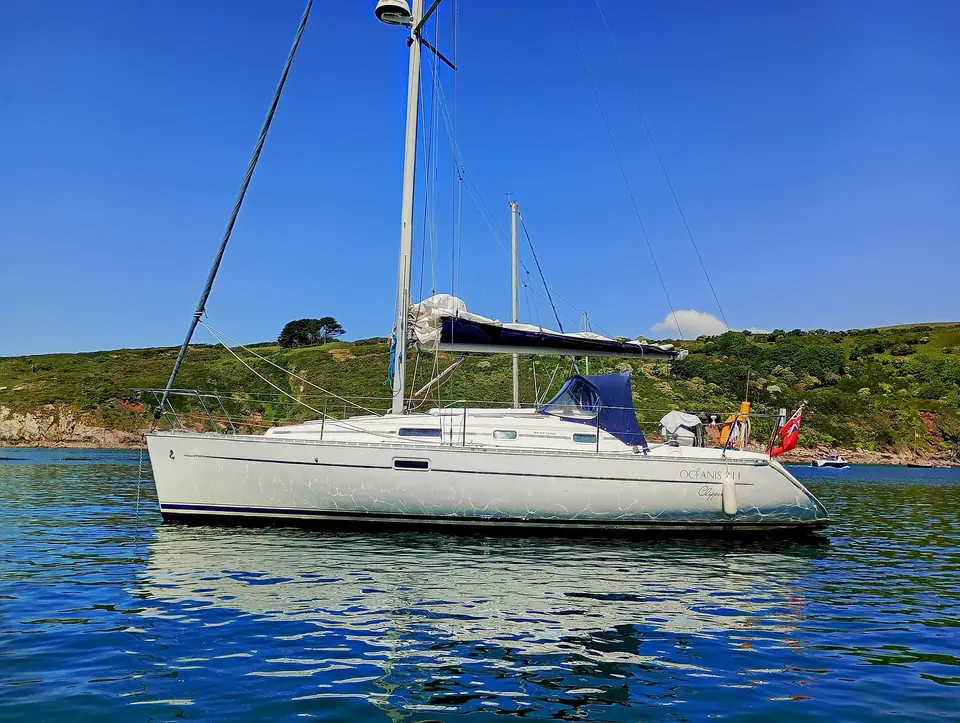
We have not found a freely licensed photo of the Beneteau First 36.7 yet, so these show other Beneteau boats, each captioned with the boat pictured.
More performance sailboats to explore
Dehler 36
Performance Sailboats, 36 ft
Used $65K to $120K
Beneteau First 36
Performance Sailboats, 36 ft
Used $250K to $360K
Beneteau First 35
Performance Sailboats, 36 ft
Used $95K to $165K
Dehler 36 CWS
Performance Sailboats, 36 ft
Used $35K to $70K
Other Beneteau models
- Beneteau 49
- Beneteau 50
- Beneteau 57
- Beneteau 343
- Beneteau Antares 5.80
- Beneteau Antares 6
- Beneteau Antares 6.80
- Beneteau Antares 7
- Beneteau Antares 7.30
- Beneteau Antares 7.60
- Beneteau Antares 7.80
- Beneteau Antares 8
- Beneteau Antares 8.00
- Beneteau Antares 8.05
- Beneteau Antares 8.60
- Beneteau Antares 8.80
- Beneteau Antares 9
- Beneteau Antares 9.80
- Beneteau Antares 10.80
- Beneteau Antares 11
- Beneteau Antares 12
- Beneteau Antares 13.80
- Beneteau Antares 30
- Beneteau Antares 32
- Beneteau Antares 36
- Beneteau Antares 42
- Beneteau Antares 620 HB
- Beneteau Antares 650 HB
- Beneteau Antares 750 HB
- Beneteau Cyclades 39.3
- Beneteau Cyclades 43.3 and 43.4
- Beneteau Cyclades 50.5
- Beneteau First 18 SE
- Beneteau First 20
- Beneteau First 21.7
- Beneteau First 24
- Beneteau First 25
- Beneteau First 25.7
- Beneteau First 27
- Beneteau First 27.7
- Beneteau First 30
- Beneteau First 31.7
- Beneteau First 35
- Beneteau First 36
- Beneteau First 38
- Beneteau First 40
- Beneteau First 40.7
- Beneteau First 44
- Beneteau First 45
- Beneteau First 47.7
- Beneteau First 53
- Beneteau First 211
- Beneteau First 235
- Beneteau First 285
- Beneteau First 305
- Beneteau First 310
- Beneteau First 345
- Beneteau Flyer 6
- Beneteau Flyer 7
- Beneteau Flyer 8
- Beneteau Flyer 9
- Beneteau Flyer 10
- Beneteau Flyer 12
- Beneteau Flyer 500
- Beneteau Flyer 550
- Beneteau Flyer 650
- Beneteau Flyer 701
- Beneteau Flyer 750
- Beneteau Grand Trawler 62
- Beneteau Gran Turismo 32
- Beneteau Gran Turismo 36
- Beneteau Gran Turismo 40
- Beneteau Gran Turismo 41
- Beneteau Gran Turismo 44
- Beneteau Gran Turismo 45
- Beneteau Monte Carlo 6
- Beneteau Oceanis 30.1
- Beneteau Oceanis 31
- Beneteau Oceanis 34
- Beneteau Oceanis 34.1
- Beneteau Oceanis 35
- Beneteau Oceanis 35.1
- Beneteau Oceanis 36 CC
- Beneteau Oceanis 37
- Beneteau Oceanis 38
- Beneteau Oceanis 38.1
- Beneteau Oceanis 40
- Beneteau Oceanis 40 CC
- Beneteau Oceanis 41
- Beneteau Oceanis 41.1
- Beneteau Oceanis 42
- Beneteau Oceanis 42 CC
- Beneteau Oceanis 43
- Beneteau Oceanis 44 CC
- Beneteau Oceanis 45
- Beneteau Oceanis 46
- Beneteau Oceanis 46.1
- Beneteau Oceanis 48
- Beneteau Oceanis 50
- Beneteau Oceanis 51.1
- Beneteau Oceanis 54
- Beneteau Oceanis 55
- Beneteau Oceanis 58
- Beneteau Oceanis 311
- Beneteau Oceanis 320
- Beneteau Oceanis 321
- Beneteau Oceanis 323
- Beneteau Oceanis 331
- Beneteau Oceanis 350
- Beneteau Oceanis 351
- Beneteau Oceanis 370
- Beneteau Oceanis 390
- Beneteau Oceanis 400
- Beneteau Oceanis 411
- Beneteau Oceanis 423
- Beneteau Oceanis 430
- Beneteau Oceanis 440
- Beneteau Oceanis 461
- Beneteau Oceanis 473
- Beneteau Oceanis 500
- Beneteau Oceanis 510
- Beneteau Oceanis Clipper 361
- Beneteau Oceanis Clipper 373
- Beneteau Oceanis Clipper 381
- Beneteau Oceanis Clipper 393
- Beneteau Oceanis Yacht 54
- Beneteau Oceanis Yacht 60
- Beneteau Oceanis Yacht 62
- Beneteau Sense 43
- Beneteau Sense 46
- Beneteau Sense 50
- Beneteau Sense 55
- Beneteau Swift Trawler 30
- Beneteau Swift Trawler 34
- Beneteau Swift Trawler 35
- Beneteau Swift Trawler 41
- Beneteau Swift Trawler 44
- Beneteau Swift Trawler 48
- All Beneteau models